18_100754_ General 1946-7_Vol_2
This Release 01 PDF is a 28-page late-1947 Air Materiel Command / Army Air Forces packet about reported “flying disc” and “flying saucer” material. It is not a single sighting report. It pulls together transmittals, routing sheets, copies of the September 1947 Air Materiel Command opinion letter, photograph-evaluation correspondence, requests for follow-up, and administrative leads that later sit close to the Project SIGN record trail.
Status: graph_investigation_draft; needs_human_review; not_a_finding. This page summarizes the released source text and graph context for review. It does not decide whether any reported object was anomalous.
Evidence media
- Official PDF: WAR.GOV Release 01 PDF
- Verified Open Sky access copy: release-file PDF
The asset is a scanned PDF. Each PDF page is an image of a paper document; the inspected key pages show typed memoranda, stamps, routing marks, and signatures, not object photographs, radar plots, or technical diagrams. The embedded images below are page renders derived from the verified official PDF to make high-signal source pages easier to inspect.
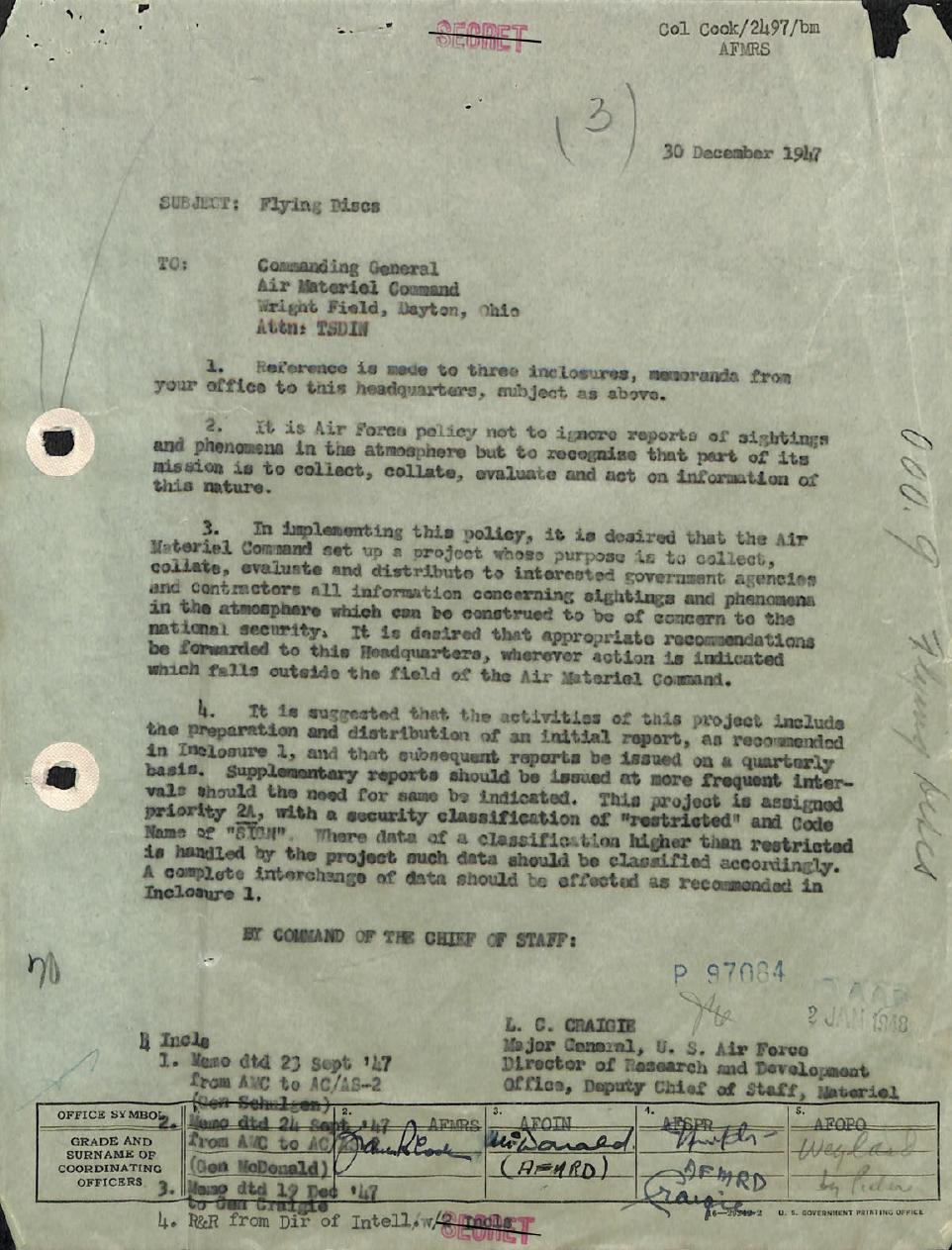
Derived page render, PDF page 3. A typewritten page marked SECRET, dated 30 December 1947, with subject Flying Discs. It says Air Force policy was not to ignore atmospheric sighting reports and assigns the Air Materiel Command project priority 2A, classification Restricted, and code name SIGN.
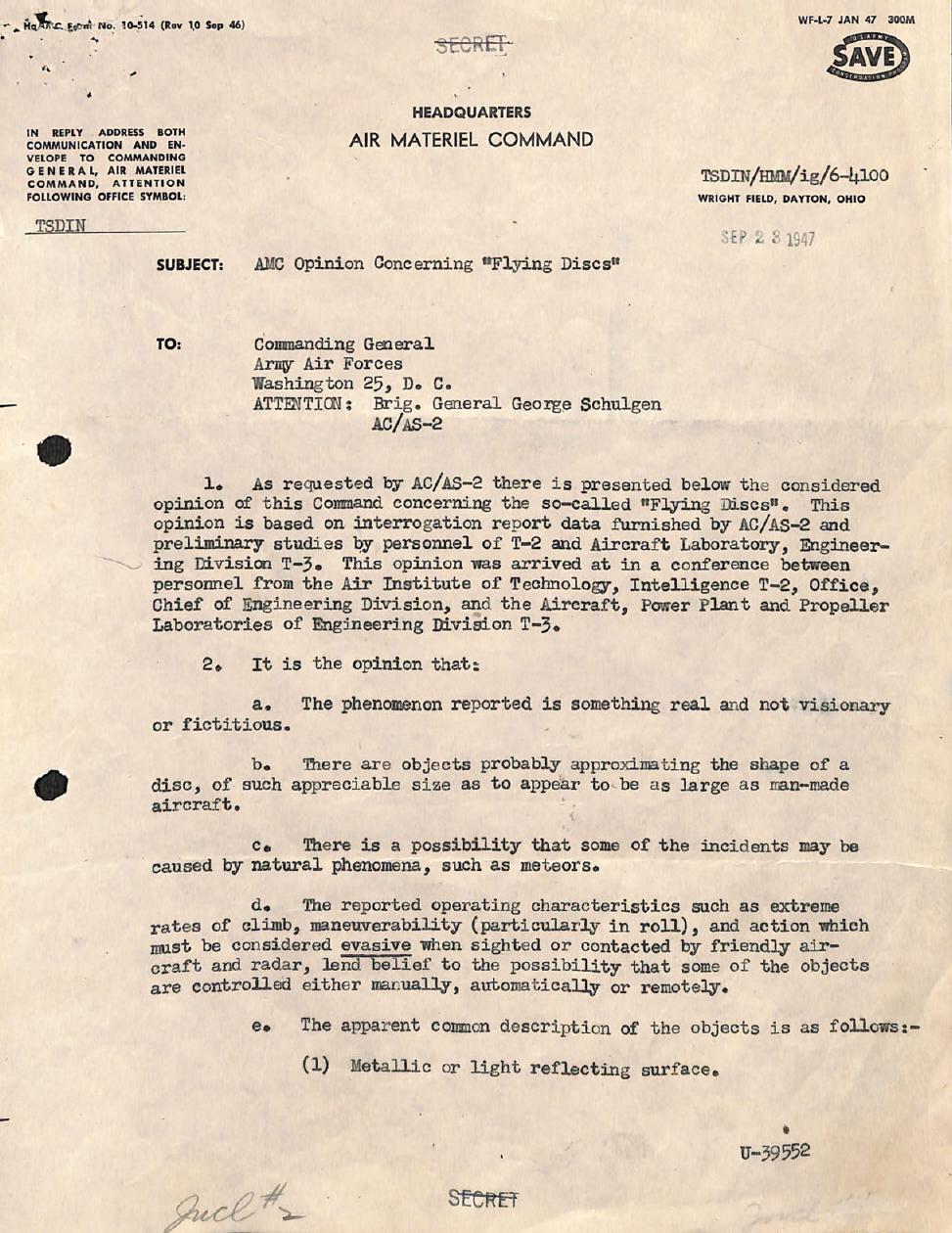
Derived page render, PDF page 9. A scanned Air Materiel Command memorandum headed AMC Opinion Concerning "Flying Discs", dated 23 September 1947 and addressed to Brig. Gen. George Schulgen. The visible text begins the opinion section, including the source's statement that the reported phenomenon was considered something real and not visionary or fictitious; that is source language, not an Open Sky conclusion.
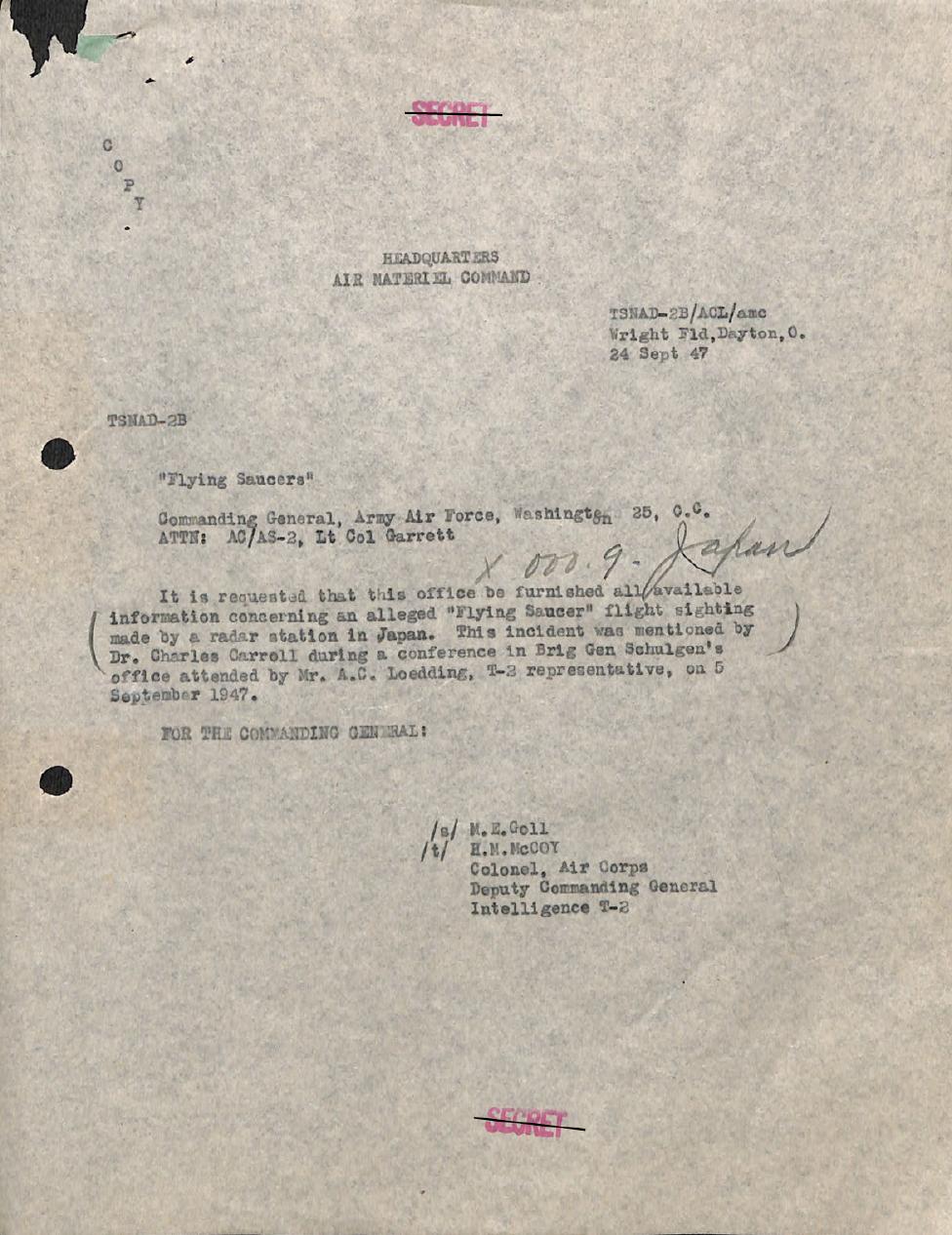
Derived page render, PDF page 24. A typewritten page marked SECRET, dated 24 September 1947, requesting available information on an alleged flying-saucer sighting by a radar station in Japan. The released page is a request for information, not a radar plot or radar data sheet.
Investigation reading
The Release 01 access copy was checked against the recorded SHA-256 hash and the OCR was read across all 28 page markers. All 28 pages have OCR text. PDF metadata reports 28 pages, a 61,464,225-byte file, and one page image per PDF page. Rendered-page spot checks covered the Project SIGN directive, the AMC opinion pages, the Horten-reference pages, the Merchant/Kirtland correspondence, the Japan radar-station request, and the August 1947 routing-sheet exchange.
Compact page map from the full read-through:
| Page(s) | Source reading |
|---|---|
| 1-3 | H. M. McCoy transmits copies of flying-disc reports to Major General L. C. Craigie; the 30 December 1947 response says the Air Materiel Command should collect, collate, evaluate, and distribute information on atmospheric sightings of possible national-security concern. Page 3 assigns the work priority 2A, classification Restricted, and code name SIGN. |
| 4-6 | Fourth Air Force / Hamilton Field correspondence about Mary L. Herron/Herren photographs from near Jefferson, Oregon. The text says marks in the photographs were believed to be film, paper, or camera defects, not pictures of flying discs, and requests no further investigation of that incident. The referenced photographs/negatives are not visible as separate photo plates in this PDF. |
| 7-8 | Air Materiel Command asks for follow-up on a Seattle item reported in the Dayton Journal on 12 November 1947, press claims about weapons developed in Spain, a close-range Alaska flying-disc report mentioned in a USAF intelligence report, and progress on plotting North American flying-disc reports. Page 8 handles classification stamping for that correspondence. |
| 9-14 | The 23 September 1947 AMC Opinion Concerning "Flying Discs" letter appears with a later COPY. This is the high-signal section: it gives the source's opinion language, common reported characteristics, possible explanations, lack-of-physical-evidence caution, and recommendation for a formal study. |
| 15-17 | A 24 September 1947 Flying Disc letter references a Loading Flying Disc drawing, Royal Aircraft Establishment Technical Note AERO 1705, Horten tailless-aircraft material, Horten IX photographs, a Parabola drawing, and a Moscow military-attaché report. The released pages here are text references to those materials, not the photographs or drawings themselves. |
| 18-22 | Merchant / Kirtland / Los Alamos correspondence. The packet describes Mrs. Madeline Organa/Gwynne Merchant's theory about flying discs and recommends closing the matter without interrogating her. A rendered-page read of page 20 favors Central Mexico in the theory paragraph, while stored OCR reads Central Russia; that transcription conflict should be checked against the scan before downstream reuse. |
| 23-24 | An Air Force / Air Materiel Command information request asks for all available information on an alleged flying-saucer flight sighting made by a radar station in Japan and mentioned in a Schulgen-office conference attended by A. D. Loedding. No radar plot, scope image, coordinates, or raw radar data appears on the released page. |
| 25-28 | AC/AS-2 forwards the complete file of reported flying-disc sightings for photostats; an August 1947 routing sheet lists common reported characteristics, including metallic surface, blue-brown haze or trail in some cases, circular/elliptical shape, C-54/Constellation apparent size, rear tabs, formations of three to nine objects, speeds above 300 knots, and lateral oscillation. Page 28 records Curtis E. LeMay's response that the Army Air Forces had no research project with the characteristics described. |
What the file appears to contain
The strongest source-level reading is that this is an administrative and analytical packet showing how Air Materiel Command and Air Force intelligence offices were gathering, copying, evaluating, and routing flying-disc reports in 1947.
The Project SIGN thread is explicit. The 30 December 1947 memorandum says the Air Materiel Command should set up a project to collect, collate, evaluate, and distribute information about atmospheric sightings that could be of national-security concern. The memo assigns the project a priority, security classification, and code name: SIGN.
The packet also preserves the widely cited Air Materiel Command opinion letter. In the source text, AMC says its opinion was based on interrogation report data from AC/AS-2 and preliminary studies by T-2 and Engineering Division laboratories. The letter states that reported objects were described as disc-like, metallic or light-reflecting, sometimes in formations of three to nine, generally above 300 knots, with occasional trail or sound reports. The same letter also names meteors, possible undisclosed domestic projects, lack of crash-recovered physical evidence, and possible foreign propulsion as considerations. Those are source-text positions from the 1947 letter, not Open Sky conclusions.
The Mary L. Herron/Herren photo chain is a useful prosaic-check example inside the packet. The source says the photographs were taken near Jefferson, Oregon, between 5 and 12 November 1946, and that the visible marks were believed to be film, paper, or camera defects. The file says no flying-disc incidents had been reported from that vicinity around those dates.
Several other leads are preserved but not resolved by the packet: the Seattle / Dayton Journal item, the September Alaska close-range sighting, the Japan radar-station information request, the Horten flying-wing references, the Merchant/Kirtland/Los Alamos correspondence, and the August 1947 request for FBI background investigation on certain witnesses. These are leads for source comparison, not findings.
Source custody and provenance
- Official/source URL: WAR.GOV Release 01 PDF
- Open Sky release-file copy: war-gov-18-100754-general-1946-7-vol-2-9e677b86
- Official CSV row:
17 - Agency listed by the release: Department of War
- Source/container kind: PDF
- PDF page count: 28
- File size: 61,464,225 bytes
- OCR status:
frontier_ocr_complete; 28 pages with text; 21 OCR chunks - SHA-256:
85d659d6b2208610ac55e6c82cfed0315002f4b6d43963a29fb8e973258bfdd2
The verified Open Sky release-file copy matches the recorded hash. The official WAR.GOV URL remains the canonical source pointer; the release-file endpoint is the access copy used for this investigation draft.
Graph context
The graph has an exact Document record for the PDF asset and a separate Release 01 manifest-record document for CSV row 17. The asset record is modeled as official-primary provenance and points back to the WAR.GOV PDF URL.
The semantic graph currently preserves:
125extracted source-text claims64entity mentions19sensor/platform event records0table rows20candidate crosslinks requiring human review
The extracted sensor/platform records mostly reflect source text around aircraft, aircraft radar, the Japan radar-station request, and comparative aircraft material. They should be read as extracted descriptions from the packet, not as validated sensor evidence. For example, page 24 is a request for information about a radar-station sighting in Japan; it is not itself a radar return.
The candidate crosslinks are dominated by the Kirtland anchor and point toward FBI Vault and NARA records for later Kirtland-related material. Those links are useful for follow-up because the Merchant correspondence mentions Kirtland Field and Los Alamos, but the graph marks them as review leads only. No crosslink on this page is treated as a confirmed relationship.
Leads to check
- Compare pages 9-14 against known copies of the September 1947 AMC/Twining memorandum and Project SIGN files to confirm whether the packet copy matches other archival versions.
- Locate the Mary L. Herron/Herren photographs or negatives, if they survive outside this PDF, and compare them against the text's camera/film/paper-defect assessment.
- Search for the Dayton Journal item from 12 November 1947 and any associated Seattle report referenced on page 7.
- Trace the September Alaska close-range sighting mentioned in the Air Materiel Command correspondence and determine whether the fuller observation report exists elsewhere.
- Identify the Japan radar-station report referenced on page 24 and check whether it appears in AC/AS-2, Schulgen, Loedding, or related intelligence files.
- Separate Horten flying-wing comparative material from actual sighting evidence; the packet cites Horten references and a Moscow attaché report, but does not itself prove a Horten explanation for any sighting.
- Re-check the page 20 Merchant-theory sentence visually: the rendered scan appears to say
Central Mexico, while OCR text saysCentral Russia. - Follow the Merchant/Kirtland/Los Alamos chain through the graph's FBI Vault and NARA candidate crosslinks, keeping those crosslinks in
needs_human_reviewstatus until source text is compared directly. - Review the page 27 request for FBI background investigation on certain witnesses and determine whether the requested FBI response is present in another file.
Lead check notes
- Partial — AMC/Twining memorandum comparison: Pages 9-14 contain both an original-style copy and a later
COPYof the 23 September 1947 AMC opinion letter signedN. F. TWINING. A human version comparison is still needed before treating the copies as textually identical to other archival editions. - Partial — Mary L. Herron/Herren photographs: Pages 4-6 discuss attached photographs and negatives, but the checked PDF pages do not display the object/sky photographs as separate visual evidence. Locating the original enclosures remains open.
- Partial — 12 November 1947 Dayton Journal / Seattle item: Page 7 identifies the newspaper item and says it should be followed up. This PDF does not include the clipping itself.
- Blocked — September Alaska close-range sighting: Page 7 only points to a recent USAF intelligence report from
AG/A2-4. The underlying report is needed before the Alaska lead can be interpreted. - Partial — Japan radar-station report: Page 24 is an information request, not the radar report itself. Later Japan radar summaries in other records may be comparison leads, but they should not be treated as confirmed matches without date/source reconciliation.
- Checked — Horten comparative material: Pages 15-17 use Horten material as aerospace/intelligence context and cite photographs/drawings elsewhere. These pages do not themselves display those images and do not establish a Horten explanation for a reported sighting.
- Partial — Merchant / Kirtland / Los Alamos chain: Pages 18-22 identify Mrs. Merchant, Kirtland Field, Los Alamos, and a recommendation to close without interrogation. The
Central Mexicoversus OCRCentral Russiadiscrepancy is a transcription quality-control lead. - Partial — FBI background-investigation request: Page 27 preserves a reference-form summary requesting FBI background investigation of certain flying-disc witnesses. The exact response chain remains open.
Limits
This draft is based on the released PDF, its OCR, rendered-page spot checks, and existing graph records. It is not a completed human adjudication.
The OCR includes redacted lines, illegible names, imperfect dates, and variant spellings. For example, the same photo-related lead appears as Mary L. Herron in a cover record and Mary L. Herren in the correspondence. The Merchant section also has at least one material OCR-versus-scan tension: page 20 should be visually rechecked before anyone cites the locality in that theory paragraph.
The packet contains duplicate copies, routing sheets, cover sheets, and later administrative notes, so page count does not equal unique incident count. It also refers to attachments, photographs, drawings, technical notes, radar information, and background investigations that are not fully resolved on this page. Until those referenced materials are located and compared, this record should be treated as a source-custody and investigation-draft page, not a finding.
Deep investigation — graph + web reconnaissance
Source reread
- The verified access copy is a 28-page, 61,464,225-byte scanned PDF with SHA-256
85d659d6b2208610ac55e6c82cfed0315002f4b6d43963a29fb8e973258bfdd2. The page renders and OCR support treating this as a 1947 administrative / analytical packet, not as a single sighting case. - Page 9 is the 23 September 1947 Air Materiel Command opinion memo to Brig. Gen. George Schulgen. Its phrase that the reported phenomenon was
something real and not visionary or fictitiousis preserved as source language from AMC, not as an Open Sky finding. - Page 20 was visually rechecked because OCR had a material locality ambiguity. The scanned line reads that Mrs. Madeline Gwynne Merchant's theory placed the launch locality in
Central Mexico, notCentral Russia; any reuse of the OCR should preserve that correction. - Page 24 is a request for all available information about an alleged flying-saucer flight sighting made by a radar station in Japan. It contains no radar plot, scope image, track table, coordinates, or measurement data. The rendered page reads the Schulgen-office conference date as
5 September 1947, while stored OCR had read9 September 1947; the scan should control unless a better copy proves otherwise.
Graph connections checked
- Neo4j has two official-primary
Documentrecords for this title: the PDF asset and the Release 01 manifest-row record for CSV row17, both ingested from the WAR.GOV PURSUE Release 01 source node. - The graph currently materializes
125machine-extracted claims,19machine-extracted sensor/platform events, and24text chunks across the manifest, description, and frontier-OCR material. These are extraction artifacts for review. In particular, theRADAR-type sensor events are sourced to language such asfriendly aircraft and radarin the AMC opinion and the Japan radar-station information request; they are not validated radar returns. - The
20candidate crosslink relationships collapse to a small Kirtland-centered review set: FBI Vault UFO Part 06/07/08 page leads and NARA catalog Kirtland AFB records from 1949-1959. The shared anchor isKirtland, so these are provenance/search leads only, not identity links, causality claims, or resolutions for this 1947 packet.
External provenance and context
- Direct WAR.GOV fetches for the PDF, release landing page, and CSV returned
403 Access Deniedduring this check. Because the cached official-primary PDF verifies by size and hash, that is treated as current access/custody context rather than a failure of the source copy. - The FBI Vault UFO collection and the FBI Vault UFO Part 06 PDF were reachable. Part 06 is a 129-page FBI PDF; the graph-linked page-67 lead reads as a later Kirtland / January 1949
green aerial phenomenonreport, not the same 1947 Air Materiel Command packet. It remains useful as a Kirtland comparison lead, but it should not be merged into this record without page-level source alignment. - NARA catalog pages for graph-linked Kirtland records such as
28932855and28933542returned public HTML, but the live catalog/API response did not expose record JSON in this environment. The catalog identifiers and titles remain useful official-archive leads; the next pass should open or export the specific NARA records before turning them into citations beyond the lead level.
Prosaic checks and unresolved items
- The Mary L. Herren photograph chain already contains a source-side prosaic assessment: the marks were believed to be film, paper, or camera defects, and no flying-disc incidents were reported near Jefferson, Oregon, for the stated November 1946 dates. The underlying photographs or negatives are still needed for independent review.
- The AMC opinion memo itself lists possible natural phenomena such as meteors, possible undisclosed domestic projects, lack of crash-recovered physical evidence, and speculative foreign propulsion as considerations. Those are source positions inside the memo, not adjudicated explanations for the file's separate leads.
- Astronomy, weather, launch, satellite, and aircraft-correlation checks are not meaningful for the packet as a whole because it aggregates multiple leads without enough date/time/location detail. Those checks belong to the unresolved underlying items: the Seattle newspaper item, September Alaska close-range report, Japan radar-station report, and any recoverable photo/negative exhibits.
Follow-up leads
- Compare the pages 9-14 AMC/Twining text against other official Project SIGN / Project Blue Book copies at the page level.
- Locate the Mary L. Herren photographs/negatives or a higher-quality enclosure set before treating the photo lead as visually reviewed.
- Trace the Seattle /
Dayton Journalitem, the September Alaska report, and the Japan radar-station request into their underlying source files. - Reconcile the FBI Vault and NARA Kirtland crosslinks as later comparison records, keeping the graph
CANDIDATE_CROSSLINKstatus unless direct source text proves a stronger relationship.
Audit note
This deep pass used the wiki page, full OCR, source-page renders, read-only graph queries, and official/archive web checks. No Neo4j writes were made, no finding or hypothesis node is implied, and all machine-extracted claims remain machine_extracted_needs_human_review / not_a_finding until a human source comparison verifies them.
Sources
- WAR.GOV Release 01 official PDF: 18_100754_ general 1946-7_vol_2.pdf
- Open Sky release-file endpoint: /api/explore/war-gov/release-file/war-gov-18-100754-general-1946-7-vol-2-9e677b86
- WAR.GOV Release 01 CSV row:
17 - FBI Vault UFO collection: https://vault.fbi.gov/UFO
- FBI Vault UFO Part 06 PDF comparison lead: https://vault.fbi.gov/UFO/UFO%20Part%2006/at_download/file
- NARA catalog lead for Kirtland AFB January 1949: https://catalog.archives.gov/id/28932855
- NARA catalog lead for Kirtland AFB March 1949: https://catalog.archives.gov/id/28933542
- Verified SHA-256:
85d659d6b2208610ac55e6c82cfed0315002f4b6d43963a29fb8e973258bfdd2 - Open Sky graph asset id:
official:doc:war-pursue-uap-release:asset:18-100754-general-1946-7-vol-2-pdf:9e677b869768