331_120752_Numeric_Files_1944–1945_37153_German_Armament_Equipment_Documents
Evidence media
- Official PDF: Open the verified Release 01 file.
- Media note: this asset is a 17-page scanned PDF. The images below are derived page renders from the official PDF for readability; they are not standalone object photographs.
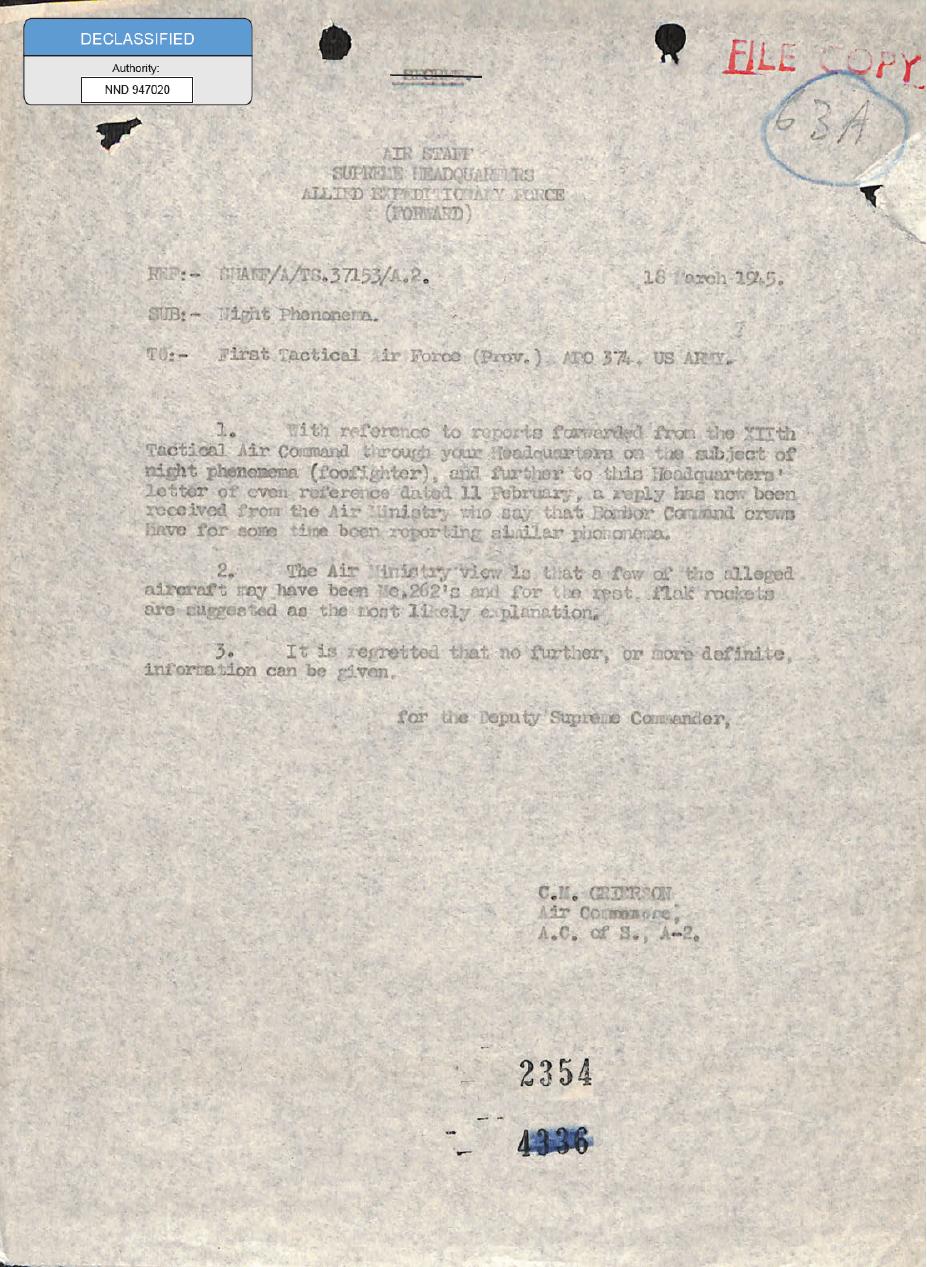
Derived page render, PDF page 1. Opening SHAEF Air Staff memorandum dated 18 March 1945. The page-image reading favors “foo-fighters” and “flak rockets,” while the OCR is imperfect on those words.
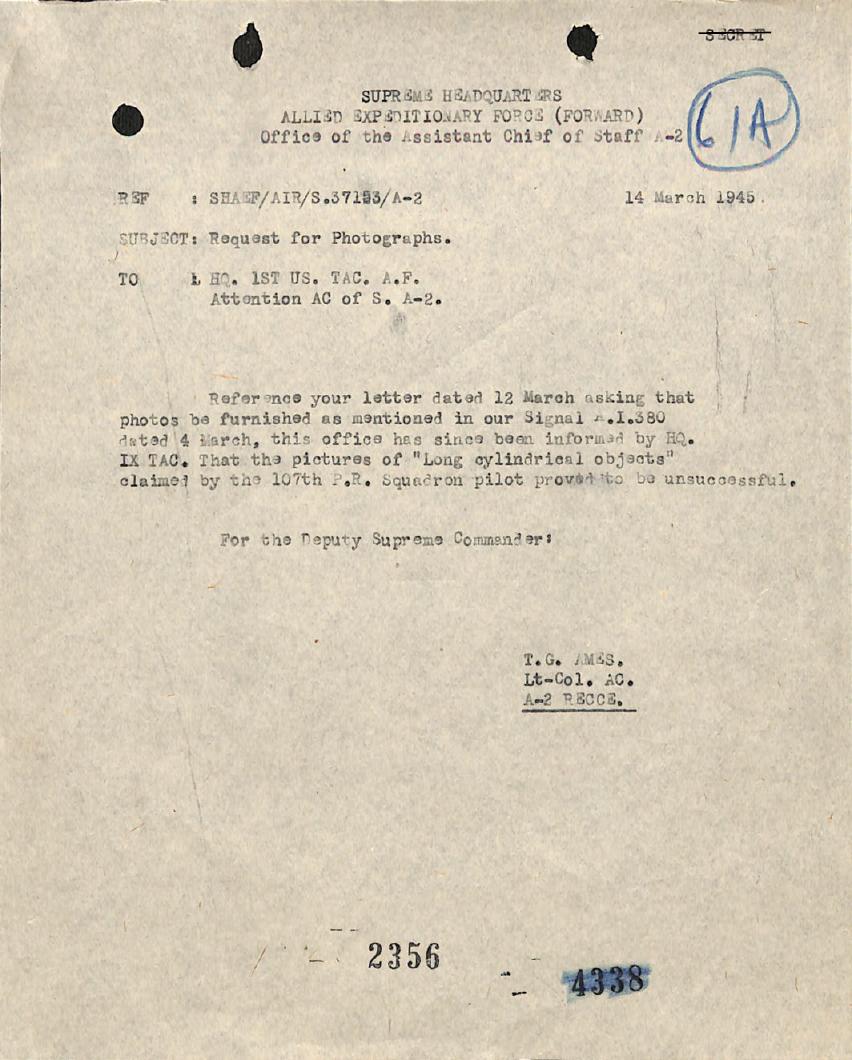
Derived page render, PDF page 3. A 14 March 1945 request-for-photographs memorandum states that pictures of “long cylindrical objects” claimed by a 107th P.R. Squadron pilot proved unsuccessful.
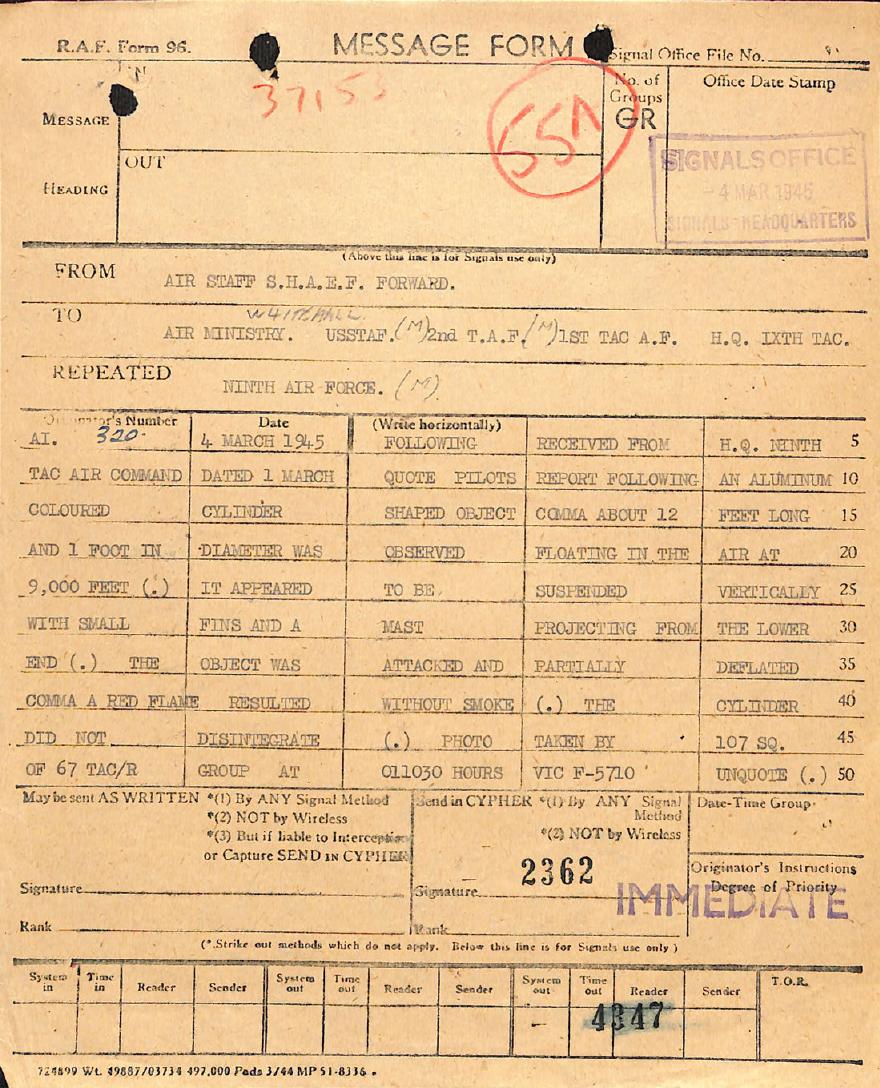
Derived page render, PDF page 7. RAF message-form copy relaying the pilots’ report of an aluminum-colored cylinder-shaped object about 12 feet long and 1 foot in diameter, with the photo reference reading “VIC F-5710” on the visible form.
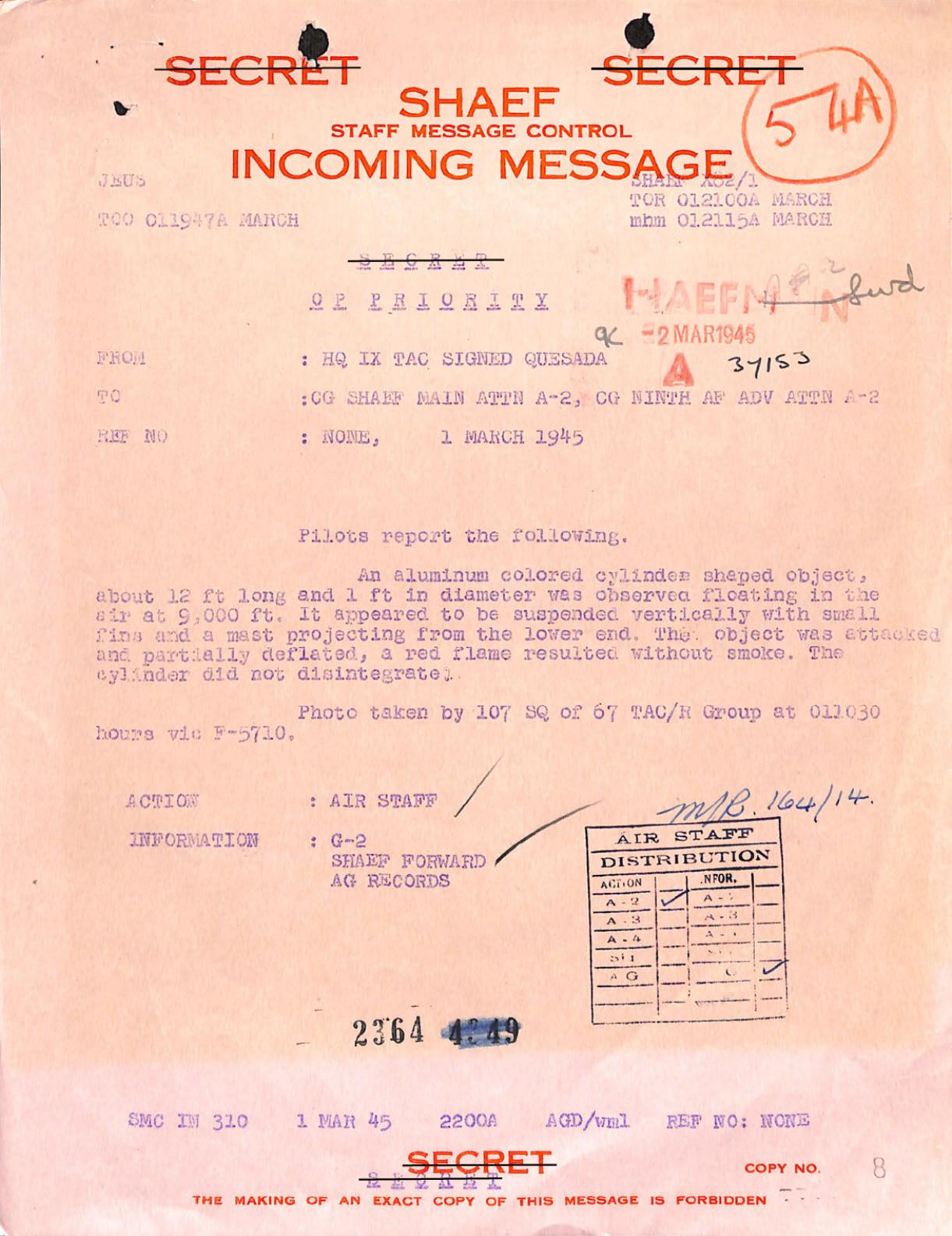
Derived page render, PDF page 9. SHAEF incoming-message copy of the same cylinder-object report. The page image again favors “vic F-5710”; one OCR line had read “via F-5719,” so exact grid interpretation remains a source-reading lead.
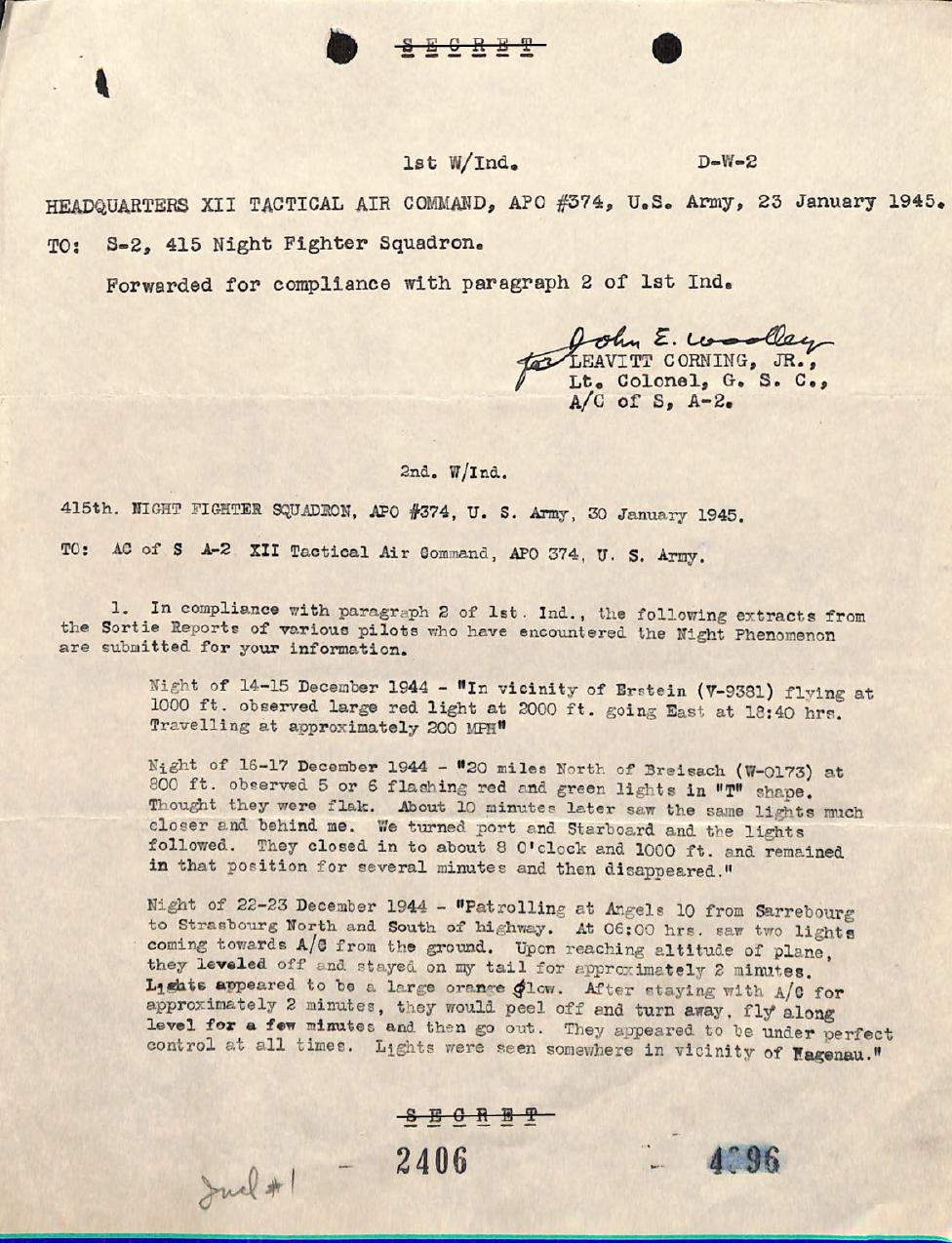
Derived page render, PDF page 15. 415th Night Fighter Squadron sortie-report extracts list December 1944 light observations near Erstein, Breisach, and the Sarrebourg–Strasbourg/Hagoneau area.
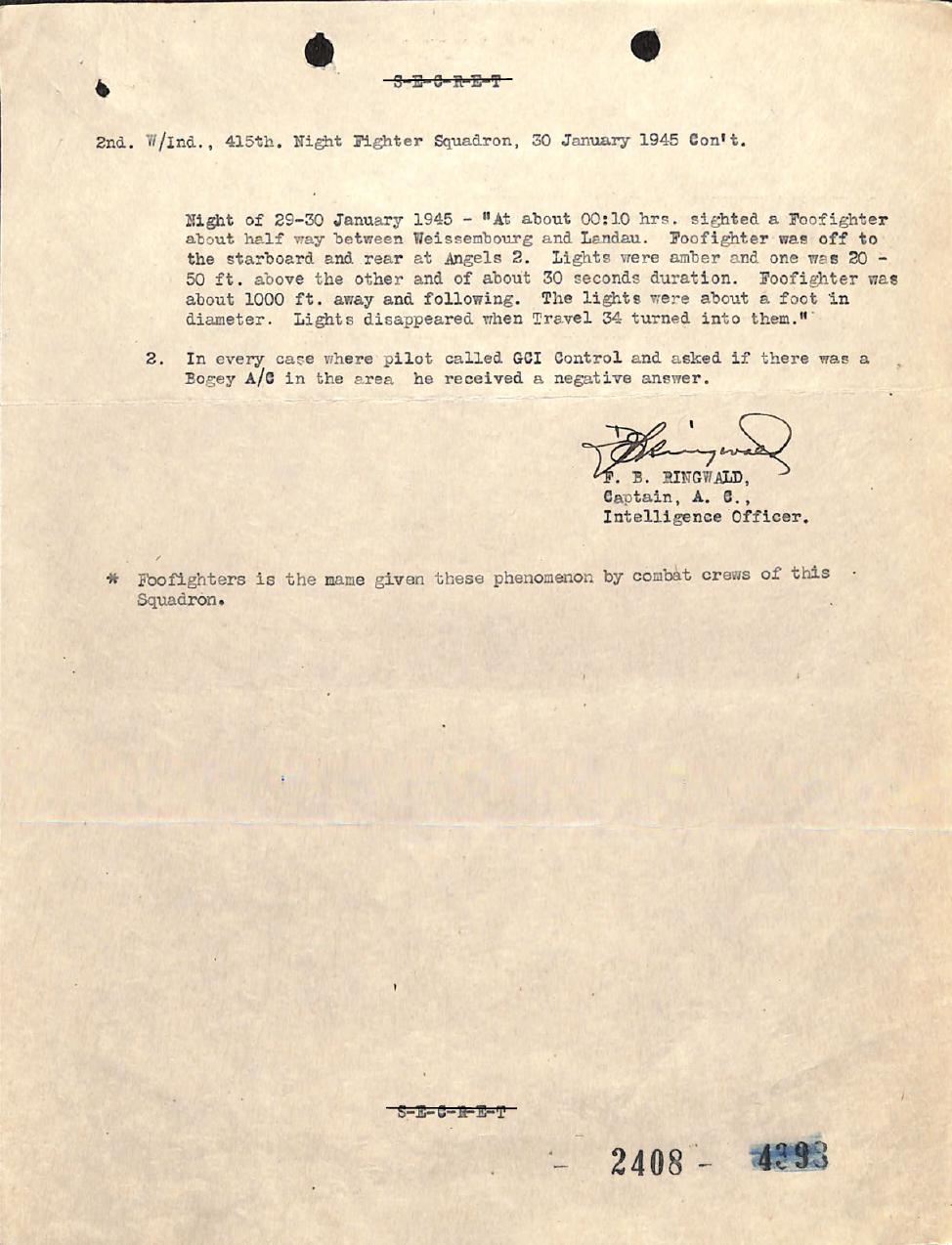
Derived page render, PDF page 17. Continuation page for the 29–30 January 1945 “Foofighter” entry between Weissembourg and Landau, followed by the note that GCI Control returned negative bogey answers when pilots asked.
Investigation reading
This Release 01 item is a 17-page scanned Department of War PDF of Allied wartime message traffic and memoranda filed under SHAEF/Air/S.37153. It is not a photo set or video record. It is a compact archival packet: memoranda, RAF message forms, staff-message-control copies, endorsements, and extracted sortie reports about “night phenomena,” “foo-fighters,” colored lights, a reported long cylindrical object, attempted photography, and technical-intelligence follow-up.
The source was read across all 17 OCR page sections and checked against representative high-resolution page renders. The OCR has text for every page, but several grid strings, call signs, and technical words are OCR-sensitive. The page images are therefore important: page 1 visually favors “foo-fighters” and “flak rockets” even though OCR text can surface “foo-fires” or “fire rockets”; pages 7 and 9 visually favor “VIC F-5710” for the cylinder-object photo line; and page 17 reads “00:10 hrs,” “Weissembourg and Landau,” and “GCI Control.”
No embedded object photographs, maps, plotted tracks, or diagrams are visible in the checked pages. The file repeatedly discusses photographs of “long cylindrical objects,” but the packet also records that those photographs were unsuccessful. The released evidence here is therefore documentary correspondence and relayed witness/sortie-report text, not visible object imagery.
At a document-structure level, the packet reads as follows:
| Pages | What they cover |
|---|---|
| 1–2 | March 1945 SHAEF/Air Ministry correspondence on night phenomena. The Air Ministry says Bomber Command crews had reported similar phenomena, suggests Me.262 aircraft for some reports and flak rockets for others, and still says the affair lacked a definite satisfactory explanation. |
| 3, 6–9 | Requests and signals around the reported aluminum-colored cylinder-shaped object near 9,000 feet, plus the unsuccessful-photo trail. |
| 4–5 | Adjacent message traffic about German bomb torpedoes and film records. This appears to be in the same file folder but is not itself a foo-fighter sighting report. |
| 10 | Air Ministry note saying an attached report probably refers to “Fink Bombs” in A.I.1(A) Report No. 565/1944, paragraphs 125 and 129. |
| 11–14 | SHAEF and tactical-air-command correspondence asking for technical-intelligence follow-up on reports from the 415th Night Fighter Squadron. |
| 15–17 | 415th Night Fighter Squadron sortie-report extracts from December 1944 through January 1945 describing colored lights, flames, glows, and a named “Foofighter” observation. |
What the file appears to contain
The packet preserves two related but distinct evidence threads.
The first thread is the March 1945 cylinder-object report. A message copy says pilots reported an aluminum-colored cylinder-shaped object, about 12 feet long and 1 foot in diameter, floating at roughly 9,000 feet. It appeared suspended vertically, with small fins and a mast projecting from the lower end. The report says the object was attacked and partially deflated, a red flame resulted without smoke, and the cylinder did not disintegrate. Pages 7 and 9 both carry the same core report. Page 7 clearly reads “VIC F-5710,” and the higher-resolution page-9 render also favors “vic F-5710,” despite one OCR line reading “via F-5719.” That discrepancy should be treated as a transcription and map-grid lead, not as a settled coordinate.
The same thread records an attempted photography trail. Page 3 says pictures of “Long cylindrical objects” claimed by a 107th P.R. Squadron pilot proved unsuccessful. Page 6 says photos of long cylindrical objects taken by 67th TAC/R pilots at 011030 in the F-5710 vicinity were unsuccessful and that a full written report would follow. Page 8 asks that photos, a full written report by the pilots concerned, and any further instances be reported. The released PDF supports a document trail for attempted photography, but not a usable photograph of the object.
The second thread is the 415th Night Fighter Squadron sequence. Page 14 quotes the squadron as saying crews had been followed by lights that blinked on and off, changed colors, came very close, and appeared to fly formation with aircraft. The forwarding endorsement asks for better data: color, intensity, size, duration, altitude, timing, direction of travel, whether lights crossed Allied lines, where they appeared relative to the aircraft, and how close they approached.
The sortie extracts on pages 15–17 include multiple dated entries:
- 14–15 December 1944 near Erstein: a large red light, with the high-resolution page image reading grid
V-9381, aircraft at about 1,000 feet, the light at about 2,000 feet, moving east at 18:40 hours at about 200 mph. - 16–17 December 1944 north of Breisach: five or six flashing red and green lights in a “T” shape, first thought to be flak, then seen closer behind the aircraft; the page image favors
V-0173and about 800 feet for the initial aircraft altitude. - 22–23 December 1944 on patrol from Sarrebourg to Strasbourg: two orange-glow lights reportedly came up from the ground at a visually checked
06:00 hrs, reached the aircraft’s altitude at Angels 10, stayed on the aircraft’s tail briefly, then peeled away and went out near the typedHageneauarea. Earlier OCR/text-only readings of this line can blur the time and place name. - 23–24 December 1944: reddish flames at distance, and a separate glowing red object south of “Point X” that shot upward, changed aspect, dived, and disappeared.
- 26–27 December 1944: yellow flame streaks, red balls of fire, line-like groups of lights, vertically staggered white lights, and a light near Worms that reportedly came close, followed for several minutes, then pulled up and went out of sight. One entry says GCI Blunder returned a negative answer when asked about enemy aircraft in the vicinity.
- 27–28 December 1944: orange lights in the patrol area and, near Luneville, red and white lights behind the aircraft; the controller check in this entry is negative, but the OCR and page image differ on the call-sign reading.
- 29–30 January 1945 between Weissembourg and Landau: a “Foofighter” off the starboard rear at Angels 2, amber lights stacked 20–50 feet apart, about 30 seconds duration, about 1,000 feet away and following. Page 17 says the lights disappeared when Travel 34 turned into them.
The source also contains its own conventional leads. The Air Ministry suggested Me.262 aircraft for some reports and flak rockets for others. Another Air Ministry note suggested “Fink Bombs” for an attached report. The sortie extracts repeatedly mention flak, enemy-aircraft checks, and ground-control negative replies. The file is valuable because it preserves both the unusual observation language and the wartime attempts to test ordinary or technical-intelligence explanations.
Source custody and provenance
This is an official-primary WAR.GOV/PURSUE Release 01 PDF asset, listed in official CSV row 22 under the Department of War. The source-of-record URL is preserved in frontmatter and cited below.
The cached Release 01 file was checked against the recorded source-pack inventory. The verified size is 15,892,720 bytes and the SHA-256 is:
cc709f89f3f3de832ee3979817a3c716727dd03c2f4fe26a545f1904b29fd467
PDF metadata reports 17 pages. The page-image structure shows one scanned page image per PDF page, and the OCR layer contains text for all 17 pages. The PDF is a scanned historical document packet rather than a born-digital report.
Direct official retrieval can be access-controlled, so the Open Sky release-file endpoint provides the verified working copy for the explorer. The official WAR.GOV URL remains the canonical citation.
Graph context
Open Sky models this item as a Document asset with the official PDF URL, matching SHA-256, and provenance tier official_primary. The graph also has the corresponding Release 01 record for CSV row 22.
The current graph context lists 17 text chunks attached to the document, including the manifest text and OCR chunks. The semantic extraction layer currently preserves 140 source-text claim records, 64 entity mentions, 4 sensor-event records, and no table rows for this item. Those graph records are discovery aids and are not findings.
The most useful graph-supported themes are:
- object-description and observation text around the reported aluminum-colored cylinder;
- witness/observer testimony from the 415th Night Fighter Squadron extracts;
- prosaic and technical-intelligence leads, including Me.262 aircraft, flak rockets, “Fink Bombs,” flak, enemy-aircraft checks, GCI/controller checks, and unsuccessful photographs;
- provenance links between the PDF asset, the Release 01 record, the official WAR.GOV source, and the OCR/semantic extraction records.
There are no candidate crosslinks recorded for this slug in the current graph context.
Leads to check
- Locate Air Ministry A.I.1(A) Report No. 565/1944, paragraphs 125 and 129, which page 10 cites as the possible “Fink Bombs” reference.
- Reconcile
F-5710versusF-5719by checking original message copies, related SHAEF/Air or IX TAC records, and the relevant wartime map grid. The page images in this PDF favorF-5710. - Search for the “full written report” promised after the unsuccessful-photo signal, if it survives in adjacent SHAEF, IX TAC, 67 TAC/R, 107th P.R. Squadron, or Air Ministry files.
- Check 415th Night Fighter Squadron sortie logs, mission reports, aircraft identifiers, controller logs, and GCI station records for the December 1944–January 1945 entries.
- Re-read exact grid strings and call signs from the original images before geocoding. Some OCR readings are visibly fragile, especially in the page-15 and page-16 sortie extracts.
- For each sortie report, test conventional candidates before escalation: flak, illumination devices, rockets, enemy or friendly aircraft, ground lights, weather, astronomical visibility, instrument/observer limitations, and wartime reporting chains.
- Keep the cylinder-object thread separate from the 415th light-report sequence unless another source explicitly connects them as the same incident.
Lead check notes
- Partial — Air Ministry A.I.1(A) Report No. 565/1944: The source itself cites the report, but the underlying paragraphs are not included in this PDF. They require an external Air Ministry or UK archival source.
- Checked / still open — F-5710 versus F-5719: Pages 7 and 9 visually favor
F-5710; theF-5719reading is best treated as an OCR/transcription uncertainty unless another original copy supports it. - Partial — promised full written report: This PDF records the promise of a full written report and the unsuccessful-photo note, but does not include the follow-up report itself.
- Partial — 415th Night Fighter Squadron records: The PDF includes sortie extracts, not the underlying mission files or controller logs. Those source layers would be needed for per-sortie reconstruction.
- Partial — conventional checks before escalation: The source already contains several ordinary explanatory leads, but it does not complete the analysis needed to accept or reject them.
- Checked — file-thread separation: The page sequence supports treating the cylinder-photo thread and the 415th sortie-light thread as related folder contents rather than one merged incident.
Deep investigation — graph + web reconnaissance
Source reread
This pass rechecked the official-primary Release 01 PDF as a scanned 17-page Department of War/SHAEF packet tied to CSV row 22, with verified size 15,892,720 bytes and SHA-256 cc709f89f3f3de832ee3979817a3c716727dd03c2f4fe26a545f1904b29fd467. The source remains two related documentary threads, not a single resolved event: the March 1945 cylinder-object / unsuccessful-photo traffic, and the 415th Night Fighter Squadron sortie extracts.
High-resolution page-image review sharpened several OCR-sensitive points:
- Page 9, the SHAEF incoming-message copy, supports the same cylinder-object description as page 7: an aluminum-colored cylinder-shaped object, about 12 feet by 1 foot, vertical at about 9,000 feet, with fins and a mast. The photo line reads best as
vic F-5710, notvia F-5719; the OCR variant should remain a transcription lead rather than a coordinate finding. - Page 9 also favors the stronger wording that the object was
attacked and partially deflated, with a red flame and no smoke, rather than a softenedcolored/darkenedreading. That is still relayed message traffic, not physical confirmation of the object. - Page 15 visually supports
V-9381for the Erstein entry,V-0173and800 ftfor the Breisach entry, and06:00 hrswith typedHageneaufor the 22–23 December Sarrebourg–Strasbourg entry. These corrections are source-reading hygiene; they do not resolve the observations.
Read-only graph connections
Neo4j was checked read-only. The graph has two official Document records for this item: the linked PDF asset and the Release 01 CSV record. The asset node carries the official WAR.GOV PDF URL, official_primary provenance, current-manifest reconciliation, the verified byte length, the full-download hash, and frontier-OCR metadata for 17 pages / 14 OCR chunks.
Direct graph relationships remain provenance/discovery aids: 17 TextChunk nodes, 140 machine-extracted Claim nodes, 64 EntityMention nodes, and 4 SensorEvent nodes. The SensorEvent records are not sensor confirmations; they are unreviewed machine extractions from words such as aircraft in source passages about Me.262 possibilities and aircraft-relative light reports. A secondary GitHub markdown-conversion document is linked as derived from the official asset, with the official WAR.GOV PDF preserved as source of record. No CANDIDATE_CROSSLINK records were found for this slug.
Official/archive web reconnaissance
The canonical public citation remains the WAR.GOV/PURSUE Release 01 record and PDF URL. Direct WAR.GOV retrieval of both the release page and PDF returned 403 Access Denied during this check, which is treated as access/custody context rather than a source failure because the verified release-file copy matches the official inventory size and SHA-256.
NARA Catalog search routes for 37153 German Armament Equipment Documents foo fighters and 415th Night Fighter Squadron foo fighters were reachable as HTML search pages, but no specific NARA catalog identifier or scanned counterpart was pinned from those routes in this check. A Wayback CDX wildcard check for the exact WAR.GOV PDF pattern returned an empty JSON list; an exact CDX probe timed out once. Those results are negative/limited reconnaissance, not evidence against the document.
The strongest external follow-up targets remain official archival layers already implied by the file: Air Ministry A.I.1(A) Report No. 565/1944 paragraphs 125 and 129 for the Fink Bombs reference; XII Tactical Air Command and 415th Night Fighter Squadron sortie logs; GCI/controller logs for Blunder, Greyhound, and other calls; and any surviving IX TAC / 67 TAC/R / 107th P.R. Squadron written report promised after the unsuccessful photographs.
Prosaic checks before escalation
The source itself preserves several ordinary or wartime-technical lanes that must be tested before any escalation: Me.262 aircraft, flak rockets, Fink Bombs, flak, ground lights, enemy-aircraft checks, and GCI/controller negative replies. For the cylinder-object thread, a useful next step is not speculation about object class but reconstruction of F-5710 against the relevant wartime grid, the 1 March 1945 011030 timing, the 67 TAC/R and 107th P.R. Squadron mission context, and the missing written report/photo custody.
For the 415th sortie-light thread, astronomy/weather checks cannot be completed from this packet alone because the entries provide partial locations, altitudes, and local times but not aircraft tracks, exact coordinates, headings, horizons, weather, moon/star conditions, or controller plots. Satellite checks are not applicable to 1944–1945 observations. Launch/rocket checks should be confined to wartime weapons, flak, illumination, aircraft, and technical-intelligence records rather than modern space-launch catalogs.
Limits and open questions
This section adds provenance, graph, and web-context review only. It does not create a finding, hypothesis, or resolution decision. The released PDF still contains copied message traffic, endorsements, and sortie extracts; it does not contain the object photographs mentioned in the messages, and one memo says the photos were unsuccessful. Machine-extracted graph claims remain machine_extracted_needs_human_review / not_a_finding until checked against page images and corroborating records.
Open questions for a future human pass: pin the exact archival parent file and NARA/UK record identifiers; obtain the Air Ministry Fink Bombs report; verify whether the promised full written cylinder-object report survives; reconcile all grid/call-sign readings against original images; and reconstruct individual 415th sorties with weather, sky, aircraft, GCI, and flak/rocket context.
Audit note
The public page was checked against the PDF hash/size, OCR text, representative page renders, read-only graph context, and official/archive web reconnaissance. No Neo4j writes were made, and the public markdown should remain free of local filesystem or cache paths.
Limits
This draft does not resolve the sightings and does not assert a finding. It is an investigation draft based on the released PDF, its OCR, page-image checks, Release 01 provenance, current graph context, and this deep graph/web reconnaissance pass.
The PDF does not include the actual photographs mentioned in the messages. It says those photographs were unsuccessful, so the available evidence here is documentary testimony and military correspondence, not visible object imagery.
The OCR is complete across the 17 pages, but several names, grid references, stamps, call signs, and routing details are faint or ambiguous. Exact coordinate work should be based on direct page-image review and corroborating records, not OCR alone.
Some source language is relay traffic: copied signals, endorsements, extracts, and summaries. Individual observations may have passed through multiple administrative layers before appearing in this packet.
The graph extraction is useful for discovery, but extraction counts and labels should not be treated as adjudication. The status of this page remains graph_investigation_draft, needs_human_review, and not_a_finding.
Sources
- Official/source URL: https://www.war.gov/medialink/ufo/release_1/331_120752_numeric_files_1944–1945_37153_german_armament_equipment_documents.pdf
- Open released file: war-gov-331-120752-numeric-files-1944-1945-37153-german-armament-equipment-doc-7bd99ac6
- Official CSV row:
22 - Agency: Department of War
- File type and size: scanned PDF, 17 pages, 15,892,720 bytes
- SHA-256:
cc709f89f3f3de832ee3979817a3c716727dd03c2f4fe26a545f1904b29fd467 - OCR coverage: 17 pages with text; 14 OCR chunks in the current Release 01 context
- Open Sky graph context:
war_pursue_uap_release_2026_05_08andwar_pursue_release01_semantic_2026_05_12