38_143685_box_Incident_Summaries_173-233
Investigation reading
Status: graph_investigation_draft · needs_human_review · not_a_finding.
This file is best read as a packet, not as one sighting. The PDF has 144 scanned pages. The cached Release 01 OCR has 144 page markers and text on all 144 pages; the PDF itself is copy-restricted, so ordinary text extraction produced only page breaks. The cover identifies the packet as a transmittal of incident summary sheets “173 - 233 Incl.” from Air Materiel Command material, but the contents are not a simple linear 173-233 sequence. The packet includes out-of-sequence inserts, OCR-damaged incident numbers, repeated checklist pages, narrative attachments, radar/GCA entries, green-fireball correspondence, photograph references, and a closing investigation guide.
The full-source read-through treated the packet as an archive bundle. The page images are one scanned page image per PDF page, and representative high-signal pages were visually checked: the Fukuoka/F-61 airborne-radar form, Goose Bay GCA radar form, Richmond time-exposure photograph reference, Hokkamai radar-site form, Furstenfeldbruck/Racecard visual-radar thread, Van Lloyd/Kirtland green-light form, Dr. La Paz green-fireball narrative, and the radar-investigation checklist. Those checks support a packet-level reading: most pages are typed forms and narrative pages, not standalone photographs, radar-scope images, object diagrams, or raw sensor plots.
This draft preserves what the source packet says and what the graph currently indexes. It does not resolve any embedded incident, identify any object, or promote an extracted claim into a finding.
Evidence media
- Official PDF: Open Sky release-file copy
- Canonical source pointer: WAR.GOV Release 01 PDF
The images below are derived page renders from the official Release 01 PDF copy. They are provided as reading context for the source packet; they are not standalone original photographs.
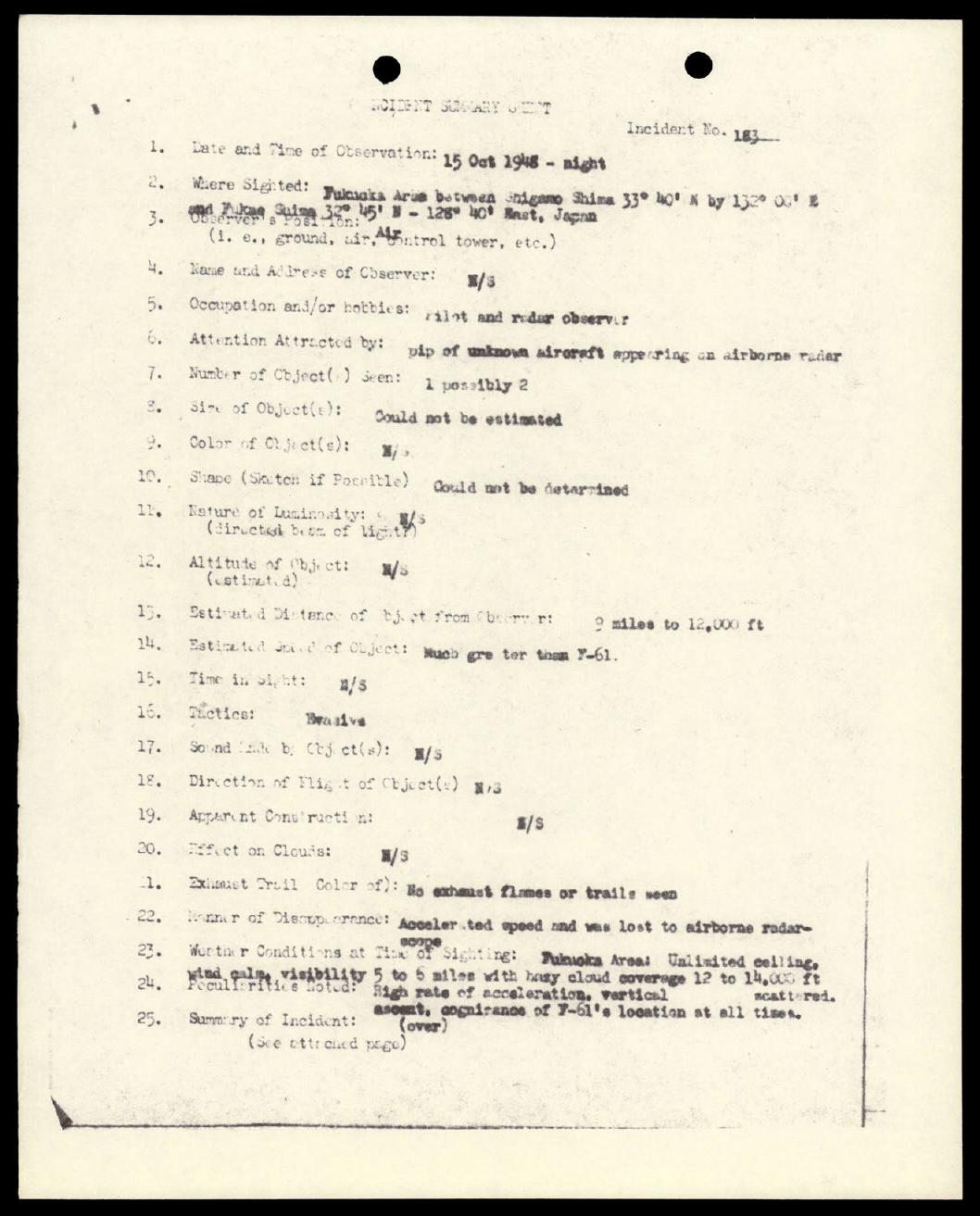 Page 25 render: Fukuoka-area F-61 report form. The visible page is a typed incident sheet describing an airborne-radar/visual report; it does not show a radar-scope photograph or plot.
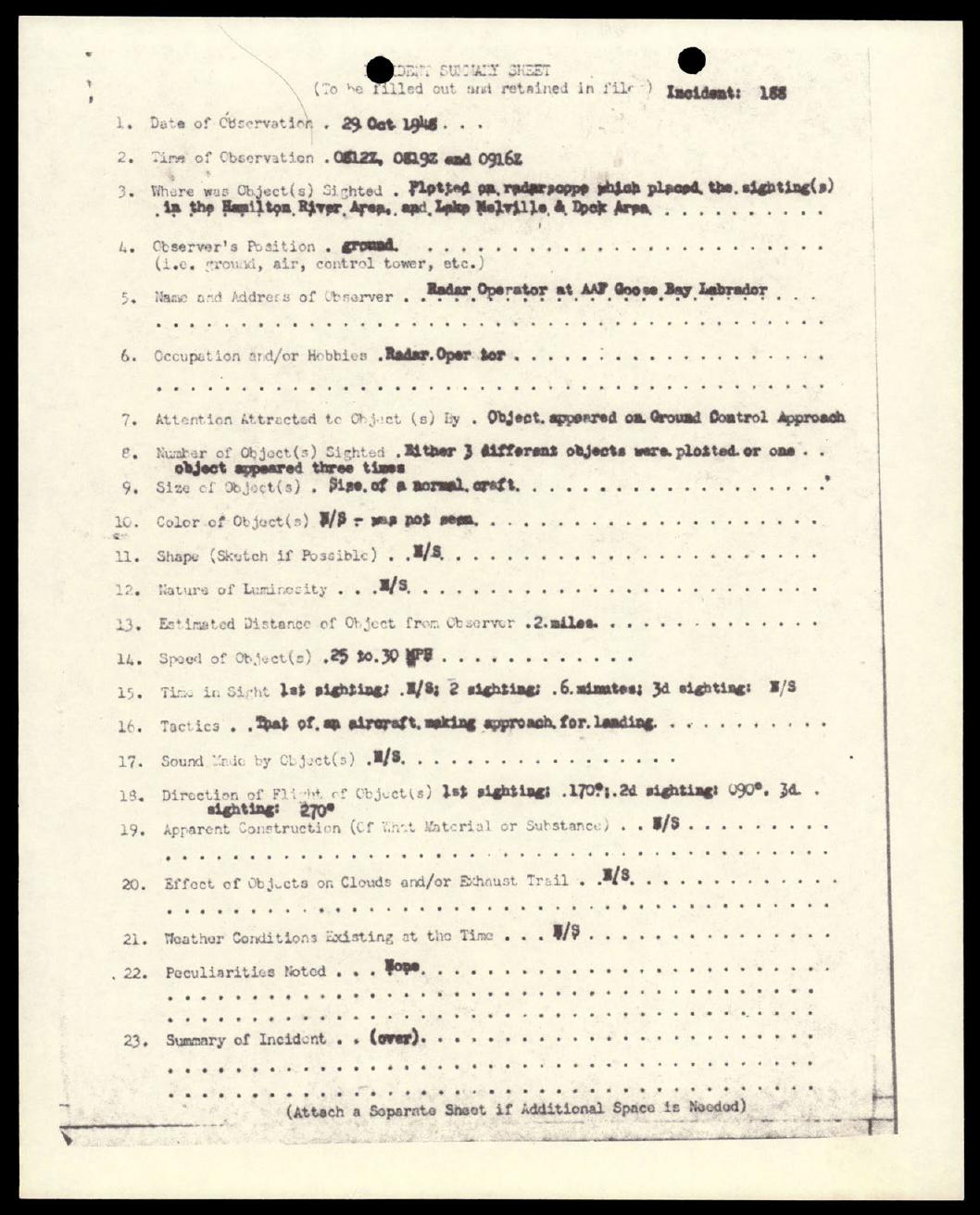 Page 35 render: Goose Bay incident form for a ground-controlled-approach radar report; the packet narrative continues on the following page.
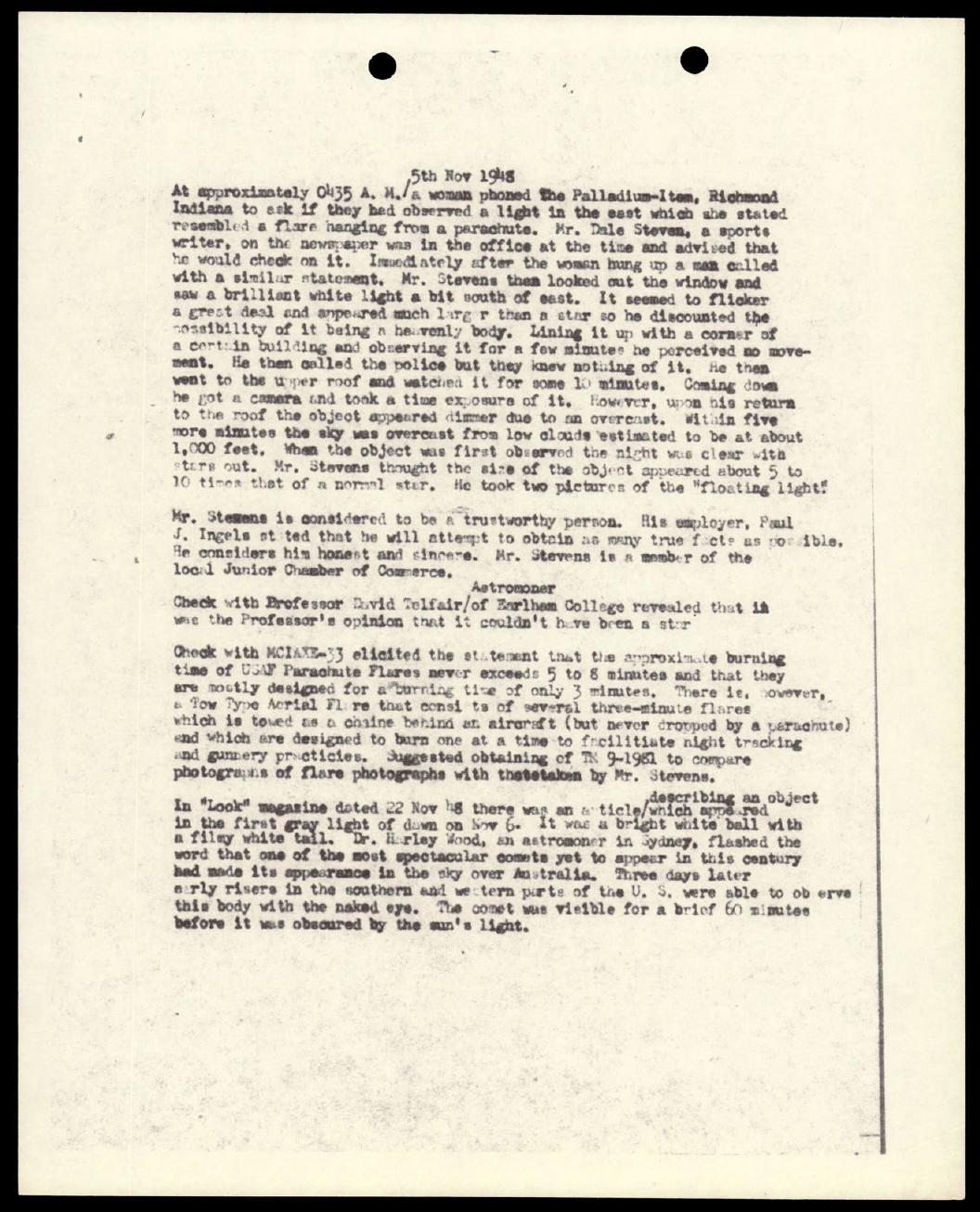 Page 54 render: Richmond, Indiana narrative mentioning Dale Stevens, two time-exposure pictures, and proposed comparison against flare photographs. The visible page is text; it does not include the photographs themselves.
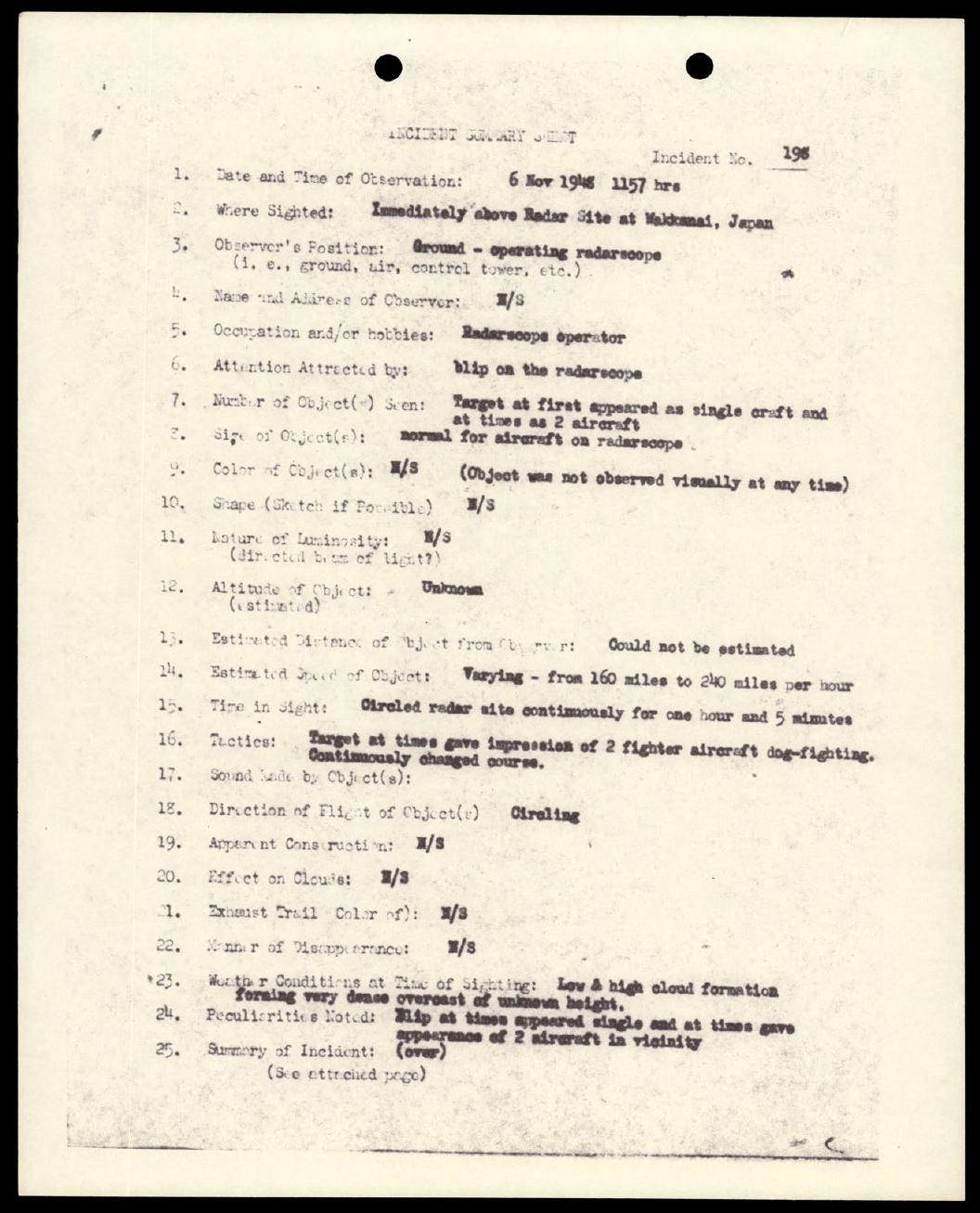 Page 55 render: Hokkamai/Nakano, Japan radar-site report form. The page describes a radar-scope blip, but the visible evidence is typed form text rather than an actual radar plot.
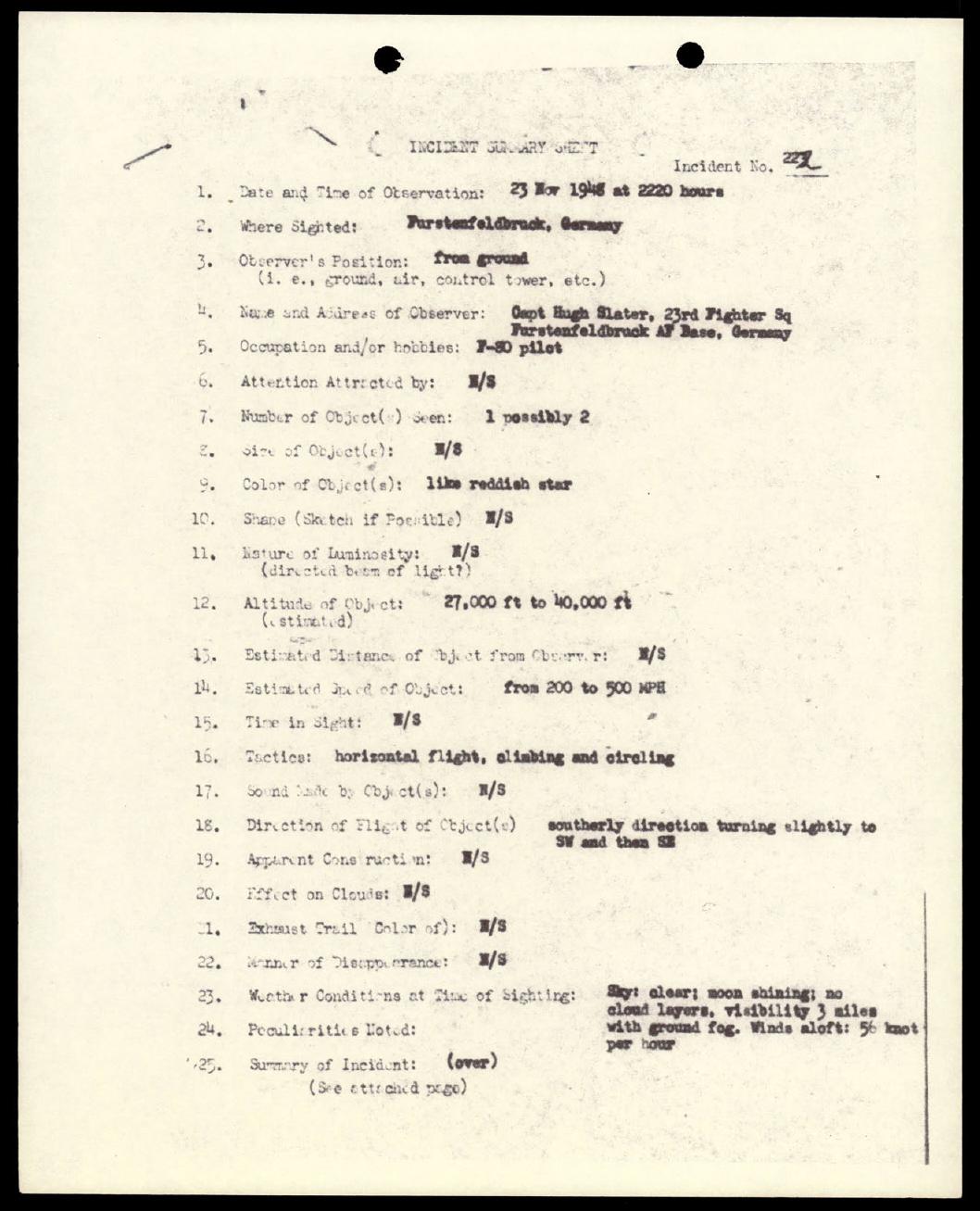 Page 114 render: Furstenfeldbruck incident-record form introducing the Capt. Hugh Slater visual report and the Racecard radar follow-up thread.
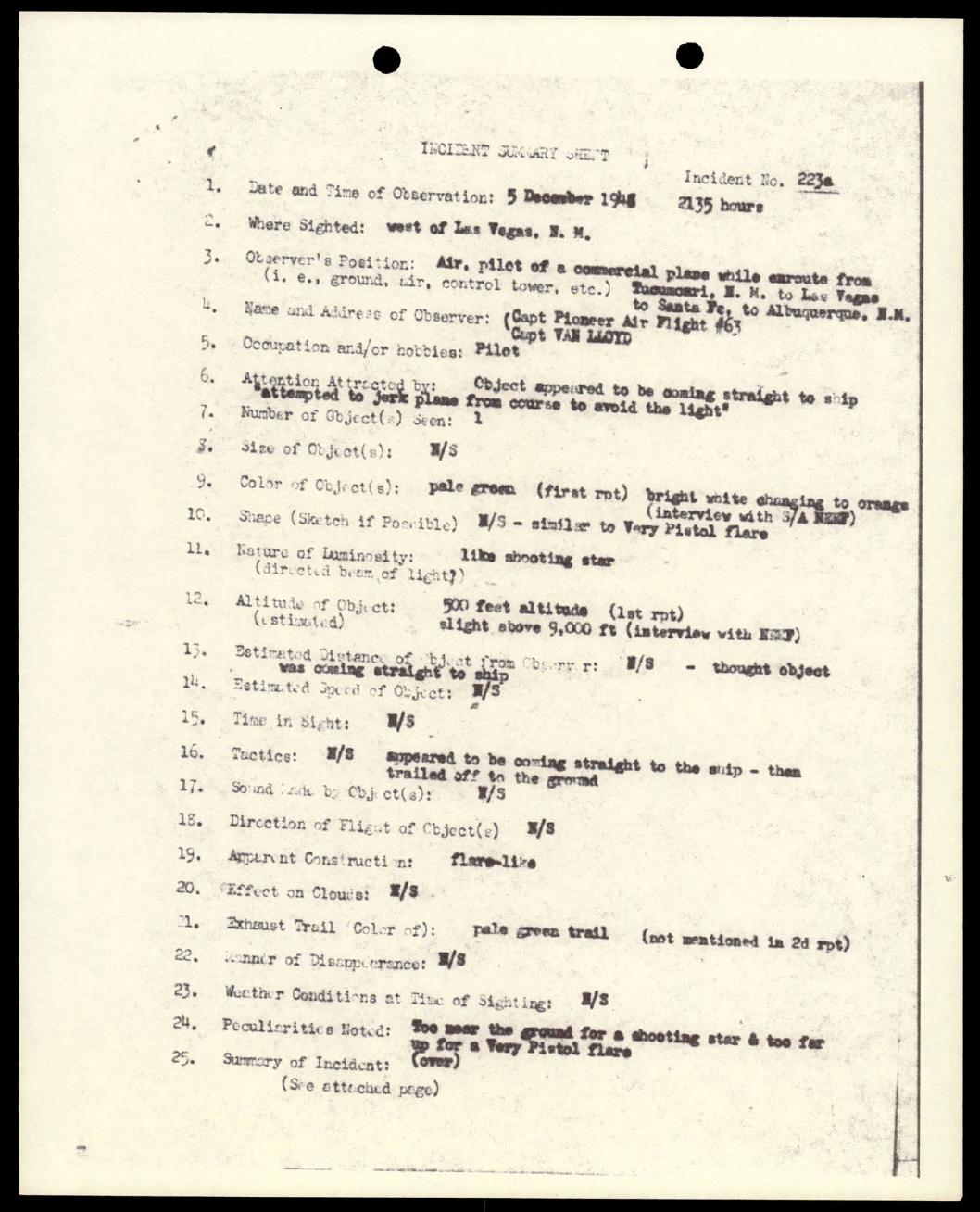 Page 118 render: Incident 223a form for Capt. Van Lloyd / Pioneer Flight #63, west of Las Vegas, New Mexico, with pale-green / bright-white-to-orange wording and Kirtland-area route context.
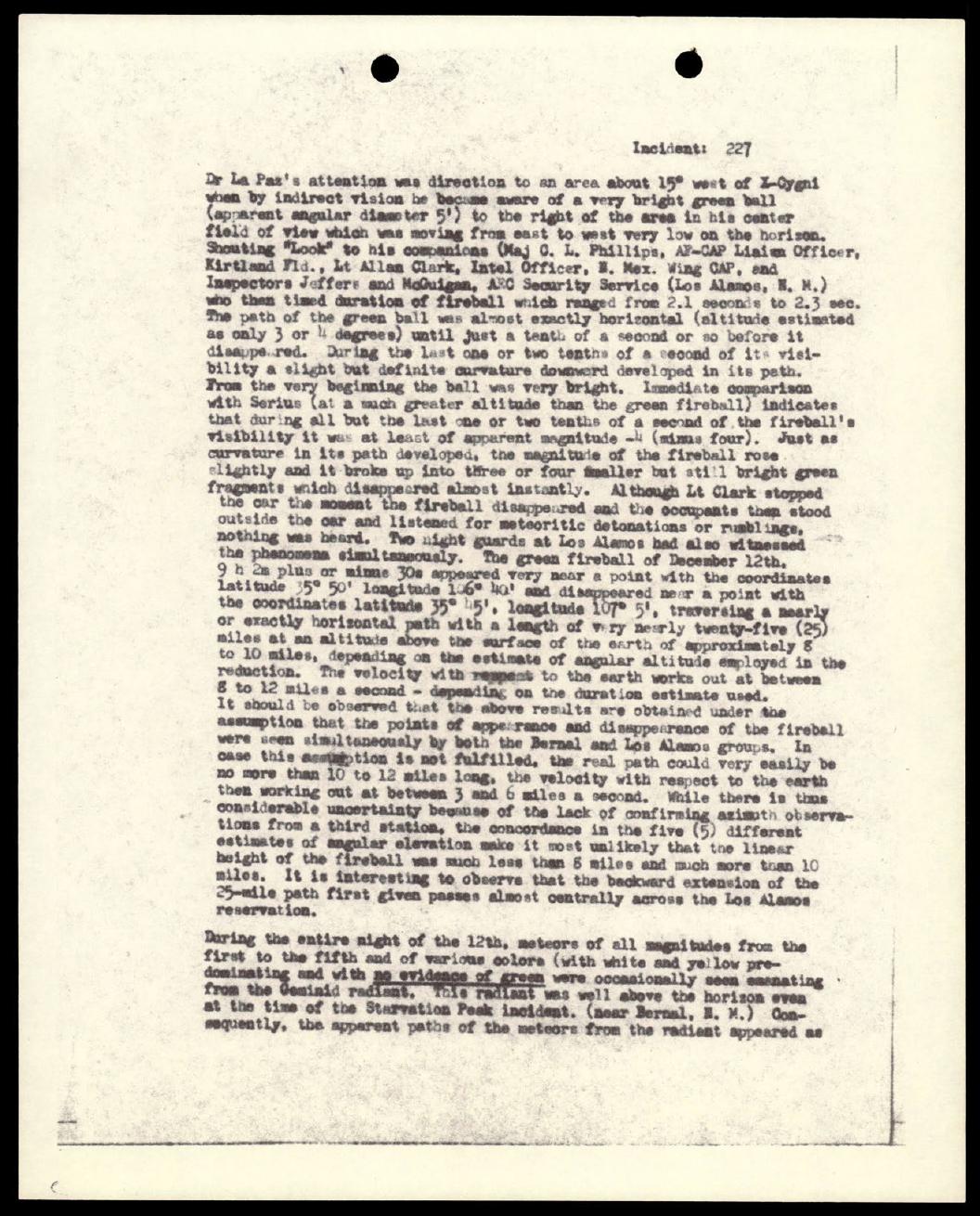 Page 127 render: Incident 227 narrative naming Dr. La Paz and describing a bright green fireball, timing estimates, trajectory discussion, fragmentation, and uncertainty language.
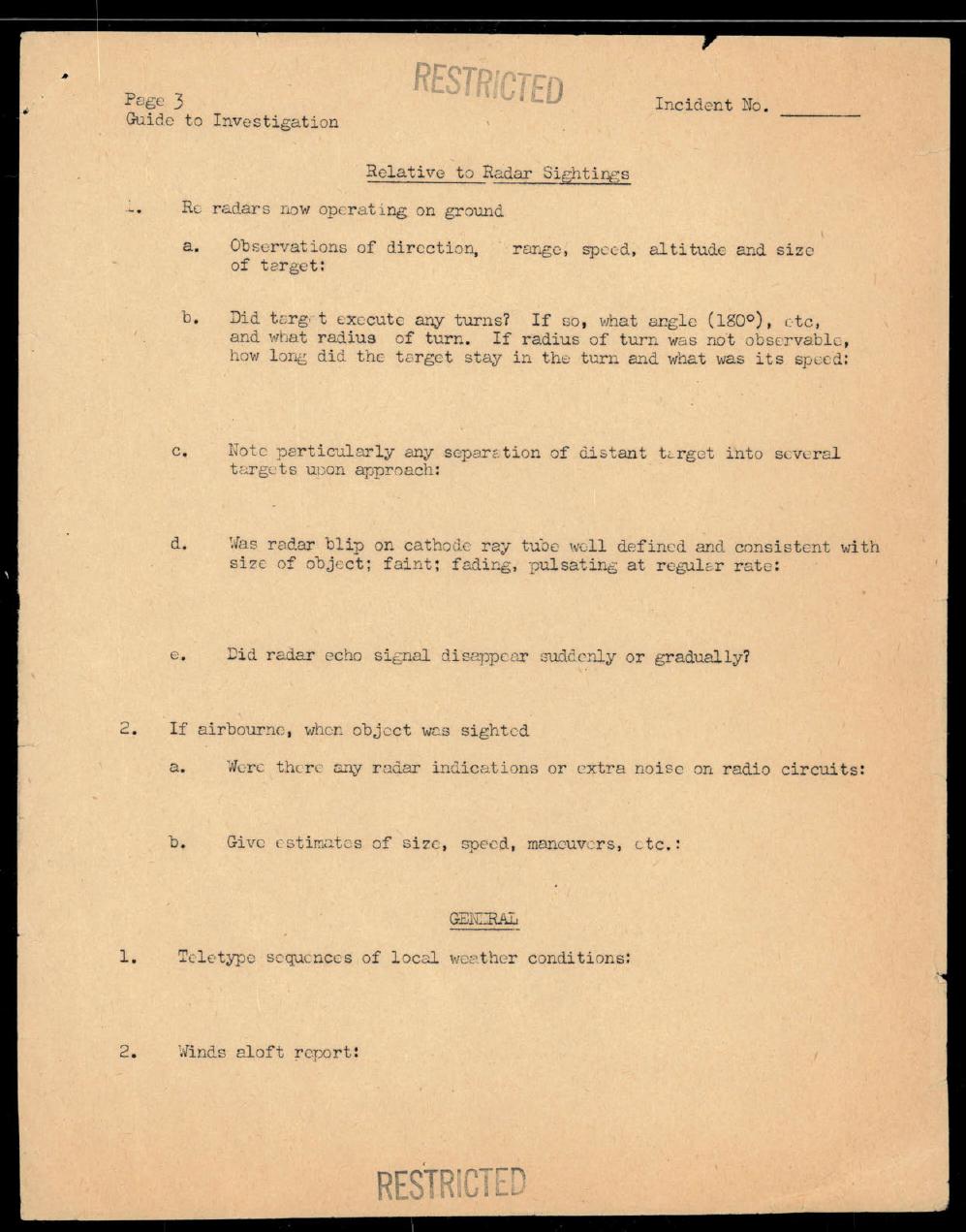 Page 142 render: “Guide to Investigation” page headed “Relative to Radar Sightings,” listing radar direction, range, speed, altitude, target behavior, echo behavior, weather, and winds-aloft questions.
What the file appears to contain
The packet is mostly typewritten incident sheets with one or two pages per entry. The representative page-image pass showed scanned typed pages rather than embedded photograph plates, radar plots, or object diagrams. Several pages mention photographs, sketches, radar data, or possible sensor records, but the released packet pages reviewed here mainly preserve written summaries and checklist fields rather than the underlying photographic negatives, radar-scope plots, or original station logs.
| Page range | Reading notes |
|---|---|
| 1 | Cover/transmittal page for incident summary sheets 173-233. |
| 2-19 | Early packet entries around incidents 173-178, including ground observations, Santa Fe-area reports, San Pablo/Kentwood/Honolulu material, a balloon-sounding sheet, and a short luminous-ocean account. |
| 20-32 | Out-of-sequence or inserted entries including incident 180, incidents 151-154, incidents 185-186, and the high-signal F-61/Fukuoka report in which an object was described as visually and airborne-radar observed on 15 October 1948. |
| 33-48 | Godman AFB/Venus material, Goose Bay GCA radar pages, Turner/Neubiberg/Fort Riley/Moorhead entries, and a balloon-cluster entry later identified in the text as MIT cosmic-ray research equipment. |
| 49-66 | More Goose Bay and radar/checklist material, the Richmond, Indiana white-light report with time-exposure photograph references, Hokkamai/Nakano radar-site material, Grays Harbor, and a Crescent City witness cluster. |
| 67-82 | Incidents 201, 201A, 201B, and 202-206, including orange/white light reports, Newark AFB, Peace River/Alberta, comet-like wording, and Clark AFB material. One passage says A-2 considered a weather balloon with a light as a possible explanation for an entry in this range. |
| 83-91 | Andrews AFB and Clark AFB entries, plus a report whose page text describes a flak-burst-like object and corkscrew-like trail. |
| 92-113 | Korean observation-post material, a Project Sign request page, Dayton/Needmore/Fairfield-Suisun/Chanute/Pittsburgh/Martinsburg/Newburgh/San Francisco/Midland material, including a Fairfield-Suisun report that notes a weather balloon was released shortly before the sighting. |
| 114-129 | Furstenfeldbruck visual/radar material and the main New Mexico green-fireball cluster: Las Vegas, Kirtland, Sandia Base, Bernal, Dr. La Paz, Holloman/White Sands follow-up language, and comparisons against ordinary meteors/flares. |
| 130-139 | New Brighton, Florida, North Powder/Oregon, Abilene/Texas, Dunroost/New Jersey, and Jackson/Mississippi entries. The Jackson page says no photographs were taken because no camera was available. |
| 140-144 | A “G.I. Division Unidentified Aerial Objects” investigation guide, including a radar-sighting section and a general section asking for weather, winds aloft, flight schedules, testing-device releases, photographs or negatives, sketches, signed statements, and physical evidence where possible. |
High-signal source threads in the packet include:
- Radar and sensor reports. Pages 25-26 describe an F-61/Fukuoka-area case where an unknown was described as visually observed and seen on airborne radar, while the F-61 itself was intermittently visible to ground radar. Pages 35-36 describe Goose Bay GCA radar returns with bearings, times, estimated speed, and base-map plotting. Pages 55-56 describe a Hokkamai/Nakano radar-site target that was not visually observed, appeared at times as one or two aircraft, and was evaluated in the text as a possible Soviet “Ferret” electronic-reconnaissance aircraft. Pages 114-115 describe a Furstenfeldbruck report where a ground observer saw a reddish star-like object and Racecard IF Station later reported an unidentified radar object south of Munich. Page 142 is an investigation-guide page for radar sightings.
- New Mexico green-fireball material. Pages 116-129 are the densest cluster. They include Capt. Goode and Pioneer Flight #63 / Capt. Van Lloyd Las Vegas-Kirtland reports, Sandia Base observations, Dr. La Paz’s Bernal account, Los Alamos witness references, Holloman/White Sands checks, flare comparisons, and meteor-shower discussion. The text repeatedly notes uncertainty in altitude, duration, trajectory, observer geometry, and interpretation.
- Prosaic and mundane follow-up leads. The packet itself preserves several ordinary-explanation leads: Godman AFB material identifying one object as Venus; a balloon cluster identified as MIT cosmic-ray research equipment; weather-balloon language in some entries; the Hokkamai “Ferret” evaluation; Richmond flare-comparison work; Fairfield-Suisun balloon-release timing; and Holloman/White Sands inquiries about lighting devices or flares.
- Photograph and sketch references. Page 54 says Dale Stevens took two time-exposure pictures of a Richmond “floating light” and that comparison with flare photographs was being pursued. Page 139 says no photographs were taken in the Jackson, Mississippi report because no camera was available. Page 143 instructs investigators to obtain photographs or original negatives where available and sketches where not. No standalone photograph plates were confirmed in the representative rendered pages reviewed for this draft.
Source custody and provenance
- Official/source URL: https://www.war.gov/medialink/ufo/release_1/38_143685_box7_incident_summaries_173-233.pdf
- Open release-file copy: war-gov-38-143685-box-incident-summaries-173-233-be226374
- Official Release 01 CSV row:
27 - Agency shown in the Release 01 record: Department of War
- Source/container kind: PDF
- Verified Release 01 copy size: 49,382,924 bytes
- SHA-256:
1d9722f764878359c73135f82b12608f1267eaf90d274c7d5775ab43bc9a289c - PDF page count: 144
- OCR coverage available for this draft: 144 pages with text
The verified Release 01 copy is a scanned, copy-restricted PDF with one scanned page image per page. A current official-server HEAD probe was blocked, while a browser-style byte-range request returned a PDF response with a larger advertised total size than the verified Release 01 copy. That is a custody/versioning lead: compare any current official payload against the verified Release 01 copy before treating them as byte-identical.
Graph context
Open Sky currently models this release item as both a Release 01 record and a PDF asset document. The exact document records point to the WAR.GOV release landing page/CSV record and to the PDF URL above.
The graph has a large machine-extracted semantic layer for this packet: 1,807 extracted claim records, 612 entity mentions, 85 sensor-event records, and 0 table-row extractions for this asset. The extraction is useful as an index into the packet, but it needs human review before analytical use. The extracted categories are dominated by repeated observation/witness language, motion and measurement fields, object descriptors, aircraft/platform references, radar references, prosaic leads, redaction notes, and time/location anchors.
The sensor-event count should be handled carefully. The packet really does include radar-related text, but many sensor-event records are triggered by ordinary words such as aircraft, radar, radar operator, GCA scope, and investigation checklist prompts. Those records are navigation cues into the source, not independent radar tracks.
The graph also carries 10 candidate crosslinks, mostly around the Kirtland anchor and external FBI/NARA records. Those are leads only. They should not be treated as confirmed joins until the specific pages, dates, people, and source excerpts are compared manually.
Leads to check
- Split this packet into incident-level child pages or case clusters before drawing cross-case conclusions. The page count and incident density are too high for one page to adjudicate every entry.
- Manually confirm incident numbering against page images. OCR appears to drop leading digits on some late-packet forms, and the packet contains out-of-sequence inserts.
- For the radar cases, check original radar logs or operational records where available: Fukuoka/F-61, Goose Bay GCA, Hokkamai/Nakano, Furstenfeldbruck/Racecard, and the packet’s own radar-guide questions.
- For the New Mexico green-fireball cluster, compare the Dec. 5-13 accounts with Dr. La Paz’s trajectory/meteor arguments, meteor-shower timing, Holloman/White Sands activity checks, flare possibilities, Los Alamos/Sandia/Kirtland context, and any surviving contemporary correspondence.
- Locate the Richmond, Indiana time-exposure photographs or negative comparison records mentioned on page 54, if they survive elsewhere. The released PDF text references them, but this packet does not visibly include standalone photo plates.
- Preserve the packet’s own prosaic leads: Venus, MIT balloon equipment, weather balloons, flare comparisons, Soviet aircraft/electronic-reconnaissance evaluation, flight schedules, weather, winds aloft, and testing-device release checks all need source-by-source verification.
- Review the Kirtland candidate crosslinks against the exact 5 December 1948 Las Vegas/Kirtland passages before connecting them to FBI or NARA pages in public prose.
- Compare any current official-server PDF payload with the verified Release 01 copy before using the current URL as a replacement source, because the byte-range response now advertises a different total size.
Lead check notes
- Partial — incident-level split: Current linked wiki/source checks show the adjacent incident-summary packet pages and the historic-intelligence overview, but no separate child pages yet for the Fukuoka/F-61, Goose Bay GCA, Hokkamai/Nakano, Furstenfeldbruck/Racecard, Richmond/Dale Stevens, or December 1948 New Mexico green-fireball anchors in this packet. The packet still needs incident-level child pages before case-level interpretation.
- Checked — incident-numbering caution: Full OCR has 144 page markers, but page headings confirm the packet is not a simple 173-233 sequence. Pages 21-28 contain incidents 151-154 inside this packet; pages 114-116 use
Incident No. 23for the Furstenfeldbruck and New Mexico entries; page 124 readsIncident No. 26while page 125 readsInd Rept: 226; page 137 has a damaged checklist layout for Incident 232. Incident numbers should be checked against page images before reuse. - Partial — radar cases: The release-file text and page renders confirm radar-related source threads for the Fukuoka-area F-61 report, Goose Bay GCA returns, Hokkamai/Nakano radar-site report, Furstenfeldbruck/Racecard follow-up, and the packet’s radar-investigation guide. Original radar logs, scope plots, or station records were not found in the current linked corpus.
- Partial — New Mexico green-fireball cluster: Pages 116-129 preserve the Las Vegas/Kirtland/Sandia/Bernal thread, including Capt. Goode, Capt. Van Lloyd of Pioneer Flight #63, Dr. La Paz, Holloman/White Sands checks, flare comparisons, and meteor-shower discussion. The current wiki does not yet have a standalone page for this December 1948 green-fireball sequence.
- Needs external source — Richmond time-exposure photographs: The page-54 render confirms the text reference to Dale Stevens taking two time-exposure pictures and to a proposed comparison with flare photographs. Searches of the current linked corpus found the Dale Stevens/Richmond anchor only in this packet, and no visible photograph plate, negative, or separate comparison record was identified here.
- Checked — prosaic leads stay incident-specific: The packet itself preserves ordinary-explanation leads including Venus, MIT cosmic-ray balloon equipment, weather balloons, flare comparisons, the Hokkamai Soviet “Ferret” evaluation, flight schedules, weather, winds aloft, and testing-device release checks. Those leads should stay attached to individual incidents rather than being treated as one packet-wide resolution.
- Checked — Kirtland graph crosslinks remain audit-only: The graph currently shows 10 Kirtland-anchored candidate crosslinks from this asset to FBI Vault and NARA targets. The relationship statuses remain
needs_human_reviewandnot_a_finding, and the shared snippet is the page-119 Van Lloyd/Kirtland passage. That supports source navigation only; it does not establish same-event identity with later Kirtland records.
Deep investigation — graph + web reconnaissance
Source reread
- The verified Release 01 PDF copy remains a 49,382,924-byte, 144-page, copy-restricted scan with SHA-256
1d9722f764878359c73135f82b12608f1267eaf90d274c7d5775ab43bc9a289c. The source is a packet of incident sheets and attachments, not one case file. - OCR and page-render review confirm that the highest-signal pages are typed forms or narratives rather than raw sensor exhibits. The Fukuoka/F-61 pages 25-26 describe a visual/airborne-radar report and say the F-61 was intermittently visible to ground radar, but the page image is not a radar-scope photograph or plot. The Goose Bay pages 35-36 similarly preserve GCA scope wording, bearings, times, speed estimates, and base-map plotting in typed text rather than an underlying scope image.
- The Hokkamai/Nakano pages 55-56 are important because the source itself says the target was not visually observed, appeared in ground clutter, sometimes looked like one aircraft and sometimes two, and was evaluated in the text as a possible Soviet
Ferretelectronic-reconnaissance aircraft. That is a source-stated prosaic/intelligence lead, not a resolved identification by this page. - The New Mexico pages 118-127 preserve the Van Lloyd / Pioneer Flight #63 Kirtland report and Dr. La Paz green-fireball narrative with internal cautions: color and altitude differ between the first and second Van Lloyd reports; the La Paz calculation depends on simultaneous-observation assumptions; the same cluster explicitly discusses ordinary meteors, flares, Holloman/White Sands checks, and Geminid meteor context.
- The radar-investigation guide on pages 142-143 is administrative. It tells investigators to collect radar direction, range, speed, altitude, target behavior, echo behavior, weather, winds aloft, flight schedules, testing-device releases, photographs/negatives, sketches, signed statements, and physical evidence. It is not itself a specific radar event.
Read-only graph checks
- The exact Release 01
Documentnode is present with CSV row27, title38_143685_box_Incident_Summaries_173-233,frontier_ocr_page_count: 144,frontier_ocr_chunk_count: 124,full_download_bytes: 49382924, and ingest-timecontent_range: bytes 0-65535/49382924. - Direct graph relationships for this asset are dense but review-only: 126
TextChunklinks, 1,807Claimlinks, 612EntityMentionrecords, 85SensorEventrecords, 10CANDIDATE_CROSSLINKrelationships, one official CSV-recordRELATED_TOdocument, and one derived secondary Markdown-conversion document. No graph write was made. - The semantic layer remains machine extraction. The
SensorEventset is dominated by keyword hits such asaircraft,radar, andaircraft radar; true radar-bearing source passages exist in the packet, but many graph sensor records are checklist/form-language or ordinary aircraft-context hits. These records should staymachine_extracted_needs_human_review/not_a_findinguntil compared to page images and source text. - All 10 candidate crosslinks use the shared Kirtland anchor and the page-119 Van Lloyd/Kirtland passage. The targets include FBI Vault UFO Part 06 page 67, FBI Vault Part 07 page 48, FBI Vault Part 08 page 50, and NARA Kirtland file units including
Kirtland AFB, N. Mex, January 1949 - Incident Number: 244and later 1952/1959 Kirtland files. These are archival review leads only; they do not establish same-event identity, causality, or resolution. - Graph prosaic/context overlays did not add a ready-made correlation for this 1948 packet: exact 1948 checks against
AstronomyEvent,WeatherEvent, andLaunchEventreturned no matching records, and there are currently noSatelliterecords in the graph. That absence is a coverage limit, not evidence that weather, astronomy, balloons, aircraft, flares, or military activity were ruled out.
External provenance and context
- Direct live requests to the WAR.GOV landing page, official CSV, and this PDF URL returned
403 Access Deniedduring this check. That does not break custody because the cached official-primary file verifies by size and SHA-256, and the graph preserves ingest-time official response metadata. - Internet Archive CDX records for the exact WAR.GOV PDF URL show a 2026-05-08
200application/pdfcapture with length49388074and a later 2026-05-14200application/pdfcapture with length160795707. That supports the existing custody/versioning caution: compare any current official payload against the verified Release 01 copy before treating it as byte-identical. - The FBI Vault UFO Part 06 download endpoint returned
200 application/pdf; the graph's page-level text for Part 06 page 67 is a 31 January 1949 Kirtland AFB message aboutunknown, aerial phenomena, approximately 30 witnesses, and an estimated 100 total sightings. It is relevant New Mexico/Kirtland archival context, but it is later than the December 1948 Van Lloyd/La Paz cluster and remains a lead rather than a merge. - NARA catalog pages for the Kirtland January 1949 and March 1949 file units returned reachable catalog HTML. The graph metadata identifies them as Project Blue Book/NARA file-unit records with unrestricted access/use and Fold3 online-resource pointers. Exact page-image comparison is still needed before using them as corroboration for any incident in this packet.
Prosaic checks and follow-up leads
- The packet itself already contains the strongest prosaic-check menu: Venus for Godman AFB material, MIT cosmic-ray balloon equipment, weather-balloon release timing, Richmond flare-comparison work, Hokkamai/Soviet
Ferretevaluation, meteor/Geminid discussion, Holloman/White Sands flare or lighting-device checks, flight schedules, weather, and winds aloft. - The next editorial move should be incident-level splitting, not a packet-wide conclusion. Priority child pages or source cards: Fukuoka/F-61 airborne radar, Goose Bay GCA, Hokkamai/Nakano radar site, Furstenfeldbruck/Racecard, Richmond/Dale Stevens time exposures, and the December 1948 New Mexico green-fireball cluster.
- Follow-up should compare exact NARA/FBI pages, dates, names, and source excerpts against the packet before promoting any crosslink. Richmond photographs/negatives, original radar logs or scope plots, and New Mexico green-fireball correspondence are still missing from this page.
Audit note
This section is a graph-and-web reconnaissance update only. It preserves the source facts, machine-extracted graph state, official/archive leads, prosaic-check lanes, and unresolved questions without creating a finding, hypothesis, or resolution decision.
Limits
This is a source-reading and graph-investigation draft, not a human-reviewed case conclusion. It should not be cited as a finding.
The scan is readable but uneven. Some names, numbers, stamps, and incident identifiers are unclear or OCR-damaged. Redactions and illegible text remain. The packet is also a bundle of many incidents and administrative forms, so summary language here is packet-level by necessity.
The graph’s extracted claims are machine-generated review aids. Counts and categories help navigate the source, but they do not establish that an event occurred as described or that a prosaic explanation is correct. Several records explicitly need follow-up against weather, astronomy, aircraft, balloon, radar, flare, meteor, and archive-custody sources.
No original radar plots, photographs, or physical-evidence exhibits were confirmed in the representative rendered pages used for this draft. Where the text mentions photographs, sketches, radar data, or physical evidence, this page treats those as leads to locate the underlying records.
Sources
- WAR.GOV/PURSUE Release 01 official PDF: 38_143685_box7_incident_summaries_173-233.pdf
- Open release-file copy for this asset: war-gov-38-143685-box-incident-summaries-173-233-be226374
- SHA-256 verification:
1d9722f764878359c73135f82b12608f1267eaf90d274c7d5775ab43bc9a289c - Release 01 manifest record: row
27, title38_143685_box_Incident_Summaries_173-233, agencyDepartment of War