65_HS1-834228961_62-HQ-83894_Section_2
Evidence media
- Official PDF: Open Sky release-file copy · WAR.GOV source
Selected page renders below are derived from the official PDF to show the packet's evidence types without turning the 194-page file into a gallery.
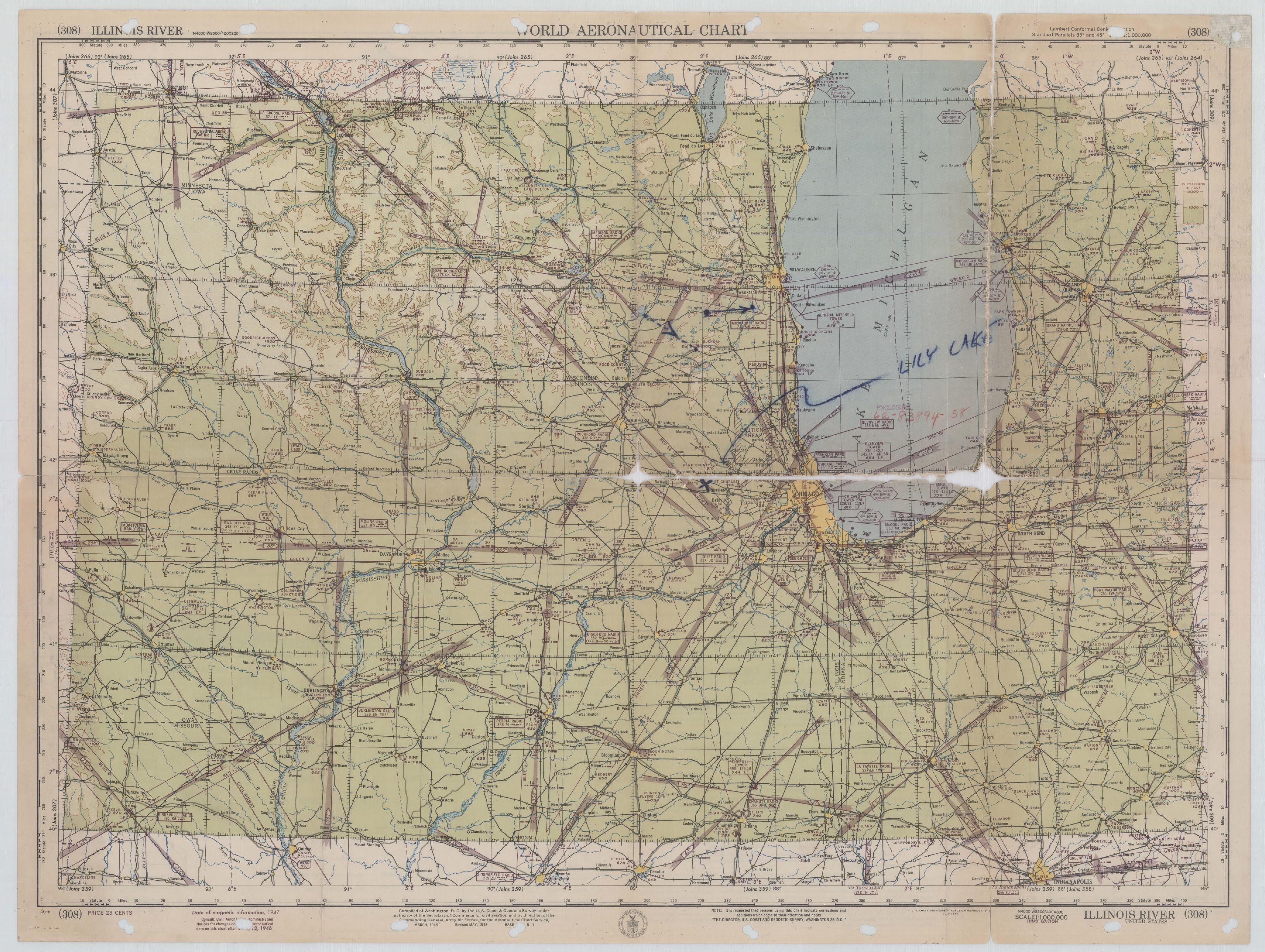 Page 22: aeronautical chart enclosure for the Wisconsin/Shaver thread, with Midwest aviation-chart labels and handwritten markings. This is route/geography context, not object imagery.
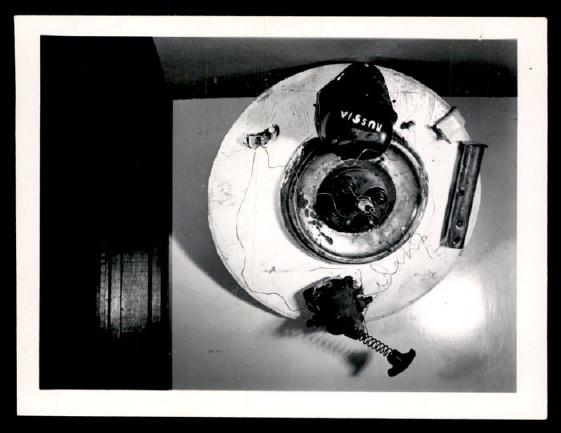 Page 79: exhibit photograph of the Saybrook object viewed from above. The nearby memo describes a wooden platter with attached parts; this render should be treated as recovered-object/probable-prank context, not as an aerial photograph.
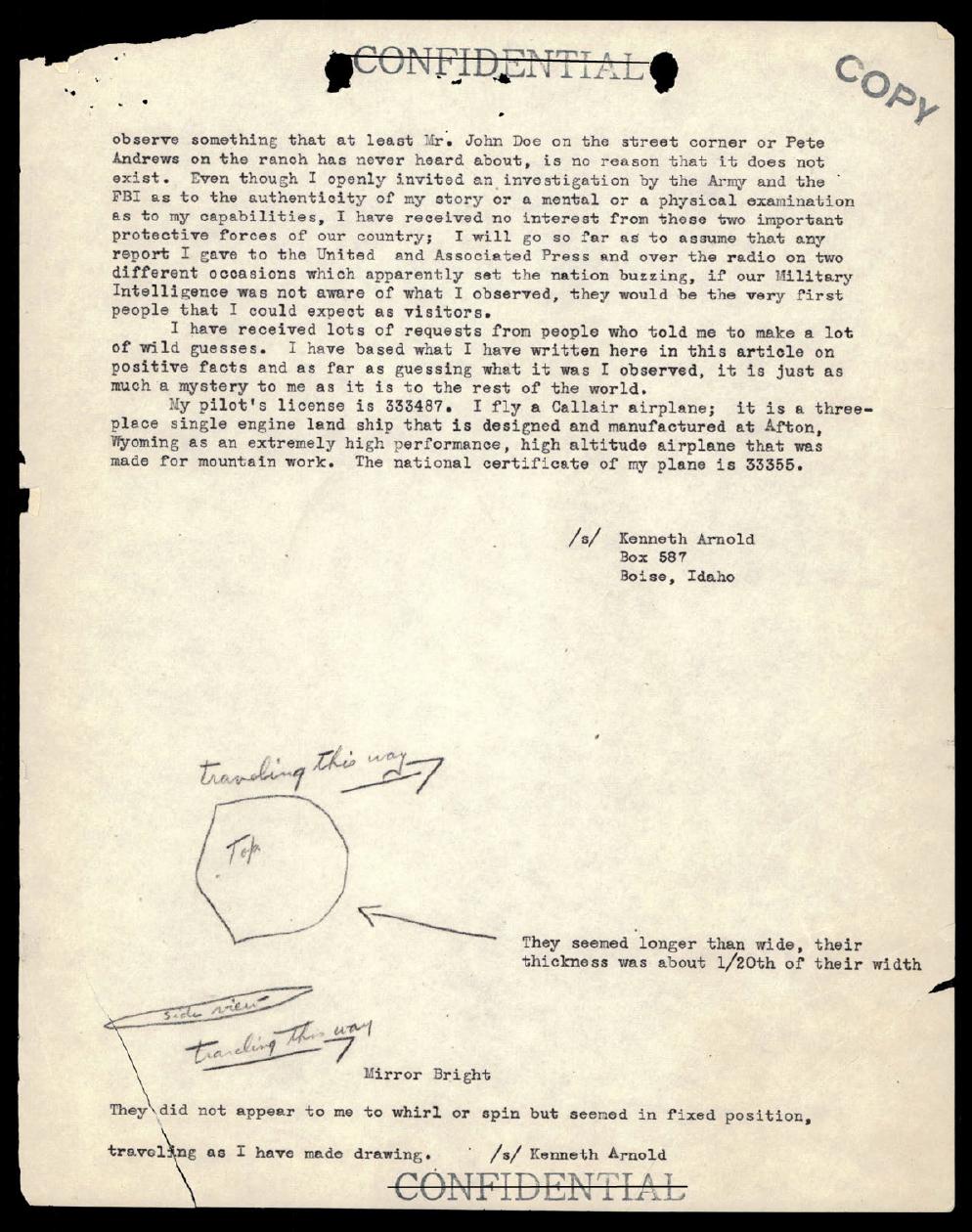 Page 167: Kenneth Arnold statement page with handwritten top/side-view sketches, direction-of-travel annotations, and the typed note that the objects appeared "Mirror Bright" and did not whirl or spin.
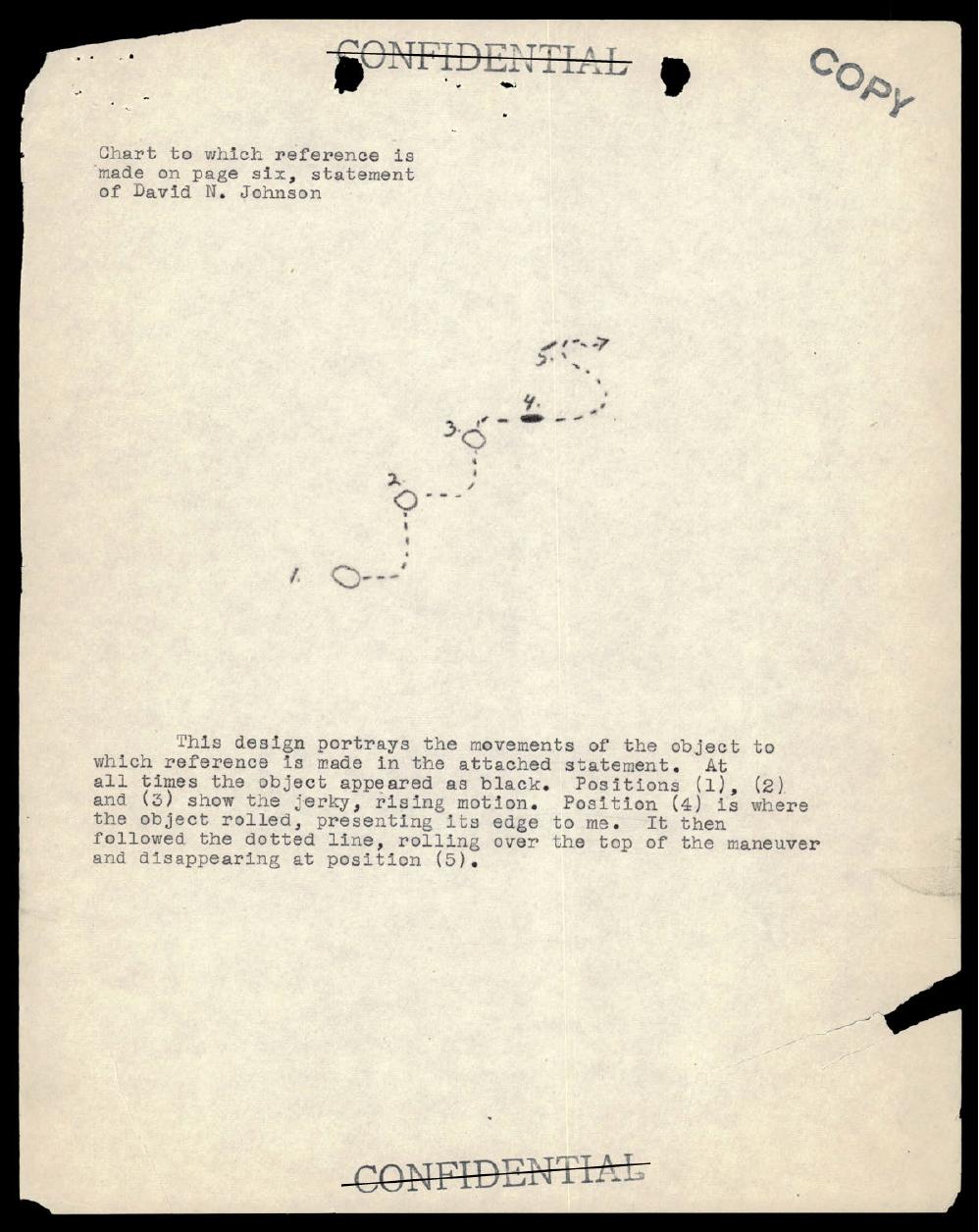 Page 172: David N. Johnson chart showing a dotted movement path and numbered positions, with typed explanation of the reported jerky/rising motion and roll.
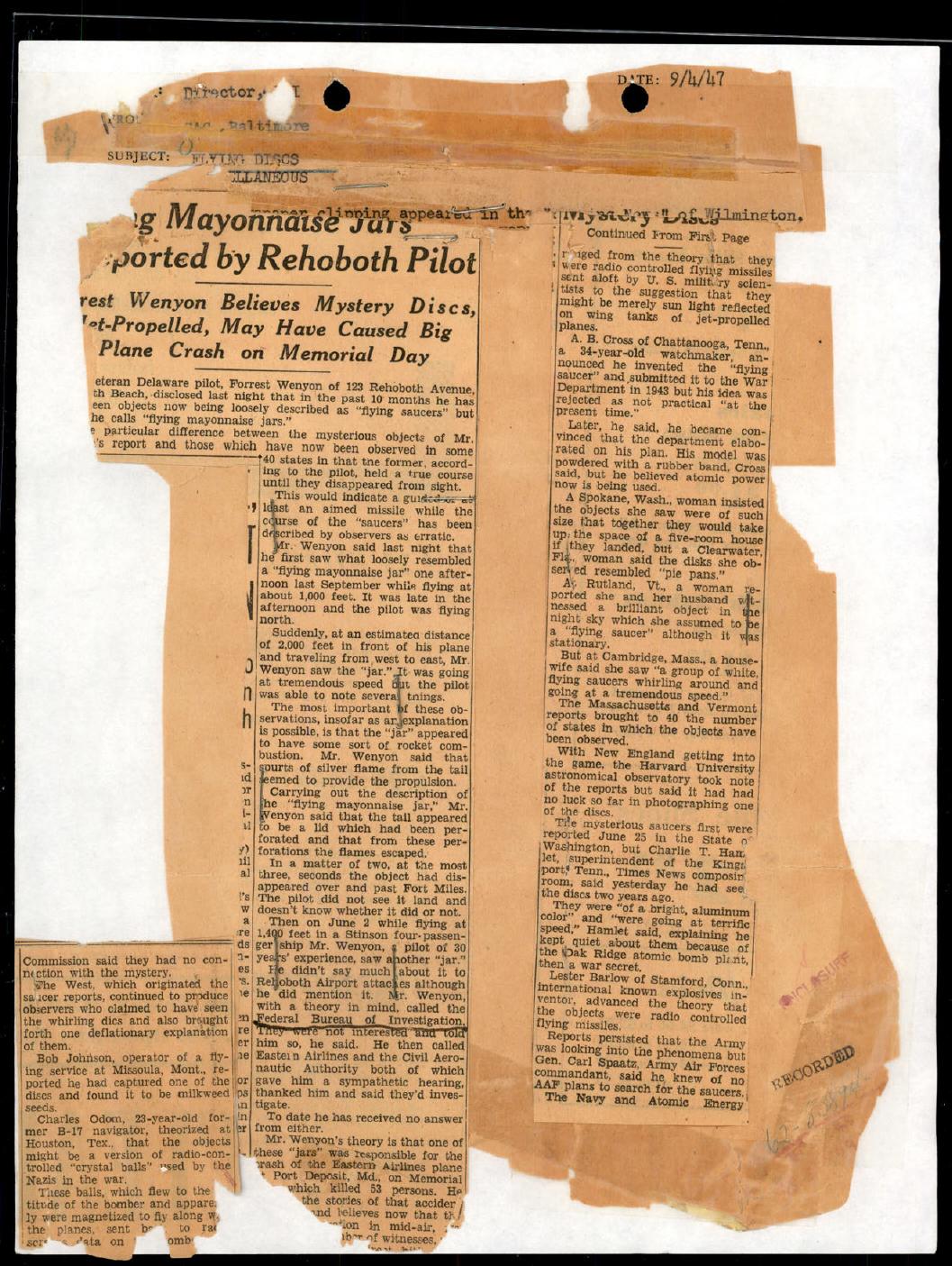 Page 194: deteriorated newspaper-clipping page preserving the Rehoboth/Wenyon "flying mayonnaise jars" press account. Several lines are clipped, overlapped, or difficult to read, so the clipping should remain source-context rather than a clean transcript.
Investigation reading
This released file is a 194-page FBI Headquarters section of file 62-HQ-83894, not a single incident report. This draft treats it as a packet of mixed serials: FBI office memoranda, Army Air Forces intelligence attachments, teletypes, citizen letters, newspaper clippings, map/diagram enclosures, photographs of a recovered ground object, and witness statements from several 1947 flying-disc threads.
Coverage checked for this draft:
- PDF metadata: 194 pages, 118,380,300 bytes, SHA-256
e196678aefbf9d1239524925838250d452ac3155789d226d6ebe0158b915070e. - OCR coverage: 194 page markers and 194 pages with text, totaling about 213,561 OCR characters.
- Full-packet searches:
photograph,negative,camera,radar,balloon,meteor,weather,aircraft,B-25,tin foil,aluminum,radio active,atomic,hoax, and named anchors including Casella, Truke/Trunk, Raymond Lane, Shaver, Dahl, Crisman, Kenneth Arnold, Emil Smith, William Rhodes, David Johnson, Hedstrom, Saybrook, Twin Falls, Bethel, Williams Field, and Rehoboth/Wenyon. - Visual spot checks: the Wisconsin aeronautical chart, the Saybrook object photographs, Kenneth Arnold's shape sketch, David N. Johnson's motion chart, and the Rehoboth/Wenyon newspaper-clipping page.
The safest reading is packet-level. It should be split into child case pages before anyone uses it for cross-case statistics or public conclusions.
What the file appears to contain
The file preserves a September-1947-era FBI Headquarters section that collects incoming and forwarded material on early postwar "flying disc" reports. Several pages are administrative wrappers or reverse sides with stamps only, but the packet has many high-signal embedded records.
| Page range | Packet thread | Reading notes |
|---|---|---|
| pp. 1-3 | Section cover and San Francisco forwarding memo | The cover identifies Section 2. The forwarding memo says San Francisco is sending photostatic copies of August 1947 Army Air Forces material received through Major William E. Graham / Lt. Col. Donald Springer at Hamilton Field. |
| pp. 4-7 | Hackensack, New Jersey, August 3, 1947 | Charles Casella and William Truke/Trunk describe a small round/oval object near Simons Avenue. Joyce McFarland reports seeing it near the horizon; a neighbor did not see it. The file preserves immediate prosaic leads: a child's balloon was mentioned at the scene, no string was observed, and local police reported no additional sources. |
| pp. 8-16 | Raymond and Laura Lane / Dow Chemical / Midland, Michigan | The Lanes report a small white burning/hissing event and recovered fused sand-like material. Dow personnel report ordinary sand, ammonia odor, small silver material, very low radioactivity in some grayish material, and comparison to but not identification with Los Alamos sand. The same pages emphasize discrepancies, Lane's amateur photography/electricity interest, and AAF notification. |
| pp. 17-23 | Richard Shaver telegram and Wisconsin two-airplane report | A War Department request asks about Richard F. Shaver of Lily Lake, Illinois. The attached report claims two Wisconsin observations by witnesses in aircraft, with extreme speed estimates, weather noted as CAVU, and an aeronautical chart enclosure. The chart page is geographic context, not object imagery. |
| pp. 24-28 and 138-148 | Tacoma / Maury Island / Dahl-Crisman-Arnold-Smith material | The file links the Maury Island fragment story, the Davidson/Brown B-25 crash at Kelso, Tacoma press calls, Ray Palmer, Kenneth Arnold, and United Airlines pilot Emil Smith. Later teletypes contain explicit hoax language and competing accounts about who knew what when. This needs its own child page because it mixes a claimed incident, a fatal aircraft crash, press handling, and post-event interviews. |
| pp. 29-45 and 154-157 | Public letters, coded newspaper item, and FBI lab handling | These pages include odd citizen correspondence and the Newsday / "Radio Ham" coded-message thread. The decoded message is a public-letter/newspaper curiosity, not evidence of a physical event. |
| pp. 46-51 and 124-132 | FBI/AAF policy and jurisdiction memoranda | Internal memoranda discuss newspaper claims about Soviet interest, wartime tin-foil/radar analogies, whether discs might be a classified Army/Navy project, and whether the FBI should assist. A September 5, 1947 AAF letter says a survey found no AAF project with characteristics associated with the discs. |
| pp. 52-56 | Myrtle Creek / Canyonville, Oregon | Ray Hatfield and student Noble Ellison report a glistening aluminum-like object east of Myrtle Creek, viewed from an aircraft. The report notes no vapor trail, no sound over the aircraft noise, and no other local witnesses found. |
| pp. 57-65 and 177-179 | Twin Falls, Idaho | H. E. Hedstrom, family/neighbor witnesses, Detective Richard Frazier, and other police personnel report groups of glowing lights in triangular formations. The later memo says the sky was overcast, size/height could not be estimated, and no further investigation was being conducted. AAF checks reported no relevant experiments near Twin Falls on the date in question. |
| pp. 66 and 115-119 | William Albert Rhodes / Phoenix photographs | The file preserves FBI handling of William Rhodes's reported Phoenix photographs and negatives. The text says Rhodes reported hearing a noise like an aircraft, seeing an odd-shaped craft, taking a Brownie Box Camera photograph, and later handing negatives to an Army Air Force Intelligence representative through the FBI. The actual Rhodes image prints are not reproduced in this section as visible photo plates. |
| pp. 68, 94, 120-127 | Additional Oregon/Portland and related reports | These pages include Agate Beach/Newport, Oswego, Portland police, Shouns/Tennessee, and Portland prospecting/Cascade reports. Some have prosaic leads such as meteorological balloon language or limited viewing conditions; others are eyewitness reports needing separation by incident. |
| pp. 70-77, 98-108, 111-113, 134-137 | Citizen correspondence and submitted-material threads | These include letters to Hoover, A. Courtney Parker's Vermont observation, Madeline Merchant's Santa Fe/Los Alamos contact letter, Mrs. Mixon's submitted material identified as powdered soapstone, and a Ryan letter about a publication's saucer theory. These are source-custody records, not resolved cases. |
| pp. 75-91 | Saybrook, Illinois recovered "flying disc" | The Springfield memo says Mrs. June Anderson reported a disc found in her yard. The object is described as an old wooden platter with a silver plate, spark plug, timer, and brass tubing; the memo calls it likely a juvenile prank. Pages 79, 81, 83, 85, 87, and 89 are close-up exhibit photographs of the physical object. Visual review confirms these are ground/exhibit photographs of a small contraption, not aerial-object images. |
| pp. 159-176 | Fourth Air Force copies: Kenneth Arnold and David N. Johnson | These pages include Lt. Col. Springer / Fourth Air Force material, an interview note on Kenneth Arnold, Arnold's own written statement and sketch, and David N. Johnson's search-and-observation statement with a motion chart. Arnold's page 167 sketch shows top and side views, direction-of-travel annotations, "Mirror Bright," and the claim that the objects did not whirl or spin. Johnson's page 172 chart is a drawn motion/path diagram, not a photograph. |
| pp. 180-184 | Bethel, Alaska / Captain Jack Peck and Vince Daly | San Francisco forwards a report that Captain Peck and co-pilot Vince Daly saw and followed a smooth, streamlined object near Bethel. The packet says Anchorage was asked to interview them separately. |
| pp. 186-190 | Hamilton Field and Williams Field / Chandler, Arizona attachments | These Army Air Forces copies include Captain William Byerd / Lt. Ward Stewart material at Hamilton Field and Lt. Eric Armstrong's report near Lake Mead while flying from Williams Field. They are typed witness/interview reports, not sensor records. |
| pp. 192-194 | Rehoboth / Forrest Wenyon newspaper-clipping thread | The FBI page includes an interview wrapper and a deteriorated newspaper clipping about Forrest Wenyon's "flying mayonnaise jars" claims. Visual review confirms it is a secondary press clipping preserved in the file, not primary sensor evidence. |
The strongest immediate archive value is not one spectacular conclusion; it is the packet's density. It shows how, in mid-1947, the FBI and Army Air Forces were simultaneously collecting witness claims, physical-object submissions, press rumors, aircraft-pilot reports, suspected hoaxes, and jurisdictional correspondence.
Source custody and provenance
- Official file: WAR.GOV PDF
- Open released-file endpoint: war-gov-65-hs1-834228961-62-hq-83894-section-2-48443212
- Release: WAR.GOV / PURSUE Release 01
- Official CSV row:
2 - Agency: FBI
- Container type: PDF
- PDF title:
65_HS1-834228961_62-HQ-83894_Section_2 - SHA-256:
e196678aefbf9d1239524925838250d452ac3155789d226d6ebe0158b915070e - File size: 118,380,300 bytes
- Page count: 194 pages
- OCR status: complete for all 194 pages in the Open Sky release copy
The release manifest describes this item as a more complete version of an FBI 62-HQ-83894 section, with fewer redactions and missing pages than the public FBI Vault copy. That manifest claim still needs a page-by-page comparison against the FBI Vault version before the archive should publish exact "newly declassified" deltas.
Graph context
The graph currently models this asset as an official-primary Document and links it to the Release 01 record. It also has the source release record for the WAR.GOV/PURSUE row and a derived markdown conversion node.
Current semantic context for this file:
- Extracted source-claim records: 1,028
- Extracted entity mentions: 420
- Extracted sensor-event records: 16
- Extracted table rows: 0
- OCR chunks: 124 in the asset inventory; the graph neighbor summary reports 127 text chunks including manifest and OCR chunks
The extraction categories are broad: observation and witness-testimony claims dominate, with additional motion/object descriptors, time mentions, agency/document identifiers, redaction notes, prosaic leads, platform references, and one radar extraction. The radar item is not raw radar data; it comes from an internal memo summarizing a newspaper claim about wartime tin foil used against radar and speculation about aluminum discs.
The graph also shows candidate crosslinks to NARA/FBI Vault pages around anchors such as Kirtland and Minot. In this packet, those anchors are mostly embedded in biography/contact text or related correspondence, so they should remain lead-level only until a human checks the target documents and source snippets.
Leads to check
- Split this section into child pages for the major embedded threads: Hackensack, Raymond Lane/Dow material, Shaver/Wisconsin chart, Maury Island/Tacoma, Myrtle Creek, Twin Falls, Saybrook recovered object, Rhodes/Phoenix photographs, Arnold/Johnson Fourth Air Force packet, Bethel/Peck-Daly, Williams Field/Lake Mead, and Rehoboth/Wenyon.
- Compare the WAR.GOV release against the FBI Vault version page by page. The manifest says this version has fewer redactions and missing pages; that needs exact page-delta documentation.
- For Saybrook, retain the exhibit photos as recovered-object/probable-prank context, not aerial imagery. If possible, locate any Springfield Office destruction/transfer follow-up.
- For Rhodes, locate the actual photo prints/negatives and the Army Air Force Intelligence custody trail. This section describes the negatives being accepted but does not provide clear image plates of the Rhodes photographs.
- For Arnold and Johnson, preserve both statements at source-text level and reconcile OCR/date issues before creating child-case timelines. The packet includes Arnold's written statement and sketch, while Johnson's chart is a movement diagram from a search assignment.
- For Maury Island, keep the claimed fragments, the Kelso B-25 crash, anonymous press calls, and hoax statements as separate evidence strands. Do not merge them into one resolved narrative without reviewing the associated teletypes and external records.
- For AAF/FBI policy memos, separate institutional-jurisdiction evidence from sighting evidence. The September 5 AAF letter is an agency-position record, not a case resolution for the entire packet.
- For graph work, audit the 16 sensor-event records. Several are ordinary mentions of aircraft or cameras, not independent instrument observations.
Lead check notes
- Partial — child-page split: Current linked Release 01 corpus checks support splitting the packet rather than treating it as one case. The strongest separate overlaps are Maury Island/Tacoma in
65_HS1-834228961_62-HQ-83894_Section_3, Rhodes/Phoenix material in Sections 4, 9, and 5, the Wisconsin/Shaver thread in65_HS1-834228961_62-HQ-83894_Serial_130, and Twin Falls material in the incident-summary file38_143685_box7_Incident_Summaries_1-100. Those overlaps are source-routing leads; each child page still needs direct page-image comparison. - Blocked — FBI Vault comparison: The WAR.GOV manifest's fewer-redactions/missing-pages claim is not resolved on this page. A page-by-page FBI Vault comparison is still required before publishing exact declassification deltas.
- Checked — Saybrook exhibit photos: Page 75 describes the object as an old wooden platter assembled with a silver plate, spark plug, timer, and brass tubing, with six enclosed views. The rendered page 79 photo confirms this is an exhibit/object photograph. Keep it as recovered-object/probable-prank evidence, not aerial imagery; any destruction/transfer follow-up still needs a Springfield Office or file-custody source.
- Partial — Rhodes/Phoenix custody: This section describes William Albert Rhodes's Brownie camera report and negative handling, but the visible rendered images selected here are the Saybrook object, Arnold sketch, Johnson chart, and Rehoboth clipping. Current linked corpus hits place additional Rhodes/Phoenix material in Sections 4, 9, and 5, so the actual print/negative custody trail remains a child-page task.
- Partial — Arnold/Johnson statements: Rendered pages 167 and 172 confirm Arnold's sketch page and Johnson's movement chart. The Johnson statement also says his motion-picture film showed no trace of an object, so the chart should be kept as a statement exhibit, not as photographic confirmation.
- Partial — Maury Island/Tacoma: Pages 24, 26, and 28 preserve the B-25 crash, claimed fragments, press-call, and hoax/disclosure strands inside one headquarters packet. Section 3 is the denser companion file in the current linked corpus; this page should not merge those strands into one resolved narrative.
- Checked — policy versus sighting evidence: The AAF/FBI memoranda and the September 5 AAF agency-position letter belong in an institutional-jurisdiction child note. They should not be used as a blanket resolution for the embedded witness reports.
- Partial — graph and sensor-event audit: The candidate graph crosslinks to Kirtland and Minot are anchor-only matches from biographical/contact text, not case matches. The 16 sensor-event records should stay audit leads until each is remapped to a specific embedded report and checked against the page image.
Deep investigation — graph + web reconnaissance
Source reread and media check
This pass re-opened the released Section 2 packet as a 194-page FBI Headquarters file section, not as a single incident narrative. The verified Release 01 asset remains the official PDF copy linked above: 118,380,300 bytes, SHA-256 e196678aefbf9d1239524925838250d452ac3155789d226d6ebe0158b915070e, 194 PDF pages, 194 OCR page markers, 194 text-bearing OCR pages, and 124 inventory OCR chunks. Current direct WAR.GOV portal, CSV, and PDF fetches from this cron host returned HTTP 403, so public review should use the Open Sky release-file endpoint until direct WAR.GOV fetches are reachable from this environment.
The source reread confirms the existing packet-level posture. Page 4 preserves the Hackensack report in which one witness first comments that a child had apparently lost a balloon before the pair describe a round black object they thought moved too fast for an ordinary balloon. Pages 8 and 14 preserve the Raymond and Laura Lane / Dow Chemical material: Dow reportedly considered the story fantastic, found ordinary sand and low-level radioactivity in some material, and noted the witness’s access to business paint and radioactive materials. Pages 79-91 are the Saybrook recovered-object/exhibit sequence, with photographs of a constructed circular object and a September 5, 1947 FBI instruction that the alleged disc could be destroyed if Army officials were not interested. Pages 159-176 are the dense Fourth Air Force / Kenneth Arnold / David N. Johnson cluster, including Arnold’s statement and sketch page, Johnson’s search assignment, Johnson’s movement chart, and Johnson’s own note that his 8 mm motion-picture film showed no trace of any object. Page 194 is a low-readability newspaper clipping about Rehoboth pilot Forrest Wenyon and “flying mayonnaise jars,” useful as media context but not as a clean primary witness statement.
Representative page-image checks support the evidence-type boundaries. Page 79 is a ground/exhibit photograph of a circular object with visible internal components; it is not an aerial UAP image. Page 167 is a typed Arnold statement page with handwritten sketches/labels, including the object-thickness and mirror-bright/source-description annotations; it is a statement/sketch exhibit rather than a photograph. Page 194 is a degraded newspaper clipping with partial text and cannot reliably support more than a clipping-level provenance note without a cleaner newspaper copy.
Read-only graph context
Read-only Neo4j checks found the Release 01 PDF asset modeled as an official-primary Document linked to the WAR.GOV/PURSUE source and its text chunks. No graph writes were performed, and no case, finding, hypothesis, or resolution node was created or promoted from this packet.
The direct graph neighborhood records 126 TextChunk nodes via HAS_CHUNK, 1,028 machine-extracted Claim nodes via HAS_EXTRACTED_CLAIM, 420 EntityMention nodes carrying this asset as source_asset_id, 16 SensorEvent nodes via DESCRIBES_SENSOR_EVENT, one raw Location node for “Minot,” and 20 CANDIDATE_CROSSLINK relationships. The checked claim, mention, location, and sensor records remain machine_extracted_needs_human_review / not_a_finding. The one radar sensor extraction is not a radar track; it comes from source text about wartime tin foil used to offset radar and speculation about aluminum discs. Several other sensor/platform extractions are ordinary aircraft mentions in witness narratives, camera use, or aviation biography.
The graph crosslinks remain useful as routing aids but not as corroboration. Candidate matches to FBI Vault parts and NARA Project Blue Book-style records are all audit-only candidate_crosslink_needs_human_review links. In this Section 2 packet, the Minot anchor is from Arnold biographical text, not a Minot incident in the file, and the Kirtland anchors appear in contact/correspondence passages rather than a verified same-event match. Those links should not be used to merge cases until the target pages are compared against the source snippets.
External official and archive reconnaissance
| Source checked | URL / access result | Why it matters |
|---|---|---|
| WAR.GOV/PURSUE source spine | https://www.war.gov/UFO/, https://www.war.gov/Portals/1/Interactive/2026/UFO/uap-csv.csv, and the Section 2 PDF URL currently returned HTTP 403 from this cron host | Confirms why this page relies on the verified Open Sky release-file copy and stored release metadata for public review, while retaining the canonical WAR.GOV URL as provenance. |
| FBI Vault official UFO collection | https://vault.fbi.gov/UFO returned HTTP 200 | This is the official FBI comparison collection for the manifest claim that the public FBI Vault version is more redacted or missing pages. |
| FBI Vault UFO Part 02 file | https://vault.fbi.gov/UFO/UFO%20Part%2002/at_download/file returned HTTP 200 as an official PDF | Candidate comparison target for shared FBI file pages, but a page-by-page delta is still required before saying which Section 2 pages are newly exposed. |
| NARA catalog records surfaced by graph crosslinks | https://catalog.archives.gov/id/28932855 and https://catalog.archives.gov/id/28975434 returned HTTP 200 | These provide official archival targets for Kirtland and Minot-named crosslink leads. The current Section 2 source snippets do not establish same-event identity. |
Prosaic checks before escalation
The packet itself contains multiple prosaic lanes that should be preserved before escalation. Hackensack has a balloon lead in the first witness exchange, even though the witnesses then argue speed/appearance were unusual. The Lane/Dow sequence has material-analysis language pointing to ordinary sand, ammonia odor, extremely low radioactivity, and local access to relevant materials; it should be treated as a lab/provenance lead, not as exotic material evidence. The Saybrook pages are recovered-object exhibit photographs plus custody/destruction handling, not sky photographs.
For the Arnold/Johnson cluster, Section 2 strengthens source provenance but does not add independent instrumentation. Arnold’s page is statement plus sketch evidence. Johnson’s account is valuable because it records an intentional aerial search, a camera attempt, fatigue/oxygen and suggestion self-checks, and the negative result that the processed 8 mm film showed no trace of any object. That keeps Johnson in a testimony-plus-negative-media lane until the original film/camera records or a higher-generation source can be located.
Follow-up leads
- Run a page-by-page comparison between the 194-page PURSUE Section 2 copy and the FBI Vault UFO Part 02/nearby parts to document missing pages, redaction changes, and duplicated serials without guessing.
- Split child pages for Hackensack, Lane/Dow, Saybrook, Rhodes/Phoenix, Arnold/Johnson, Maury Island, and Wenyon/Rehoboth before graph-level synthesis.
- Locate original or higher-generation media for Rhodes/Phoenix photographs, Arnold’s sketches, Johnson’s 8 mm film, Saybrook object photos, and the newspaper clipping sources.
- Treat the 20 graph candidate crosslinks as worklist items only; first verify the specific source snippets and target pages, especially Minot and Kirtland anchors.
- For each child thread, perform prosaic checks first: balloons, pranks/constructed objects, reflections, newspaper reproduction artifacts, aircraft traffic, weather, fatigue/oxygen issues, and source-custody gaps.
Audit note
This deep-investigation section used the wiki page, verified release-file metadata, OCR text, rendered page images, read-only graph queries, and official/archive web checks. It preserves source facts, testimony, machine-extracted graph records, prosaic leads, and unresolved questions as separate layers. It does not assert a finding, hypothesis, or resolution decision.
Limits
- This is a headquarters file section with many embedded reports; it should not be treated as one UFO case.
- OCR is useful but not perfect. Some pages are faint, mirrored reverse sides, clipped, or partially illegible. Rendered-page checks should control when the OCR conflicts with visible page content.
- Several pages are press clippings or letters from the public. They preserve provenance and public-report context but are not official confirmation of the claims they repeat.
- Some pages contain explicit prosaic leads or hoax/prank language; those should be preserved as leads and source claims, not converted into archive-wide conclusions.
- No finding, hypothesis, or resolution is asserted here. This page is a graph investigation draft awaiting human review.
Sources
- WAR.GOV / PURSUE Release 01, official PDF: 65_hs1-834228961_62-hq-83894_section_2.pdf
- Open Sky release-file endpoint: war-gov-65-hs1-834228961-62-hq-83894-section-2-48443212
- Release 01 manifest record, CSV row
2, title65_HS1-834228961_62-HQ-83894_Section_2, agencyFBI. - Open Sky semantic graph record for document
official:doc:war-pursue-uap-release:asset:65-hs1-834228961-62-hq-83894-section-2-pdf:4844321219e3.