65_HS1-834228961_62-HQ-83894_Section_5
Evidence media
- Official PDF: Open Sky release-file copy and WAR.GOV source PDF.
- Verified release-file SHA-256:
8bac3aeb023a716259510a74b1264cc38f16b3a012e420e1551a163e4df57573.
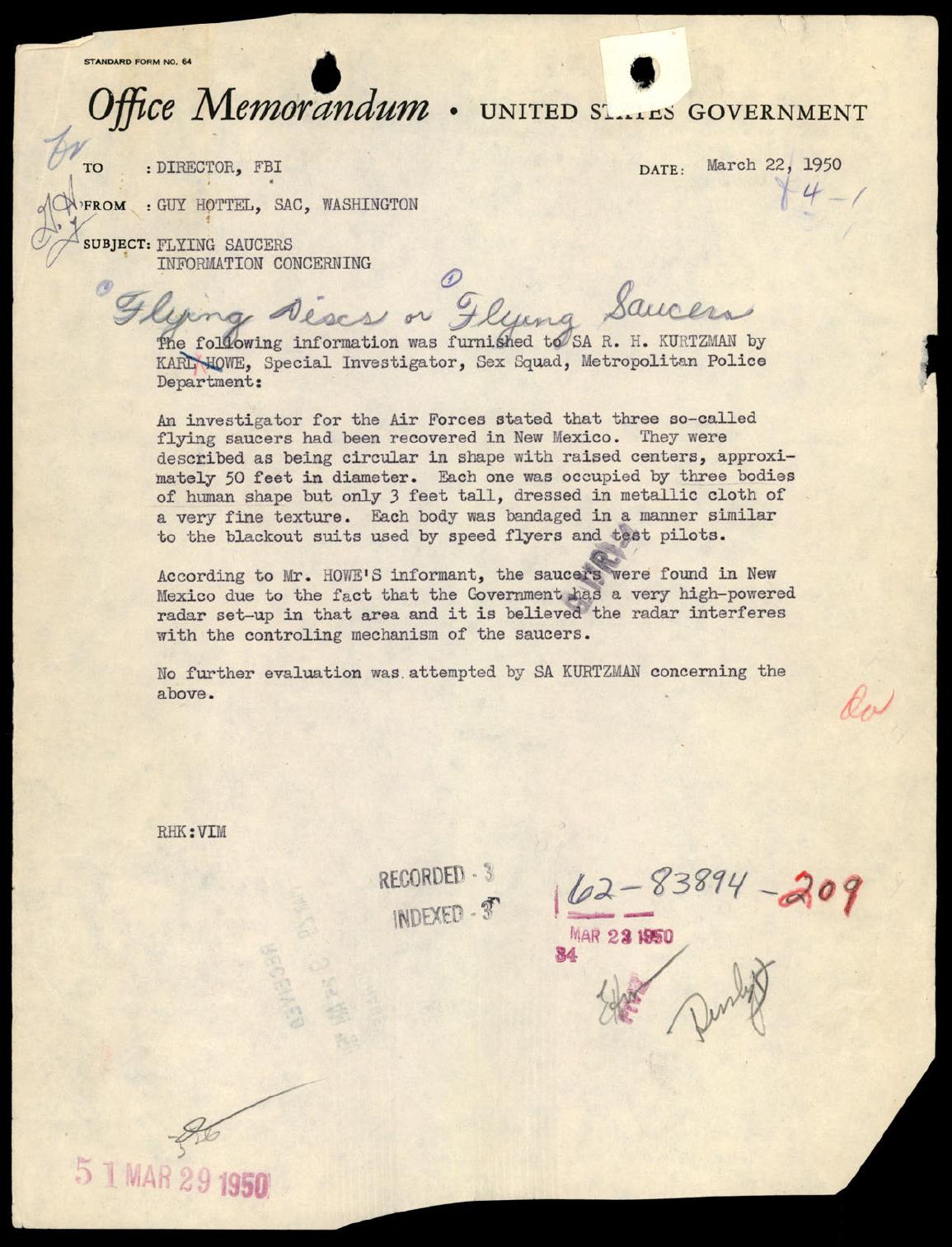
Page 68: derived render from the official PDF. The March 22, 1950 Guy Hottel memorandum records a second-hand statement relayed to the FBI about alleged recovered saucers in New Mexico. The memo itself says no further evaluation was attempted, so it is custody evidence for what was relayed to the Bureau, not verification of the described recovery.
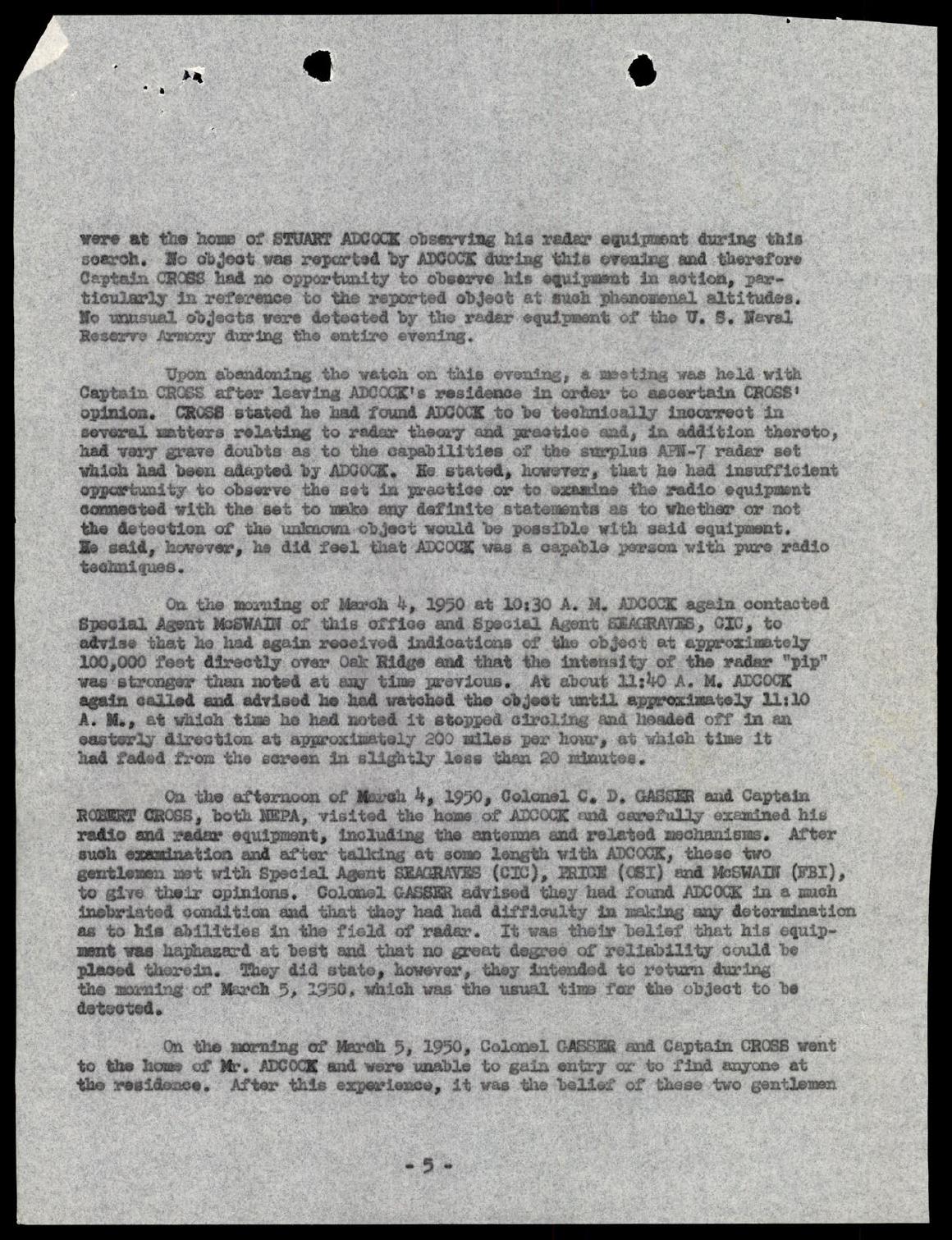
Page 94: derived render from the official PDF. This Oak Ridge/Adcock follow-up page says no unusual objects were detected by the Naval Reserve radar during that evening's watch and records Captain Cross's doubts about the surplus APR-7 radar set, while also noting he had limited opportunity to test the equipment.
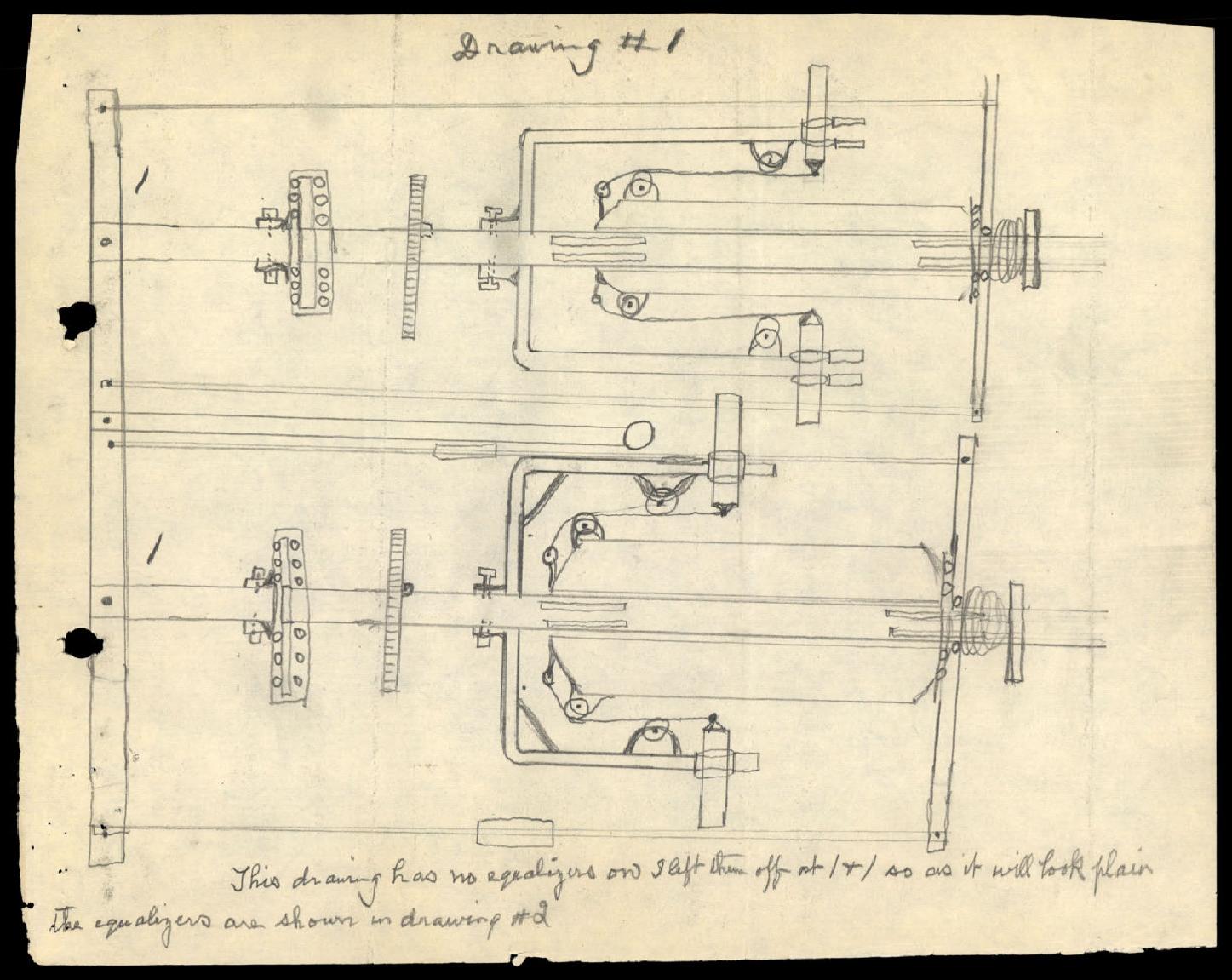
Page 140: derived render from the official PDF. The page is a hand-drawn mechanical diagram labeled Drawing #1, associated with the Ward/Ubalsky correspondence. It is a submitted concept/mechanism drawing, not a photograph of an observed object.
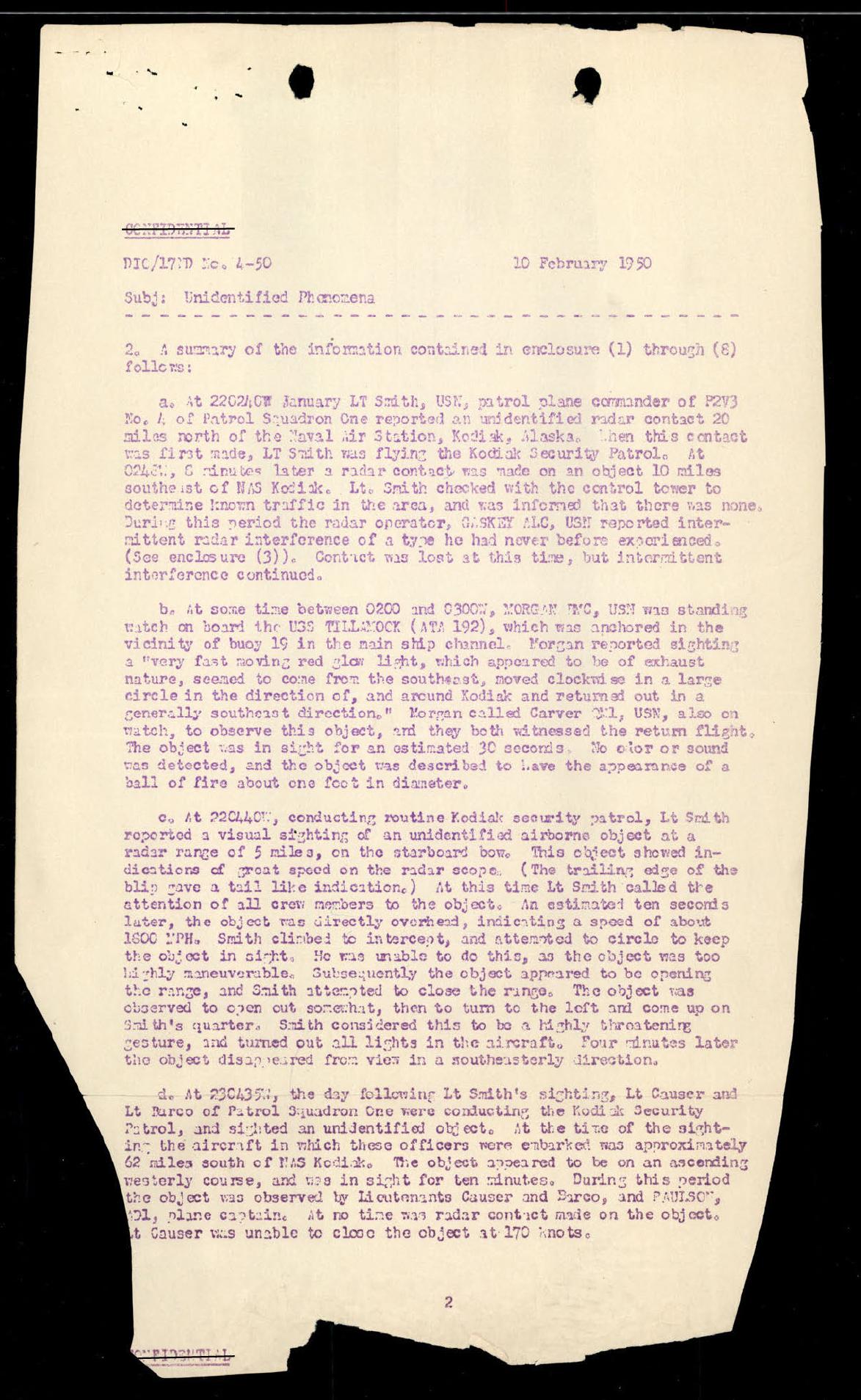
Page 147: derived render from the official PDF. The confidential February 10, 1950 Unidentified Phenomena page summarizes Kodiak-area radar/visual observations and radio-interference reports. It is report text, not sensor imagery.
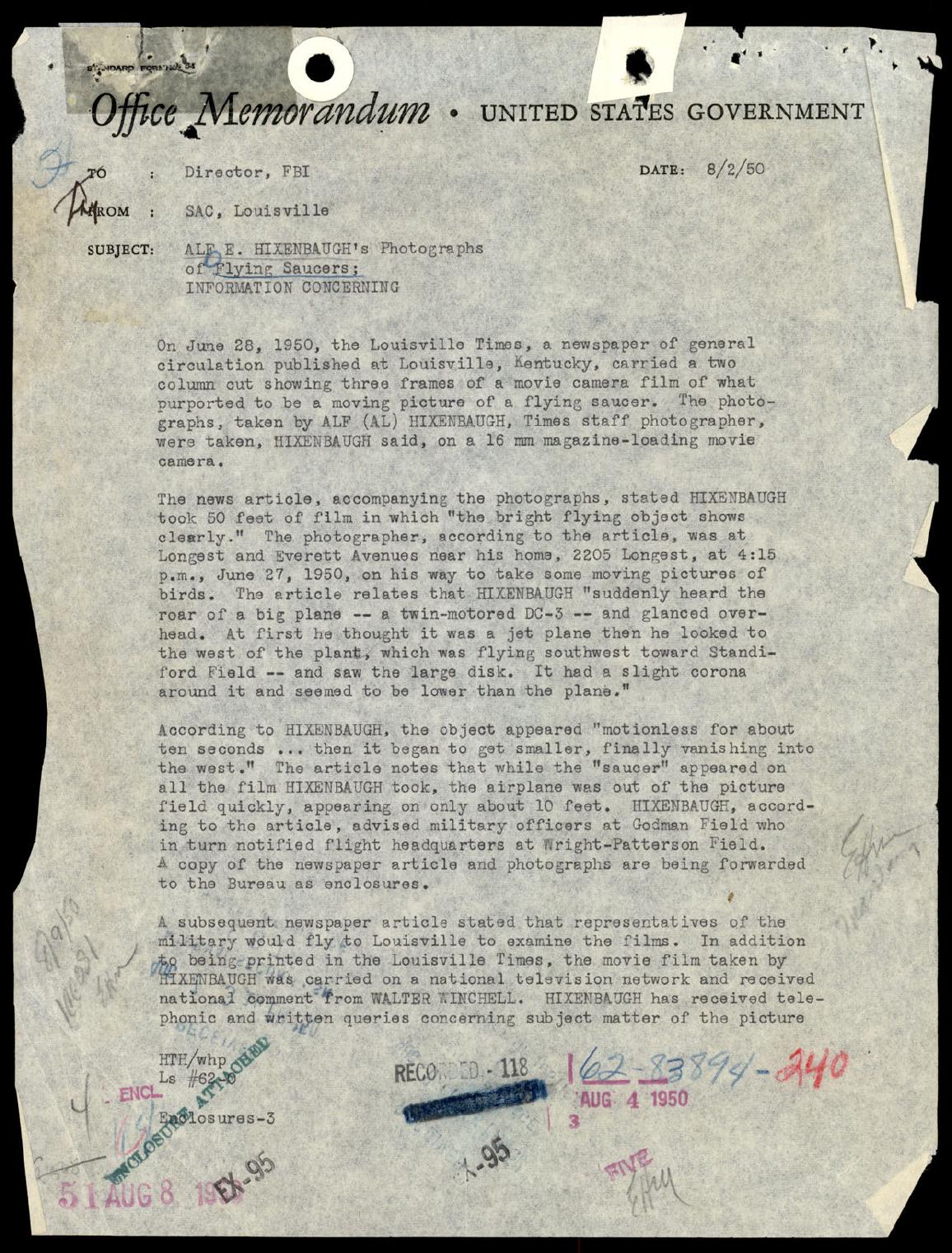
Page 187: derived render from the official PDF. The FBI Louisville memorandum summarizes the Louisville Times account of Alf/Al Hixenbaugh's reported 16 mm film frames and notes military notification. This page documents the memorandum trail; it is not the original film.
Investigation reading
This file should be read as a Headquarters FBI packet, not as one UFO case. The cover identifies Section 5 of file 62-HQ-83894, serial range 186-245. The released PDF is 209 pages, and the OCR pass contains 209 page markers with 206 pages carrying readable text. The pages mix FBI routing slips, memoranda, teletypes, incoming public letters, military/intelligence copies, newspaper clippings, technical sketches, and reverse-side scans.
The packet mainly covers late-1949 through mid-1950 flying-disc traffic. It preserves both substantive incident reports and routine file handling: Bureau referrals to Air Force/OSI/Army/ONI, acknowledgements to citizens, clippings filed for context, and correspondence about the FBI's limited jurisdiction after Air Force responsibility for flying-saucer matters.
High-signal page ranges from the full pass:
| Pages | Reading note |
|---|---|
| 1-2 | Cover/service pages for Section 5 and FOIPA handling marks. |
| 3-25 | Alexandria, Louisiana flying-saucer convention item; Ernest Cuneo/Walter Winchell/Peter Cameron Jones correspondence; Los Angeles checks that did not locate Jones. |
| 26-30 | Navy intelligence report on an Oregon airborne observation by a private Cessna pilot on 27 May 1949: several elongated oval objects, estimated speeds, altitude/geography notes, and a reporting-officer comment leaving the explanation unresolved in the source. |
| 31-38 | Camp Hood flying-disk file-management note, Caldwell/Manhattan Beach OSI referral, and a citizen proposal involving balloons or cardboard disks. |
| 39-43 | Glen Sprouse/Parkersburg, West Virginia account of a small bright yellow rocket-like object passing near his Luscombe aircraft; the FBI forwarded the unverified information to Air Force OSI. |
| 44-56 | Rudy Pick/Coulter/Venus story, public flying-saucer letters, Denver University lecture report, and Bureau no-further-action responses. |
| 57-96 | Oak Ridge/Knoxville radar-security thread involving Stuart Adcock's surplus radar set, Army/AEC/ORI/OSI/Navy checks, doubts about equipment/reliability, and procedural concern over responsibility for vital-facility air-security reports. This range also contains the Guy Hottel recovered-saucers memorandum and a D. M. Ladd summary of Air Force views. |
| 97-101 | U.S. News & World Report article about disk-like aircraft concepts; visually this is reproduced press material, not an original evidence photograph. |
| 102-118 | Miguel Angel Garcia Macias correspondence and drawings/clipping referral; Laura McCluskey Geneva, Illinois sighting letter; Elmira, New York “landing” report identified in the file as a corrugated cardboard box; Air Force notification paperwork. |
| 119-145 | William Albert Rhodes photograph-custody request, then Lewis Ward/Ubalsky letters with hand-drawn saucer-mechanism sketches. The rendered pages show real submitted drawings, but the drawings are only claimed/conceptual material. |
| 146-148 | Confidential intelligence report on unidentified phenomena around Kodiak/Alaska-region patrols and radar/visual observations, with a weather-balloon check and an unresolved “possibly electrical” note in the source. |
| 149-155 | New Orleans/Halfey or Halferty “photographs” and a German-language clipping. The visible clipping appears sensational or satirical and should not be treated as a source photograph of an actual event. |
| 156-159 | A confidential briefing-style summary on unidentified aerial phenomena: Sweden/ghost rockets background, theories, and a prosaic assessment emphasizing balloons, aircraft, meteors, psychology, and press amplification. |
| 160-168 | UCLA journalism inquiry, Ward follow-up interview, New Mexico/Phoenix material, Washington Field Douglas Harrison sighting report, and OSI referral instruction. |
| 169-181 | Downers Grove/North Chicago reports, Phoenix radar/visual teletype, and Alice, Texas found-disc reports. The Alice item is explicitly described as a practical joke made from airplane-wing pieces. |
| 182-191 | Keyhoe book inquiry and Alf/Al Hixenbaugh Louisville Times movie-frame material, including a clipping with three low-resolution newspaper halftone sky frames. |
| 192-209 | Chicago/Petrone and “New Flying Saucer” letter, Ray Turner/Oak Park correspondence, and Walter D. Jones of Toronto reporting a luminous cloud-filtered object over a farm. |
What the file appears to contain
The packet is a cross-section of the FBI's 1949-1950 flying-disc file traffic. It does not present a single investigation with one outcome. Instead, it shows how the Bureau received reports, sent some items to military intelligence channels, logged clippings and citizen claims, and often replied that the Air Force or another military office was the appropriate agency.
Several items are unusually important for later researchers:
-
Oak Ridge / Stuart Adcock radar sequence, pages 57-96. A Knoxville radio-station operator reported radar returns over the Oak Ridge area, with altitudes variously recorded around 40,000 to 100,000 feet. The packet shows concern because Oak Ridge was a vital facility, but it also records serious checks: Naval Reserve equipment did not detect the object; qualified personnel questioned the surplus set and Adcock's radar theory; the reliability of the reading remained doubtful; and the later summary says the actual existence of an object at such altitude was considered improbable. The file is valuable because it preserves the coordination problem among FBI, AEC, Army, Air Force, Navy, CIO/ORI/OSI channels, and local radar resources. It does not include a radar plot image.
-
Guy Hottel memorandum, page 68. This is the well-known March 22, 1950 Washington Field memo saying a Metropolitan Police special investigator relayed an Air Forces investigator's statement about three recovered saucers in New Mexico and small bodies. The document itself states that no further evaluation was attempted by the receiving FBI agent. In this packet it sits among many forwarded, second-hand, press-driven, or unverified flying-saucer reports; it should be cited as a record of what was relayed to the FBI, not as verification that the described recovery occurred.
-
Air Force/FBI posture memo, page 75. D. M. Ladd's March 28, 1950 memo records Air Force Intelligence officers saying the Air Force had publicly discontinued its project in December 1949 after over three-fourths of incidents were attributed to misidentifications such as lighted weather balloons and other airborne objects. It also notes that area commanders would handle security-related reports and that the FBI had stopped its flying-saucer investigation in October 1947 so the Air Force could take over.
-
Oregon/Navy report, pages 26-30. A pilot report describes four or five elongated oval objects seen in eastern Oregon on 27 May 1949, with estimates of speed, distance, shape, and course. The OCR is noisy in this section, so the page images and any better source copy should be consulted before extracting exact coordinates or technical details.
-
Photograph and image-related material. The packet contains many references to photographs or clippings, but few original photographic evidentiary items. Visual checks found: a
U.S. News & World Reportarticle with aircraft/model imagery; a German clipping with sensational saucer/“Mr. X” imagery that appears staged or satirical; Ward/Ubalsky hand-drawn mechanism diagrams; and a Louisville Times clipping reproducing Hixenbaugh's alleged 16 mm sky-disk frames as newspaper halftones. These are not equivalent to original negatives, film, or instrument records. -
Explicit prosaic or hoax records. The Elmira “flying saucer” report is described as a corrugated cardboard box. The Alice, Texas found-disc item is described by Houston as a practical joke constructed from airplane-wing pieces and freshly painted. The Phoenix June 29, 1950 object is followed by a Kirtland special inquiry page identifying the object as a bright balloon with instruments attached, observed by Lt. John D. Pike near 47,000-50,000 feet.
Source custody and provenance
- Review status:
graph_investigation_draft - Investigation status:
needs_human_review - Finding status:
not_a_finding - Agency: FBI
- Official Release 01 CSV row:
5 - Source/container type: PDF
- Released file: Open reviewed release file
- Official/source URL: https://www.war.gov/medialink/ufo/release_1/65_hs1-834228961_62-hq-83894_section_5.pdf
- SHA-256 of the reviewed release-file copy:
8bac3aeb023a716259510a74b1264cc38f16b3a012e420e1551a163e4df57573 - Reviewed file size: 58,041,955 bytes
- PDF page count: 209
- OCR coverage: 209 page markers; 206 pages with readable text; 137 OCR chunks attached to the asset record
The official manifest describes this as part of the FBI 62-HQ-83894 case file, with investigative records, eyewitness testimony, public reports, high-profile incident accounts, photographic-evidence references, technical proposals, convention material, researcher accounts, and media coverage. It also says the FBI Vault version is more redacted and missing some pages. That comparison remains a lead to verify page-by-page rather than a conclusion made by this draft.
Graph context
Open Sky's graph currently models this Release 01 item as a document asset and a related release-record document. The asset node is keyed to the official media URL and the SHA-256 above; the release-record node is keyed to the WAR.GOV Release 01 manifest record.
Graph-neighbor counts at the time of this draft:
- Extracted source-text claims:
1216 - Entity mentions:
552 - Sensor-event records:
142 - Table rows:
0 - Text chunks attached around the document/OCR/manifest layer: about
140 - Candidate crosslinks:
20
The sensor-event records are useful as an index, but they should be read cautiously. Most radar events are textual references inside memoranda, teletypes, or clippings; this PDF does not show raw radar plots. The aircraft/platform records include ordinary aircraft context, not necessarily evidence sensors. The two IR references come from the German clipping's caption language, not from a verified infrared instrument record.
Candidate crosslinks are also leads only. Several are driven by broad anchors such as Kirtland, and they point toward FBI Vault and NARA records involving Kirtland AFB/New Mexico. Those links may help cluster related records, but they do not establish that Section 5 is the same incident as every Kirtland-labeled target.
Leads to check
- FBI Vault comparison. Compare this WAR.GOV Section 5 page-by-page against the FBI Vault UFO parts to verify exactly what is newly present, less redacted, or absent in the older public version.
- Split child investigations. Create child pages or case clusters for Oak Ridge/Adcock radar, the Hottel memorandum, the Oregon/Navy pilot report, Parkersburg/Sprouse rocket-like object, Phoenix June 1950 balloon/radar sequence, Alice found-disc hoax, Hixenbaugh film/clipping, Ward/Ubalsky drawings, Halfey/Halferty German clipping, and the Kodiak/Alaska unidentified-phenomena report.
- Photograph custody. For Rhodes, Barden, Halfey/Halferty, and Hixenbaugh, locate any original negatives, film, prints, military photo-handling notes, or lab analyses. Treat newspaper halftones and printed clippings as secondary visual reproductions until originals are found.
- Radar-source custody. For Oak Ridge and Phoenix, look for raw radar logs, operator notes, instrument diagrams, or follow-up Air Force/Army/AEC files. The packet contains text descriptions and administrative follow-up, not radar-scope imagery.
- OCR quality review. Recheck low-text or blank-looking pages, including 65, 150, 182-184, 197, 199, and 201, plus reverse-side pages with bleed-through. Some are likely separators or backs, but the rendered images should be confirmed before excluding content.
- Official media delta check. Preserve the reviewed hash above, and separately compare any current live WAR.GOV response to the archived release-file copy before claiming the official media has or has not changed.
Lead check notes
- Needs external source — FBI Vault comparison: The manifest's claim about the FBI Vault copy being more redacted or missing pages still needs a page-by-page comparison against the relevant FBI Vault PDFs. The current Release 01 copy and linked corpus do not by themselves establish the exact declassification delta.
- Partial — split child investigations: Exact-anchor checks in the current linked Release 01 corpus place Hottel, Sprouse/Parkersburg, Hixenbaugh, Ward/Ubalsky, Halfey, and the Elmira cardboard-box item in this Section 5 packet. Oak Ridge, Oregon, Phoenix/Kirtland, Rhodes, Alice-practical-joke, and Kodiak anchors also appear in related Release 01 files. These are clustering leads only; each child page still needs direct source-page alignment before it becomes a case narrative.
- Partial — photograph and film custody: The rendered pages confirm a submitted Ward/Ubalsky technical drawing and an FBI Louisville memorandum about Hixenbaugh's Louisville Times film frames. This Section 5 copy does not provide original Rhodes, Barden, Halfey/Halferty, or Hixenbaugh negatives, prints, or 16 mm film; those remain archival/media-custody leads.
- Partial — radar-source custody: The Oak Ridge pages preserve Adcock's reports, military/Navy follow-up, and doubts about the surplus APR-7 setup; page 147 preserves report text for Kodiak radar/visual observations; and the Phoenix sequence includes a source statement identifying one object as a bright balloon with instruments attached. No raw radar logs, scope photographs, instrument diagrams, or operator notebooks were found in this Section 5 review, so Air Force, Army, AEC, Navy, or station records remain needed for instrument-level analysis.
- Checked — OCR quality triage: Review of the low-text page anchors shows pages 65, 150, 182, and 197 carrying file-number or separator-style text; pages 183, 184, and 199 are blank in the OCR; and page 201 carries repeated file-number text. Keep these as low-content custody pages unless a higher-quality copy shows additional content.
- Partial — graph crosslinks: Candidate crosslinks for this file are dominated by the broad anchor
Kirtlandand point to FBI Vault/NARA Kirtland-labeled records still markedneeds_human_review/not_a_finding. They are useful for navigation and audit, not as evidence that the target records describe the same incident. - Needs external source — official media delta: The checked page preserves the SHA-256 above for the Open Sky release-file copy. Any claim that the current WAR.GOV media has changed, or has not changed, requires a fresh live official-media comparison.
Limits
This page does not resolve any embedded sighting. It is a human-readable investigation draft over a large file packet.
Important limits:
- The PDF is a mixed serial bundle, not one incident report.
- OCR is noisy, especially in technical pages, reverse-side scans, and handwritten material.
- Many claims are hearsay, citizen letters, clippings, or forwarded military/intelligence copies rather than direct FBI investigation results.
- Several pages refer to photographs, film, radar, or drawings without preserving original negatives, original film, or radar plots in this PDF.
- The Hottel memo is a record of a second-hand statement and explicitly says no further evaluation was attempted in that memo.
- Visual material in the checked renders includes reproduced press images, a sensational German clipping, and hand-drawn mechanical diagrams; none of those alone proves a physical craft or anomalous object.
- Redactions, illegible text, and page-order artifacts remain and should be handled as source-custody issues before deeper analytic claims are made.
Deep investigation — graph + web reconnaissance
Source reread and media check
- Re-verified the reviewed Open Sky release-file copy against the public custody fields already on this page: SHA-256
8bac3aeb023a716259510a74b1264cc38f16b3a012e420e1551a163e4df57573, 58,041,955 bytes, 209 PDF pages, 209 OCR page markers, and 206 pages with readable OCR text. - The OCR/source reread confirms this is a mixed FBI Headquarters Section 5 bundle (
62-HQ-83894, serials 186-245), not one case file with one conclusion. High-signal internal anchors remain Oak Ridge/Adcock radar traffic, the Guy Hottel memorandum, Oregon/Navy pilot-report pages, Ward/Ubalsky drawings, Kodiak/Alaska unidentified-phenomena reporting, Hixenbaugh film/copy material, and several explicit prosaic or hoax records. - Visual review of the derived renders tightened the media boundaries: page 68 is the Guy Hottel memorandum and visibly includes the line that no further evaluation was attempted; page 147 is typed Kodiak/Alaska report text describing radar/visual observations and radio interference, not a radar image; page 187 is an FBI Louisville memorandum about Hixenbaugh's reported 16 mm film/newspaper material, not the original film frames.
Read-only graph connections
- Open Sky currently has two matching
Documentrecords for this item: the Release 01 CSV record and the linked PDF asset. The PDF asset is connected directly to 139 OCRTextChunkrecords, 1,216 machine-extractedClaimnodes, 142SensorEventrecords, oneSource, one related release-record document, one derived/manifest document, and 10 audit-onlyCANDIDATE_CROSSLINKrelationships. - The extracted claims and sensor events remain
machine_extracted_needs_human_review/unreviewed_machine_extract; they are useful indexes into the source text, not findings. Examples checked against the OCR include Oak Ridge radar-return statements, the explicit source-text warning that the reported 100,000-foot Oak Ridge object was not verified, and the Hixenbaugh/Alice/Kodiak anchors. - The candidate crosslinks are driven mostly by broad
Kirtlandanchors. The linked targets include NARA Catalog records titledKIRTLAND AFB, N.M., August 1952,Kirtland AFB, N. Mexico, August 1952, andKirtland AFB, N. M., April 1959, plus FBI Vault page-level targets in UFO Parts 06, 07, and 08. The graph relationship semantics explicitly mark these as audit-only candidate links, not identity, causality, provenance equivalence, or case resolution.
External provenance and official-context checks
- The live FBI Vault UFO collection page responded and lists
UFO Part 01throughUFO Part 16; the checked official download endpoints for Parts 06, 07, and 08 responded as PDFs (%PDF-1.4) with byte-range support. That matters because the graph's FBI Vault candidates point into those parts, but the next step is still a page-by-page comparison against this WAR.GOV Section 5 copy before saying what is newly released, less redacted, or missing. - The NARA Catalog routes for the Kirtland candidate records responded as live catalog pages. They are relevant as official archival context for Kirtland/New Mexico anchor text, not as proof that this Section 5 packet and the NARA records describe the same event.
- Direct WAR.GOV PDF/CSV probing from this cron environment returned
403 Forbidden, so this pass did not claim a fresh official-media delta. The audited source for public work remains the verified Open Sky release-file copy linked above, with the exact hash preserved.
Prosaic checks before escalation
- Oak Ridge/Adcock is not just a radar-hit claim: the same packet records no matching flight plan from Smyrna Air Base, no unusual objects detected by the Naval Reserve Armory radar during the checked watch, qualified doubts about Adcock's surplus APR-7 setup, and an explicit non-verification statement for the reported 100,000-foot object.
- The broader source packet itself includes prosaic framing: the Air Force posture memo says more than three-fourths of reports had been attributed to misidentifications such as lighted weather balloons and other airborne objects; the briefing pages emphasize balloons, aircraft, meteors, psychology, press amplification, and international-security anxiety as common drivers.
- Several embedded items already have source-level non-anomalous handling: the Alice, Texas object is described as a practical joke made from airplane-wing pieces; the Phoenix/Kirtland sequence includes a bright-balloon-with-instruments explanation; and the Hixenbaugh material includes a staff-photographer skepticism/trick-photography lead. These do not resolve Oregon, Kodiak, Oak Ridge, or other subreports, but they set the standard for prosaic checks before any escalation.
Follow-up leads and limits
- Priority archival follow-up is to align this 209-page WAR.GOV Section 5 PDF against FBI Vault UFO Parts 06-08 page by page, then record exact deltas in redaction, page presence, page order, and image/film enclosures rather than relying on the manifest summary.
- The strongest child-investigation candidates remain Oak Ridge/Adcock, Oregon/Navy 27 May 1949, Kodiak/Alaska January 1950, Hixenbaugh film custody, the Hottel memo provenance chain, and Kirtland/New Mexico crosslink triage. Each needs its own source-page alignment and external official-file checks before becoming a case narrative.
- This section made no Neo4j writes and does not promote any
Finding,Hypothesis, orResolutionDecision. It upgrades source custody, graph-context interpretation, and external provenance leads only.
Sources
- WAR.GOV Release 01 official PDF URL: 65_hs1-834228961_62-hq-83894_section_5.pdf
- Open Sky release-file route for the reviewed copy: /api/explore/war-gov/release-file/war-gov-65-hs1-834228961-62-hq-83894-section-5-b246c782
- Reviewed copy SHA-256:
8bac3aeb023a716259510a74b1264cc38f16b3a012e420e1551a163e4df57573 - WAR.GOV Release 01 manifest record:
65_HS1-834228961_62-HQ-83894_Section_5, CSV row5, FBI, PDF. - Page anchors used in this reading: pages 26-30, 41-43, 57-96, 100, 140, 146-148, 153-159, 165, 170, 174, 178-180, 187-191, 202, and 208 of the released PDF.