65_HS1-834228961_62-HQ-83894_Section_7
Evidence media
- Official PDF: Open the Release 01 file. The verified PDF is 205 pages and matches SHA-256
d1cc1285f2af2229df0f6a50dae11e72b943d94e95fb7effb34ba3433c12d82e. - Selected page renders from the official PDF:
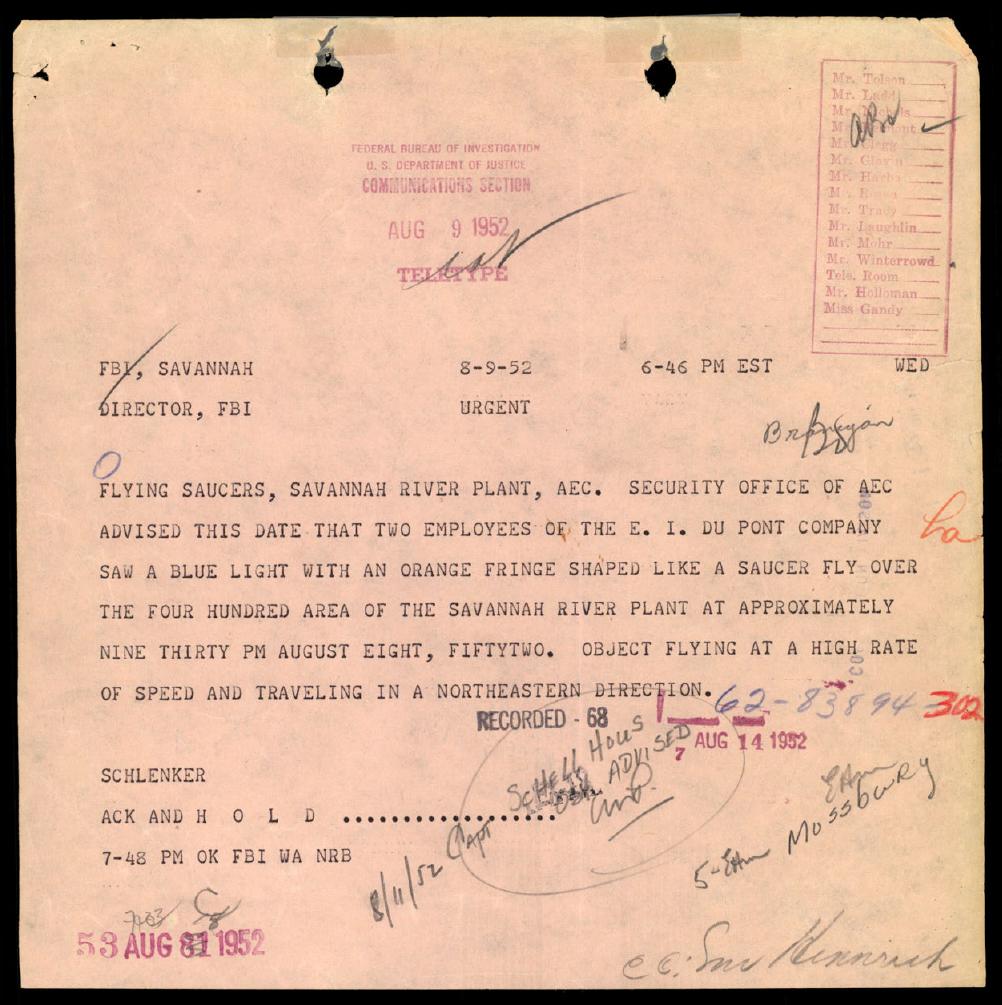
Page 3 is the Savannah FBI teletype reporting that the AEC security office said two E. I. Du Pont employees saw a blue light with an orange fringe over the Savannah River Plant. This is a teletype summary, not a witness statement or instrument record.
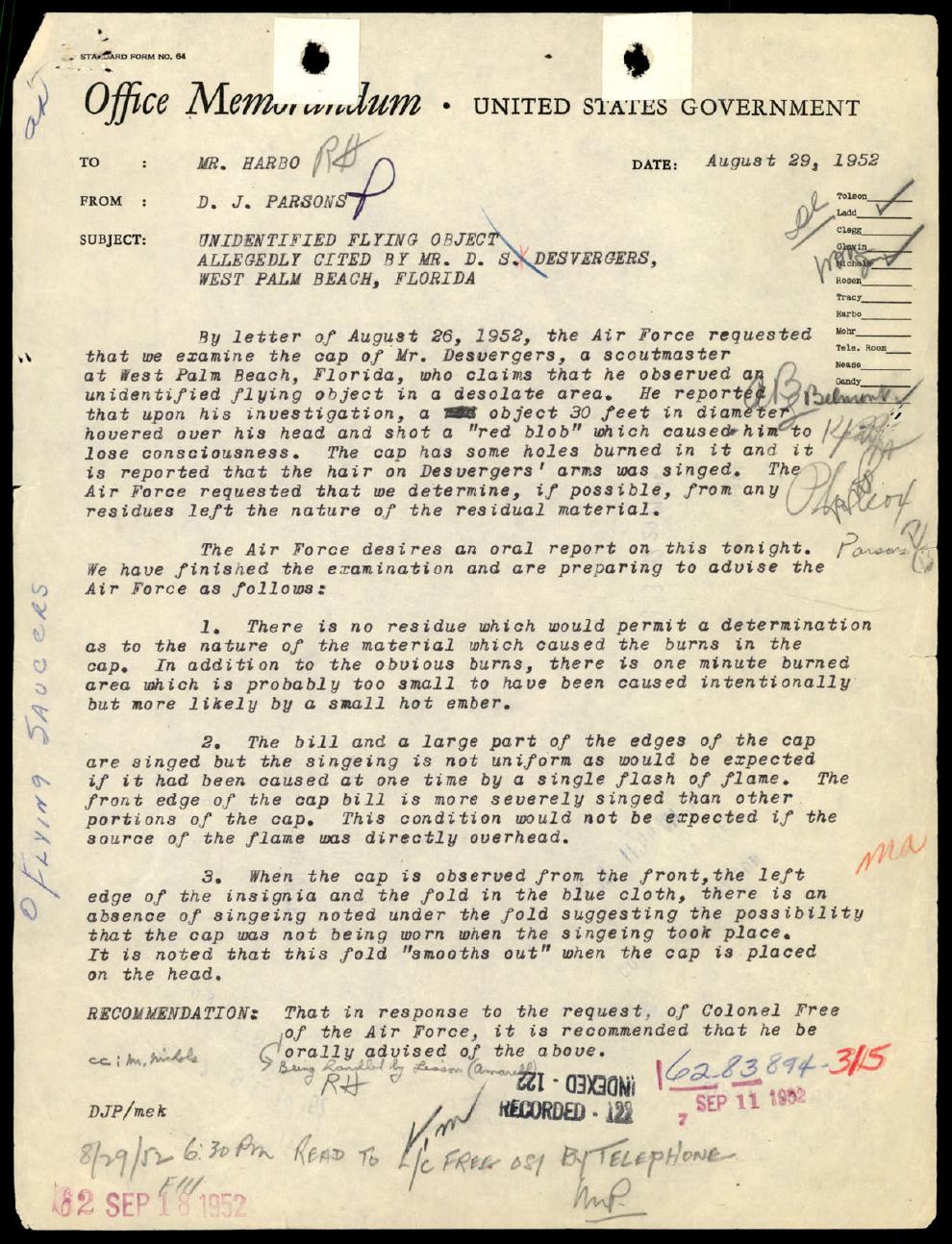
Page 44 is the FBI memorandum on the Desvergers/West Palm Beach cap examination. The visible memo records laboratory observations about singeing and residue limits; it does not show the cap or a photograph of the alleged object.
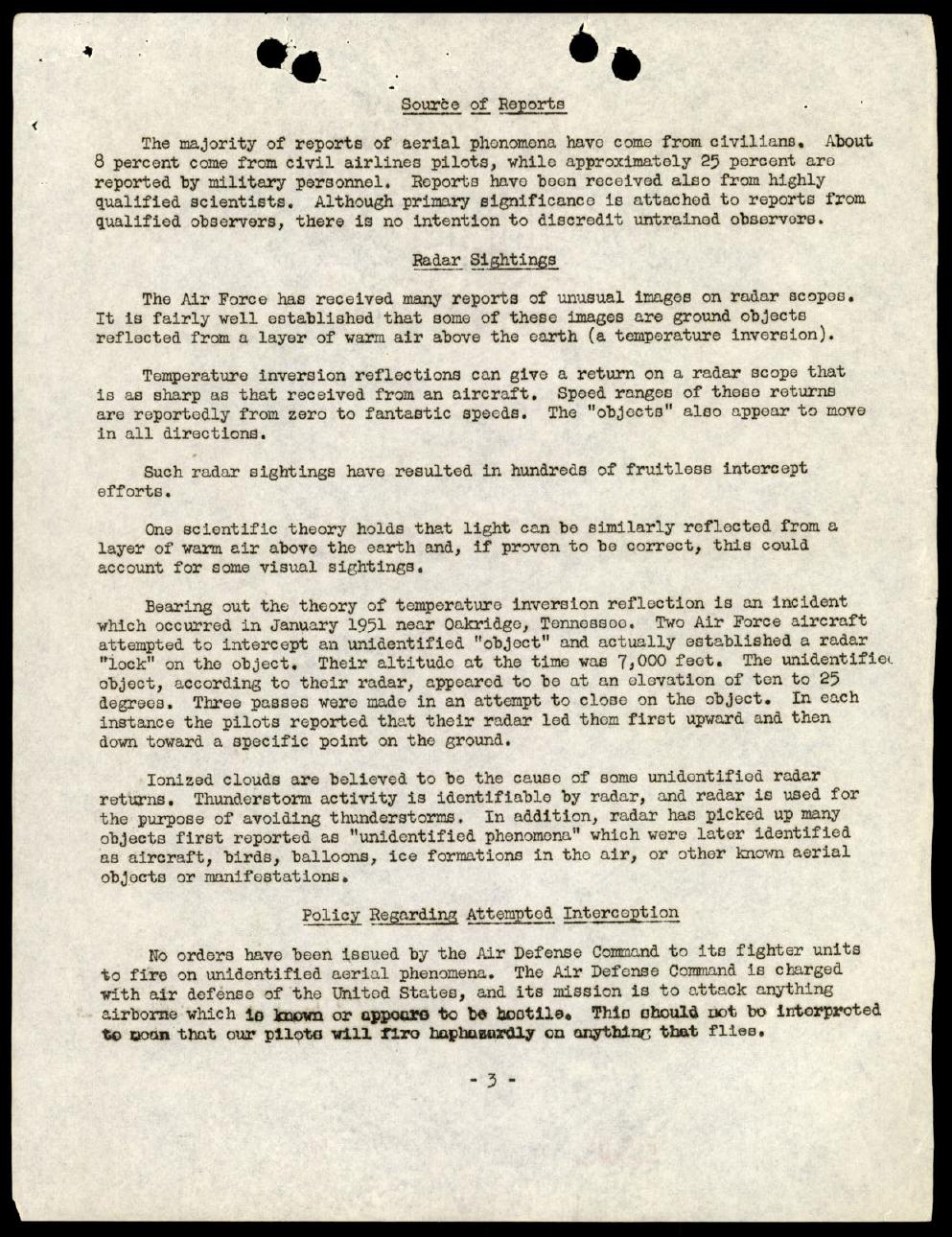
Page 73 is an Air Force public-information page discussing report sources, radar-scope images, temperature inversions, intercept policy, and prosaic radar-return explanations. It is evaluation/context prose, not a raw radar plot.
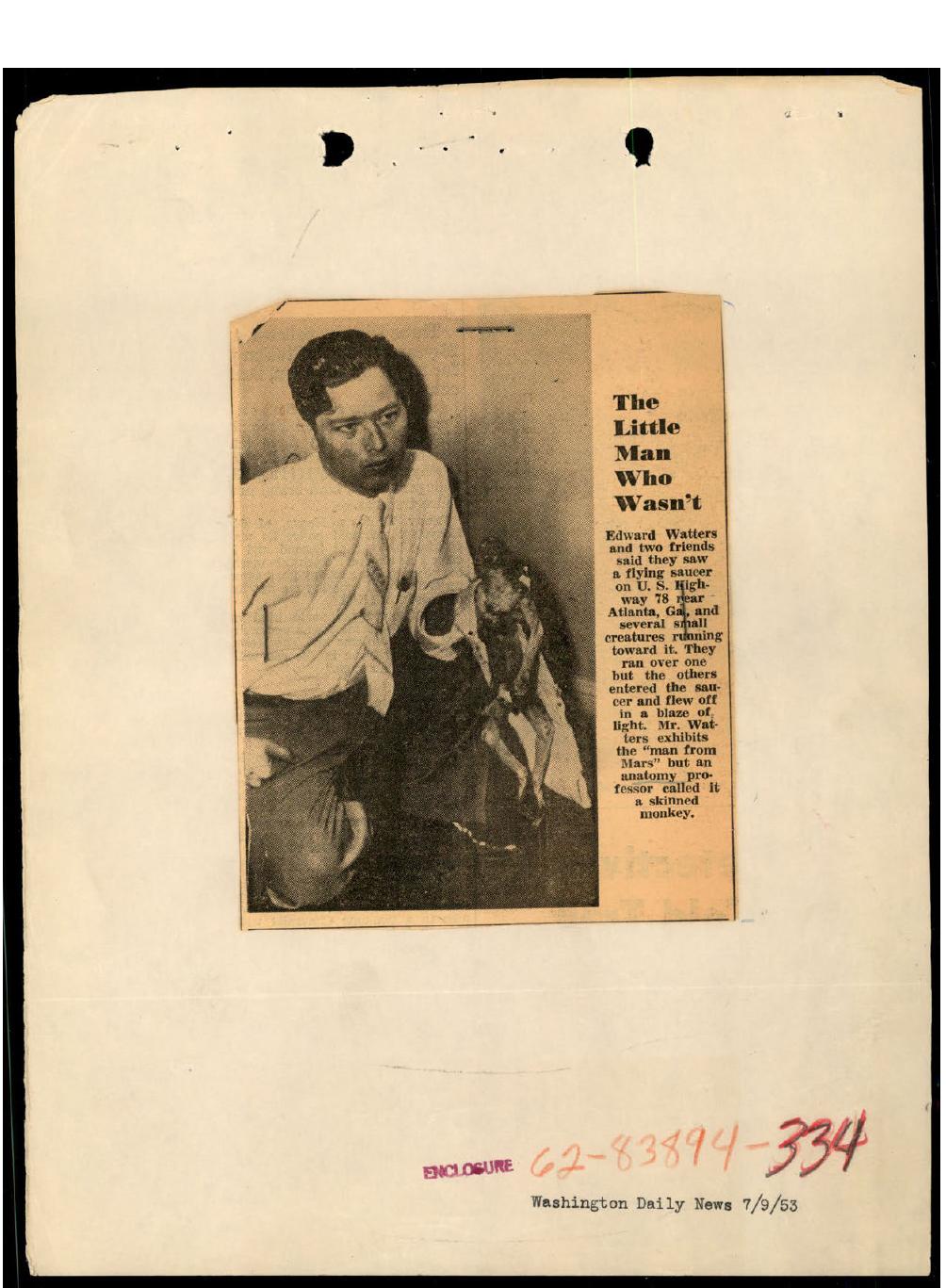
Page 159 is a newspaper-clipping enclosure titled “The Little Man Who Wasn't,” with a grainy halftone image of a man displaying an indistinct small figure or object. The page documents the press clipping inside the FBI packet; it is not a clear standalone creature photograph or physical-exhibit record.
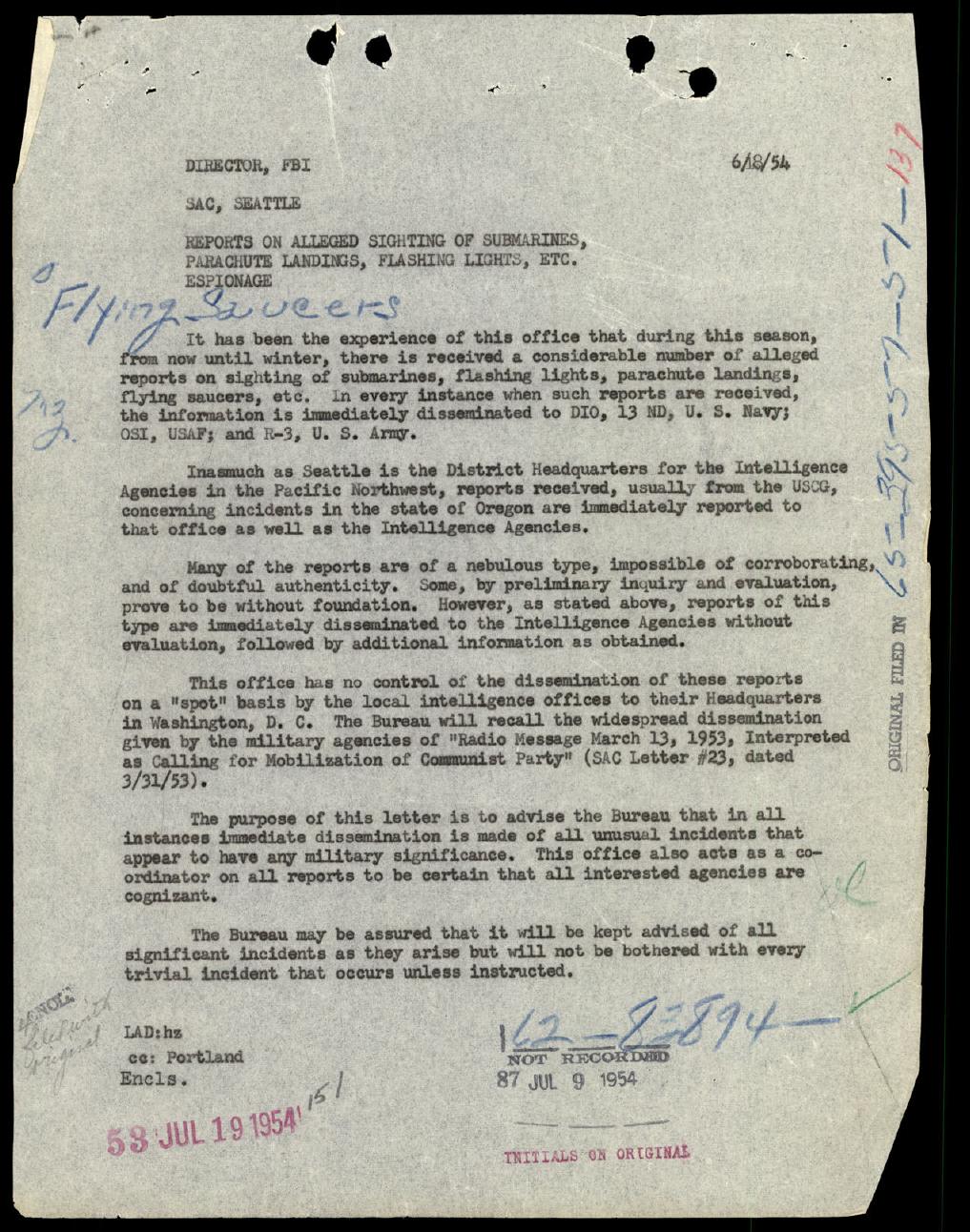
Page 199 is a Seattle SAC memorandum about seasonal reporting of submarines, parachute landings, flashing lights, flying saucers, and similar incidents. It describes routing/dissemination practice for unusual reports rather than resolving any specific sighting.
Investigation reading
This file is best read as an FBI Headquarters section packet, not as a single UFO case. The cover sheet places it in file 62-HQ-83894, Section 7, serials 302-343. Across 205 PDF pages, the packet mixes FBI routing pages, public correspondence, Air Force/OSI referrals, press and magazine material, foreign-language letters, and a few high-signal incident threads from 1952-1954.
The full released source was checked as a 205-page PDF with complete OCR coverage across 205 pages. Representative rendered-page checks were made for the Savannah River teletype, the Desvergers cap-burn memorandum, the Air Force radar/evaluation pages, the Smithsonian negative letter, the Navy motion-picture-film memorandum, the Space Review article page, the Atlanta/Mableton creature clipping, the Pivec/Dornig letter thread, the Truman Bethurum lecture thread, and the Seattle seasonal-reporting memo. Those checks show that the highest-signal pages are mostly text records: memos, teletypes, letters, clippings, and newsletter pages. They do not, in the checked pages, show the underlying photos, film frames, radar plots, cap exhibit, or physical-object exhibits described by the text.
The practical reading is therefore packet-level custody and triage. The page identifies the main serial clusters and what each cluster can support, while leaving incident-level resolution to later child pages and source corroboration.
What the file appears to contain
Packet map
| Pages | Main content seen in the source |
|---|---|
| 1-2 | Headquarters cover and serial/index material for Section 7. |
| 3-4 | Savannah River Plant/AEC teletype from August 1952: two E. I. du Pont employees reportedly saw a blue light with an orange fringe, saucer-shaped, over the Four Hundred Area, moving northeast at high speed. |
| 5-17 | Public letters and FBI replies/referrals to the Air Force, including correspondence from Edmond J. Kane, Ora E. Tygrett, and W. H. Jennings; several reverse/bleed-through administrative pages. |
| 18-24 | Anonymous German-language material and translation describing a supposed 1944 German/V-weapon-style flying saucer; Borderland Sciences / Meade Layne / Max Freedom Long correspondence appears nearby. |
| 25-38 | Public letters and speculative material, including a tinsel/sample inquiry, a spotlight-aircraft theory, and disease/“disc” theories; mostly correspondence rather than investigative evidence. |
| 39-43 | FBI internal guidance and SAC-letter material emphasizing that field offices should route flying-disc details to Air Force OSI. |
| 44-45 | D. S. Desvergers / West Palm Beach memorandum. The text describes the alleged object, “ring of fire”/red blob, burned cap, and FBI laboratory observations; the rendered page does not show the cap itself. |
| 46-60 | Ray Elwell correspondence presenting a long gravity/magnet theory of saucers; no independent physical evidence is visible in the packet pages reviewed. |
| 61-64 | Montana “strange white object” memo and Newark/USAF OSI request concerning John L. Riley and George Stock after an allegedly photographed object near Paterson/Passaic, New Jersey. |
| 65-68 | Fred J. Eekhout / The Hague correspondence and FBI reply noting Air Force referral. |
| 69-84 | Air Force and public-information material, including a New Yorker “Something in the Sky” article excerpt. These pages include Air Force discussion of report sources, radar returns, temperature inversion, interceptions, photography equipment, and common explanations. They are text pages, not raw radar plots. |
| 85-87 | Invoice/forwarding pages to the Air Force concerning possible unidentified-object investigation material. |
| 88-99 | Marvel/Manuel W. Reece Smithsonian negative/picture correspondence. The checked page is a letter describing a spot on a negative/picture; the actual negative or picture is not shown there. |
| 100-102 | A public letter proposing decoys, guided missiles, and radar/radio tactics against saucers. |
| 103-104 | Intelligence Advisory Committee / CIA memoranda about proposed study of the “flying saucers” phenomenon, a German scientist’s theory, and reports of an African explosion later framed in relation to meteor/explosion uncertainty. |
| 105-125 | Robert D. Wolf correspondence and the International Flying Saucer Bureau / Space Review issue. These pages preserve early civilian-saucer-community claims, representative directories, sighting reports, publicity, and article text. |
| 126-130 | Legal Attache London note about an old 1947 small-newspaper flying-saucer story, plus a difficult/low-legibility foreign or propaganda-related page. |
| 131-134 | John Bailey / Bowie, Maryland telephone report; the material stresses vague details and Air Force referral rather than FBI investigation. |
| 135-141 | Francisco Troncoso Silva / Valparaiso, Chile Spanish-language letter thread and FBI response. |
| 142-148 | Fort Buchanan, Puerto Rico report: five witnesses observed a bright star/ball-of-fire-like object at 11:30 AM on April 8, 1953, with RB-36 aircraft also in the area; plus Watertown, Massachusetts correspondence from Mrs. Robert H. Davisson. |
| 149-166 | W. S. Woodfill / Circleville, Ohio rumor chain. The incoming letter repeats a story about alleged FBI visits, captured saucers, and a Martian in California; FBI follow-up states the subject was outside FBI jurisdiction and that the visitor to farmer Bruce Stevenson was Jack W. Grant, a private saucer hobbyist/television-antenna salesman, not an FBI representative. |
| 154-163 | Atlanta/Mableton “little men” or creature thread appears in duplicated teletype, forwarding pages, and a clipping enclosure. The source text says reporter Tom McRae relayed Edward Waters/Voters’ account of three small animals near a supposed saucer; a veterinarian and later an Emory anatomy professor are described as treating the body as animal/monkey-family material. The page-159 clipping includes a grainy newspaper halftone of a man displaying an indistinct small figure or object, but not a clear standalone creature photograph or physical-exhibit record. |
| 169-181 | Alois and Olga Pivec / Adolph Dornig material. Newark sends German photostats and translations about claimed new aerodynamics, a sewing-machine invention, Communist interest in Austria, and a claimed practical flying saucer. The rendered memo pages show letter-thread summaries, not technical drawings or working evidence. |
| 187-191 | Linda Butler / Milton, Kentucky school inquiry and FBI reply referring flying-saucer opinions to the Air Force. |
| 192-198 | Truman Bethurum / George Hunt Williamson / Henry Maday Cincinnati public-lecture thread. The pages treat the matter as publicity, possible fraud concern, and jurisdictional referral to the Air Force/OSI rather than a physical-evidence investigation. |
| 199-200 | Seattle SAC memo explaining seasonal reports of submarines, parachute landings, flashing lights, and flying saucers; the memo says reports were disseminated to Navy, OSI/USAF, and Army intelligence and that many reports were nebulous or impossible to corroborate. |
| 202-205 | Joseph Gunderson inquiry about Leslie/Adamski's Flying Saucers Have Landed and FBI reply that the book did not concern an FBI-jurisdiction matter. |
High-signal anchors
- Savannah River Plant / AEC, page 3. This is one of the clearest incident snippets in the packet. It gives a time, site, two company employees, color, shape, direction, and speed description. It is still only a teletype summary in this file; the employee statements, AEC security notes, or any plant-security logs are not shown on the checked page.
- Desvergers cap-burn memo, page 44. The memorandum is valuable because it separates the reported claim from laboratory observations. The source text says the Air Force asked for examination of a cap associated with the West Palm Beach account; the visible findings say residue was insufficient to identify the material, singeing was not uniform, and the pattern raised the possibility that the cap may not have been worn when singed. No cap photo is visible on the checked page.
- Air Force radar/evaluation pages, pages 71-74. These are not raw radar records. They are Air Force public-information/evaluation text discussing source types, radar images, temperature inversions, ionized clouds, aircraft, birds, balloons, ice formations, meteors, missiles, and better photographic equipment such as diffraction-grating cameras and wide-sky Schmidt telescope concepts.
- Photograph/film references. The file repeatedly mentions images or film, including Riley/Stock, a Smithsonian negative/picture, a Navy photographer's motion-picture film, and
Space Reviewphoto claims. In the rendered pages checked, these are references to photos or film, not the actual images or frames. - Atlanta/Mableton creature thread, pages 154-163. The source preserves an important early “little men” rumor chain with press handling, FBI teletype, Air Force referral, veterinarian comments, and a news clipping. The page should be split into a child incident page before making cross-case claims.
- Pivec/Dornig and Bethurum/Williamson threads, pages 169-198. These are useful for mapping 1950s saucer contactee/invention/publicity networks, but the packet does not turn their claims into technical proof.
Source custody and provenance
- Official/source URL: https://www.war.gov/medialink/ufo/release_1/65_hs1-834228961_62-hq-83894_section_7.pdf
- Open released file: war-gov-65-hs1-834228961-62-hq-83894-section-7-f85532f0
- Release row: WAR.GOV/PURSUE Release 01 CSV row
7. - Agency: FBI.
- Container: PDF, 205 pages, 62,687,106 bytes.
- SHA-256:
d1cc1285f2af2229df0f6a50dae11e72b943d94e95fb7effb34ba3433c12d82e. - OCR coverage: Frontier OCR complete; 205 OCR pages, 205 pages with text, about 275,891 OCR characters, 156 OCR chunks.
- Review status:
graph_investigation_draft; investigation statusneeds_human_review; finding statusnot_a_finding.
The release manifest describes this file as part of the FBI 62-HQ-83894 case file, with investigative records, eyewitness testimony, public reports, photographic-evidence references, technical proposals, convention/researcher material, and media coverage. It also states that the file is partially posted on FBI Vault with more redactions and some missing pages, while this release is presented as the more complete version with minor redactions.
Graph context
The evidence graph currently represents this item as two exact document records: the WAR.GOV release-row record and the PDF asset record with the canonical PDF URL and hash above. The semantic layer attached to this source includes:
958extracted claim records.457entity mentions.38sensor-event records.159text chunks connected to the source record.0semantic table rows.0candidate crosslinks attached to this source in the current extraction output.
The extracted claim mix is broad because the packet itself is broad: observation and witness-testimony claims, object descriptors, motion statements, radar/sensor references, prosaic leads, document identifiers, agencies, dates, and redaction/missing-data notes. The graph's sensor and platform hits should be treated cautiously. Many are references inside Air Force public-information pages, magazine articles, or correspondence, not instrument records attached to one incident.
Graph counts are therefore useful for navigation and triage, not for resolution. The next graph work should split high-value serial clusters into child pages or linked incident/source nodes before any cross-case analysis.
Leads to check
- Savannah River/AEC/Du Pont: locate the underlying AEC security-office report, employee identities if unredacted elsewhere, plant-security logs, local weather/astronomy, aircraft/balloon traffic, and any Savannah FBI follow-up.
- Desvergers cap evidence: locate the Air Force request, any FBI Laboratory worksheet, the cap photographs or physical-exhibit record, and compare the memo's burn-pattern observations against the public Desvergers/Scoutmaster case files.
- Riley/Stock photograph: locate the image/negative or ATIC/Wright-Patterson file; separate the actual photo analysis from the Newark background checks on John L. Riley and George Stock.
- Navy photographer film: identify the referenced motion-picture film and ATIC analysis package, then verify whether the memo corresponds to a known film case before linking it to any named case.
- Air Force public-information pages: model pages 71-74 as evaluation-policy/source-context material; do not treat the radar examples as raw radar tracks unless underlying plots or reports are located.
- Fort Buchanan/Ramey, Puerto Rico: find witness statements from the three Army captains, sergeant, and civilian; check RB-36 flight logs and Ramey AFB intelligence records for April 8, 1953.
- Atlanta/Mableton creature story: split pages 154-163 into a child incident page; verify
Atlanta Constitutioncoverage, Edward Waters/Voters name variants, Emory anatomy-professor attribution, veterinary notes, and any photographs if they exist outside this packet. - Woodfill/Circleville rumor: preserve the rumor-chain structure. The FBI follow-up points to Jack W. Grant as a private saucer hobbyist, not an FBI agent; local Circleville newspaper coverage and Bruce Stevenson reporting should be checked before broader claims.
- Pivec/Dornig: inspect the German photostats/translations in full, and track the
62-101030refiled serial references before treating this as an engineering or intelligence lead. - Bethurum/Williamson: keep the Cincinnati material in a contactee/publicity/fraud-risk lane; check whether the planned Taft Auditorium event occurred and whether OSI received a dissemination memo.
- Seattle seasonal-reporting memo: compare the Seattle SAC summary with OSI/Air Force Pacific Northwest reporting and Wright-Patterson evaluation files.
- Release comparison: compare this WAR.GOV release against the corresponding FBI Vault pages to identify newly declassified pages, missing FBI Vault pages, and redaction differences.
Lead check notes
- Partial — Savannah River/AEC/Du Pont: Page 3 and the OCR confirm the teletype details: Savannah River Plant, AEC security office, two E. I. Du Pont employees, blue light with orange fringe, and northeast travel. Current Release 01 OCR finds a separate Savannah River anchor in
62-HQ-83894_SUB_A, but not the underlying AEC security report, employee statements, plant logs, weather, astronomy, or traffic records. - Partial — Desvergers cap evidence: Page 44 confirms the FBI memorandum's laboratory-language limits: no identifying residue, non-uniform singeing, and a cap-position concern. The current linked corpus adds only a West Palm Beach anchor outside this packet; the Air Force request, FBI Laboratory worksheet, cap photographs, and physical-exhibit chain remain missing.
- Partial — Riley/Stock photograph and Navy photographer film: The selected packet preserves references to George Stock/John L. Riley photo handling and a Navy photographer's motion-picture film sent through Air Technical Intelligence channels. The current linked corpus has a few related ATIC or name anchors, but no actual negative, photograph, film frame, or ATIC analysis package was found in the checked pages.
- Checked — Air Force public-information pages: Pages 71-74 are policy/evaluation context. Page 73 discusses radar-scope images, temperature inversions, ionized clouds, aircraft, birds, balloons, ice formations, and intercept policy; it should not be modeled as a raw radar-track record unless the underlying plots or incident files are located.
- Partial — Fort Buchanan/Ramey, Puerto Rico: The selected OCR confirms the Fort Buchanan/Ramey thread and notes RB-36 aircraft in the area. Wider Release 01 OCR has only loose Ramey/Puerto Rico anchors, not the witness statements, RB-36 logs, or Ramey intelligence records needed to check the April 8, 1953 report.
- Partial — Atlanta/Mableton and Woodfill/Circleville: Pages 154-163 preserve the Atlanta/Mableton press and referral chain, and page 159 shows a clipping enclosure with an indistinct newspaper image, not a clear physical-exhibit photograph. Pages 149-166 also preserve the Woodfill/Circleville rumor chain and the FBI follow-up pointing to Jack W. Grant as a private saucer hobbyist; local newspaper, veterinary/Emory, and Bruce Stevenson source records are still needed before either thread is promoted beyond packet context.
- Partial — Pivec/Dornig and Bethurum/Williamson: Exact Pivec/Dornig anchors are concentrated in this packet, while Bethurum/Williamson anchors also appear in the current Release 01 Section 8 OCR. The next source check is a translation/refile comparison for
62-101030and a page-level Section 7/Section 8 comparison before mapping contactee, invention, or publicity networks. - Needs external source — Seattle memo and release comparison: Page 199 confirms Seattle's routing practice for seasonal unusual reports, and wider Release 01 OCR has many Seattle/Pacific Northwest anchors. The corresponding OSI/Air Force/Wright-Patterson files and a page-by-page FBI Vault comparison are still outside the checked linked corpus.
Deep investigation — graph + web reconnaissance
Source reread and media check
The deep pass reopened the official Release 01 PDF, its OCR text, and selected rendered pages rather than relying on the graph alone. The clearest incident-level source facts remain narrow:
- Savannah River Plant/AEC, PDF p. 3: an FBI Savannah teletype dated August 9, 1952 says AEC security reported two E. I. Du Pont employees saw a blue light with an orange fringe, saucer-shaped, over the Four Hundred Area at about 9:30 PM on August 8, 1952, moving northeast at high speed. The rendered page is a teletype summary with routing marks; it is not a witness statement, security log, photograph, radar plot, or plant-instrument record.
- D. S. Desvergers/West Palm Beach, PDF p. 44: the FBI memorandum separates the reported claim from laboratory observations. It says the Air Force requested examination of Desvergers' cap; the visible findings say no residue permitted material identification, the singeing was non-uniform, the front edge of the bill was more severely singed than expected for a directly overhead flame source, and the fold/insignia pattern raised the possibility that the cap may not have been worn when singed. The checked render shows memorandum text only, not the cap itself.
- Air Force evaluation pages, PDF pp. 72-74: these pages are policy/context prose. They discuss report-source quality, radar-scope returns, temperature inversions, ionized clouds, aircraft, birds, balloons, ice formations, visual/radar tracking limits, and future instrument plans. They are not raw radar records for a specific event.
- Atlanta/Mableton “little men” thread, PDF pp. 154-163: the packet preserves duplicated FBI teletypes, referral pages, and a newspaper-clipping enclosure. The source chain says reporter Tom McRae relayed Edward Waters/Waiters/Voters' account; the same packet contains the prosaic lead that an Emory anatomy professor called the displayed body a monkey-family animal. The page-159 clipping image is too coarse to identify a creature/object independently.
Read-only graph connections
The Neo4j check was read-only. The exact WAR.GOV PDF asset node is linked to the Release 01 source, to the Release 01 row record, and to a secondary UFO-USA markdown-conversion record. Its graph properties preserve the same canonical PDF URL, SHA-256 d1cc1285f2af2229df0f6a50dae11e72b943d94e95fb7effb34ba3433c12d82e, 205 OCR pages, and frontier_ocr_complete status.
For the exact PDF asset, the current neighborhood contains 158 text-chunk nodes, 958 machine-extracted claim nodes, and 38 machine-extracted sensor-event nodes. The strongest phrase hits match the source reread: Savannah River, West Palm/Desvergers, radar/temperature-inversion context, Fort Buchanan/Ramey, Atlanta/Mableton, Woodfill/Circleville, Pivec/Dornig, Bethurum/Williamson, Seattle, and the Navy-photographer film reference. These graph records are useful navigation aids, but their review_status remains machine_extracted_needs_human_review and finding_status remains not_a_finding; they are not promoted here into findings or hypotheses.
External provenance and official-context checks
- FBI Vault: the official FBI Vault page for UFO Part 07 is live at https://vault.fbi.gov/UFO/UFO%20Part%2007/view, with a downloadable PDF at https://vault.fbi.gov/UFO/UFO%20Part%2007/at_download/file. Header/range probing showed that Vault file is much smaller than the WAR.GOV Release 01 PDF, so it should be used as a comparison target for missing pages/redactions, not assumed to be byte-identical.
- National Archives / Project BLUE BOOK: the National Archives Project BLUE BOOK page at https://www.archives.gov/research/military/air-force/ufos is the official institutional context for Air Force UFO-report holdings. It frames Project BLUE BOOK as the Air Force investigative channel from 1947-1969; this supports the packet's repeated FBI-to-Air-Force/OSI referral posture but does not verify any individual Section 7 incident.
- Savannah River Site context: the official SRS history page at https://www.srs.gov/general/about/history1.htm confirms the Savannah River Site was constructed in the early 1950s to produce nuclear-weapons materials, primarily tritium and plutonium-239. That makes the AEC/Savannah River teletype a sensitive-site report, but the checked external context still does not supply the underlying AEC security log, Du Pont employee statements, or local sky/traffic records.
Prosaic checks and source limits
- The Savannah River snippet has useful time/site/direction descriptors, but it lacks duration, angular size, elevation, exact observer positions, weather, astronomical conditions, aircraft/balloon traffic, and plant-security corroboration. Those are the required prosaic checks before escalation.
- The Desvergers cap memorandum itself contains cautionary physical-evidence constraints: no identifying residue, non-uniform singeing, and a cap-position concern. Any later Desvergers child page should preserve that as source text before discussing broader public versions of the Scoutmaster case.
- The Air Force radar pages should be modeled as explanatory/evaluation material. Temperature inversion, ionized-cloud, aircraft, bird, balloon, ice-formation, meteor, missile, weather, and instrument-error checks are explicitly part of the source's own evaluation framework.
- The Atlanta/Mableton thread contains its own likely-hoax/prosaic lane through the newspaper clipping and professor/veterinary descriptions. Until original newspaper pages, veterinarian notes, Emory attribution, and any physical exhibit photographs are found, the page supports a press/referral-chain entry, not biological evidence.
Follow-up leads
- Build child incident/source pages for the Savannah River Plant teletype, Desvergers cap memorandum, Atlanta/Mableton creature story, and Woodfill/Circleville rumor chain so the packet page does not carry all analytical load.
- Run a page-by-page comparison between the WAR.GOV Section 7 PDF and FBI Vault UFO Part 07 to identify the manifest-claimed redaction/page differences.
- Search official AEC/SRS, Air Force OSI, Project BLUE BOOK, and FBI laboratory holdings for the Savannah River security report, Desvergers cap request/workpaper, Riley/Stock photo, Navy photographer film, Fort Buchanan/Ramey records, and Atlanta referral correspondence.
- Keep Pivec/Dornig and Bethurum/Williamson in a contactee/invention/publicity-network lane until translated source pages and adjacent Section 8 overlap are normalized.
Audit note
No Neo4j writes were performed. No Finding, Hypothesis, or ResolutionDecision conclusion is created or implied. This section adds source-grounded reconnaissance, graph navigation context, official external provenance, and prosaic-check constraints for later human review.
Limits
- This packet is not one case. It is a Headquarters file section containing many serials, rumors, public letters, agency referrals, and media excerpts.
- Several pages are reverse-side scans, bleed-through pages, envelopes, or low-text administrative slips. The low-text pages noted during source review include pages 101, 111, 168, 185, 186, 201, and 205.
- OCR is strong enough for packet-level navigation, but some handwriting, foreign-language pages, mirrored text, and dark scans need separate transcription before quotation-level analysis.
- References to photographs, negatives, motion-picture film, radar locks, or technical devices are often textual references. The checked rendered pages do not display the underlying visual/technical exhibits.
- The packet contains repeated names with OCR variants, including Waters/Voters, Reece/Reese, Davisson/Davison, Bethrum/Bethurum, and Dornig/Dernig. Those variants should be normalized only after source comparison.
- No finding, explanation, or resolution is asserted here.
Sources
- WAR.GOV/PURSUE Release 01 PDF asset: 65_HS1-834228961_62-HQ-83894_Section_7.
- Local release-file route for the cached official PDF: war-gov-65-hs1-834228961-62-hq-83894-section-7-f85532f0.
- WAR.GOV/PURSUE Release 01 record page anchor: Release 01 row 7.
- Source identity for verification: FBI, Release 01 CSV row
7, PDF, 205 pages, SHA-256d1cc1285f2af2229df0f6a50dae11e72b943d94e95fb7effb34ba3433c12d82e.