65_HS1-834228961_62-HQ-83894_Serial_130
Investigation reading
This Release 01 PDF is best read as a mixed FBI/Army Air Forces serial packet, not as one UFO incident. The file carries multiple 1947 “flying disc” reports, witness interviews, transmittal memoranda, newspaper clippings, sketches, message forms, one analytical summary table, and several prosaic or cautionary explanation threads. This page is a graph_investigation_draft; it is needs_human_review and remains not_a_finding.
The full 126-page sequence was reviewed through the released OCR and representative rendered-page checks. The source is scan-heavy: most pages are typewritten records or clippings, but some pages are image plates or low-contrast scans that the stored OCR does not capture. Visual spot checks found that pages 71-72 are photographic/sky-image plates with no readable text, while pages 88, 90, 97, and 100 contain visible typed text despite empty stored OCR. Those pages should be treated as coverage gaps until the OCR is repaired.
The highest-level reading is that Serial 130 preserves a working 1947 collection packet: individual witness statements first, then internal evaluation and analytical tabulation, then additional reports and forwarded messages. Some pages use strong historical language, including the page-36 statement that “something is really flying around,” but this wiki page does not adopt that as an Open Sky finding. It records that the statement exists in the source packet and points to the checks still needed.
Evidence media
- Official PDF: Open Sky release-file copy for the 126-page FBI Serial 130 packet.
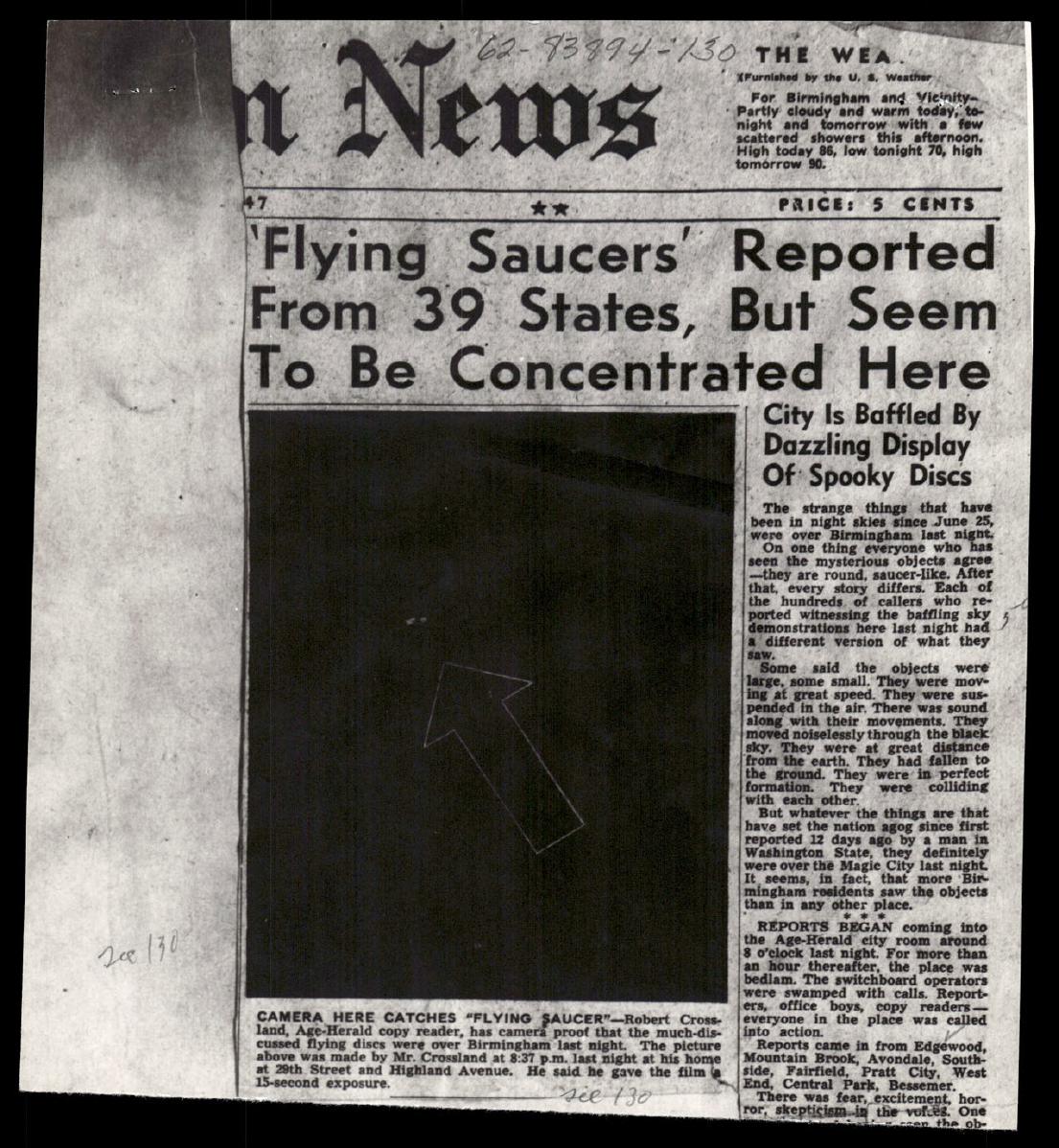 Page 9: Birmingham newspaper clipping with the reproduced Robert Crossland “camera proof” image and an arrow pointing to a small bright mark. This is a newspaper halftone/reproduction preserved in the FBI packet, not a clean primary negative or an object-identification proof.
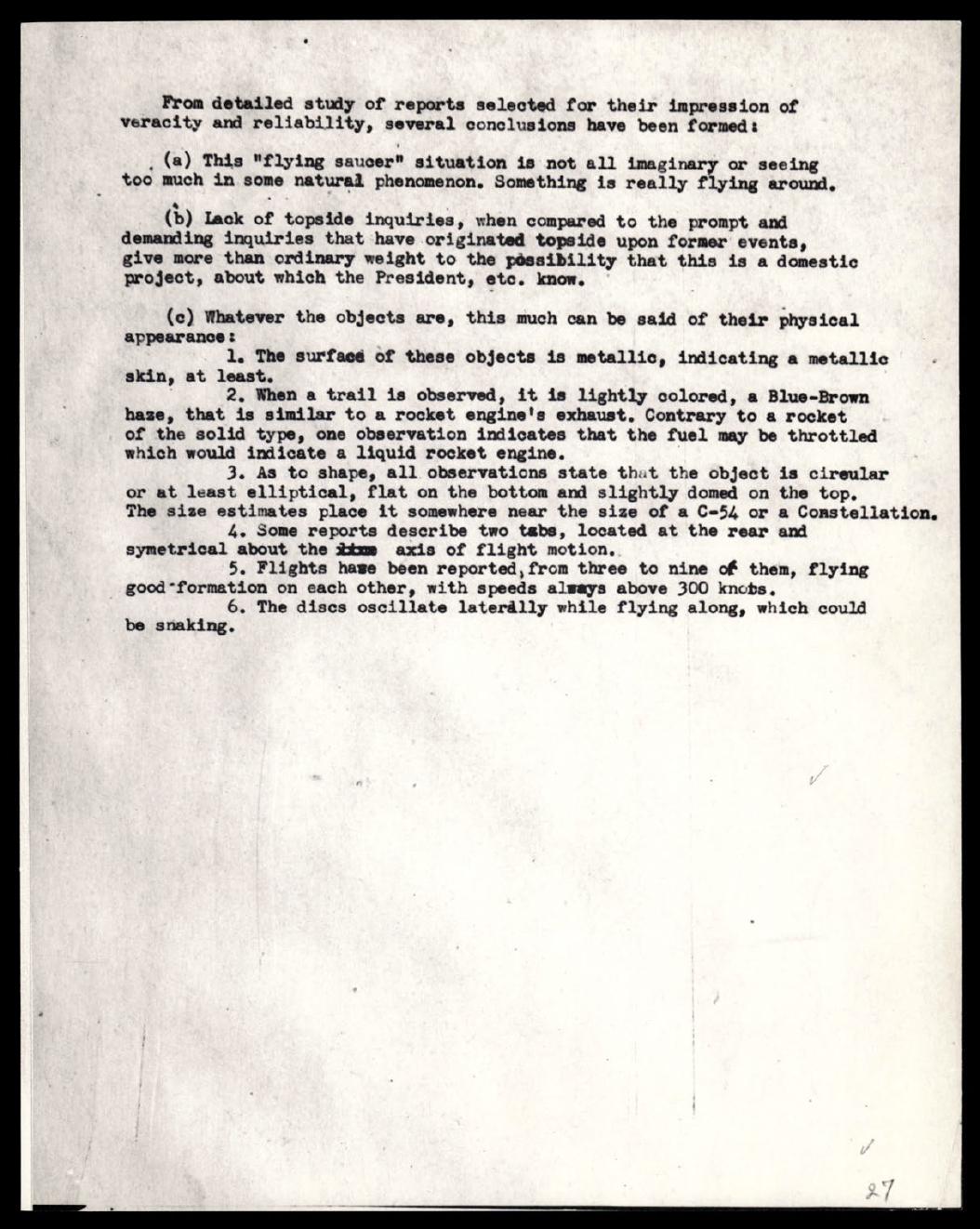 Page 36: typewritten analytical page preserving the source statement that “something is really flying around” and a list of inferred object traits. Treat this as a historical source assertion inside the packet, not as an Open Sky conclusion.
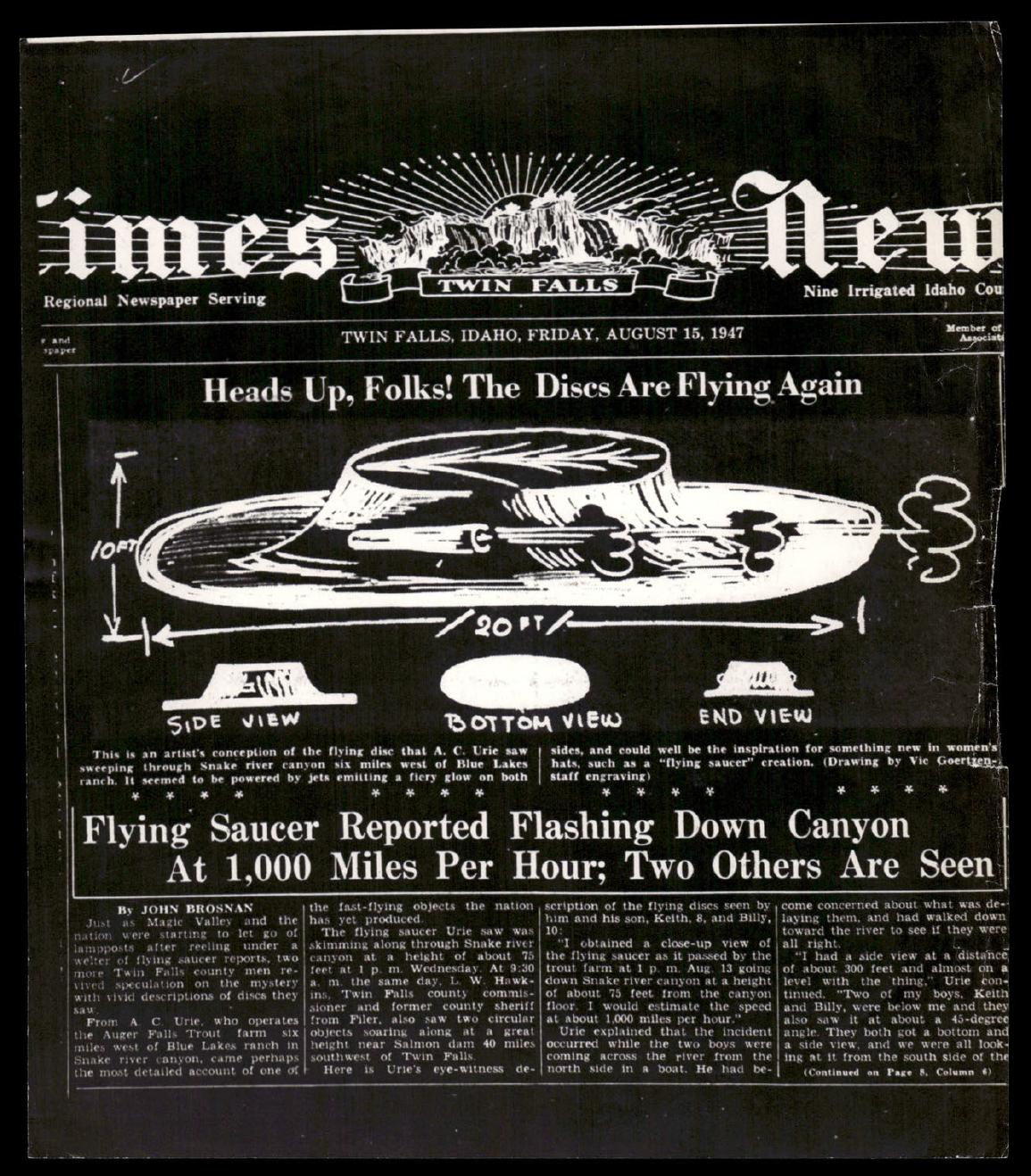 Page 44: Twin Falls newspaper clipping with an artist's conception of a reported disc, including side, bottom, and end-view drawings. This is a press depiction/reconstruction, not a primary photograph of the reported object.
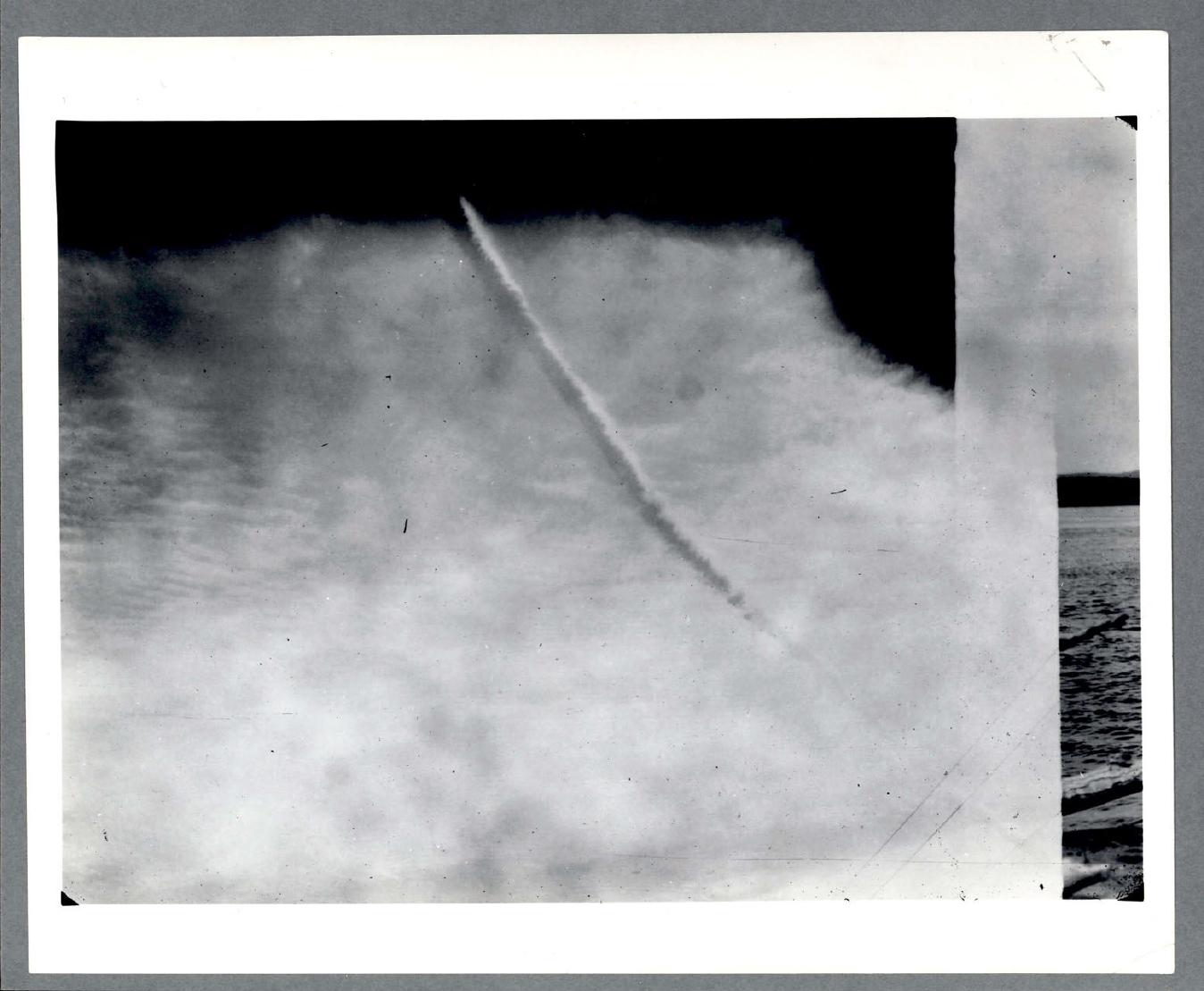 Page 71: under-captioned photographic plate showing a cloudy sky/landscape scene and a faint diagonal streak. The packet does not provide enough captioning here to assign the image confidently to one incident without a source-custody check.
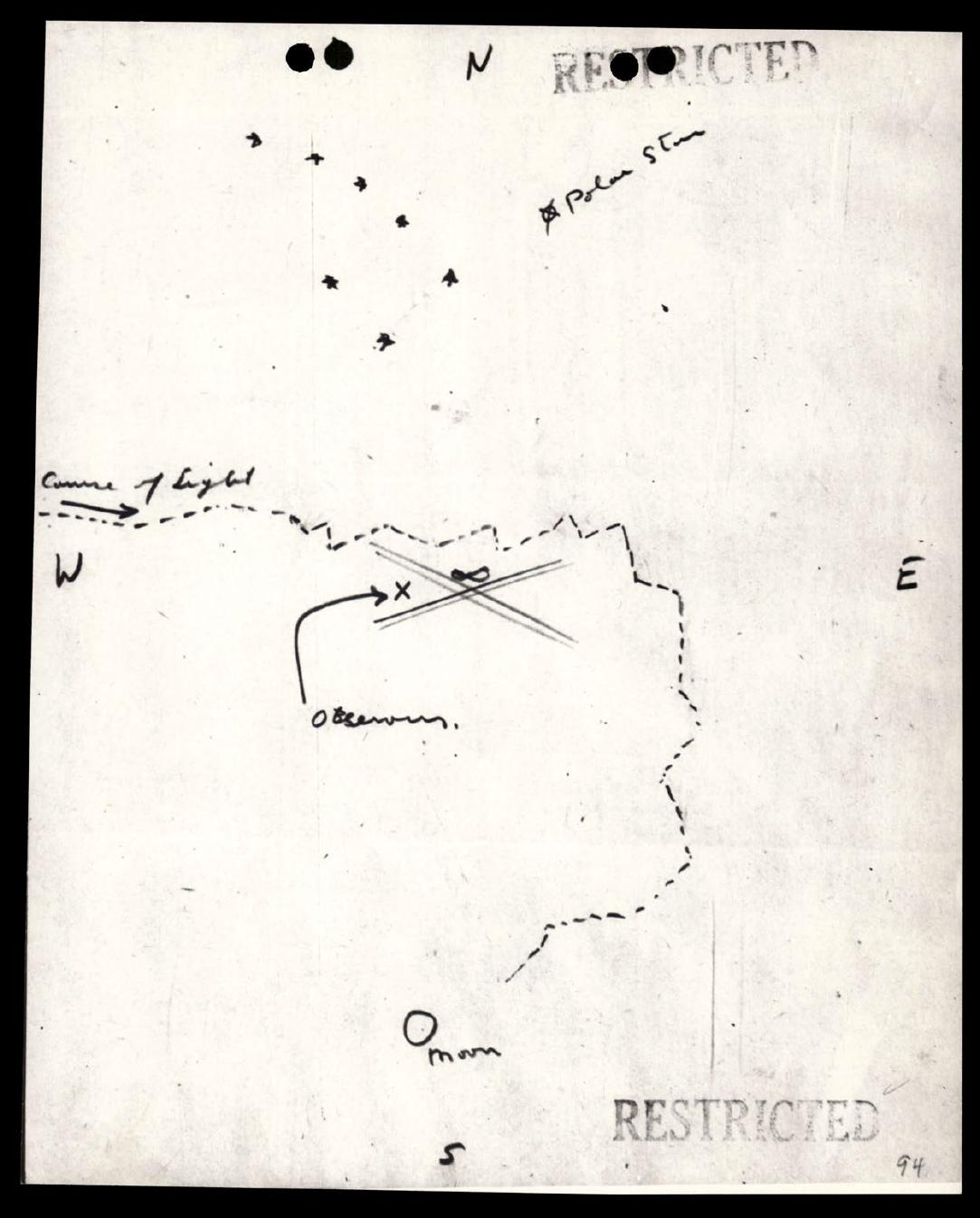 Page 105: hand-drawn course-of-flight sketch attached to the Maxwell Field report, with cardinal directions, observer position, and course markings. It is a source sketch/diagram, not a radar plot or instrument record.
What the file appears to contain
The packet opens with Air Defense Command interviews of Pan American personnel. Pages 1-4 cover Captain Alpheus O. Powell and navigator Walter I. White, who reported seeing unidentified objects on 4 August 1947 during a Constellation flight from Gander, Newfoundland, to La Guardia Field. Powell’s account places the sighting near the Everett fan marker / Bedford radio beacon area northwest of Boston, with the aircraft at roughly 8,000 feet. He described a bright orange, cylindrical object below the aircraft level, estimated around the length of a P-40 fuselage, under observation for about 30 seconds. White separately described a deep-gold, reflective, elliptical or saucer-like object, about 15 feet long and 2-3 feet deep. The notes include weather, airspeed, course, and explicit questioning about tow targets, pilot balloons, and radiosonde devices.
Pages 5-14 form a Birmingham, Alabama cluster from early July 1947. The military cover memorandum says a photograph of the publicized “flying disc” was enclosed, along with a witness statement and clippings. The rendered page 7 itself is only typed report text; it says the print showed two light spots and a light trail, and that Birmingham photographers considered it more than a negative flaw. Page 9 contains a newspaper reproduction: a dark night-sky image with a small bright mark or streak emphasized by an arrow, captioned as Robert Crossland’s “camera proof.” This is a newspaper halftone/clipping, not a clean primary image plate. Page 14 adds Staff Sergeant Ira L. Livingston’s statement from Birmingham, reporting round glowing objects moving southwest at an estimated high speed. These pages should be handled as a mixture of official forwarding paperwork, witness statement, and media reproduction.
Pages 15-35 cover Newfoundland and Harmon Field/Codroy/Grand Falls reports. They include transmittals, final reports, sworn interrogations, and Constabulary statements. The Harmon Field material reports a 10 July 1947 object or trail roughly six miles south-southwest of Harmon Field, described as circular “like a wheel,” silvery or translucent, leaving a bluish-black trail roughly 15 miles long. Multiple witnesses are interviewed: John E. Woodruff describes the object/trail cutting through cloud; John N. Sherman/Nahrmen describes a bluish-black band-like trail but says he saw the trail rather than the object; Robert W. Leidy says he had an Argus camera and took two Kodachrome photos of the trail. The packet says the film would be made available or forwarded, but the reviewed pages do not themselves show those trail photographs. The Codroy and Grand Falls pages add separate witness statements describing reddish/yellow discs, cone-like trails, and egg- or jellyfish-like objects.
Page 36 is an important internal analysis page. It says the selected reports made an impression of “veracity and reliability,” then concludes that the “flying saucer” situation was not entirely imaginary and that “something is really flying around.” It also speculates that lack of higher-level inquiry might fit a domestic project known at senior levels, and lists inferred traits such as metallic surfaces, blue-brown exhaust-like haze, circular or elliptical form, and formation flight. This is a historical analytical assertion inside the packet, not a resolved conclusion by Open Sky.
Pages 37-45 shift to Fourth Air Force / FBI-forwarded western reports. They include F. M. Johnson’s Portland/Mt. Adams letter, Richard “Dick” Rankin’s Bakersfield-area account and Oregonian clipping, and the Twin Falls / A. C. Urie Snake River canyon material. Page 44 visibly contains an artist’s conception from the Twin Falls newspaper: side, bottom, and end views of an alleged disc with dimensions and jet-like glow, credited as a newspaper drawing. It is not a primary photograph. The Urie pages are useful for witness-description and media-provenance work, but the visual element is a reconstructed illustration.
Pages 46-53 include Williams Field / Tenth Air Force reports and a civilian letter. Lt. Eric B. Armstrong reported five or six white circular objects near Lake Mead on 28 June 1947. Lt. William C. McGinty reported two round objects descending at very high speed over the Grand Canyon on 10 June 1947. Pages 52-53 are a Los Angeles letter mixing an account of “saucers” with a highly speculative second phenomenon involving red shiny fragments or rays; it should be treated as correspondence, not an official determination.
Pages 54-62 are a dedicated prosaic-explanation lane. Dan Nelson of Oklahoma City offered a “Flying Saucer Mystery Solved” explanation based on reflections in automobile or aircraft glass, especially at dusk, with apparent saucer shapes caused by reflected bright objects and vibration. The text is overconfident in places, but it is valuable because it shows the 1947 file preserving mundane explanation attempts alongside sighting reports.
Pages 63-69 include Naval Research Laboratory and Air Inspector correspondence. One thread forwards John F. Cole material through Dr. R. Tousey; another is a cautious Air Inspector memorandum by James O. Cobb about a brief bright light seen from Arlington, Virginia, with sketches and weather checks. Cobb explicitly weighs possible meteor, balloon, beacon, burning aircraft, and imagination explanations. A later NRL note records C. C. Rockwood’s supplementary description of a silvery sphere or disc near the White Sands route, with meteorological balloon considered but questioned because of apparent speed. Pages 70-72 appear to be attached visual material: page 70 has a “Flight Path” label and a dark, low-contrast plate; pages 71-72 show photographic/sky-image plates, including a cloudy field and a utility-pole/wire scene. Their relationship to the nearby NRL/Cobb/Zohn material needs a human source check because the stored OCR gives no caption text.
Page 73 is a British Air Ministry cipher-message summary. It reports that during normal night flying practice on 16 January 1947, a Mosquito was vectored to an unidentified aircraft at 22,000 feet over the North Sea/Norfolk area, with two brief AI contacts that faded and apparent evasive action by the unidentified aircraft. This is not a radar plot or full technical file in this PDF; it is a message summary.
Pages 74-79 are an AFRER-CO analytical table for eighteen selected “Flying Disc” reports. The table fields include date, hour, location, observer, occupation, observed-from ground/air, number of objects, altitude, direction, speed, distance, time in sight, deviation from straight flight, color, size, shape, sound, trail, weather, manner of disappearance, and remarks. Page 79 is a summary/evaluation table, not raw sensor data. It includes credibility notes, field-operations checks, and remarks such as “unexplained,” “not stated,” or possible reflection-angle language.
Pages 80-83 supply detailed backing records for some table entries: Manitou Springs/Colorado “supersonic platters,” Byron Savage’s Oklahoma City report, and a Greenfield, Massachusetts letter. Savage’s pages include a field-engineer/private-pilot biography and a white object seen near Oklahoma City, with an explicitly uncertain “swishing” sound that the witness admits could be imagination or expectation.
Pages 84-103 are a large Boise / Kenneth Arnold / David N. Johnson cluster. They include a Fourth Air Force transmittal, interviews assessing Arnold’s credibility, Johnson’s statement about search flights to see and photograph a flying disc, Johnson’s own black-object sighting near Boise/Meridian, a film-processing note saying the motion-picture film showed no trace of an object, a hand-drawn chart of Johnson’s reported movement path, an interview of Kenneth Arnold, Arnold biographical material, and Arnold’s own narrative of the 24 June 1947 Cascade/Mt. Rainier sighting. The stored OCR misses several visible pages in this cluster: rendered pages 88 and 90 contain Johnson statement text, and rendered pages 97 and 100 contain Arnold narrative text. Candidate graph crosslinks to Minot should be treated with caution here because the Minot matches come from Arnold’s biography, not from a Minot incident in this serial.
Pages 104-105 are the Tactical Air Command / Maxwell Field report and sketch. The report records a 23 June 1947 night light over Maxwell Field, Montgomery, Alabama, described as star-bright, fast, zig-zagging, and making a course change; the memo says a check with Maxwell Field operations found no scheduled experimental aircraft nearby. It says “no plausible explanation is offered,” but it remains a report plus local check rather than a resolved finding. The attached page is a rough hand-drawn flight-path sketch with observer position, moon, cardinal directions, and course, not a photograph.
Pages 106-107 return to the NRL / White Sands-area interview with C. H. Zohn and companions. This thread includes people familiar with rocket-sonde work, aircraft, and meteorological balloons. It is a useful prosaic-check cluster because it explicitly raises balloon familiarity while preserving the witnesses’ reported speed/appearance issue.
Pages 108-111 contain interviews with United Air Lines Captain E. J. Smith and co-pilot Ralph Stevens after their Boise-to-Portland/Ontario-area report. They describe groups of silhouetted objects seen shortly after departure, with the co-pilot sighting them first, weather clear, and Ontario tower reportedly seeing nothing from the ground. Stevens is cautious: he says he cannot identify the objects as man-made, radio-controlled, clouds, or otherwise, and frames his statement as uncertainty rather than proof.
Pages 112-113 contain Major Archie B. Browning’s sworn typed statement and a sparse attached diagram page. Browning reported a very bright, silvery, round disc-shaped object off his left wing while flying a B-25 from Ogden toward Kansas City on 6 July 1947. The rendered page is testimony, not sensor evidence. The attached diagram page is mostly sparse marks, not a clear chart.
Pages 114-116 add Fairfield-Suisun, Wisconsin Civil Air Patrol, and classified-message material. Captain James H. Burniston describes an object rolling side-to-side near Fairfield-Suisun. The Wisconsin CAP page reports very fast “saucer” observations from aircraft, with striking speed estimates that need independent checking. The 10 July classified message reports Lt. Alvin S. Heerman’s P-51 sighting of a flat light-reflecting object at high altitude near southern California coordinates.
Pages 117-121 include additional notes and message traffic, including repeated Newfoundland summaries and two Elmendorf, Alaska reports. The Elmendorf messages describe grayish or aluminum-colored balloon-like objects, with one explicitly said to resemble a balloon about ten feet in diameter and another about three feet in diameter. These pages are important because they preserve “balloon-like” descriptions inside the same packet as more dramatic disc reports.
Pages 122-124 are an Edward A. Plummer letter from Frostburg, Maryland. Plummer reports a circular/round, light-colored airborne object and loud jet-like sound, then offers possible explanations: a new type of aircraft or a high-powered jet-propelled aircraft with wing tips or fuel assembly hidden. He asks for aircraft checks in the area at the stated time.
Page 125 is a Danforth/Watseka, Illinois recovered-package memo. It describes an “instrument” received from Sheriff Merle T. Wilmoth, said to have landed on a farm and burned vegetation, but the described contents are old radio/electrical components: plaster-of-paris body, Nathaniel Baldwin power microphone, Polymet filter condenser, bakelite cylinders with copper wire, and magnetic metal. The page shows no recovered-object photo. This should not be merged with the aerial sighting clusters without a separate custody review.
Page 126 closes with a Richmond/USAF memorandum about pilot-balloon observers who report a strange metallic disk seen through a theodolite during wind observations. The memo says the observers assumed the object might be foreign because newspapers reported no U.S. authority for such a craft. This is a useful instrument-observer lead, but the page does not include the actual theodolite records or plotted measurements.
Source custody and provenance
- Official/source URL: https://www.war.gov/medialink/ufo/release_1/65_hs1-834228961_62-hq-83894_serial_130.pdf
- Open Sky release-file copy: war-gov-65-hs1-834228961-62-hq-83894-serial-130-108379f8
- Release: WAR.GOV/PURSUE Release 01
- Official CSV row:
9 - Agency: FBI
- Source/container type: PDF
- PDF size:
106,690,293bytes - PDF pages:
126 - SHA-256:
6446322736ff970386c35f5d305a9d245e632e80f53594ca948718cefd8669a9 - OCR status in the release inventory:
frontier_ocr_complete, with126pages reported and120pages reported with text.
The official manifest describes this as part of FBI file 62-HQ-83894, with investigative records, eyewitness testimonies, public reports, photographic evidence references, technical-proposal material, researcher accounts, and media coverage from 1947-1968. The manifest also says the comparable FBI Vault posting is more redacted and has some pages missing, while this Release 01 version includes newly declassified pages and only minor redactions.
Graph context
The graph has an exact Release 01 document node for this PDF and a related release-record node for the WAR.GOV landing/manifest row. The modeled document carries the official URL, canonical URL, official-primary provenance tier, and the verified SHA-256 hash above.
Machine extraction currently reports 1086 extracted claim nodes, 343 entity mentions, 57 sensor-event records, and 111 OCR chunks for this file. Those extracted graph records are useful navigation aids, but they overcount or flatten the packet because this PDF contains many different serials, clippings, witness statements, and messages. For example, many “sensor” records are ordinary words such as aircraft, camera, photo, or an “EO” text fragment inside a summary table, not raw telemetry. The packet also contains visible tables, but the current semantic table-row count is 0, so the AFRER-CO report table is not yet fully modeled as structured rows.
The graph lists 10 candidate crosslinks. Several are Minot-related because the Arnold biographical pages mention Minot, North Dakota. That is a biographical place-name match, not evidence that Serial 130 contains a Minot sighting. The candidate crosslinks should remain leads only until page-level provenance is checked.
Deep investigation — graph + web reconnaissance
Source reread and media boundaries
A deep reread confirms that Serial 130 is a 1947 packet of many source threads, not one event. The strongest public value is the way it preserves source-routing, testimony, analysis, image references, and contemporaneous prosaic checks in the same 126-page file. The page-36 rendered analytical sheet visibly contains the phrase “Something is really flying around” in a set of historical source conclusions, but it is unattributed in the checked packet context and should remain a source-text lead rather than an Open Sky finding.
The visual material needs careful separation. Page 9 is a Birmingham newspaper reproduction of Robert Crossland’s publicized “camera proof,” not a clean negative or primary photographic plate. Page 44 is a Twin Falls artist’s conception. Page 71 is an under-captioned monochrome image that visually resembles a funnel/cloud/plume scene over or near water, but it has no readable caption, date, location, or incident label on the rendered page, so it should not be tied to a specific report without external custody metadata. Page 105 is a hand-drawn Maxwell Field course/observer sketch with cardinal directions and course markings; it is not radar, telemetry, or a sensor plot.
The source packet itself also preserves several explicit checks and limits: Powell/White were asked about tow targets, pilot balloons, and radiosonde devices; Cobb’s Arlington/NRL memo weighs meteor, balloon, beacon, burning-aircraft, and imagination explanations; C. C. Rockwood’s White Sands-area account is compared against meteorological balloon familiarity; the Maxwell Field memo says operations reported no scheduled experimental aircraft nearby; and the Elmendorf messages include balloon-like descriptions inside the same file as more dramatic disc reports.
Read-only graph connections
The graph has one exact official-primary Document node for the WAR.GOV PDF URL and Release 01 row 9, with a verified full-download size of 106,690,293 bytes and SHA-256 6446322736ff970386c35f5d305a9d245e632e80f53594ca948718cefd8669a9. It is linked to the WAR.GOV/PURSUE Release 01 Source, the official release-record document, and a secondary GitHub markdown-conversion node. The official WAR.GOV PDF asset remains the provenance anchor; the secondary conversion is only a search/comparison aid.
Read-only relationship counts for the official asset returned 1,086 HAS_EXTRACTED_CLAIM links, 113 HAS_CHUNK links, 57 DESCRIBES_SENSOR_EVENT links, and 10 CANDIDATE_CROSSLINK links. The 113 graph chunks include release/source/manifest chunks as well as the 111 OCR chunks listed in the inventory. Claim-kind counts are dominated by unreviewed machine extraction: 275 observation claims, 275 witness-testimony claims, 157 motion claims, 133 object-descriptor claims, 117 time claims, 56 platform claims, and 46 prosaic-lead claims. These are useful page-navigation signals, not adjudicated evidence.
The graph’s SensorEvent records should not be promoted as actual sensor evidence. A property check shows 54 lowercase aircraft records, 2 uppercase Aircraft records, and one eo fragment; sampled records are ordinary text mentions from witness/platform descriptions with review_status: machine_extracted_needs_human_review and finding_status: not_a_finding. The real evidence on this page is still source text, witness statements, clippings, sketches, and forwarded memoranda unless a specific instrument record is separately located.
The ten candidate crosslinks are also audit-only. They are generated from the shared Minot anchor in Kenneth Arnold’s biographical text (“I went to grade school and high school at Minot, North Dakota”), not from a Minot incident in Serial 130. Targets include NARA Minot catalog records, FBI Vault Part 02/04 page candidates, and community catalog entries. None of those links establish identity, causality, corroboration, or resolution without page-level target review.
External provenance and official/archive context
The public official chain for this page is WAR.GOV/PURSUE Release 01 plus the Open Sky verified release-file copy. The WAR.GOV Release 01 source record also preserves the public release landing page, CSV manifest, and the press release titled “Department of War Releases Unidentified Anomalous Phenomena Files in Historic Transparency Effort.” The graph notes that direct media fetching can be blocked from the cron host even when the official record and verified bytes are already present, so the Open Sky release-file route is the safer public access path for the reviewed hash.
For older archive comparison, the FBI Vault UFO collection is the relevant official legacy lane: https://vault.fbi.gov/UFO. The graph’s FBI Vault Part 02/04 crosslinks are currently derived from the Arnold/Minot biographical passage and must be checked against the actual Vault pages before any redaction/missing-page delta is claimed. The National Archives Project BLUE BOOK reference page is live at https://www.archives.gov/research/military/air-force/ufos and is the correct official route for Air Force/BLUE BOOK context, but this page should not assert a BLUE BOOK match until a specific NARA file, image set, or report number is tied to one of Serial 130’s clusters.
Prosaic checks and follow-up leads
Serial 130 should be split into child investigations before cross-case analytics. Priority clusters are Powell/White near the Boston route, Birmingham/Crossland, Newfoundland/Harmon Field/Codroy/Grand Falls, page-36 analytical authorship, Rankin/Johnson/Urie, NRL/Cobb/Zohn, the AFRER-CO table, Johnson/Arnold, Maxwell Field, United Air Lines Smith/Stevens, Browning, Burniston/CAP/Heerman, Elmendorf, Danforth/Watseka, and Richmond theodolite observers. Each cluster needs its own weather, aircraft, balloon/radiosonde, meteor, searchlight/reflection, film-handling, military-operations, and archive-custody checks.
The most immediate data-quality task is OCR repair for pages where the rendered images carry content but the stored OCR is blank or weak, especially pages 88, 90, 97, and 100 in the Johnson/Arnold sequence. The most important provenance tasks are to locate the original Birmingham print/negative, Robert Leidy’s referenced Kodachrome trail photos, the source metadata for pages 70-72 visual plates, any film-processing records for David Johnson’s motion-picture attempt, and the authorship/routing of the page-36 analytical sheet.
Audit note
This section adds graph and web reconnaissance only. It does not create a finding, hypothesis, or resolution decision. Machine-extracted claims, sensor-event records, and candidate crosslinks remain machine_extracted_needs_human_review / not_a_finding navigation aids until each claim is verified against rendered source pages or official external records.
Leads to check
- Split this serial into child pages or case clusters before cross-case analytics: Powell/White Boston flight, Birmingham/Crossland, Harmon Field/Codroy/Grand Falls, page-36 analysis, Rankin/Johnson/Urie, Armstrong/McGinty, Dan Nelson reflections, NRL/Cobb/Zohn, AFRER table, Johnson/Arnold, Maxwell Field, United Air Lines Smith/Stevens, Browning, Burniston/CAP/Heerman, Elmendorf, Plummer, Danforth/Watseka, and Richmond theodolite observers.
- Repair OCR coverage for rendered pages 71-72, 88, 90, 97, and 100. The visible page images contain either photographic plates or typed text that the stored OCR does not preserve.
- Locate and compare the referenced Birmingham print, Robert Crossland newspaper image, Robert Leidy Kodachrome trail photos, and any NRL/flight-path plates. The reviewed PDF contains references and reproductions, but not a clean provenance chain for every image.
- Compare this Release 01 PDF page-by-page with the older FBI Vault version to identify newly declassified pages, missing pages, and changed redactions before claiming exact deltas.
- Run prosaic correlation checks by cluster: aircraft schedules, pilot-balloon and radiosonde launches, weather and cloud layers, meteors, searchlights/reflections, newspaper-clipping provenance, film/negative handling, and local operations logs.
- Verify authorship/context for the page-36 conclusions memo. Its language is high-signal, but it needs source-custody anchoring before being used in any public analytical claim.
- Keep the Danforth/Watseka recovered “instrument” separate from aerial cases until its custody, components, and FBI handling are modeled as their own evidence thread.
Lead check notes
- Partial — child-page split: Current linked Release 01 OCR/inventory checks support splitting Serial 130 into child clusters rather than treating it as one case. Powell/White also appears in
38_143685_box7_Incident_Summaries_1-100; Twin Falls/Urie appears in Section 3, Section 2, Serial 130, and the incident-summary file; Arnold/Johnson appears in Sections 2 and 3 plus the incident-summary file; Danforth/Watseka has related Section 3 context. These are source-routing overlaps, not case resolutions. - Checked — visual media type boundaries: The rendered pages separate evidence types: page 9 is a Birmingham newspaper reproduction with a small marked image; page 44 is a Twin Falls artist's conception; pages 71-72 are under-captioned photographic plates; page 105 is a hand-drawn Maxwell Field course sketch. The clean Birmingham print/negative, Robert Leidy Kodachromes, and any original NRL/flight-path photo records remain unlocated in the current linked corpus.
- Partial — OCR coverage repair: The release OCR has zero body text for pages 71, 72, 88, 90, 97, and 100. Rendered-page checks confirm pages 71-72 are photo plates, while pages 88, 90, 97, and 100 contain readable Johnson/Arnold typed text. Those pages need OCR repair/transcription before exact quotes or extracted claims are promoted.
- Needs external source — FBI Vault comparison and prosaic checks: The current Release 01 source set does not itself supply a page-by-page comparison against the older FBI Vault copy, nor the weather, aircraft, pilot-balloon/radiosonde, meteor, searchlight/reflection, film-lab, or operations records needed to test each cluster. Those checks remain external-source work.
- Partial — page-36 authorship/context: The page-36 render confirms an unattributed typewritten analytical page with the source phrase “something is really flying around.” The surrounding packet does not yet provide enough author, routing, or enclosure context to use that statement as more than a source-text lead.
- Checked — Danforth/Watseka separation and Minot crosslinks: Page 125 keeps the Watseka/Danforth item in a component/custody lane rather than as an aerial sighting. The graph crosslinks for this asset anchor on “Minot” in Kenneth Arnold biography snippets and remain audit-only; they are not incident corroboration for Serial 130.
Limits
This is a packet-level investigation draft, not a resolution page. It preserves reports, statements, clippings, and analysis from 1947; it does not decide what the reported objects were.
The packet mixes primary official records, typed witness statements, newspaper clippings, forwarded correspondence, message summaries, sketches, and prosaic theories. A claim in one page should not be treated as corroborating another page until the dates, observers, locations, and custody trail are separated.
Visual material is uneven. Some pages refer to photographs or film, but do not reproduce the underlying photo; some newspaper clippings contain a visible image or artist’s conception but not primary object imagery; some attached visual pages are low-contrast and under-captioned.
The stored OCR is incomplete for several visible pages, and some OCR spellings or names are noisy. Any exact quote, name, coordinate, or speed estimate should be verified against rendered page images before being promoted.
The graph context is machine extracted and remains review-only. It should guide investigation, not create findings, hypotheses, or resolved identifications.
Sources
- WAR.GOV/PURSUE Release 01 official PDF: 65_HS1-834228961_62-HQ-83894_Serial_130
- Open Sky release-file copy: war-gov-65-hs1-834228961-62-hq-83894-serial-130-108379f8
- Release inventory metadata: official CSV row
9, FBI, PDF,126pages, SHA-2566446322736ff970386c35f5d305a9d245e632e80f53594ca948718cefd8669a9. - Graph extraction summary for this document:
1086extracted claims,343entity mentions,57sensor-event records,111OCR chunks, and10candidate crosslinks requiring human review.