65_HS1-834228961_62-HQ-83894_Serial_153
Evidence media
- Official Release 01 PDF: open the released file.
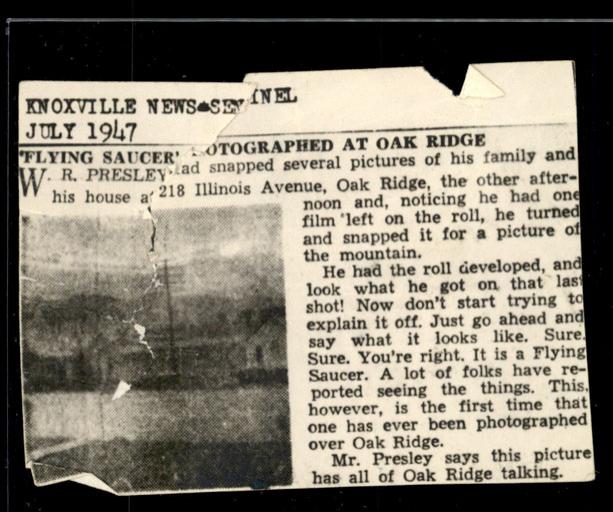
Page 4: derived render from the official PDF. This is a Knoxville News-Sentinel clipping with a halftone reproduction and article text about the Presley/Oak Ridge photograph story; it is press reproduction, not an original negative or standalone print.
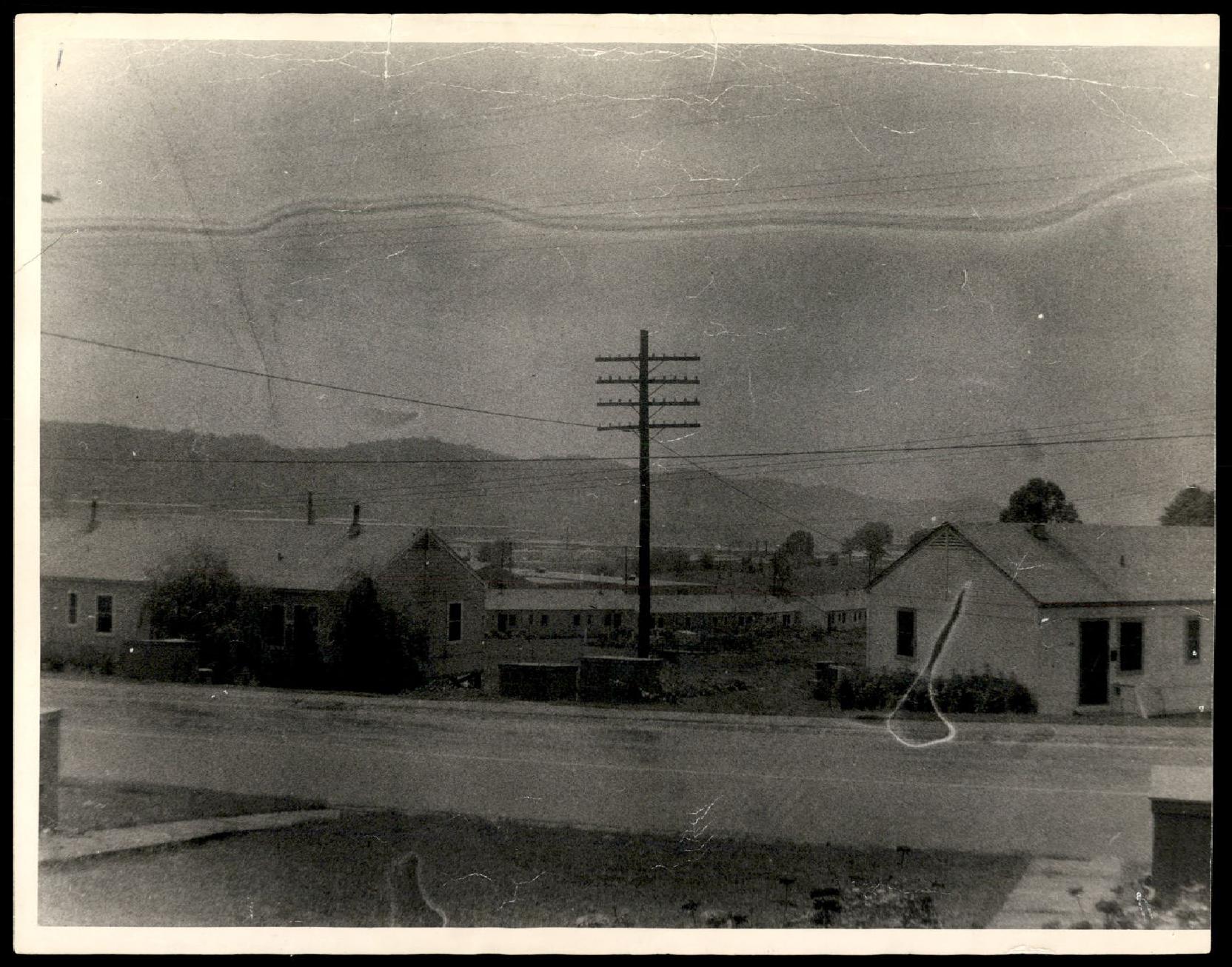
Page 6: derived render from the official PDF. The exhibit shows a residential or small-town scene with utility poles, wires, low hills, heavy scratches and specks, and an ambiguous marked area; no distinct object is identifiable from this render alone.
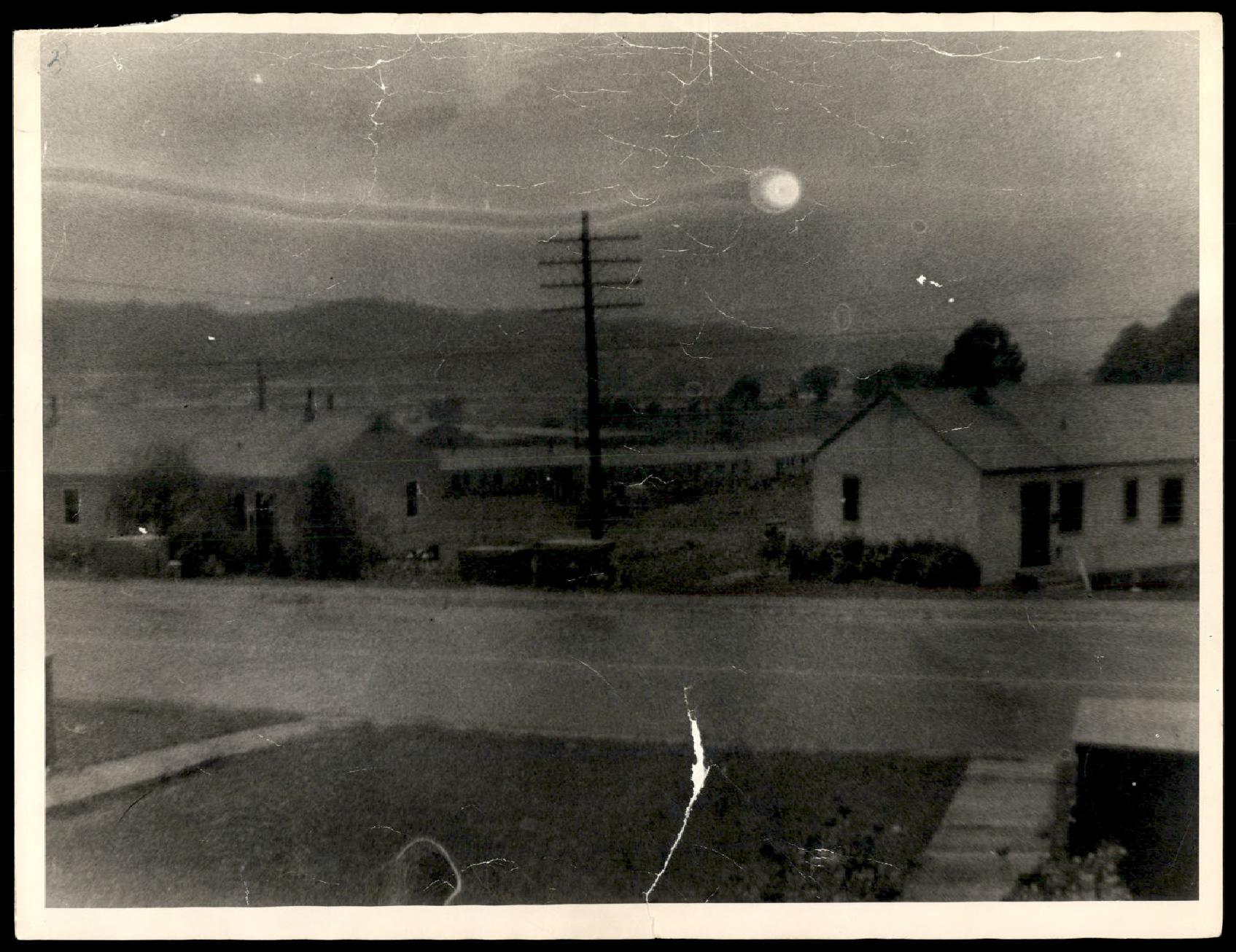
Page 8: derived render from the official PDF. The second exhibit shows a similar street-and-utility-pole scene with a bright circular spot in the upper-right sky area near utility lines, along with other scratches and copy artifacts; the source image alone does not identify the spot.
Investigation reading
This Release 01 item is a short FBI serial packet about reported “flying saucers” over the Oak Ridge area in July 1947. The file is not a long memorandum; it is a nine-page enclosure set built around two photographs and a newspaper clipping. The useful reading is therefore page-level: folder/custody pages, one typed enclosure note, one Knoxville News-Sentinel clipping, two photo exhibits, and mostly blank divider or backing pages.
The packet’s own wording is cautious in one place and promotional in another. Page 2 says the Bureau was receiving “two photographs of reputedly ‘flying saucers’ seen at Oak Ridge, Tennessee, during July 1947,” plus a photostatic copy of a newspaper clipping. Page 4 is the clipping, headlined “‘Flying Saucer’ Photographed at Oak Ridge,” about W. R. Presley of 218 Illinois Avenue, Oak Ridge, who reportedly took a final exposure on a roll of film while photographing toward the mountain. The article says the developed photograph became a local talking point and calls it a “Flying Saucer.” That is the newspaper’s language, not an Open Sky conclusion.
The visual pass found two full-page photographic exhibits. One shows a residential or semi-rural scene with buildings, utility poles, wires, hills or a distant ridge, and heavily worn photographic surface artifacts. The other similar scene has a handwritten “2” in the upper-left margin and a bright, round, unresolved spot in the upper-right sky area near utility wires. The images are too degraded to identify the bright feature from this packet alone.
What the file appears to contain
| Page | Reading |
|---|---|
| 1 | FBI Central Records Center folder/cover for 62-HQ-83894, volume 1, serial 153 only, with declassification sticker. |
| 2 | Knoxville file #65-11 enclosure note: two photographs of reputed “flying saucers” seen at Oak Ridge during July 1947 and a photostatic Knoxville News-Sentinel clipping. |
| 3 | Enclosure backing/cover marked 62-83894-153 and ENCLOSURE. |
| 4 | Knoxville News-Sentinel clipping from July 1947. It names W. R. Presley, 218 Illinois Avenue, Oak Ridge, and describes a final roll-of-film exposure toward the mountain. A small newspaper halftone image is embedded in the clipping. |
| 5 | Mostly blank backing page marked 62-83894-153. |
| 6 | First full-page photo exhibit. No caption is visible. The scene includes buildings, a road or foreground strip, a utility pole with crossarms, utility wires, a low horizon, and many scratches/specks. No object can be identified from this page alone. |
| 7 | Mostly blank divider/backing page with a faint file notation. |
| 8 | Second full-page photo exhibit, marked with a handwritten 2. It shows a similar residential/utility-pole scene with a bright circular unresolved feature in the upper-right sky area, plus many surface scratches and specks. |
| 9 | Mostly blank backing page marked 62-83894-153. |
The document-level search over the nine pages finds the strongest terms around Oak Ridge, Presley, photographs, the Knoxville clipping, and “flying saucer” language. It does not contain radar data, instrument logs, weather analysis, astronomy checks, negative analysis, witness interview transcript, or a technical conclusion inside this serial packet.
Source custody and provenance
The official WAR.GOV/PURSUE Release 01 record lists this as FBI CSV row 10, title 65_HS1-834228961_62-HQ-83894_Serial_153, source/container type PDF, and canonical URL:
https://www.war.gov/medialink/ufo/release_1/65_hs1-834228961_62-hq-83894_serial_153.pdf
Open Sky’s release-file route for the item is:
/api/explore/war-gov/release-file/war-gov-65-hs1-834228961-62-hq-83894-serial-153-67c2ef13
The PDF reviewed for this draft is 9 pages and 5,546,075 bytes. Its SHA-256 was verified from the custody inventory and the reviewed file as fbb76ffa1aad67e53d98e189b557ee3f893d2374ca28ae93862a79db20908db6.
Graph context
The graph currently models this item as an official-primary Document asset tied to Release 01 CSV row 10 and to the broader WAR.GOV/PURSUE source record. The exact graph records also show a related asset record for the same title under an earlier or alternate URL form, which is relevant to the hash/custody reconciliation above.
The semantic graph facts available for this slug are mostly manifest-level: FBI as agency, 65_HS1 / 62-HQ-83894 as file identifiers, the broad 1947-to-1968 manifest description for the larger FBI case file, and the stated limitation that the FBI Vault version is more redacted and missing pages. The current extracted fact counts are 7 claims, 7 entity mentions, 0 sensor events, and 0 table rows. No candidate crosslinks are currently modeled for this specific slug.
For investigation purposes, that means the graph is useful for custody and file identity, but the page-level reading still has to come from the actual PDF pages and image review. The graph should not be treated as a complete semantic model of the Presley/Oak Ridge photo packet yet.
Leads to check
- Confirm that the related same-title asset record in the graph maps to this same reviewed PDF and does not represent a separate source file.
- Link this serial to the broader FBI
62-HQ-83894Oak Ridge/Presley material in the larger case file before writing any cross-file interpretation. Related file pages appear to include later correspondence about the photographs and should be reviewed separately. - Locate any original negatives, higher-quality prints, or FBI/AEC/Army technical correspondence tied to W. R. Presley’s photographs. The released serial contains photo copies, not the original negatives.
- Separate the newspaper clipping’s embedded halftone image from the two full-page photo exhibits. They are different evidence presentations and should not be blended.
- Check the 218 Illinois Avenue / Oak Ridge sightline, likely direction toward the mountain, time-of-day context, utility-wire geometry, and photographic artifact possibilities before escalating the bright feature in page 8.
- Compare page 6 and page 8 against any follow-up analysis in adjacent FBI serials. If another serial evaluates the negatives or development artifacts, it should be cited as a separate source, not silently imported into this page.
Lead check notes
- Checked — same-title source records: Current Release 01 source records trace the direct WAR.GOV PDF URL and an older malformed same-title asset URL to CSV row 10 and the same 5,546,075-byte PDF with SHA-256
fbb76ffa1aad67e53d98e189b557ee3f893d2374ca28ae93862a79db20908db6. No separate same-title PDF was found in the current linked corpus. - Partial — broader Oak Ridge/Presley thread: The current linked corpus points to Section 4 pages 84-88, 105, 109, and 112-113 as later Presley/Gasser context. Those pages say Presley photographed a “vapor trail” and then a “ball of fire,” preserve Colonel Gasser's speculative commentary, and should be cited as Section 4 source context rather than treated as text contained in this nine-page serial.
- Partial — negatives and technical correspondence: Section 4 page 113 says a Wright-Patterson technical-intelligence evaluation found raised emulsion on the negative with the sphere and suggested a drop of warm water or developer rolled across that negative and the succeeding negative. This serial itself does not include the original negatives, a standalone lab-report image, or the full Air Force/AEC handling file, so the original-media custody lead remains open.
- Checked — clipping versus exhibits: The page renders separate the newspaper presentation from the photo exhibits: page 4 is a Knoxville News-Sentinel halftone clipping, while pages 6 and 8 are full-page exhibit renders from the released PDF.
- Needs external source — sightline and image context: The release file and current linked corpus do not provide camera metadata, a surveyed sightline from 218 Illinois Avenue, weather/astronomy checks, or utility-wire/photographic-geometry analysis. Those checks require external map, weather, astronomy, and photo-forensics sources.
- Partial — page 6/page 8 follow-up: Section 4 supplies adjacent-source evaluation language about the negatives and development artifacts, but exact comparison to original prints or negatives is not available in the Release 01 source images. Use Section 4 as adjacent context unless an original print, negative, or complete technical file is obtained.
Deep investigation — graph + web reconnaissance
Source reread
Serial 153 is the short Knoxville enclosure packet, not the later technical evaluation file. Page 2 identifies the package as two photographs of reportedly “flying saucers” seen at Oak Ridge during July 1947 plus a photostatic Knoxville News-Sentinel clipping. The converted OCR is useful but noisy: it misreads parts of the cover/file numbering and page-4 clipping, so the rendered page review carries more weight for names and visual context.
The page-image reread keeps the evidence types separate. Page 4 is a newspaper/photostatic reproduction that names W. R. Presley and Oak Ridge and presents the story in press language. Page 6 is a degraded full-page photo exhibit showing a residential or small-town scene with utility poles, wires, low hills, scratches, and specks; no distinct aerial object is identifiable from that render alone. Page 8 shows a similar scene with a bright circular feature in the upper-right sky area, but the same page is heavily affected by scratches, dust, creases, and copy artifacts. The serial itself contains no radar log, camera metadata, weather record, astronomy check, witness interview transcript, or technical conclusion.
Graph connections reviewed
Read-only Neo4j checks matched this item to the official Release 01 record, the current canonical PDF asset for CSV row 10, and an earlier same-title asset record whose malformed URL was later reconciled to the verified PDF. The verified file size and SHA-256 remain 5,546,075 bytes and fbb76ffa1aad67e53d98e189b557ee3f893d2374ca28ae93862a79db20908db6.
The matching graph neighborhood is mostly custody/provenance rather than interpretation: five text-chunk relationships across the release-row/current/prior asset records, seven machine-extracted claims on the current asset, no modeled sensor events, and no CANDIDATE_CROSSLINK relationships for this slug. Those seven claim records are identity/metadata claims such as 65_HS1, 62-HQ-83894, FBI, 1947/1968 manifest dates, and a redaction/missing-pages limitation. They remain machine_extracted_needs_human_review / not_a_finding and do not identify the photographed feature.
Text-neighborhood searches are still valuable. They connect the Presley/Oak Ridge thread to the larger Section 4 WAR.GOV packet: pages 84-88 preserve the early Knoxville/AEC/Gasser narrative, while pages 112-113 preserve the later Wright-Patterson / Air Materiel Command technical-intelligence evaluation. The graph also has legacy FBI Vault Part 06 page records and Project SIGN / Project Blue Book microfilm records that appear to duplicate parts of the same technical trail. Those are provenance-alignment leads, not automatic same-page or same-event conclusions.
External provenance and context
| Source checked | URL | Result and relevance |
|---|---|---|
| WAR.GOV/PURSUE Release 01 serial PDF | https://www.war.gov/medialink/ufo/release_1/65_hs1-834228961_62-hq-83894_serial_153.pdf | Canonical Release 01 URL for this PDF. Live probes from this environment returned access-denied responses, consistent with prior WAR.GOV blocking behavior; the verified Open Sky release copy and manifest metadata remain the evidence base for this page. |
| WAR.GOV/PURSUE Section 4 PDF | https://www.war.gov/medialink/ufo/release_1/65_hs1-834228961_62-hq-83894_section_4.pdf | Adjacent official Release 01 source for the same Presley/Oak Ridge thread. Section 4 should be cited separately because its Gasser commentary and later Air Force evaluation are not text contained in Serial 153. |
| FBI Vault UFO Part 06 | https://vault.fbi.gov/UFO/UFO%20Part%2006/at_download/file | Official FBI legacy file family was reachable. Graph page records point to a Part 06 page containing the end of the 10 February 1949 photograph-evaluation correspondence; exact PDF-page alignment should be checked before using it as a public citation beyond a comparison lead. |
| NARA / Project Blue Book / Project SIGN leads | https://catalog.archives.gov/ and https://archive.org/details/nara-pbb | NARA catalog search pages were reachable, and graph text searches show Project SIGN / Project Blue Book microfilm copies with the same warm-water/developer negative-analysis language. The archive.org microfilm records are useful leads until exact NARA catalog IDs/pages are pinned. |
Prosaic checks and unresolved lanes
The strongest prosaic evidence is adjacent-source, not a conclusion from this nine-page packet alone. Section 4 records an Air Force technical-intelligence review saying that the negative containing the sphere had raised emulsion at the relevant point; the reviewer suggested a drop of warm water or developer struck the film and rolled across that negative and the succeeding negative, making the apparent trail continuous across both frames. Section 4 also says the fogged edge and unevenly developed sections supported a development-defect explanation and recommended advising Presley of the nature of the images when the negatives were returned.
That makes the page-8 bright spot a photographic/process-artifact candidate before any escalation. The serial’s own images are copied exhibits, not original negatives; page 4 is a press reproduction; the photographs show utility lines and many physical/copy defects; and the case lacks an exact exposure time, weather record, lunar/solar geometry, camera data, or original negative inspection in this serial. Astronomy, weather, aircraft, launch, or satellite correlation would be premature until the exact exposure timing, viewing direction from 218 Illinois Avenue, and original-image custody are established.
Follow-up leads
- Align Serial 153 page-by-page with Section 4 pages 84-88 and 112-113, then cite Section 4 explicitly wherever the technical evaluation is used.
- Pin the exact FBI Vault Part 06 page and exact NARA/Project SIGN or Project Blue Book record IDs for the 10 February 1949 evaluation correspondence.
- Search for original negatives, higher-quality prints, or AEC / Wright-Patterson / Air Materiel Command correspondence for William or V. R. Presley, G. J. Rathman, C. D. Gasser/Garber, and Major Grant.
- If original metadata appears, run sightline, weather, astronomy, and photo-forensics checks from 218 Illinois Avenue separately; do not infer them from the degraded release copy.
Audit note
This deep pass used the current wiki page, verified release-file hash/size, copy-disabled PDF metadata, frontier OCR, rendered page images, read-only graph queries, adjacent Section 4 source text, and official/archive web probes. No graph writes were made, and no Finding, Hypothesis, or ResolutionDecision conclusion is created here.
Limits
This page does not identify the photographed feature and does not resolve the case. The packet contains copied photographs and a newspaper clipping, but no raw negative, no camera metadata, no formal image analysis, no radar or sensor record, and no weather/astronomy check.
The PDF is an archival scan with copy restrictions; page text was checked against converted OCR and rendered page images. The photos are low contrast and visibly damaged by scratches, specks, creases, copying, and newspaper reproduction artifacts. Small bright marks in these images may be scene content, print damage, scanning artifacts, or some combination of those; this packet alone is not enough to decide.
The manifest description describes the much larger FBI 62-HQ-83894 file as spanning 1947 to 1968. This nine-page serial is narrower: it concerns the July 1947 Oak Ridge/Presley enclosure packet.
Sources
- Official WAR.GOV/PURSUE PDF source URL: https://www.war.gov/medialink/ufo/release_1/65_hs1-834228961_62-hq-83894_serial_153.pdf
- Open Sky release-file route: /api/explore/war-gov/release-file/war-gov-65-hs1-834228961-62-hq-83894-serial-153-67c2ef13
- WAR.GOV/PURSUE Release 01 CSV manifest, row 10, FBI title
65_HS1-834228961_62-HQ-83894_Serial_153. - Released PDF page review: pages 1-9, including the Knoxville enclosure note, July 1947 Knoxville News-Sentinel clipping, and two full-page photo exhibits.