65_HS1-834228961_62-HQ-83894_Serial_164
Evidence media
- Official PDF: Open Sky release-file copy.
- Derived page renders from the official PDF:
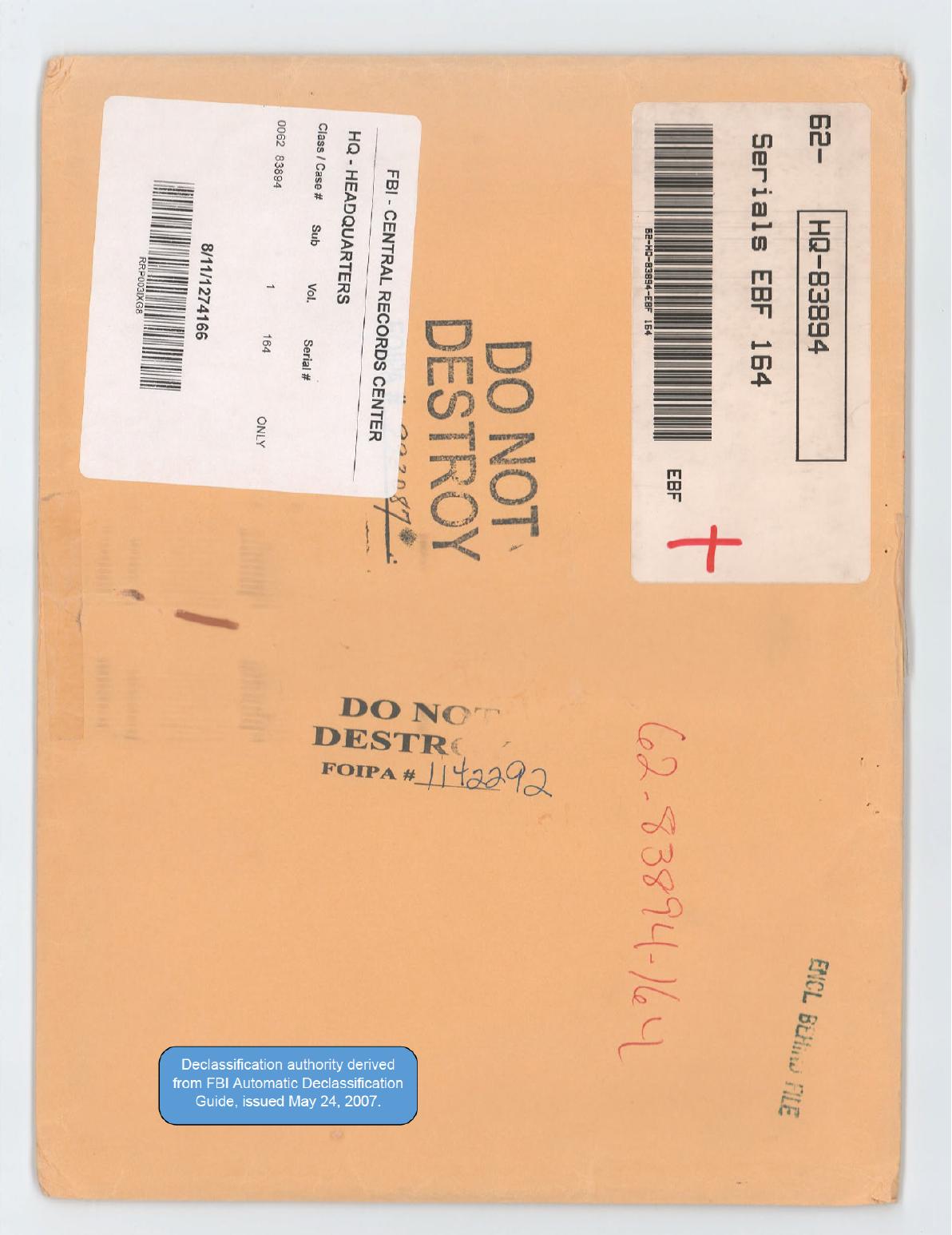 PDF p. 1: FBI Central Records Center cover for HQ-83894, serial 164, with file-control labels and “Do Not Destroy” markings.
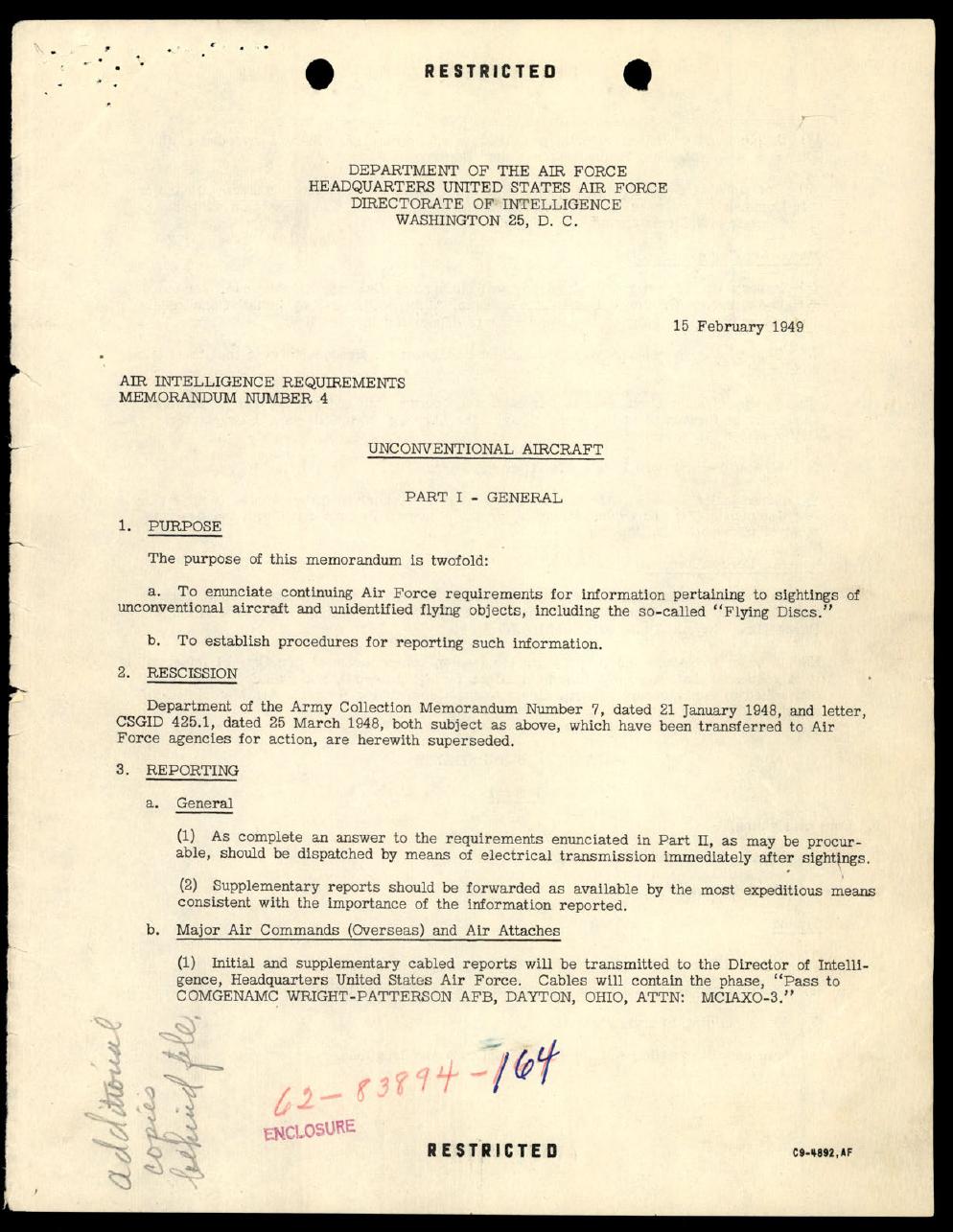 PDF p. 2: opening page of Air Intelligence Requirements Memorandum Number 4 — “Unconventional Aircraft,” dated 15 February 1949 and marked “Restricted.”
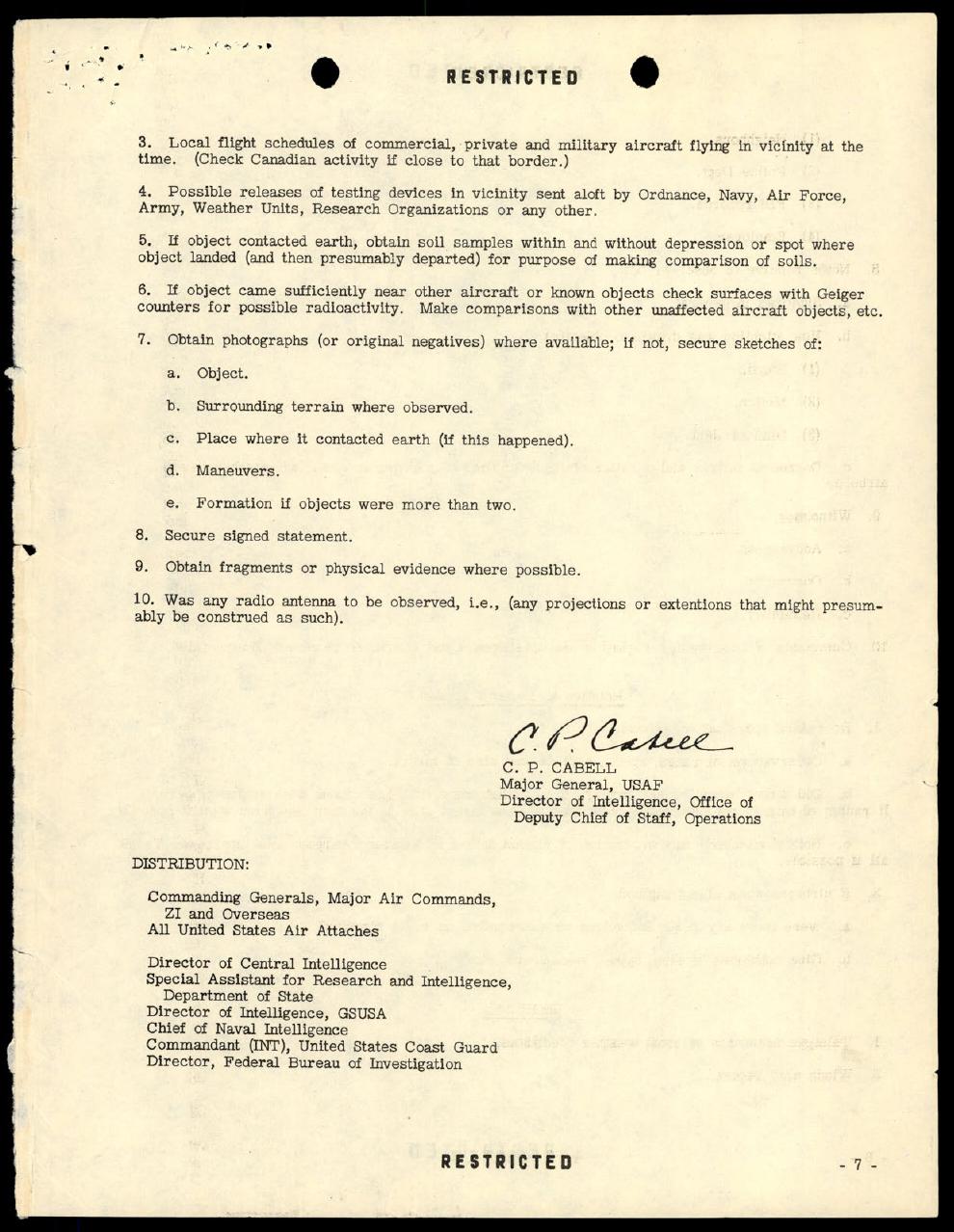 PDF p. 8: closing checklist items, C. P. Cabell signature block, and distribution list including major air commands, air attachés, DCI, State, Army, Navy, Coast Guard, and FBI recipients.
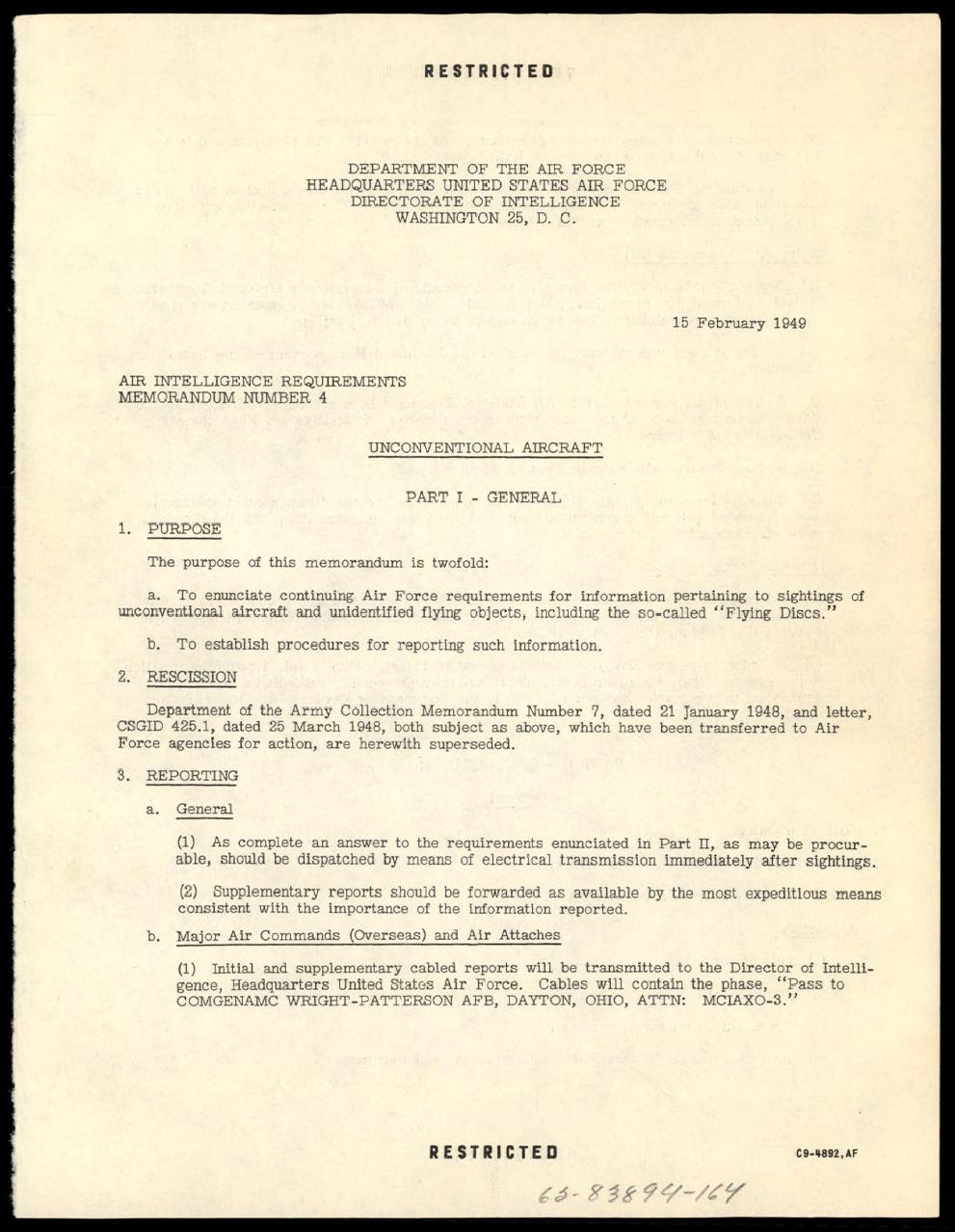 PDF p. 42: another opening page of the same memorandum; the page render favors 15 February 1949 and the Wright-Patterson routing phrase with attention code MCIAXO-3.
 PDF p. 137: mostly blank “Restricted” separator/backing page, included here to show the separator-page pattern in the repeated packet.
Investigation reading
Draft status: graph_investigation_draft; investigation status: needs_human_review; finding status: not_a_finding.
This Release 01 item is not a single sighting report. It is an FBI case-file serial preserving repeated copies of a United States Air Force Directorate of Intelligence memorandum titled Air Intelligence Requirements Memorandum Number 4 — “Unconventional Aircraft.” The memorandum is dated mostly 15 February 1949 in the visible copies and sets out how Air Force commands, air attachés, and non-Air-Force agencies should report sightings of unconventional aircraft and unidentified flying objects, including so-called “Flying Discs.”
The practical reading is: this serial is a reporting-protocol bundle. It matters because it shows what information the Air Force wanted collected in early 1949 — observer position, object appearance, maneuvers, weather, celestial checks, radar details, photographs or sketches, physical evidence, and routing to Air Materiel Command at Wright-Patterson. It does not itself resolve any sighting and does not contain object photographs, radar plots, or incident-specific witness testimony in the reviewed pages.
Source coverage check: the released PDF has 137 pages and the OCR corpus has 137 page markers with readable text. Visual page checks of the cover, representative first/last pages of the memorandum, a variant copy, and the final separator page show a file cover, typed memorandum pages, and restricted separator pages. The selected renders did not show photographs, diagrams, maps, object sketches, or other embedded visual evidence.
What the file appears to contain
The file opens with an FBI/Headquarters archival cover for serial 164. The body then repeats the same seven-page Air Force memorandum in seventeen copy sets, usually followed by a mostly blank page marked “RESTRICTED.” The repeated sets appear to be preserved copies or distribution/file copies with small visible variations in date, routing code, office-attention text, time-reference wording, and file marks.
| Copy | PDF pages | Visible date | Notable variant |
|---|---|---|---|
| 1 | 2-8 | 15 February 1949 | Uses “zonal” 24-hour time wording; routes to Wright-Patterson, Attn: MCIAXO-3; page 8 carries Cabell signature/distribution. |
| 2 | 10-16 | 15 February 1949 | Uses “local” 24-hour time wording; a page-render check favors MCIAXO-3 despite OCR reading MCIAXC-3; visible file mark reads like 66-83899-164. |
| 3 | 18-24 | 15 February 1949 | Local-time wording; MCIAXO-3; same seven-page requirements structure. |
| 4 | 26-32 | 15 February 1949 | Local-time wording; MCIAXO-3; same requirements structure. |
| 5 | 34-40 | 15 February 1949 | Local-time wording; MCIAXO-3; same requirements structure. |
| 6 | 42-48 | Page render favors 15 February 1949 | Local-time wording; MCIAXO-3; OCR read 10 February 1949, so the date remains a transcription-sensitive field. |
| 7 | 50-56 | 15 February 1949 | Uses “zonal” 24-hour time wording; MCIAXC-3 appears in the routing. |
| 8 | 58-64 | 15 February 1949 | Local-time wording; MCIAXO-3; visible file mark reads like 64-83894-164. |
| 9 | 66-72 | 15 February 1949 | Local-time wording; MCIAXC-3; same requirements structure. |
| 10 | 74-80 | Page render favors 15 February 1949 | Local-time wording; a page-render check favors MCIAXO-3 despite OCR reading MCIAXC-3; OCR read 18 February 1949, so the date/code fields remain transcription-sensitive. |
| 11 | 82-88 | 15 February 1949 | Uses “zonal” 24-hour time wording; MCIAXO-3; same requirements structure. |
| 12 | 90-96 | 15 February 1949 | Local-time wording; MCIAXO-3; file mark OCR is noisy. |
| 13 | 98-104 | 15 February 1949 | Uses “zonal” 24-hour time wording; MCIAXO-3; same requirements structure. |
| 14 | 106-112 | 15 February 1949 | Local-time wording; MCIAXC-3; visible file mark reads like 63-83894-164. |
| 15 | 114-120 | 15 February 1949 | Uses “zonal” 24-hour time wording; MCIAXC-3; same requirements structure. |
| 16 | 122-128 | 15 February 1949 | Local-time wording; MCIAXO-3; visible file marks include noisy OCR around 60-83894-164 and 23-4891. |
| 17 | 130-136 | 15 February 1949 | Local-time wording; MCIAXC-3; OCR slightly degrades the title line as “ADI” instead of “AIR” on the first page. |
Across the repeated memorandum, the core instructions are consistent:
- Purpose and routing. The Air Force wanted continuing information on sightings of unconventional aircraft and unidentified flying objects. Initial and supplementary reports were to be sent to Headquarters USAF and/or Air Materiel Command at Wright-Patterson Air Force Base, with written reports on AF Form 112.
- Observation basics. The form asks for date, 24-hour time, observer position, ground/air/sea location details, number of objects, formation, distance, elevation, altitude, time in sight, appearance, size, shape, construction, direction of flight, and maneuvers.
- Potential prosaic checks. The memo explicitly asks for celestial phenomena or planets that might account for the sighting, local weather, winds aloft, local commercial/private/military flight schedules, and possible releases of testing devices by military, weather, research, or other organizations.
- Object-description prompts. The memo asks about exhaust, clouds, lights, support, possible balloon or dirigible lift, propulsion, control surfaces, air ducts, speed, sound, disappearance, antennas, protrusions, and physical traces.
- Observer/witness prompts. It requests observer identity, address, occupation, employer, relevant hobbies, experience with astronomy/piloting/engineering, ability to judge color/speed/size at distance, reliability checks, witness details, and the interrogator’s comments on the observer.
- Radar and radio prompts. For radar sightings it asks for range, speed, altitude, target size, turns, target separation, airborne radar effects, and extra noise on radio circuits. In this serial, those are reporting requirements, not a preserved radar plot.
- Physical and media evidence prompts. The memo instructs collectors to obtain soil samples after ground contact, use Geiger counters where appropriate, obtain photographs or original negatives where available, secure sketches if photographs are unavailable, obtain signed statements, and collect fragments or other physical evidence where possible.
- Distribution. The final page is signed for C. P. Cabell, Major General, USAF, Director of Intelligence, and distributes the guidance to major air commands, United States air attachés, the Director of Central Intelligence, Department of State intelligence channels, Army intelligence, Naval Intelligence, the Coast Guard, and the FBI.
The high-signal point is therefore procedural rather than evidentiary: serial 164 documents an official 1949 collection checklist for unconventional-aircraft/UFO reporting.
Source custody and provenance
- Official source URL: https://www.war.gov/medialink/ufo/release_1/65_hs1-834228961_62-hq-83894_serial_164.pdf
- Open Sky release-file copy: war-gov-65-hs1-834228961-62-hq-83894-serial-164-fa24eb58
- Release: WAR.GOV / PURSUE Release 01
- Agency: FBI
- Official CSV row: 11
- Container: PDF, 137 pages, 30,938,461 bytes
- OCR coverage: 137 OCR page markers; all pages have some OCR text, including “RESTRICTED” separator pages.
- SHA-256:
879e35dffa0b4a126fc114f6f402a2ca398bd0b6e4718e12f377e7a65e1a3170
The PDF metadata identifies the title/subject as 65_HS1-834228961_62-HQ-83894_Serial_164. The page-image inventory shows one rendered page image per PDF page. Representative visual inspection matched the OCR at the document-structure level: a cover page, typed Air Force memorandum pages, duplicate memorandum copies, and restricted separator pages. Handwritten file marks, stamps, and attention-code variants remain transcription-sensitive.
Graph context
Open Sky currently models this item as an official Release 01 PDF asset plus its associated release-record document. The graph context for the asset includes:
Documentasset record for65_HS1-834228961_62-HQ-83894_Serial_164.Documentrelease-record node for WAR.GOV Release 01 CSV row 11.- 95 linked
TextChunkrecords, including release metadata and OCR chunks. - 1,084 source-text claim records.
- 324 entity-mention records.
- 179 sensor-event records.
- 0 candidate crosslinks returned for this asset in the current context query.
The graph counts should be read carefully. Because the PDF repeats the same memorandum seventeen times, repeated phrases such as “radar,” “aircraft,” “photographs,” “sketch,” “weather,” “balloon,” “Wright-Patterson,” and “Air Materiel Command” create many repeated extracted records. Those records are useful navigation signals, but they do not mean this serial contains 179 separate instrument events or multiple confirmed incidents. Here, most sensor/media references are checklist language telling investigators what to collect in future reports.
Leads to check
- Confirm the copy history. Determine why seventeen copies of the same Air Force memorandum are preserved in FBI serial 164. The visible variations may reflect distribution copies, file copies, later reproductions, or OCR/page-quality differences.
- Resolve date and code variants. The OCR reads one copy as 10 February 1949 and another as 18 February 1949, while most copies read 15 February 1949. The MCIAXO-3/MCIAXC-3 routing variants and CO/CS code variants should be checked against high-resolution page images before being treated as documentary differences.
- Compare against the FBI Vault posting. The WAR.GOV manifest says the broader FBI case file is partially posted on FBI Vault with more redactions and missing pages. Serial 164 should be compared page-by-page against any public FBI Vault counterpart to identify whether Release 01 adds, removes, or cleans up copies of this memo.
- Model this as reporting guidance, not an incident. This page should eventually link to any curated pages for Air Materiel Command, Wright-Patterson, C. P. Cabell, Air Force reporting requirements, and Project SIGN/early USAF UFO collection history if those pages exist or are created.
- Use the checklist carefully. The memo is a valuable source for what official collectors were instructed to ask: weather, celestial bodies, flight schedules, test-device releases, balloon/dirigible lift, photographs/negatives, sketches, soil, Geiger checks, fragments, witness reliability, and radar/radio details. Those fields can guide later case review, but they are not findings about this file.
- Check separator pages. Pages 9, 17, 25, 33, 41, 49, 57, 65, 73, 81, 89, 97, 105, 113, 121, 129, and 137 are essentially restricted separator/blank pages in OCR. A final archival audit should confirm that no hidden attachments are lost behind those separators.
Lead check notes
- Partial — copy history. The Open Sky release-file copy, release metadata, and rendered pages confirm a 137-page Serial 164 PDF with seventeen repeated seven-page memorandum copies and restricted separator pages. A Release 01 OCR search also finds related “Air Intelligence Requirements” / “Unconventional Aircraft” language in a small set of other Release 01 assets, including early Air Force files and incident-summary packets, so the copy history should be compared at page level before explaining why the FBI retained seventeen copies here.
- Partial — date and routing variants. Rendered checks of pages 10, 42, and 74 favor 15 February 1949 and MCIAXO-3 even where OCR read 10 February, 18 February, or MCIAXC-3. Treat these as OCR/transcription-sensitive fields; the remaining duplicate opening pages still need page-level review before the copy table is treated as final.
- Blocked — FBI Vault comparison. The Release 01 metadata says the broader FBI case file is partially posted on FBI Vault with more redactions and some missing pages, but this page does not yet include a page-by-page FBI Vault counterpart check for Serial 164. That comparison needs the exact FBI Vault PDF/page range before declassification deltas can be stated.
- Checked — reporting-guidance model. The file content and the existing historic-intelligence source lane support modeling Serial 164 as Air Force reporting guidance preserved in an FBI serial, not as a sighting case. The graph’s sensor/media terms are repeated checklist prompts, not separate instrument events.
- Checked — checklist use. The memorandum explicitly asks collectors to check weather, celestial bodies, flight schedules, test-device releases, possible balloon/dirigible lift, photographs or original negatives, sketches, soil samples, Geiger readings, signed statements, fragments, and witness reliability. Those fields are useful prompts for later case review, but they are not findings about Serial 164.
- Partial — separator pages. The rendered page 137 sample shows only top/bottom “Restricted” markings and no visible body text. OCR also treats the listed separator pages as essentially classification-only pages; a final archival audit should render each separator if anyone suspects an attachment or image is hidden behind a separator.
Deep investigation — graph + web reconnaissance
Source reread
Serial 164 is a reporting-requirements packet, not an incident file. The reviewed source is a 137-page FBI serial preserving seventeen repeated copies of the seven-page USAF Air Intelligence Requirements Memorandum Number 4 — “Unconventional Aircraft”, usually separated by mostly blank RESTRICTED pages. The strongest page-image checks remain PDF pages 2, 8, and 42: page 42 visually confirms the same 15 February 1949 memorandum title and Wright-Patterson routing line; page 8 visually confirms the closing checklist, C. P. Cabell signature block, and distribution to major air commands, air attachés, DCI, State, Army, Navy, Coast Guard, and the FBI.
The source-text value is procedural. The memorandum asks collectors to obtain date/time/location, object appearance, observer/witness identity and reliability, weather, celestial-body checks, local flight schedules, possible test-device releases, radar/radio details, photographs or original negatives, sketches, signed statements, soil samples, Geiger-counter checks, fragments, and other physical evidence when available. That is a useful official checklist for later case review, but it is not itself a sighting report, photograph, radar plot, lab result, or resolution.
The representative image pass found source text only. The checked renders do not show object photographs, sketches, maps, radar displays, or other primary visual evidence of an observed object. Date and attention-code variants in OCR remain transcription-sensitive because rendered pages favor 15 February 1949 and MCIAXO-3 where some OCR snippets read other dates or MCIAXC-3.
Graph connections reviewed
Read-only Neo4j checks match this slug to two official Release 01 graph records: the WAR.GOV release-row Document for CSV row 11 and the canonical PDF-asset Document with SHA-256 879e35dffa0b4a126fc114f6f402a2ca398bd0b6e4718e12f377e7a65e1a3170. The asset has 94 linked OCR chunks plus one release-record chunk, 1,084 machine-extracted claim records, 179 machine-extracted sensor-event records, and no current CANDIDATE_CROSSLINK relationships for this slug.
Those graph counts need a strict boundary. The extracted sensor events are deterministic, unreviewed terms from repeated checklist language — for example aircraft, Radar, photographs, weather, and other collection prompts. They remain machine_extracted_needs_human_review / not_a_finding; they do not mean this serial contains 179 separate instrument observations. Top organization mentions in the local graph neighborhood include United States Air Force, FBI, USAF, and Department of State, matching the memo's source and distribution context.
Graph text search added one useful official-source comparison lead: the FBI Vault legacy corpus has UFO Part 06 page records for pages 47-53 containing the same 15 February 1949 Air Intelligence Requirements Memorandum Number 4 language, including the purpose clause, observer checklist, prosaic checks, and Cabell/distribution page. That supports the page's existing FBI Vault comparison lead, but exact page-image alignment and redaction comparison still need to be done before claiming a declassification delta. A separate FBI Vault UFO Part 11 thread at pages 66-68 shows a later 8 September 1950 USAF letter and directive on reporting information about unconventional aircraft; that is reporting-policy evolution context, not the same Serial 164 packet.
External provenance and context
| Source checked | URL | Result and relevance |
|---|---|---|
| WAR.GOV/PURSUE Release 01 Serial 164 PDF | https://www.war.gov/medialink/ufo/release_1/65_hs1-834228961_62-hq-83894_serial_164.pdf | Canonical Release 01 URL for this official PDF. Live probes from this environment returned access-denied responses, so the verified Open Sky release-file copy, local asset inventory, SHA-256, OCR, and derived page renders remain the evidence base for this page. |
| FBI Vault UFO Part 06 | https://vault.fbi.gov/UFO/UFO%20Part%2006/at_download/file | Official FBI legacy PDF was reachable and identifies as UFO Part 6 of 16 with 129 pages. Read-only graph OCR for pages 47-53 contains the same 15 February 1949 memorandum, making this the best current public counterpart lead for page-by-page comparison. |
| FBI Vault UFO Part 11 | https://vault.fbi.gov/UFO/UFO%20Part%2011/at_download/file | Official FBI legacy PDF was reachable and identifies as UFO Part 11 of 16 with 127 pages. Graph OCR pages 66-68 preserve a 1950 Cabell/USAF reporting directive that narrows and modernizes the unconventional-aircraft reporting channel; useful context, but not evidence inside Serial 164. |
| Existing Open Sky historical lane | War Gov Historic Intelligence Files and Project Sign | The memo sits between early Air Materiel Command / Project SIGN collection history and later USAF reporting rules. It should be linked as official reporting-guidance provenance, not folded into any one sighting case or treated as a Project SIGN finding. |
Prosaic checks and unresolved lanes
Serial 164 already embeds prosaic-check discipline: the Air Force explicitly asked report collectors to check celestial phenomena or planets, weather and winds, local flight schedules, Canadian activity near the border, and possible testing devices sent aloft by military, weather, research, or other organizations. It also asked for original negatives, sketches, physical traces, radioactivity checks, and witness reliability notes before evaluation.
Because this serial has no specific sighting date, time, location, observer, platform, or object track, there is no meaningful astronomy, weather, aircraft, launch, or satellite correlation to run for the serial itself. Those checks should be applied downstream to individual cases that used this checklist or AF Form 112-style reporting, not to this administrative copy set.
Follow-up leads
- Perform a page-by-page Serial 164 vs FBI Vault Part 06 comparison for pages 47-53 and any adjacent pages, recording missing pages, redactions, duplicate-copy count, and image-quality differences.
- Resolve whether the seventeen repeated memorandum copies are distribution copies, FBI file copies, reproduction artifacts, or a mixture; do not infer copy history from OCR repetition alone.
- Use the checklist fields as a template when reviewing early 1949-1950 case packets such as the 1949 flying-discs file and incident-summary series, but keep each case's source facts separate.
- Expand the thin Project Sign page and early Air Force reporting-guidance context only from pinned official sources, especially Air Materiel Command, Wright-Patterson, C. P. Cabell, and later JANAP/CIRVIS reporting directives.
Audit note
This deep pass used the current wiki page, verified Release 01 asset inventory, frontier OCR, representative rendered page images with visual review, read-only Neo4j queries, FBI Vault official-PDF probes, and existing Open Sky historical context. No graph writes were made, and no Finding, Hypothesis, or ResolutionDecision conclusion is created here.
Limits
This is an investigation draft, not a human-adjudicated finding. The reviewed file is a repeated administrative memorandum, not an eyewitness case packet. It does not provide a resolved sighting, object identification, hypothesis, or prosaic resolution.
No embedded object photographs, sketches, maps, radar plots, or physical-evidence images were visible in the representative page renders. The text asks collectors to obtain those materials when available, but this serial does not itself appear to include them.
OCR is sufficient for document structure and repeated language, but handwritten file marks, small distribution codes, signatures, and date variants require page-image confirmation. The graph’s extracted sensor/media records should remain review leads because most are repeated checklist terms inside the memorandum.
Sources
- WAR.GOV / PURSUE Release 01 official PDF: 65_HS1-834228961_62-HQ-83894_Serial_164
- Open Sky release-file copy: war-gov-65-hs1-834228961-62-hq-83894-serial-164-fa24eb58
- Release 01 asset metadata: FBI, CSV row 11, PDF, SHA-256
879e35dffa0b4a126fc114f6f402a2ca398bd0b6e4718e12f377e7a65e1a3170 - OCR/page review: 137-page PDF with 137 OCR page markers; representative visual checks covered the cover page, memorandum opening pages, Cabell/distribution pages, a variant copy, and the final separator page.