DOW-UAP-D48, Department of the Air Force Report, 1996
Evidence media
- Official PDF: Open Sky release-file copy — a 181-page scanned technical report, verified against SHA-256
0dc72877cdf9cc3a1645c3c9d282928922b00e8fd9ffd7b1daf66f46c72b2071. - Derived page renders from the official PDF:
Page 1 is the Research Triangle Institute cover for "Modeling Unlikely Space-Booster Failures in Risk Calculations", prepared for the Air Force 45th and 30th Space Wing safety offices. It is a report cover, not object imagery.
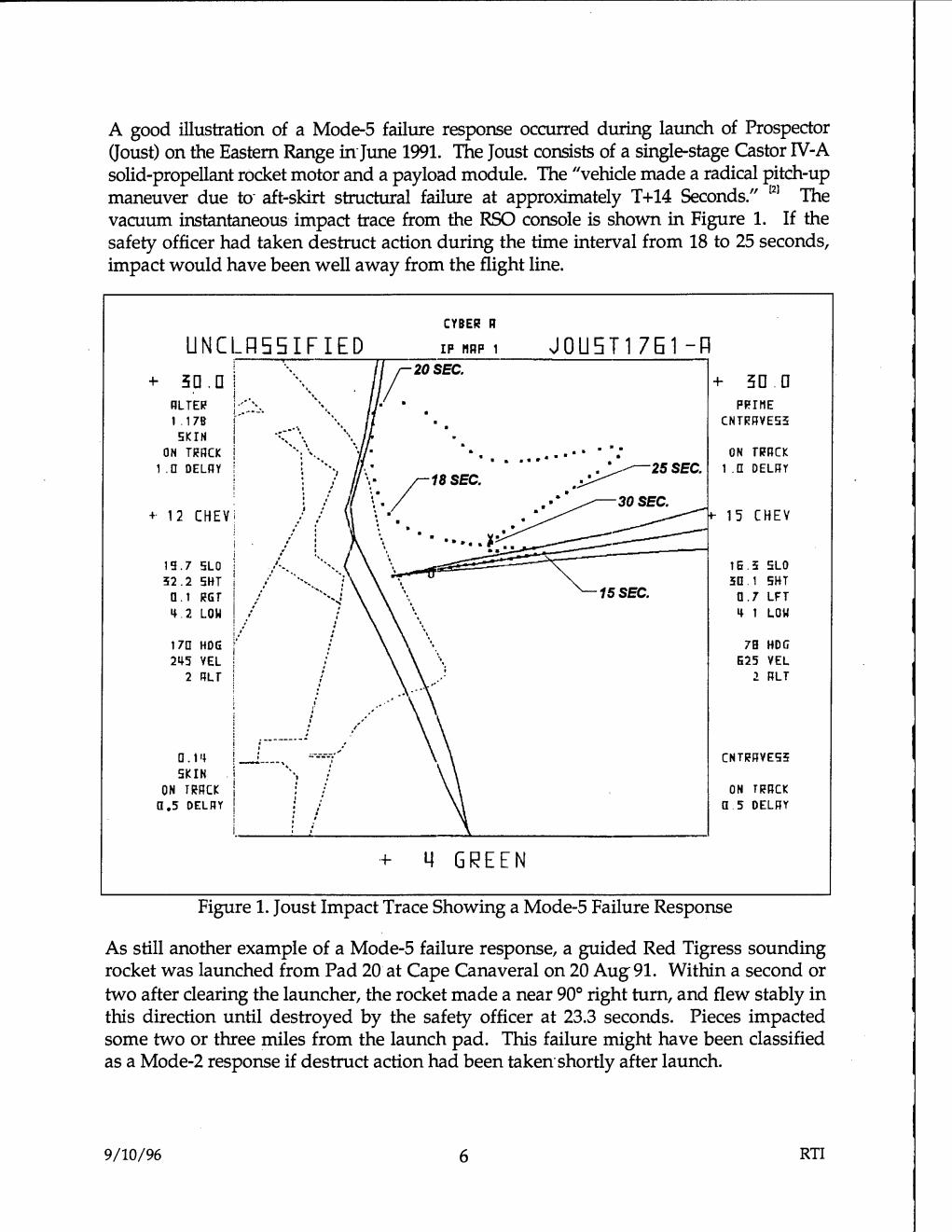
Page 15 shows Figure 1, "Joust Impact Trace Showing a Mode-5 Failure Response" from a rocket launch-failure example. The figure is a trajectory/impact trace used for range-safety modeling, not a UFO photograph.
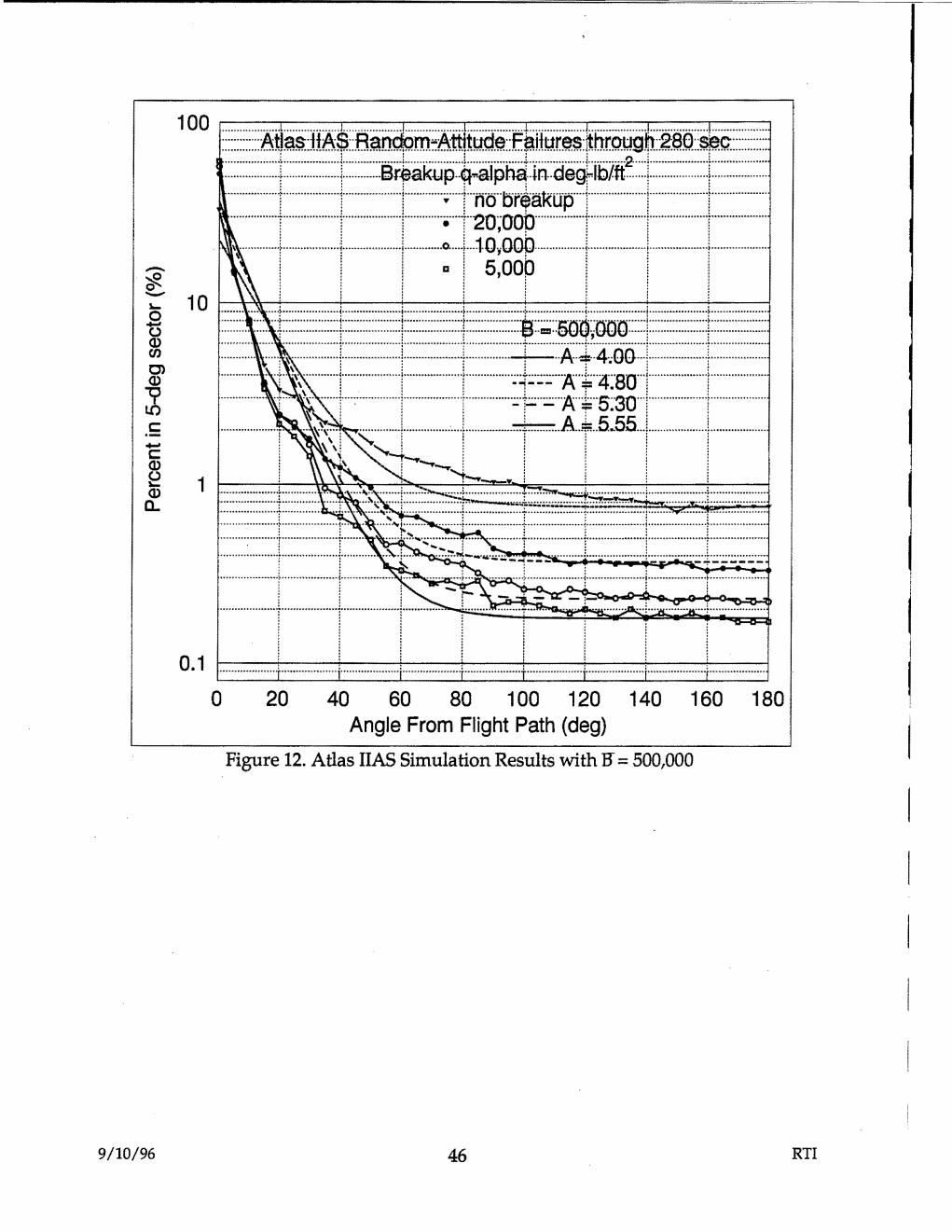
Page 55 is a technical simulation graph for Atlas IIAS random-attitude failures and Mode-5 shaping constants. It is a model-output chart, not a sensor frame.
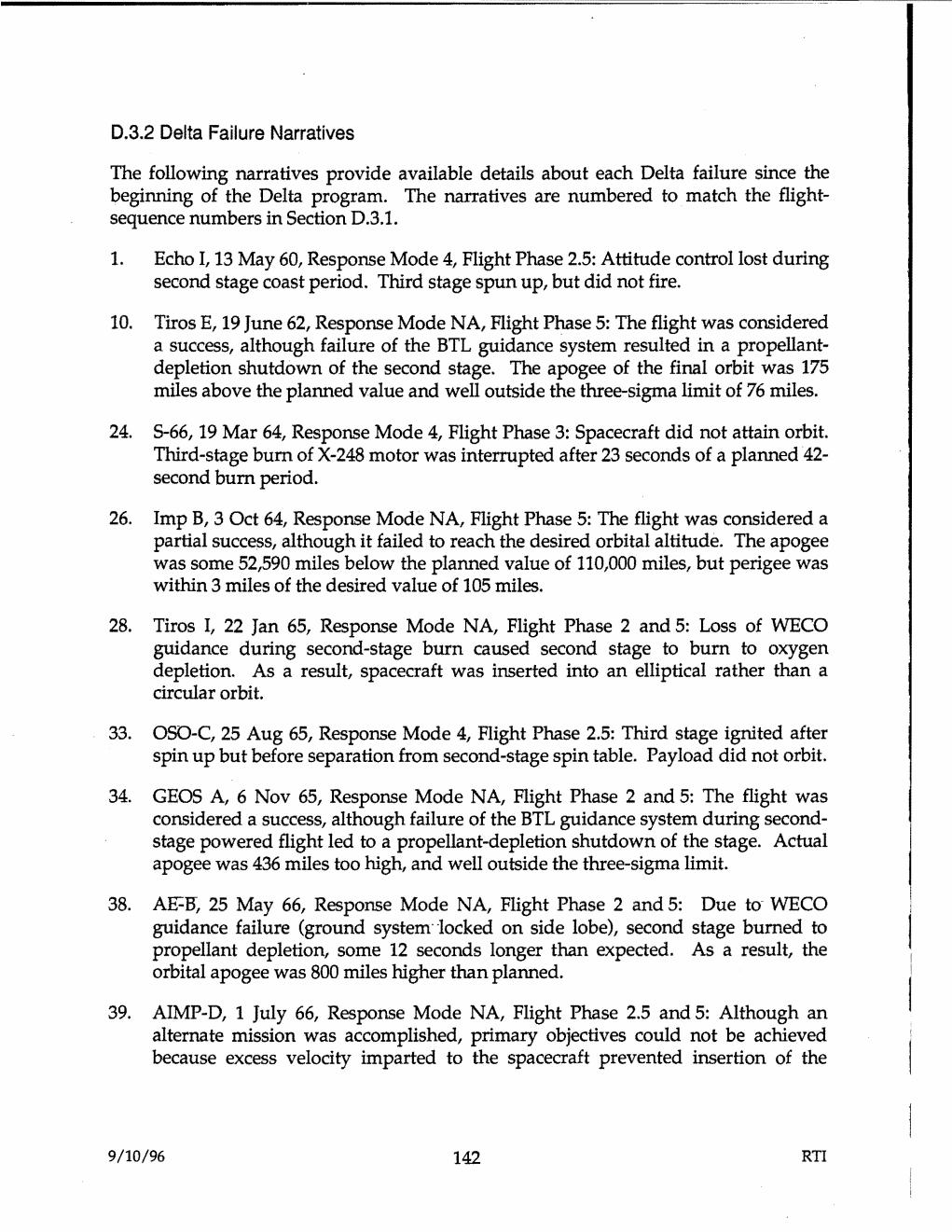
Page 151 begins the Delta launch-failure narrative appendix, listing historical flight anomalies and response-mode classifications. It is launch-history text, not photographic evidence.
Investigation reading
D48 is a 181-page scanned technical report, not a sighting narrative or imagery packet. The cover identifies it as Research Triangle Institute report RTI/5180/77-43F, dated September 10, 1996, titled "Modeling Unlikely Space-Booster Failures in Risk Calculations" and prepared for the Department of the Air Force 45th Space Wing Safety Office at Patrick AFB and 30th Space Wing Safety Office at Vandenberg AFB.
I reviewed the complete released PDF through the Open Sky release-file copy, the full OCR text, document metadata, graph context, targeted full-document searches, and rendered-page spot checks. The OCR has 181 page markers and 181 pages with text. The PDF metadata also reports 181 pages and a 22,495,083-byte file. Visual spot checks of the cover, contents, example trajectory figure, risk-contour figure, summary, Appendix D launch-history pages, radar-reference pages, and references confirm that the file is a scanned report with text, tables, graphs, and launch-risk figures. I did not see object photographs, UAP imagery, radar plots, sensor frames, or video stills in the sampled rendered pages.
Public reading map:
| PDF pages | What is covered |
|---|---|
| 1-3 | Cover, report metadata, distribution statement, report-documentation page, abstract. |
| 4 | Abstract: Mode-5 failure-response modeling, empirical launch history, Atlas/Delta/Titan failure probabilities. |
| 5-9 | Table of contents, figure list, and table list. |
| 10-15 | Introduction and examples showing why a Mode-5 failure response is needed, including Atlas, Titan, Delta, Joust/Prospector, and Red Tigress launch-failure examples. |
| 16-21 | Explanation of the DAMP Mode-5 impact-density model and launch-area risk contours. |
| 22-39 | Methodology and computed failure probabilities, including tables of Atlas, Delta, Titan, Thor, and combined launch-failure counts. |
| 40-82 | Simulation work for shaping constants: random-attitude turns, slow turns, breakup assumptions, Atlas IIAS/Delta-GEM/Titan IV/LLV1 simulations, ship-hit contours, and range distributions. |
| 83-87 | Summary and recommended values/tables for failure probabilities, response-mode percentages, and Mode-5 shaping constants. |
| 88-104 | Appendices A-C: DAMP response-mode definitions and filtering methods. |
| 105-179 | Appendix D launch and performance histories for Atlas, Delta, Titan, and Thor, including narrative failure entries and launch-history tables. |
| 180-181 | References. |
The report's own abstract says the appendix lists Atlas, Delta, and Titan missile and space-vehicle launches from the Eastern and Western Ranges through August 1996, with entries for configuration, success/failure, failure phase, and response-mode classification. That matches the full-page pass: the back half of the file is mostly launch-history data and brief failure narratives.
What the file appears to contain
The core subject is launch-area risk modeling for space boosters. The report explains that most catastrophic launch failures produce debris near the intended flight line, but less common failures can send a vehicle uprange or away from the flight line. In the DAMP risk-analysis program, those off-flight-line hazards are modeled as Mode-5 failure responses.
The early sections define the problem in engineering terms. Page 10 says typical failure outcomes include premature thrust termination, stage ignition failure, tank rupture or explosion, or rapid out-of-control tumble. It then separates those from less likely malfunctions, such as control failures or guidance-platform errors, that can cause a sustained turn away from the flight line. Page 11 states the Mode-5 model is intended to allow impacts in any direction from the launch point within the vehicle's range capability, with probability decreasing as the impact moves farther from the flight line and launch point.
The examples section is useful investigative context because it gives concrete launch-failure behaviors rather than abstract equations. Pages 12-15 summarize examples such as Atlas 8E in 1961, Titan M-4 in 1961, Atlas/Mariner R-1 in 1962, Delta Intelsat III in 1968, Delta Pioneer E in 1969, Atlas 68E in 1980, Prospector/Joust in 1991, and a Red Tigress sounding rocket in 1991. The Joust page includes a console-style impact-trace figure labeled "Figure 1. Joust Impact Trace Showing a Mode-5 Failure Response". That is a trajectory/impact-risk exhibit, not a UFO image.
The central technical body estimates failure probabilities from historical launch data, then compares simulated malfunction-turn impacts against theoretical Mode-5 distributions. Page 33 gives predicted failure probabilities for Atlas, Delta, and Titan for flight phases 0-1 and 0-2: Atlas 0.022 / 0.031, Delta 0.010 / 0.013, and Titan 0.040 / 0.064. Pages 34-35 count response-mode failures across 1,186 flights, including Atlas, Delta, Titan, and Eastern-Range Thor records. Pages 83-87 repeat summary tables and state that empirical data were insufficient to determine Mode-5 shaping constants by history alone, so the authors used simulated random-attitude and slow-turn failures.
Appendix A is important because it defines the response-mode vocabulary. It describes Mode 1 as a vehicle toppling or falling back near the launch point; Mode 2 as loss of control shortly after liftoff; Mode 3 as near-vertical flight after failure to pitch-program normally; Mode 4 as failure with impacts near the intended flight line; Mode 5 as impact possible in any direction from the launch point within range capability; and Mode 6 as normal impacts of separated stages/components. Appendix D then applies those categories to historical launch records.
Targeted searches across the full OCR found no occurrences of UFO, UAP, unidentified, or flying saucer. The word unknown appears only in ordinary engineering/statistical contexts. The visible content is about launch-vehicle failures, range safety, risk modeling, and historical booster performance. Its Release 01 relevance appears to be archival/source inclusion, not a direct UAP sighting report.
Source custody and provenance
- Official/source URL: https://www.war.gov/medialink/ufo/release_1/dow-uap-d48-report-september-1996.pdf
- Open released file: war-gov-dow-uap-d48-department-of-the-air-force-report-1996-17a8cc07
- Official CSV row:
54 - Agency in Release 01 record: Department of War
- Source kind: PDF
- File size verified from the release metadata and release-file copy: 22,495,083 bytes
- SHA-256 verified from the release metadata and release-file copy:
0dc72877cdf9cc3a1645c3c9d282928922b00e8fd9ffd7b1daf66f46c72b2071 - PDF metadata: 181 pages; title/subject "DOW-UAP-D48, Report, September 1996"; modified May 7, 2026; encrypted with copy restrictions but printable.
- OCR coverage: 181 page markers, 181 text-bearing pages, 270 OCR chunks.
The release record gives incident date 9/10/96 and location N/A. The report itself is dated September 10, 1996, and its contents are a technical study plus launch-history appendix, not one incident at one location.
Graph context
The graph has an official Release 01 record for CSV row 54 and a PDF asset record for this file. The asset record carries the official URL, canonical URL, source dataset, PDF document type, and the verified SHA-256 hash above.
The semantic extraction layer is dense because this is a long technical PDF: 1,909 extracted claim records, 914 entity mentions, 5 sensor-event records, and 45 table-row extractions. Those records are useful navigation cues, but they should not be treated as findings. Many extraction categories are over-broad for this file: ordinary technical phrases about launch-vehicle motion, impact, failure, and risk appear as object or observation descriptors.
The sensor-event records need special caution. The two RADAR examples are text-only launch-history lines: one Atlas entry says a radar operator reported multiple pieces after the instantaneous impact point stopped moving, and one Titan entry says radar tracked a ballistic-type trajectory after rate and track beacons were lost. The IR examples come from payload or mission names such as GALAXY-IR, not infrared UAP evidence. The Aircraft example comes from a company name in a Delta launch-history paragraph. None of the checked pages shows a raw radar plot, infrared frame, object photograph, or other independent sensor exhibit.
No candidate crosslink records surfaced in the selected context. Related-record links should be treated as provenance/navigation only unless a future review establishes an actual content relationship.
Leads to check
- Verify why D48 was included in Release 01: it may be a launch-risk/prosaic-correlation reference rather than a UAP case file.
- Compare the WAR.GOV PDF against any DTIC or Air Force catalog copy of RTI/5180/77-43F / 303O-TR-96-12 to confirm page count, metadata, and distribution markings.
- Audit row-number consistency across derived records. The selected Release 01 record is row 54; any stale derived reference to a different row should be corrected at the metadata layer.
- Treat Appendix D launch-history entries as possible child-source leads for launch-anomaly/prosaic-correlation work, not as UAP sightings.
- If this file is used for public education, frame it as range-safety and launch-failure context: how conventional booster malfunctions can create unusual trajectories, debris, radar/operator reports, and visual confusion.
- Revisit the graph extraction rules for long technical PDFs so payload names like
GALAXY-IR, company names likeDouglas Aircraft, and historical radar-language snippets do not inflate UAP sensor-evidence impressions.
Lead check notes
- Checked — Release 01 inclusion: current release metadata identifies this as a PDF for CSV row
54with an official description about modeling unlikely space-booster failures. Full OCR search found noUFO,UAP,unidentified, orflying saucer;unknownappears only in technical/statistical contexts. The PDF does not explain why the release selected this report, so the rationale remains a release-context question. - Needs external source — DTIC/Air Force catalog comparison: the PDF itself shows report identifiers
RTI/5180/77-43Fand303O-TR-96-12, 181 PDF pages, and the distribution markings quoted above. The current linked Release 01 corpus contains those exact report-number/title anchors only in this D48 OCR, so confirming an independent DTIC or Air Force catalog copy requires an outside catalog/source record. - Checked — Row consistency: the current release metadata for this asset resolves to CSV row
54and the verified official URL/hash above. Any conflicting derived row reference should be handled as metadata cleanup, not as evidence for a separate source document. - Partial — Appendix D child-source leads: the rendered pages and OCR confirm historical Atlas, Delta, Titan, and Thor launch-failure histories. Those entries are useful for launch-anomaly and prosaic-correlation work, but each child entry would need its original range history, accident report, or catalog source before being treated as a standalone evidence page.
- Checked — Public framing: the rendered pages show a report cover, a Joust impact trace, a simulation graph, and launch-history text. They support range-safety/launch-failure context and do not provide object photographs, UAP imagery, radar plots, or video frames.
- Partial — Extraction cleanup: current graph context surfaces radar-language snippets and
GALAXY-IRpayload-name text as sensor examples. Page review supports treating those as launch-history or payload-text artifacts unless a separate raw sensor source is found.
Deep investigation — graph + web reconnaissance
Source reread and media audit
The deep reread confirms that D48 is a technical launch-risk report, not a witness statement, UAP image packet, or sensor case file. The verified PDF is 22,495,083 bytes, SHA-256 0dc72877cdf9cc3a1645c3c9d282928922b00e8fd9ffd7b1daf66f46c72b2071, and the PDF metadata reports 181 pages under the title/subject "DOW-UAP-D48, Report, September 1996". The internal cover identifies the report as RTI/5180/77-43F / 303O-TR-96-12, "Modeling Unlikely Space-Booster Failures in Risk Calculations," dated September 10, 1996, and prepared for the Air Force 45th Space Wing and 30th Space Wing safety offices.
Representative page renders were rechecked against the OCR. Page 1 is the report cover; page 15 is a Joust range-safety impact-trace figure; page 55 is an Atlas IIAS Mode-5 simulation chart; and page 151 begins Delta failure narratives. Those images are technical-report figures and launch-history text, not UAP photographs, radar plots, or infrared/video frames. Full-text checks again found no UFO, UAP, flying saucer, or unidentified hits. The report uses words like anomalous in the ordinary launch-performance sense: failures, non-normal vehicle behavior, response modes, and risk modeling.
Read-only graph connections
Read-only graph checks found one official Release 01 PDF asset for the exact WAR.GOV URL and hash, plus the current Release 01 record for CSV row 54. The same asset has 272 linked text chunks, 1,909 machine-extracted claims, 914 entity mentions, 45 table-row extractions, and five machine-extracted SensorEvent records. Those graph records are navigation aids only: their confidence / review_status fields keep them in unreviewed_machine_extract / machine_extracted_needs_human_review, and no Finding, Hypothesis, or ResolutionDecision is implied here.
The five SensorEvent records illustrate why this page needs human review before graph promotion. Two RADAR snippets are launch-history text: an Atlas failure where a radar operator reported multiple pieces after the instantaneous impact point stopped moving, and a Titan II entry where radar tracked a ballistic-type trajectory after beacons were lost. Two IR snippets come from the payload name GALAXY-IR, not infrared evidence. One Aircraft snippet comes from Douglas Aircraft Company in the Delta launch-history section. These should be treated as extraction artifacts or launch-history context unless a separate raw sensor source is identified.
The graph also shows provenance-cleanup work still to do. The current row linkage resolves D48 to CSV row 54, while older source-pack/manifest residue still points at a row-57/D50 relationship whose relationship metadata is no longer current. A secondary GitHub markdown conversion is linked as a derived copy of the official asset; it is useful for navigation but not a replacement source of record. No CANDIDATE_CROSSLINK relationship touched the D48 asset in the checked graph context, and exact 1996 LaunchEvent graph coverage did not surface a structured counterpart for the report's Appendix D launch-history table.
Official and archive web reconnaissance
Direct official WAR.GOV fetches for the D48 PDF, Release 01 landing page, and current CSV returned 403 Forbidden during this check, which matches the known official-server access pattern and is not a source-integrity failure because the release-file copy verifies by size and hash. Internet Archive CDX did return an exact-URL capture for https://www.war.gov/medialink/ufo/release_1/dow-uap-d48-report-september-1996.pdf at 20260508141528 with status 200 and MIME type application/pdf, providing external custody support for the canonical URL.
DTIC Discover title/report-ID checks reached the official DTIC results page for the report title, RTI/5180/77-43F, and 303O-TR-96-12, but the fetched HTML did not expose a citable accession or PDF record. Those identifiers remain follow-up handles for a DTIC/Air Force catalog comparison. Until a separate catalog copy is pinned, the WAR.GOV Release 01 file and its verified Open Sky release-file copy remain the source of record for this page.
Prosaic-check posture and open leads
D48 is best modeled as prosaic-correlation infrastructure: it explains how rare booster failures, guidance/control problems, tumbling, destruct actions, uprange impacts, and range-safety tracking can create unusual trajectories or reports. It should not be converted into a standalone sighting. Astronomy, weather, satellite, and aircraft-correlation checks are not meaningful at the document level because the file is a report dated September 10, 1996, not a single observation with a witness time, azimuth, altitude, or location. Those checks belong to individual launch-history entries only after each entry is broken out and tied to original range records.
Follow-up work should therefore be bounded: reconcile the stale row-57/D50 provenance residue, verify any public use of Appendix D tables against original launch/range-history sources, pin an independent DTIC/Air Force catalog record if available, and tune extraction rules so payload names, company names, and historical radar-language snippets do not inflate sensor-evidence impressions.
Audit note
This section was added after source/OCR reread, representative page-render visual review, read-only Neo4j checks, official/archive web reconnaissance, and release-file hash/size verification. It adds context and cleanup leads only; it does not create or assert any finding about a UAP event.
Limits
This page is an investigation draft, not a final human finding. It does not adjudicate why the government release included the file, and it does not infer any UAP event from the launch-risk report. The rendered-page pass sampled high-signal pages and verified the document structure, but did not visually inspect all 181 rendered pages one by one. The full OCR was parsed across all 181 pages and searched for UAP-specific and prosaic terms.
The PDF is a scanned, compressed, copy-restricted document. OCR is strong enough for document-level reading and targeted searches, but individual table cells, figure labels, and old launch-history entries should be checked against rendered page images before being used in any precise quantitative analysis.
Sources
- WAR.GOV / PURSUE Release 01 PDF: DOW-UAP-D48, Department of the Air Force Report, 1996
- Open Sky released-file viewer endpoint: war-gov-dow-uap-d48-department-of-the-air-force-report-1996-17a8cc07
- Release 01 CSV row
54metadata preserved in the Open Sky release metadata. - PDF internal title: "Modeling Unlikely Space-Booster Failures in Risk Calculations", RTI Report No. RTI/5180/77-43F, September 10, 1996.
- Verified source hash:
0dc72877cdf9cc3a1645c3c9d282928922b00e8fd9ffd7b1daf66f46c72b2071.