DOW-UAP-D49, Launch Summary, Vandenberg AFB, 2000
Evidence media
- Official PDF: Open Sky release-file copy — a 113-page scanned launch-history register, verified against SHA-256
0dd7855ac3c69e39a9752c53fe6ba3e851d617e28adfcbf07c3ec93907877cf7. - Derived page renders from the official PDF:
Page 1 is the title page for "Vandenberg AFB Launch Summary 1958 - 2000" from the 30th Space Wing Office of History. It is an administrative cover page, not object imagery.
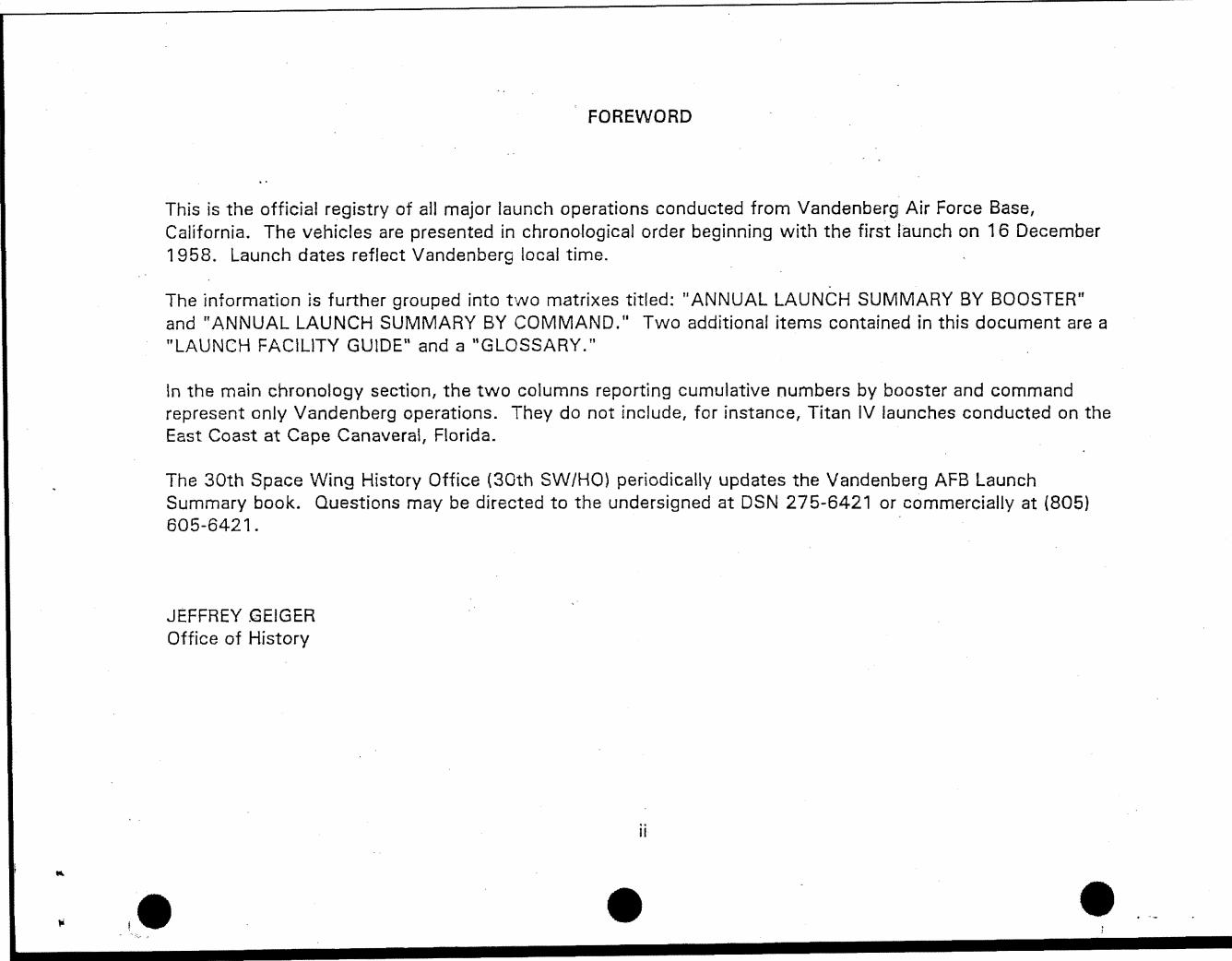
Page 3 is the foreword, which defines the file as the official registry of major launch operations from Vandenberg Air Force Base and says launch dates reflect Vandenberg local time.
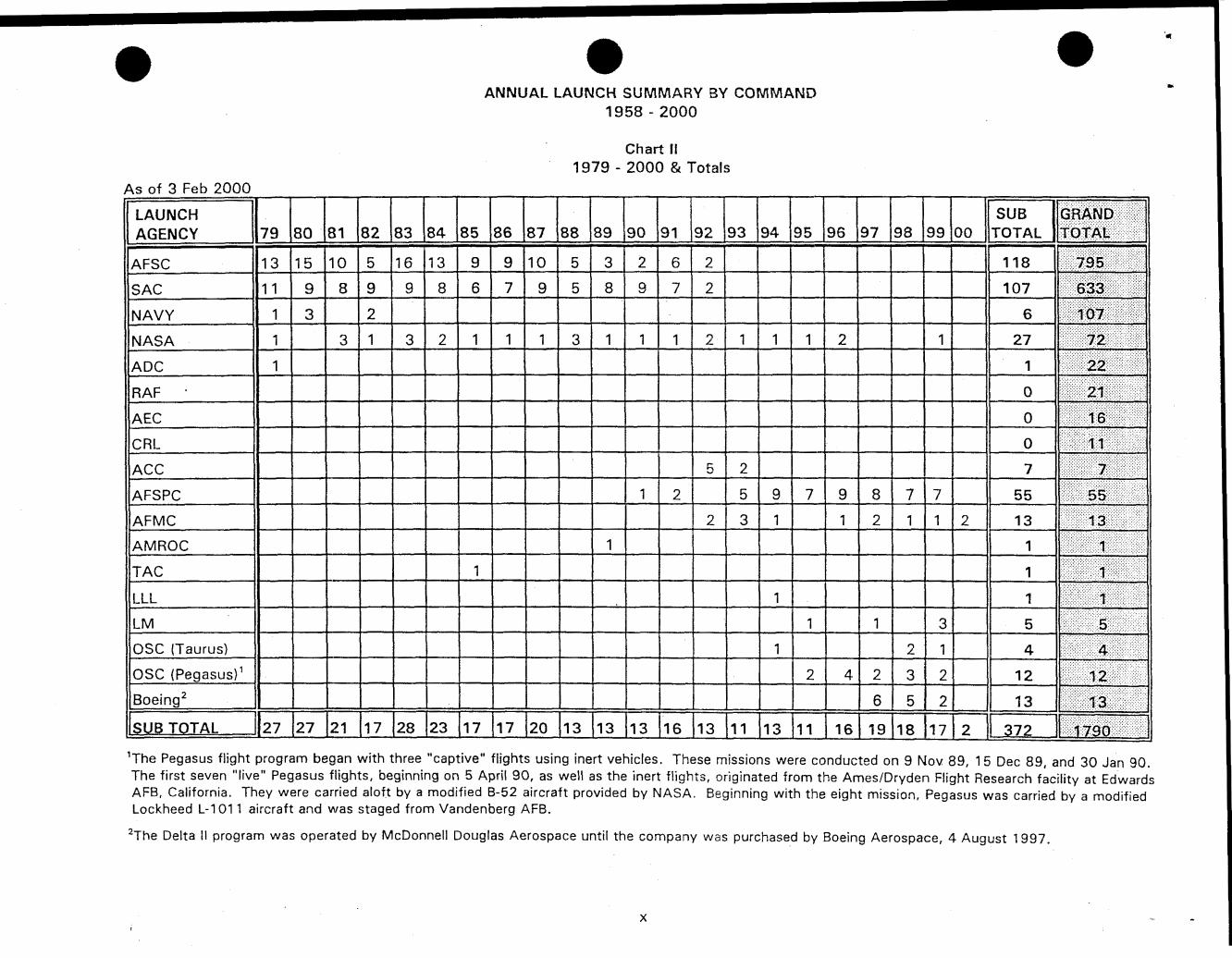
Page 11 shows the annual launch-summary-by-command table for 1979-2000 and totals, including the note about Pegasus captive/live flights and B-52/L-1011 carrier-aircraft staging.
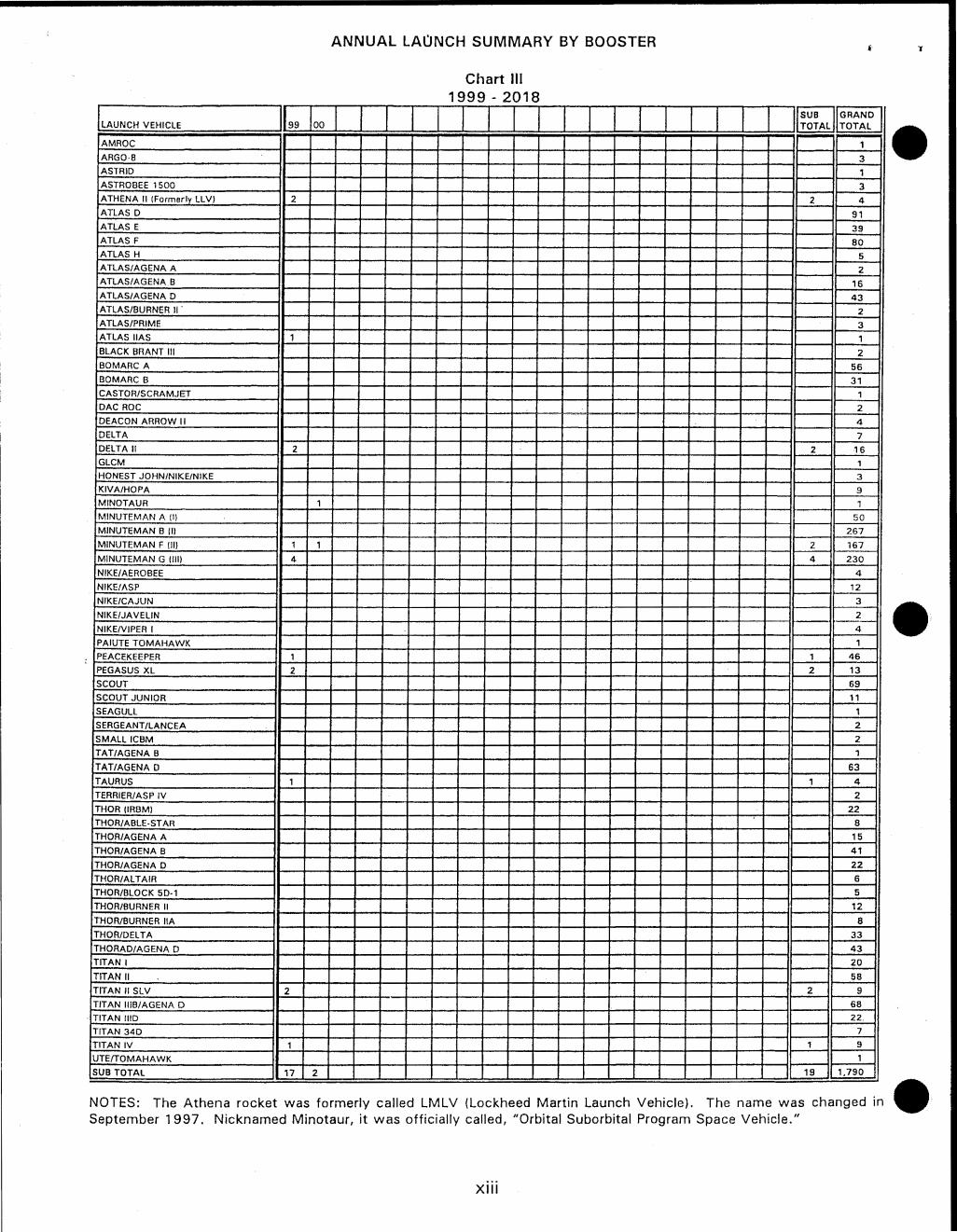
Page 14 shows Chart III of the annual launch summary by booster. The rendered page visibly carries the source label "1999 - 2018" while the populated columns visible in this release page are 99 and 00, so the label remains a source/metadata review point.
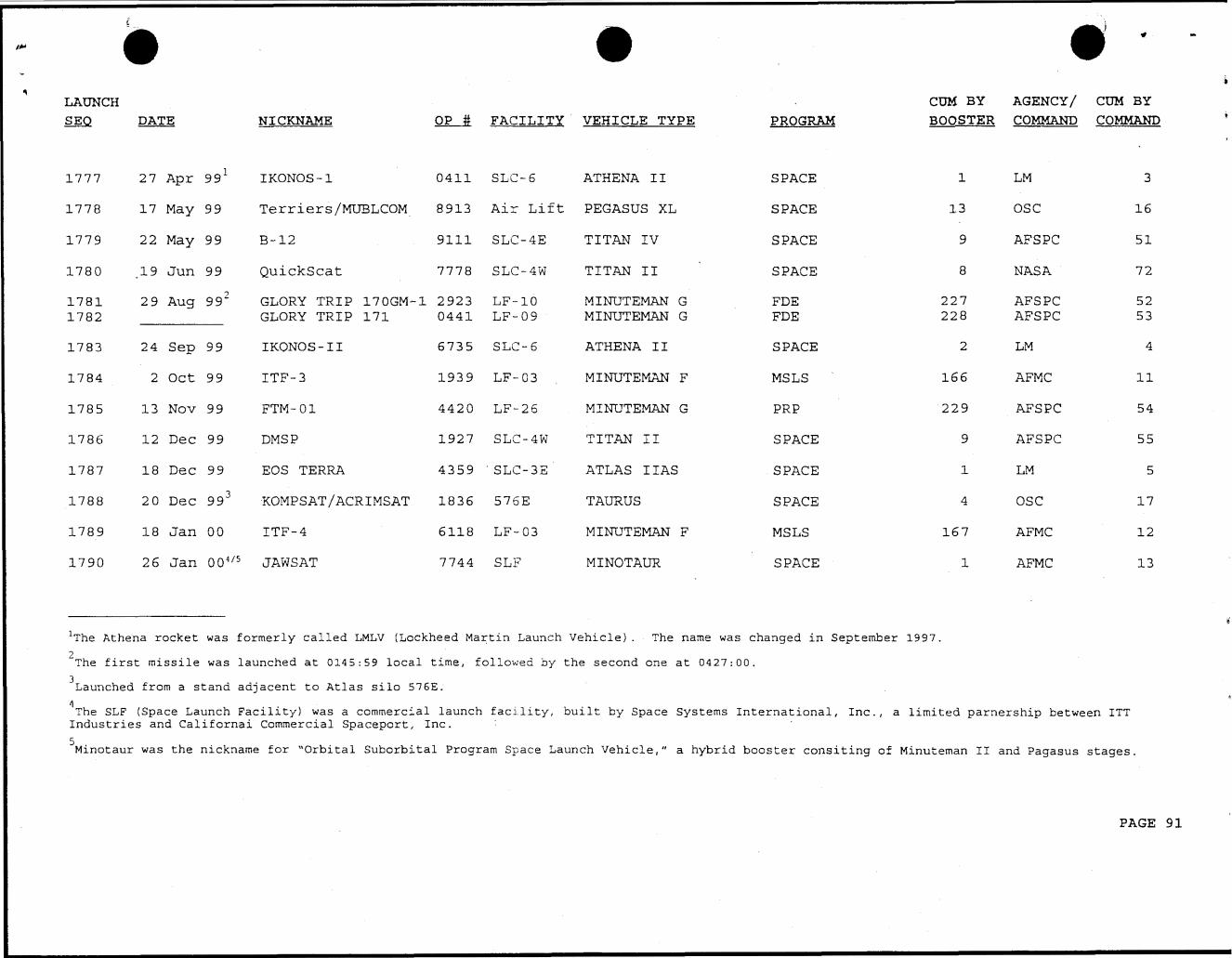
Page 105 is the end of the chronological register. The final visible entry is launch sequence 1790: 26 Jan 00 / JAWSAT / MINOTAUR / SPACE from SLF, with agency/command AFMC.
Investigation reading
This page treats the file as a source document, not as an adjudicated UAP event. Review covered the full 113-page PDF through the available OCR/text coverage, checked the Open Sky release-file copy against the recorded SHA-256 hash, compared the PDF page count and text layer, ran targeted searches across the complete document, and rendered representative pages for visual inspection.
Coverage checked:
- PDF page count:
113. - Release-file size:
9,090,715bytes. - SHA-256:
0dd7855ac3c69e39a9752c53fe6ba3e851d617e28adfcbf07c3ec93907877cf7. - OCR coverage:
113 / 113pages with text. - Full-document targeted searches found no hits for
UAP,UFO,unidentified,flying saucer, orsaucerin the OCR text. - Representative visual renders checked: title page, foreword, annual-summary charts, the start and end of the launch chronology, launcher-status tables, glossary, and index. Those rendered pages show scanned text/tables only, with no visible object photographs, radar plots, maps, infrared frames, video stills, or sensor screenshots.
The source is therefore best read as a Vandenberg launch-history reference file that can be useful for prosaic launch-correlation work, not as a standalone UAP sighting report.
What the file appears to contain
The visible title page reads “Vandenberg AFB Launch Summary 1958 - 2000” and identifies the 30th Space Wing Office of History. The foreword describes the document as the official registry of major launch operations conducted from Vandenberg Air Force Base, California, beginning with the first launch on 16 December 1958. It says launch dates are in Vandenberg local time and that the information is organized into annual launch-summary matrices, a launch-facility guide, a glossary, and a chronological launch list.
At packet level, the document reads like an administrative launch register:
| PDF pages | Content read-through | Investigation notes |
|---|---|---|
| 1 | Cover/title page | “Vandenberg AFB Launch Summary 1958 - 2000,” 30th Space Wing Office of History. |
| 2 | Distribution list | Recipients include Vandenberg/USAF space offices, NASA, Aerospace Corporation, Boeing, TRW, JPL, Kennedy Space Center, and Orbital Sciences. |
| 3 | Foreword | Defines the file as the official registry of major Vandenberg launch operations; launch dates are local time; cumulative booster/command totals are Vandenberg-only. |
| 4-8 | Glossary | Acronyms and program terms for missiles, satellites, launch complexes, commands, and test programs. Terms such as RADARSAT and RADCAL appear here as satellite/program names, not as released radar evidence for a UAP event. |
| 9 | Launch facility guide | Crosswalk of building numbers, present designations, and former designations for launch facilities. |
| 10-11 | Annual launch summary by command | Tables for 1958-1978 and 1979-2000/totals. The later chart includes notes on Pegasus captive/live flights and the use of NASA B-52 and Lockheed L-1011 carrier aircraft. |
| 12-14 | Annual launch summary by booster | Tables by vehicle/booster. The OCR shows a subtotal/grand total line of 1,789; page 14 also includes Athena/Minotaur nomenclature notes. |
| 15-105 | Chronological launch register | Launch sequence rows with date, nickname, operation or group number, facility, vehicle type, program, cumulative booster count, and command/agency. The first visible row is 16 Dec 58 / TUNE UP / THOR; the late rows include 1999-2000 entries such as IKONOS, Pegasus XL, Titan IV, Delta II, Taurus, Minuteman, and 26 Jan 00 / JAWSAT / MINOTAUR. |
| 106-111 | Vandenberg launcher status and history | Older launcher-status/history tables listing facilities, acceptance dates, first launches, present status, original purpose, last/current use, former designations, and remarks. |
| 112 | Glossary page | Defines launch-site terms such as soft, semi-hard, hard, gantry, split pad, blockhouse, space launch complex, operational system test facility, and similar terms. |
| 113 | Index | Index entries for boosters, programs, commands, facilities, and distribution references. |
High-signal reading anchors for later investigators:
- Page 3 is the clearest scope statement: this is a launch registry, not an incident narrative.
- Pages 10-14 provide aggregate counts by command and booster.
- Pages 15-105 are the useful correlation material: a date-ordered launch sequence for Vandenberg operations.
- Page 105 is especially relevant for the file’s endpoint: it includes late 1999 and January 2000 launch entries, including
JAWSATon26 Jan 00usingMINOTAUR. - Pages 106-111 may be useful for understanding old launch-site names when a sighting report uses a former facility designation.
Source custody and provenance
- Official/source URL: https://www.war.gov/medialink/ufo/release_1/dow-uap-d49-launch-summary-february-2000.pdf
- Open Sky release-file copy: war-gov-dow-uap-d49-launch-summary-vandenberg-afb-2000-775d16ea
- Release 01 CSV row:
55. - Agency: Department of War.
- Source/container type: PDF.
- PDF size:
9,090,715bytes. - SHA-256:
0dd7855ac3c69e39a9752c53fe6ba3e851d617e28adfcbf07c3ec93907877cf7. - OCR status: complete text coverage for
113 / 113pages.
There are provenance issues worth keeping visible. The PDF’s visible cover and foreword identify the document as the Vandenberg AFB Launch Summary 1958-2000, but the embedded PDF metadata title/subject inspected during review reads DoW-UAP-D27. The selected Release 01 asset record is D49 and the official URL also names D49, so the embedded metadata appears to be a file-production or export mismatch rather than evidence that the visible document is D27. This should be checked against the original official file and the release CSV before any downstream deduplication.
The document is an encrypted/copy-restricted scanned PDF, but it contains a text layer and page images. The image structure is one grayscale page image per page, consistent with a scanned administrative packet. That scan structure should not be mistaken for object photography.
Graph context
The Open Sky graph currently models this item as an official Release 01 document asset and a related release-record document. The graph has a large number of extracted claims because the launch register is table-heavy and repeats dates, programs, vehicles, agencies, commands, and launch nicknames across many pages.
Current graph context for this asset:
- Extracted claim records:
696. - Entity mentions:
653. - OCR chunks:
207. - Extracted sensor-event records:
3. - Candidate crosslinks:
0in the current per-asset context.
The three sensor/platform records should be treated as navigation cues, not sensor evidence for a UAP event. One comes from glossary/program terms around RADARSAT and RADCAL; two come from the Pegasus notes that mention NASA B-52 and Lockheed L-1011 carrier aircraft. Those are source-backed launch-history facts, but they are not released radar plots, observation frames, or UAP sensor returns.
The graph also relates this document to other Release 01 records/documents. In this draft, those relationships are not interpreted as incident-level connections. They need separate provenance review before being used as evidence of a substantive case relationship.
Leads to check
- Metadata mismatch: confirm why the PDF metadata title/subject reads
DoW-UAP-D27while the official URL, Release 01 row, and visible document title identify this asset as D49 / Vandenberg Launch Summary. - Release row/date cleanup: the selected asset context uses CSV row
55and no incident date/location, while one manifest-style graph text chunk appears to mention a different related row and an incident date of2/3/00. Verify the current official CSV and decide whether3 February 2000should be modeled as the report “as of” date rather than an incident date. - Chart/count tension: the booster summary OCR shows a subtotal/grand-total line of
1,789, while the chronological register visible on page 105 reaches sequence1790for26 Jan 00/JAWSAT/MINOTAUR. Treat this as a source/table reconciliation lead, not a corrected count. - Chart III label: the OCR reads one booster chart as
1999 - 2018even though the cover is1958 - 2000and the visible columns appear focused on99and00. Check a higher-quality render or the official source to determine whether this is an OCR/scan artifact, a template label, or a real source inconsistency. - Correlation utility: if this file is used operationally, the valuable next step is to split the launch chronology into a structured date/facility/vehicle index for prosaic correlation against sighting dates near Vandenberg and nearby Pacific test ranges.
- Release rationale: because full-text search found no
UAP,UFO, orunidentifiedterms, verify why this launch register was included in PURSUE Release 01: likely contextual/prosaic correlation value, but that should be documented rather than assumed.
Lead check notes
- Partial — Metadata mismatch: PDF metadata reports title/subject DoW-UAP-D27, while the rendered title page, foreword, official URL, and release metadata identify this file as DOW-UAP-D49, Launch Summary, Vandenberg AFB, 2000. The evidence supports treating this as a provenance/export mismatch, but the exact production history needs an official manifest or corrected-file source.
- Partial — Release row/date cleanup: current linked release metadata is inconsistent: one Open Sky release record carries row
55, while the downloaded release CSV places the D49 record at data row58and gives Incident Date2/3/00, locationN/A. Page 2 of the PDF says "As of: 3 February 2000", so2/3/00is source-backed as an as-of/report date; modeling it as a sighting incident date would need a separate official clarification. - Checked — Chart/count tension: the page-14 render shows a grand total of
1,790, and page 105 ends at launch sequence1790for26 Jan 00/JAWSAT/MINOTAUR. Any1,789reading should be treated as OCR/table extraction noise unless another source page supports it. - Checked — Chart III label: the higher-visibility page-14 render does show "1999 - 2018" on Chart III even though this release document is titled 1958-2000 and the visible populated columns are
99and00. That remains a source/template label issue rather than an Open Sky correction. - Partial — Correlation utility: the rendered foreword and chronology pages confirm the document's value as a Vandenberg launch-date/facility/vehicle register. Turning it into a structured prosaic-correlation index would require separate extraction and table QA, especially for date/facility/vehicle cells.
- Needs external source — Release rationale: the selected D49 OCR contains no hits for
UAP,UFO,unidentified,flying saucer, orsaucer. The release description says it summarizes Vandenberg launches from 1958 to 2000, but it does not explicitly state why the file was included; the prosaic-correlation rationale remains a reasonable lead, not a documented release explanation.
Deep investigation — graph + web reconnaissance
Source reread
This deeper check keeps the page in the same evidentiary posture: D49 is a launch-history source, not a UAP sighting narrative. The verified release-file copy is a 9,090,715 byte, 113-page PDF with SHA-256 0dd7855ac3c69e39a9752c53fe6ba3e851d617e28adfcbf07c3ec93907877cf7. pdfinfo reads the embedded title/subject as DoW-UAP-D27, while the visible title page, the official Release 01 URL, and the release CSV title identify the file as DOW-UAP-D49, Launch Summary, Vandenberg AFB, 2000; that is a production/metadata mismatch to reconcile, not a reason to treat the visible packet as D27.
Representative rendered-page review supports the administrative-source reading. Page 3 says the file is the official registry of major launch operations from Vandenberg Air Force Base, with launch dates in Vandenberg local time. Page 14 is Chart III under Annual Launch Summary by Booster and visibly carries a 1999 - 2018 label even though only 99 and 00 are populated in this release page; the bottom total is legible as 1,790. Page 105 is table text, not object imagery, and ends with sequence 1790, 26 Jan 00, JAWSAT, MINOTAUR, facility SLF, program SPACE, agency/command AFMC. Full OCR term checks found no UAP, UFO, unidentified, flying saucer, or saucer hits.
Graph connections reviewed
Read-only graph review found an exact official PDF asset node for the canonical URL and hash, connected to 209 text chunks, 696 machine-extracted Claim nodes, 653 EntityMention nodes, and 3 SensorEvent nodes. The claim nodes sampled here are still marked machine_extracted_needs_human_review; they mostly preserve source identifiers, organizations, places, years, launch-program words, and the release description. They should not be promoted into findings.
The three SensorEvent nodes are extraction artifacts from source text, not UAP sensor evidence. One comes from glossary/program terms around RADARSAT and RADCAL; two come from the Pegasus notes about NASA B-52 and Lockheed L-1011 carrier aircraft. Those are useful launch-history facts, but they are not radar plots, observation frames, or anomalous-object sensor returns. A focused check of graph LaunchEvent records found no modeled 2000 Vandenberg/JAWSAT/Minotaur event, so this PDF remains source material for a future launch-correlation index rather than already-structured launch telemetry in the graph.
Graph provenance also preserves the row-number tension already noted on this page. The release-record relationship still carries current row 55, while the manifest-description enrichment points to row 58; a stale relationship to a D51 release record appears with current_in_official_csv: false. Treat those as row-shift/dedupe cleanup leads. A secondary UFO-USA Markdown conversion is linked as derived from the official asset, but it remains a convenience derivative; the official Release 01 PDF is the source of record.
External provenance and prosaic checks
Direct fetches of the current WAR.GOV PDF, Release 01 CSV, and WAR.GOV UFO landing page returned 403 Forbidden during this check, so the verified cached official-primary file and the mirrored/downloaded release CSV are the reliable custody anchors available here. The downloaded release CSV line for D49 lists Incident Date 2/3/00 and Incident Location N/A; page 2 of the PDF reads "As of: 3 February 2000", so that date should be modeled as a report/as-of date unless a separate official source identifies a UAP incident. Internet Archive CDX/availability probes for the exact PDF URL were unavailable or rate-limited during this run, leaving archived-capture verification as a follow-up lead.
No meaningful weather, astronomy, satellite, or aircraft-correlation result should be asserted from D49 alone. The file is itself a prosaic-correlation reference: it can help check whether a reported light, missile plume, reentry, target, satellite, or launch-complex activity near Vandenberg overlaps a known launch date/facility/vehicle. Those checks require a separate sighting time, location, line of sight, and source report before escalation.
Follow-up leads
- Reconcile the D49 visible title/URL/hash against the embedded
DoW-UAP-D27PDF metadata. - Resolve the Release 01 row-number tension (
55relationship vs58manifest-description/downloaded CSV line) and the stale D51 relationship before using row numbers operationally. - Build a page-verified launch index from pages 15-105 with date, sequence, nickname, facility, vehicle, program, and command fields; verify every extracted row visually before using it for case correlation.
- Re-check the
1999 - 2018Chart III label against a higher-quality official copy or corrected source manifest. - Capture an archived/public official source for the exact PDF URL when WAR.GOV or Internet Archive access permits.
Audit note
This section is based on the verified release-file copy, OCR/text review, selected rendered pages, read-only graph queries, and official/archive web probes. No Neo4j writes were made, and no Finding, Hypothesis, or ResolutionDecision is asserted.
Limits
This page does not assert a finding, hypothesis, or resolution. The source is a launch-history register, and this draft should not be cited as evidence that any listed launch was anomalous. The document is useful context for known missile, satellite, target, and launch-complex activity at Vandenberg.
The visual review was representative, not a claim that every pixel of every scanned page has been manually inspected. However, the full OCR/text pass, pdfimages structure, and targeted renders support the packet-level reading: this file is text/table material, not a photographic or sensor-frame release. OCR can still misread digits, dates, chart labels, and tabular columns, so high-stakes correlations should be checked against the rendered page image before use.
Graph extraction counts should also be used carefully. In this file, launch nicknames such as “GLOWING BRIGHT,” “PILOT LIGHT,” or “LONG LIGHT” can look like object/visual descriptors to a machine extractor, but in source context they are launch nicknames or program entries. Likewise, RADARSAT/RADCAL are glossary or launch-register terms, not raw radar evidence.
Sources
- Department of War Release 01 official PDF: DOW-UAP-D49, Launch Summary, Vandenberg AFB, 2000
- Open Sky released-file viewer endpoint: war-gov-dow-uap-d49-launch-summary-vandenberg-afb-2000-775d16ea
- Release 01 asset record: CSV row
55, Department of War, PDF asset. - Verified source hash:
0dd7855ac3c69e39a9752c53fe6ba3e851d617e28adfcbf07c3ec93907877cf7.