DOW-UAP-D52, Email Correspondance, NA, August 2024
Evidence media
- Official PDF: Open Sky release-file copy
Derived page renders from the official PDF:
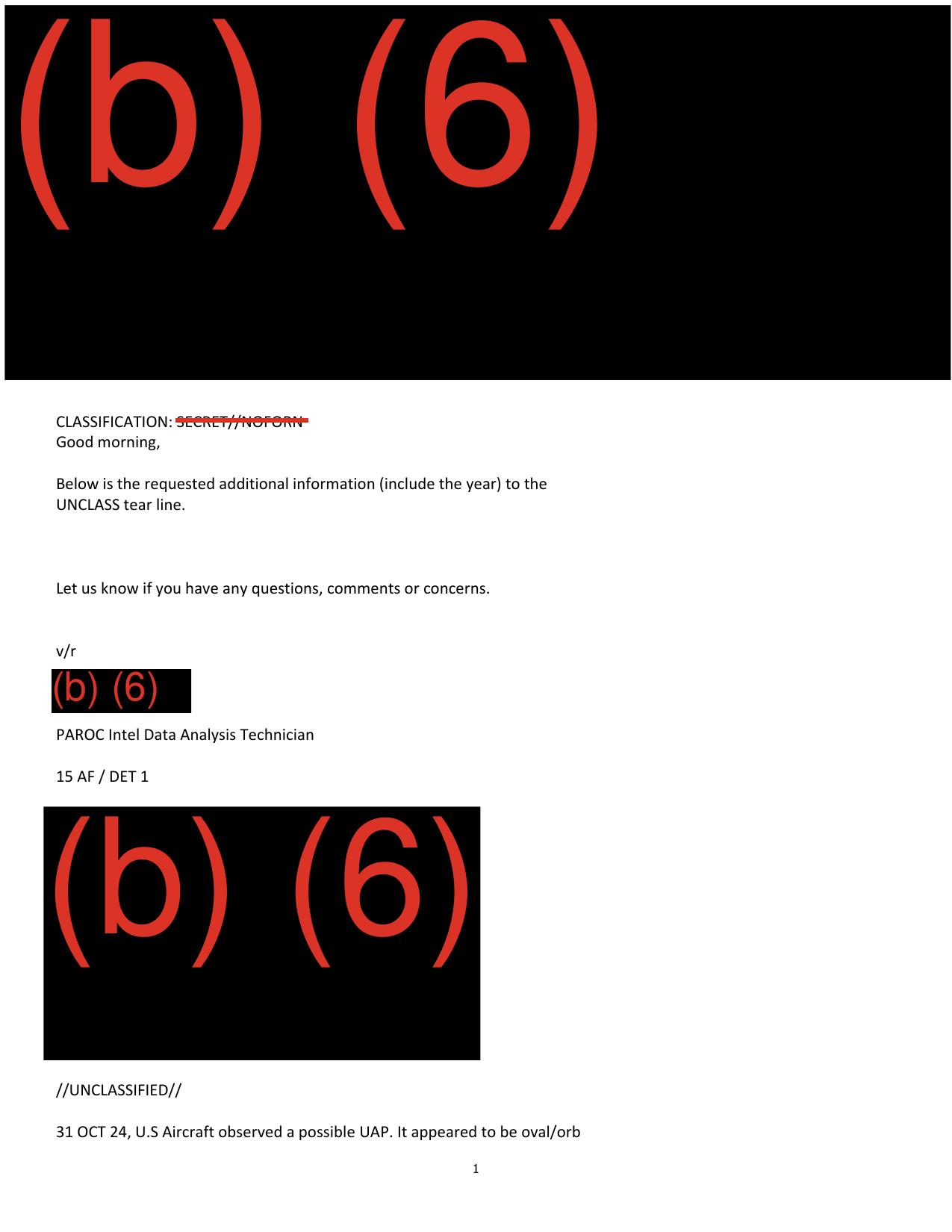
Page 1 shows the release-handling email and the first half of the unclassified tearline: 31 OCT 24, U.S Aircraft observed a possible UAP. It appeared to be oval/orb.
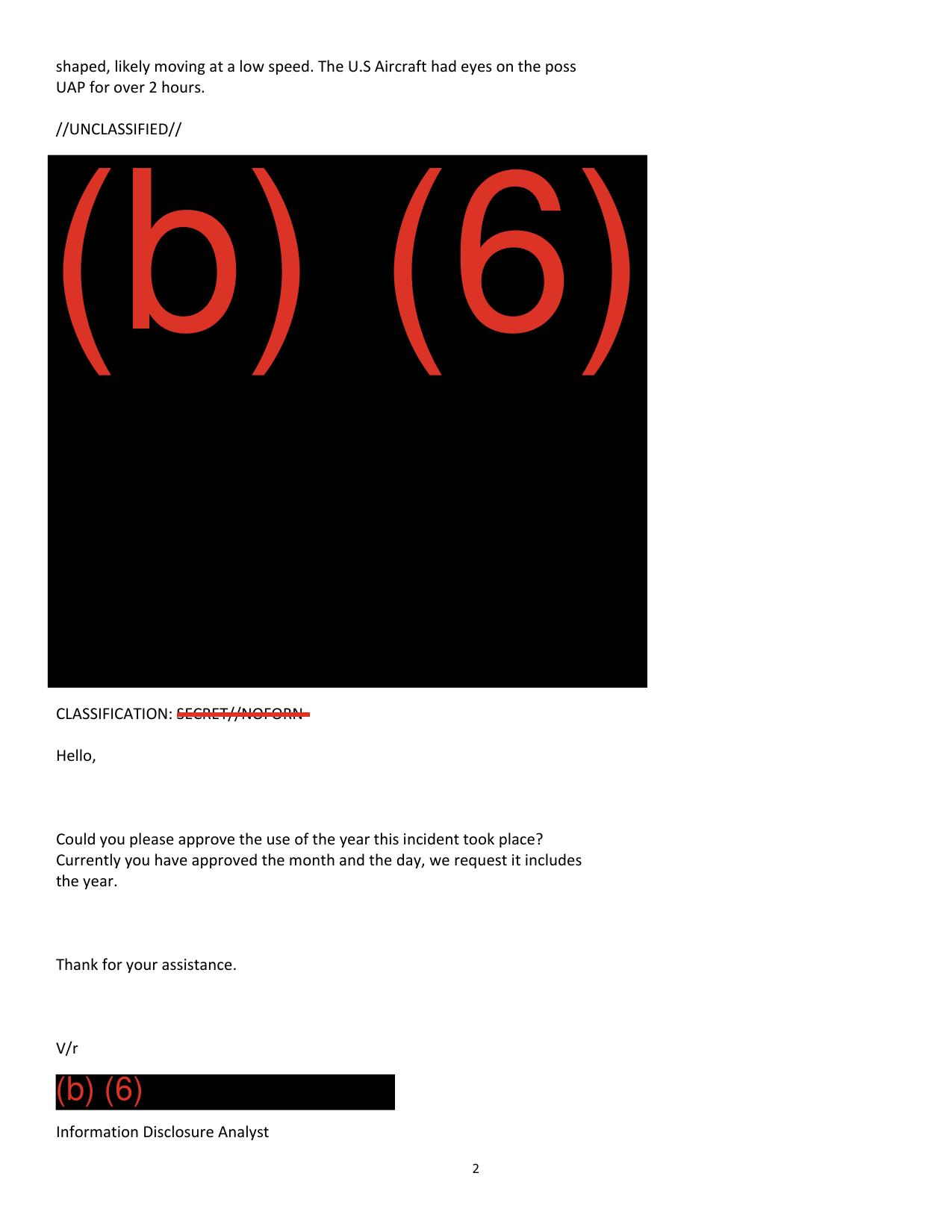
Page 2 continues the same sentence with shaped, likely moving at a low speed and had eyes on the poss UAP for over 2 hours, then asks approval to include the incident year. These renders are source-document pages, not object imagery.
Investigation reading
This released file is a short, two-page PDF of email correspondence. It is not the underlying mission report and it does not include a photograph, map, radar plot, sensor frame, video still, or other direct object imagery. The released pages preserve a request to add the year to an unclassified tearline, plus the tearline text itself.
The useful source reading is narrow. Page 1 says that additional information was being provided to the UNCLASS tear line, then gives an unclassified statement: 31 OCT 24, U.S Aircraft observed a possible UAP. It appeared to be oval/orb. Page 2 continues the sentence: shaped, likely moving at a low speed. The U.S Aircraft had eyes on the poss UAP for over 2 hours. Page 2 then asks for approval to include the year of the incident because the month and day had already been approved.
Read plainly, the document is evidence that someone in the release/classification chain was preparing or approving a short public tearline about a 31 October 2024 possible-UAP observation. It is not enough, by itself, to identify the aircraft, location, sensor, altitude, weather, exact motion, or any prosaic explanation. The wording also remains subjective: the released manifest explicitly says descriptive and estimative language reflects the reporter's interpretation at the time.
What the file appears to contain
| Page | Content visible in the released PDF | Evidence value |
|---|---|---|
| 1 | Redacted header, CLASSIFICATION: SECRET//NOFORN, a short email-style note, a PAROC Intel Data Analysis Technician signature block with names redacted, and the beginning of the unclassified tearline. | Establishes that the file is correspondence and preserves the first half of the 31 October 2024 UAP statement. |
| 2 | Continuation of the tearline, a second redacted header/classification line, and a request asking whether the year of the incident can be included. | Preserves the oval/orb shaped, low speed, and over 2 hours language, while showing the release issue was about date wording. |
The rendered pages and text layer agree on the core public wording. The page break splits the phrase oval/orb shaped, so any extraction that reads oval/orb 1 === Page 2 === shaped is a page-boundary artifact rather than source phrasing.
Source custody and provenance
- Official/source URL: https://www.war.gov/medialink/ufo/release_1/dow-uap-d52-email-correspondance-na-august-2024.pdf
- Open Sky release-file route: war-gov-dow-uap-d52-email-correspondance-na-august-2024-a3f68d20
- SHA-256:
90570293e61c9b228e557b2e83f6e32821f5cf13879b0c5b83c1b8b58153f510 - File size:
66,874bytes - PDF page count:
2 - Release CSV row:
59 - Agency: Department of War
- Release record incident date/location fields:
10/31/24/N/A - OCR coverage:
2 / 2pages with text
One provenance issue should stay visible for follow-up: the official release title is DOW-UAP-D52, Email Correspondance, NA, August 2024, but the release record's incident date is 10/31/24 and the body text also says 31 OCT 24. The embedded PDF metadata title/subject visible to PDF tooling reads DoW-UAP-D30, which does not match the visible D52 release title. That is a custody/metadata cleanup lead, not evidence that the text itself belongs to a different incident.
Graph context
Open Sky's graph currently has both the release-row record and the PDF asset record for this item. The semantic layer has 21 extracted claim records, 17 entity mentions, 2 sensor-event records, and no table rows. Those counts are useful as navigation cues, but the source document is only two pages of correspondence.
The two sensor-event records are triggered by the word Aircraft in the tearline: U.S Aircraft observed a possible UAP and The U.S Aircraft had eyes on the poss UAP for over 2 hours. They should be read as platform/observer cues, not as a released radar track, infrared track, optical sensor frame, telemetry record, or raw instrument return. The PDF itself does not show the sensor, platform type, operator view, object image, or any plotted data.
The graph shows no candidate crosslinks for this page. Related-record links to other Release 01 items should be treated as corpus navigation until a source-level relationship is verified.
Leads to check
- Locate the underlying mission report, tearline approval chain, or source record that generated the two-sentence unclassified summary.
- Reconcile the release title's
August 2024wording with the body/CSV incident date of31 OCT 24. - Resolve the embedded PDF metadata mismatch where the file reports
DoW-UAP-D30even though the official release title and URL identify D52. - Determine what
U.S Aircraft had eyes onmeans in the underlying source: unaided visual observation, crewed sensor view, full-motion video, another platform cue, or a shorthand used in the correspondence. - Check whether any separate image, video, mission report, or DVIDS item exists for the same 31 October 2024 event before connecting this correspondence to other Release 01 material.
- Preserve the source's exact phrasing around
possible UAP,appeared,likely, andover 2 hours; those are not settled measurements.
Lead check notes
- Checked — Page-render and OCR review support the page-break reading:
oval/orbappears at the bottom of page 1 andshapedbegins page 2, sooval/orb shapedshould be read as one split phrase rather than a separate numbered artifact. - Partial — The current linked Release 01 corpus exposes this item as a two-page correspondence PDF with no paired DVIDS/video field, image, map, radar plot, mission report attachment, or sensor frame. A separate mission report, source record, or tearline approval chain would be needed to expand the event context.
- Partial — The date/provenance tension remains source-backed: the title and URL say
August 2024, while the release record and body text support31 OCT 24; PDF metadata also reportsDoW-UAP-D30. Resolving that mismatch needs official manifest history or a corrected source record. - Needs external source —
U.S Aircraft had eyes ondoes not identify the aircraft, sensor, view mode, crew role, coordinates, weather, or observation geometry. Those checks remain blocked until the underlying observation package or raw media is located. - Checked — The existing related-record/corpus mentions do not by themselves establish a source-level connection to another Release 01 item; cross-file linking should wait for a direct shared source, media ID, mission report, or official pairing.
Limits
This page does not establish what the object was. It does not provide a location, altitude, bearing, speed value, aircraft type, sensor type, weather, mission context, track data, object size, object distance, or independent corroboration. Names and some header/signature fields are redacted under (b) (6). The document is correspondence about a public tearline, so it should not be treated as a complete observation packet.
Because the source contains no image or video frame, the oval/orb shaped description remains text testimony inside a release-handling email. The low speed and over 2 hours phrases are source statements to verify against the missing mission record, not conclusions.
Deep investigation — graph + web reconnaissance
Source reread
The official-primary PDF recheck supports the existing custody baseline: 66,874 bytes, SHA-256 90570293e61c9b228e557b2e83f6e32821f5cf13879b0c5b83c1b8b58153f510, two pages, encrypted copy-disabled PDF metadata, and embedded metadata title/subject DoW-UAP-D30. That metadata still conflicts with the visible D52 release title and URL; it is a custody/metadata-cleanup lead, not evidence that the visible page text belongs to D30.
OCR and rendered-page review agree on the substantive text. Page 1 is an email-style note saying the sender is providing requested additional information, including the year, for the UNCLASS tear line; it then starts the unclassified sentence 31 OCT 24, U.S Aircraft observed a possible UAP. It appeared to be oval/orb. Page 2 begins with the continuation shaped, likely moving at a low speed. The U.S Aircraft had eyes on the poss UAP for over 2 hours, then asks whether the year can be approved because the month and day were already approved. The page break is therefore a rendering/OCR boundary inside oval/orb shaped, not a separate numbered item or second description.
The document still contains no underlying mission report, map, track, photograph, radar plot, full-motion-video frame, platform details, or sensor settings. The only observation content released here is a short unclassified tearline quoted inside release/classification correspondence.
Graph connections and extraction quality
Read-only graph checks found the correct D52 PDF asset linked to Release 01 CSV row 59, with the same URL, byte count, hash, OCR status, and official-primary provenance. The semantic layer still contains 21 machine-extracted Claim nodes, 17 EntityMention nodes, and 2 SensorEvent nodes for this asset. Those records are marked unreviewed machine extraction / not_a_finding; the two sensor-event nodes are triggered by the word Aircraft and have sensor_modality: unknown, so they should be treated as platform/observer cues rather than radar, IR, optical-frame, telemetry, or raw sensor evidence.
The graph also exposes manifest-revision drift that should not be promoted into a case connection. The current D52 row record retains a stale D5 final_url/body-hash trail and a non-current relationship to the D5 asset, while a D56 row record retains a non-current relationship/body-hash trail to the D52 asset. The D52 asset itself has the correct D52 URL/hash/row-59 custody, and the D56 asset inventory points to its own different file and hash. Treat the D5/D56 links as provenance cleanup leads only, not related observations.
Exact candidate-crosslink checks for this D52 asset returned no CANDIDATE_CROSSLINK records. Exact phrase checks across the currently modeled Release 01 wiki/OCR corpus did not surface a separate mission-report or media page carrying the same 31 OCT 24, oval/orb, or over 2 hours wording beyond this D52 source text.
External provenance and official-source checks
The source of record remains the Department of War PURSUE Release 01 PDF URL and the current Release 01 row 59, whose visible fields identify a PDF, Department of War agency, redaction flag, blank video/DVIDS pairing fields, incident date 10/31/24, incident location N/A, and the D52 PDF link. The release row description frames the file as email correspondence describing a mission-report summary and requesting clarification; that supports treating this as derivative correspondence, not the mission report itself.
Live official WAR.GOV/PURSUE checks against the PDF, landing page, CSV, and release-announcement URL returned 403 responses during this pass, including byte-range attempts against the PDF. Internet Archive availability/CDX checks for the exact PDF were not usable in this run (429/timeout). Those access results do not contradict the source content because the official-primary copy already verifies by hash, size, row metadata, OCR, and rendered-page review, but they leave public web availability/history as a follow-up item.
Prosaic checks and follow-up leads
Ordinary prosaic checks remain blocked by missing context. The released text gives a calendar date and a broad aircraft-observer phrase, but no exact location, UTC time, viewing direction, altitude, range, platform, sensor mode, weather, air-traffic environment, or raw media. A read-only exact-date graph probe did not find modeled astronomy or launch records specifically on 2024-10-31, but that is only a graph-coverage result; without location and time it cannot clear aircraft, drone, balloon, celestial, satellite, weather, or sensor/display explanations.
The highest-value follow-up is the underlying mission report or source package that generated the tearline. It should answer whether had eyes on means unaided crew observation, full-motion video, an onboard sensor view, another platform handoff, or release-language shorthand; it should also resolve the title/body date tension (August 2024 in the title versus 31 OCT 24 in the body and row field) and the PDF metadata title DoW-UAP-D30.
Audit note
This deep pass does not create a finding, hypothesis, or resolution decision. It narrows the public record to verified source text, official-primary custody, unreviewed graph-extraction cues, stale manifest-link cleanup leads, and blocked prosaic checks pending the missing mission package.
Sources
- Department of War, PURSUE Release 01 PDF: DOW-UAP-D52, Email Correspondance, NA, August 2024
- Open Sky release-file route: /api/explore/war-gov/release-file/war-gov-dow-uap-d52-email-correspondance-na-august-2024-a3f68d20
- Release 01 CSV record row
59for title, agency, redaction flag, incident date, incident location, and file URL. - Verified source checks for this draft: SHA-256 match, two-page PDF metadata, full text-layer extraction, OCR coverage for both pages, and rendered-page review of pages 1-2.