DOW-UAP-PR37, Unresolved UAP Report, Middle East, 2020
Evidence media
- Open Sky release-file copy of the official PR37 MP4 — verified as an 8,543,893-byte MP4 with SHA-256
5d60cc99eda2223d7509c9ac801aa1b66200ac24572256d306b1cdb754c0ad8a. - Official DVIDS page for video 1006087.
Derived frame-context sheets below are sampled from the official MP4. They are orientation aids for the released video, masks/redactions, display marks, and the publisher-described 00:06–00:08 left-side contrast window; they are not standalone object identifications.
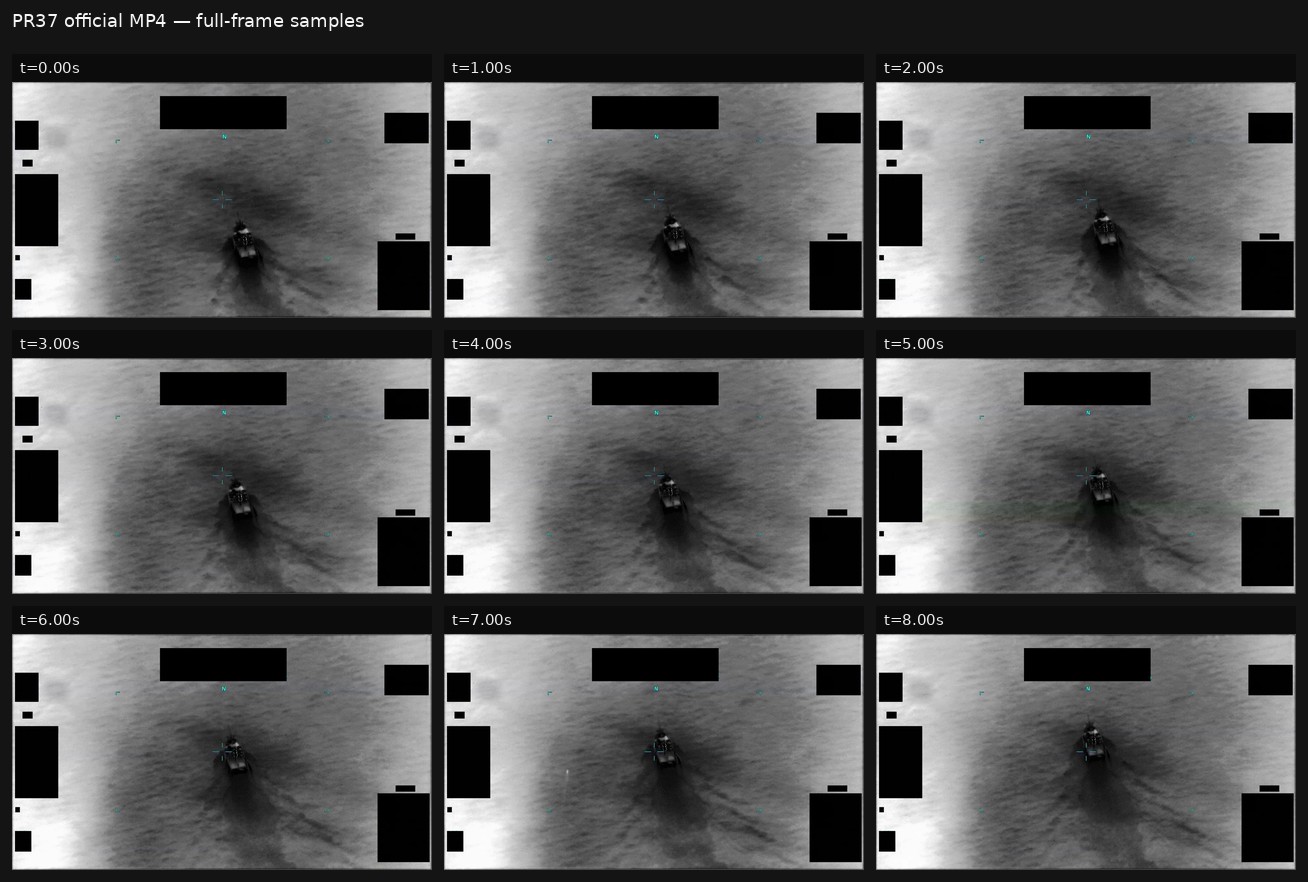 Full-frame samples show the grayscale sensor view, black masking/redactions, faint cyan/green display marks, and a persistent central scene feature. This sheet is useful for scene and interface context, not for resolving the feature's identity.
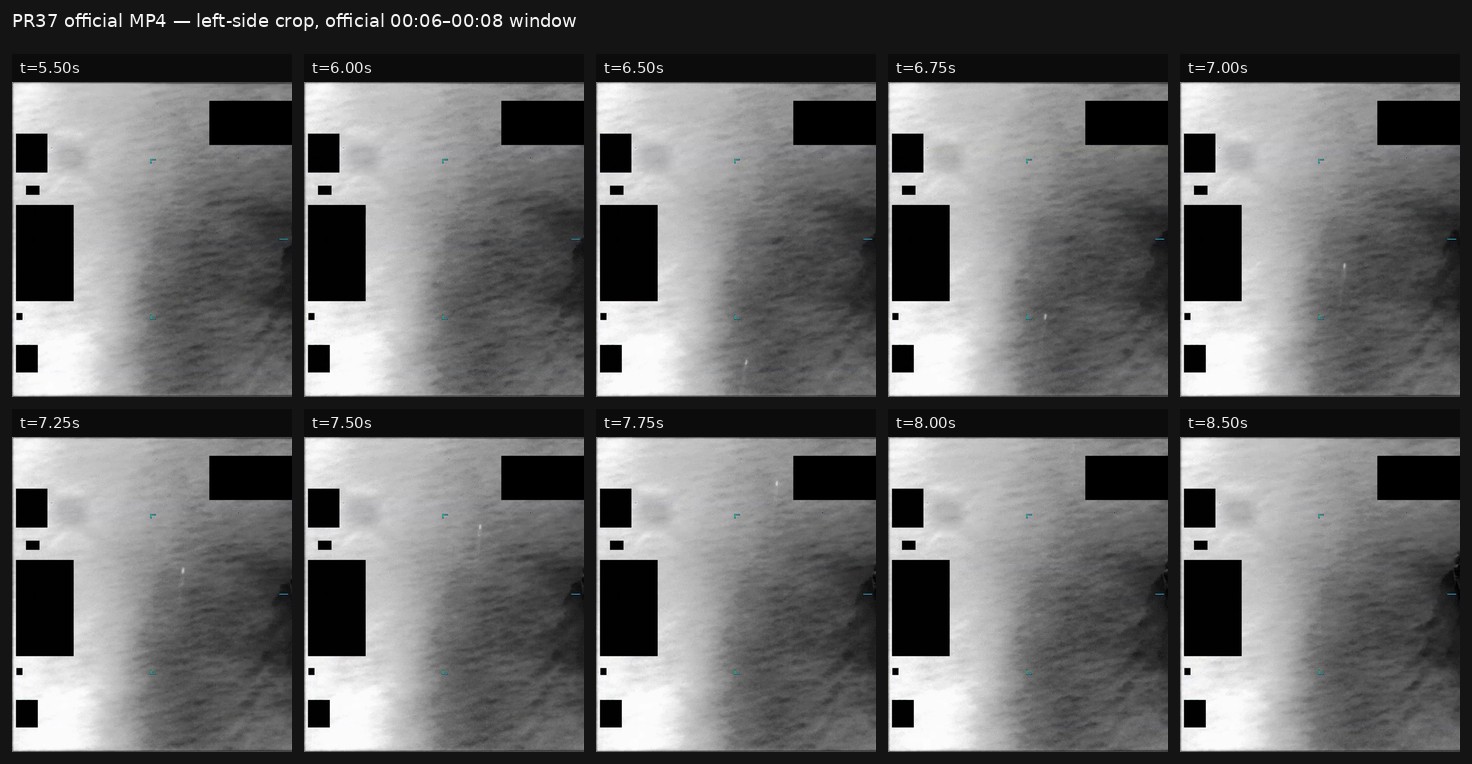 Left-side crop samples cover
 00:05.50–00:08.50 around the official 00:06–00:08 description. A faint small contrast detail is intermittently visible in the left-side window, but the public MP4 does not establish whether it is scene content, sensor/display behavior, compression, or another ordinary video effect.
Investigation reading
This Release 01 item is a short DVIDS video record identified as DOW-UAP-PR37, Unresolved UAP Report, Middle East, 2020. The DVIDS page lists video ID 1006087, VIRIN 200102-D-D0360-9165, category B-Roll, date taken 01.01.2020, date posted 05.08.2026 07:49, and location (UNDISCLOSED LOCATION). The release metadata used by Open Sky places the incident location at Arabian Gulf and describes it more broadly as Middle East 2020.
The verified released media is an MP4 video, 8,543,893 bytes, SHA-256 5d60cc99eda2223d7509c9ac801aa1b66200ac24572256d306b1cdb754c0ad8a. The file is 9.80 seconds long, 1920×1080, H.264 video at 30 fps, with an AAC stereo audio stream that is effectively silent in the checked copy. The public release-file link is available here: released MP4.
The official DVIDS description says CENTCOM submitted a report to AARO consisting of nine seconds of infrared-sensor footage from a U.S. military platform in 2020. It also states that the reporter did not provide an oral or written description. The official video description identifies the relevant visual interval as 00:06–00:08, when an area of contrast enters the sensor field of view from the bottom-left quarter, moves generally from the bottom toward the top, and exits from the top-left quarter. DVIDS cautions that this description is informational only and should not be read as an analytical judgment, investigative conclusion, or factual determination.
What the file appears to contain
The video is a brief grayscale/infrared-style sensor view with several persistent black rectangular masks or redaction blocks along the edges and near the top of the frame. Small cyan/green display marks and reticle-like interface elements are also visible. Those masks and display marks are release/interface material, not scene content.
A full-clip pass and a closer pass over the 00:06–00:08 interval show a textured grayscale scene with a larger dark central scene feature or structure visible across much of the clip. Because that feature is persistent through the sequence and is not the same as the official bottom-left-to-top-left timing description, this draft does not treat it as the described moving contrast area.
In the official window, a much smaller contrast feature is intermittently visible in the left half of the frame. It is faint and only a few pixels wide in the public MP4/contact-sheet samples. Around roughly 00:06.5–00:06.75, it appears low in the left side of the frame as a small bright or high-contrast speck/dash. By about 00:07.0–00:07.25, it is higher in the left half. Around 00:07.5–00:07.75, it appears near the upper-left to upper-middle portion of the sampled crop and then is no longer clearly distinguishable by roughly 00:08.0. That visual reading is broadly consistent with the official description of an area of contrast moving upward through the left side of the sensor field.
The public MP4 alone does not establish the feature's range, altitude, size, speed, platform-relative motion, environmental context, or identity. It should be described only as an unresolved moving contrast feature in a redacted infrared-sensor video.
Source custody and provenance
The primary public source is the DVIDS record for video 1006087, with the title DOW-UAP-PR37, Unresolved UAP Report, Middle East, 2020. DVIDS lists the unit/courtesy source as All-domain Anomaly Resolution Office and provides a CloudFront MP4 filename DOD_111689044. The Open Sky release file copy matches the release metadata hash exactly: 5d60cc99eda2223d7509c9ac801aa1b66200ac24572256d306b1cdb754c0ad8a.
There is a source-metadata tension to preserve for review rather than resolve here: DVIDS displays (UNDISCLOSED LOCATION) and date taken 01.01.2020, while the release metadata gives Arabian Gulf and an incident date of N/A. The Open Sky graph context also carries both a video-row reference and a related manifest-record row reference that do not appear to use the same row numbering. That looks like manifest/indexing cleanup, not an evidentiary contradiction about the video itself.
Graph context
Open Sky currently models this item as official video evidence plus a related official release-record document. The semantic extraction attached to the record contains 10 source-text claims, 8 entity/location/date mentions, no extracted sensor-event nodes, and no extracted table rows. The claims mostly capture source identity, agencies, the 2020 time reference, the Middle East/Arabian Gulf location wording, and the official caution that the description is not an analytical finding.
The graph has related-record navigation edges to other Release 01 materials, including DOW-UAP-PR40, Unresolved UAP Report, Middle East, 2020, and some neighboring DVIDS/PDF records from other locations. Those edges are useful for follow-up comparison, but they are not corroboration and they do not turn this clip into a resolved case.
Leads to check
- Compare PR37 with
DOW-UAP-PR40and any associated Middle East 2020 release records to see whether they are separate clips, companion records, or duplicate metadata paths. - Request or locate any missing narrative report submitted with the video. The public DVIDS text says the reporter provided no oral or written description, but there may be platform metadata or an AARO/CENTCOM submission wrapper not visible in the MP4.
- Check original sensor metadata if available: platform, field of view, range, zoom state, stabilization, gimbal/line-of-sight motion, frame timebase, and whether the moving contrast feature is scene content, sensor artifact, compression behavior, or display/annotation behavior.
- Run environmental/prosaic checks against the actual collection time and area if those can be established: air and maritime traffic, birds/insects near the sensor, wind/weather/visibility, flares/debris, and satellite/launch/reentry possibilities.
- Preserve the DVIDS location/date wording versus release metadata wording as a provenance-cleanup item.
Lead check notes
- Partial — PR37/PR40 comparison: The current linked Release 01 corpus has a separate PR40 page for DVIDS
1006093, also titled as a Middle East 2020 video. PR40 is a longer one-minute source record with an added white-line annotation at00:10, while PR37 is a 9.8-second clip with the official00:06–00:08left-side contrast description. They should be compared as related source records, but the present PR37 page does not establish duplication or same-event status. - Blocked — missing narrative or submission wrapper: DVIDS states that the reporter provided no oral or written description. Any CENTCOM/AARO submission wrapper, platform metadata, or collection log beyond the public MP4 is not present in this released page and remains an external-source lead.
- Needs external source — sensor and geometry checks: Platform identity, field of view, range, zoom state, stabilization, gimbal or line-of-sight motion, frame timebase, and unredacted display metadata are not available in the public PR37 MP4. Without those, the visible contrast cannot be measured for range, size, speed, altitude, or independent motion.
- Needs external source — prosaic/environment checks: Air and maritime traffic, birds or insects near the sensor, wind/weather/visibility, flares/debris, satellite, launch, reentry, and drone checks require an actual collection time and area or an authoritative approximation; the public source gives only broad Middle East/Arabian Gulf wording and DVIDS
(UNDISCLOSED LOCATION)metadata. - Partial — provenance cleanup: DVIDS lists date taken
01.01.2020and location(UNDISCLOSED LOCATION), while release metadata gives incident dateN/Aand locationArabian Gulf. Row references also differ between the video item and manifest-record context. Treat those as release-provenance cleanup items, not event-resolution evidence.
Limits
This draft does not identify the feature, estimate speed or size, infer intent, or make a finding. The public source is a 9.8-second redacted MP4 with no raw telemetry, no platform track, no range, no unredacted sensor overlays, and no accompanying witness narrative. The visible contrast feature is small, intermittent, and affected by compression, frame sampling, redactions, display overlays, and low scene contrast. The graph context is useful for provenance and navigation only; it is not a resolution decision.
Deep investigation — graph + web reconnaissance
Source reread
- The live DVIDS canonical page for video
1006087returned the titleDOW-UAP-PR37, Unresolved UAP Report, Middle East, 2020, with date taken01.01.2020, date posted05.08.2026 07:49, categoryB-Roll, VIRIN200102-D-D0360-9165, filenameDOD_111689044, length00:00:09, location(UNDISCLOSED LOCATION), and courtesy sourceAll Domain Anomaly Resolution Office. - The released MP4 reread matches the Open Sky custody fields: 8,543,893 bytes, SHA-256
5d60cc99eda2223d7509c9ac801aa1b66200ac24572256d306b1cdb754c0ad8a, MP4 magicftypM4V, 1920×1080 H.264 at 30 fps, 9.80 seconds, AAC stereo audio, and effectively silent audio in the checked copy. - DVIDS states that CENTCOM submitted nine seconds of infrared-sensor video to AARO and that the reporter did not provide an oral or written description. Its visual description is limited to
00:06–00:08, when an area of contrast enters from the bottom-left quarter, moves generally upward, and exits from the top-left quarter. DVIDS explicitly cautions that the description is informational only and is not an analytical judgment or finding. - A fresh visual review of the released contact sheets supports keeping the larger persistent central scene feature separate from the official
00:06–00:08left-side description. The full-frame sheet makes the official left-side feature hard to isolate; the left-side crop makes a faint, intermittent contrast mark traceable from lower-left/lower-left-center toward upper-left or upper-middle, but it is weak enough that compression, background texture, sensor/display behavior, or frame sampling remain live possibilities.
Graph connections
- The graph contains an exact
VideoEvidenceasset for DVIDS1006087with the same canonical DVIDS URL, CloudFront MP4 URL,8,543,893-byte MP4 length, and SHA-256 hash. It has one manifest-description text chunk, 10 machine-extractedClaimnodes, 8EntityMentionnodes, 0SensorEventnodes, and no table-row extraction for this asset. - The extracted claims remain
machine_extracted_needs_human_reviewandnot_a_finding. They capture source identity, AARO/Department of War/DVIDS agency wording, Middle East/Arabian Gulf location terms, the 2020/2026 date references, and the DVIDS caution language; they do not add independent sensor, range, speed, altitude, or object-type evidence. - Direct graph relationships expose manifest hygiene issues worth cleaning separately: a PR37 release-record row carries DVIDS
1006087but a stale Greece D33 PDF final URL, the PR37 video asset is associated with related CSV row94, and a PR40 release record can carry the PR37 DVIDS final URL while retaining PR40's DVIDS ID. Those are provenance/indexing problems, not corroboration and not contradictions in the MP4 itself. - Low-score
CANDIDATE_CROSSLINKedges to Greece-themed, CIA, and community documents are audit-only. Their snippets point at stale PR34/Greece release-record text rather than PR37 video content, so they should not be used as evidence that this clip connects to those records.
External provenance and context
- The DVIDS canonical and short pages were live during this check and returned the same public video page. The CloudFront MP4 endpoint answered a range request with
206 Partial Content,Content-Range: bytes 0-63/8543893, and the expected MP4 header. - Direct WAR.GOV landing and release-CSV requests returned
403 Forbiddenduring this check. That is an access/custody constraint, not a reason to distrust the already hash-verified DVIDS/MP4 copy. - Internet Archive availability showed a closest exact canonical DVIDS-page snapshot at
20260517140857; it did not show closest snapshots for the DVIDS short URL or the CloudFront MP4 in the availability response. DVIDS search returned empty202responses, while Defense.gov and AARO search pages returned403; no new official companion report, platform log, or AARO case packet surfaced in this bounded web pass.
Prosaic checks and unresolved limits
- The graph has astronomy, weather, and launch-context labels, but exact typed probes for the displayed DVIDS date
2020-01-01returned no matchingAstronomyEvent,WeatherEvent, or launch rows for that date window. Because the public source gives only a broad date, broad region, and no collection time, look direction, platform track, or coordinates, that graph no-result is a coverage limit rather than an exclusion of celestial, weather, launch, satellite, aircraft, maritime, biological, or display-artifact explanations. - The first prosaic lane remains source/imagery mechanics: redactions and masks, display symbology, compression/resampling, thermal/IR contrast behavior, platform or sensor motion, background texture, and whether the faint left-side mark is scene content at all. Environmental checks require a more precise collection time and location.
Follow-up and audit note
- Highest-value follow-ups are the missing CENTCOM/AARO submission wrapper, unredacted sensor metadata, platform and line-of-sight geometry, raw or less-compressed FMV, and a row-reconciliation pass across PR37/PR40 and adjacent Release 01 video records.
- This section adds provenance, graph, and prosaic-check context only. It does not identify the feature, create a finding, create a hypothesis, or resolve the case.
Sources
- DVIDS: DOW-UAP-PR37, Unresolved UAP Report, Middle East, 2020
- DVIDS short URL: https://www.dvidshub.net/video/1006087
- Open Sky released MP4 route: /api/explore/war-gov/release-file/war-gov-dow-uap-pr37-unresolved-uap-report-middle-east-2020-1006087
- Release-file SHA-256:
5d60cc99eda2223d7509c9ac801aa1b66200ac24572256d306b1cdb754c0ad8a