NASA-UAP-D1, Apollo 12 Transcript, 1969
Investigation reading
Read this file as a short source-transcript excerpt, not as a resolved case file. The released PDF contains four scanned pages from the Apollo 12 technical air-to-ground voice transcription. It preserves crew dialogue around two broad time windows: a fifth-day exchange in which Alan Bean describes lights or particles seen through the Alignment Optical Telescope, followed by a separate equipment/display anomaly discussion; and a sixth-day exchange in which Pete Conrad and Dick Gordon discuss the Lunar Module tracking light and small bits of material floating near the spacecraft.
The source is valuable because the statements are contemporaneous mission communications. Its limits are just as important: this release does not include photographs, video, raw telemetry plots, a sensor track, or the full surrounding Apollo 12 transcript. The page below is therefore an investigation draft for source reading and follow-up, not a finding or identification.
Evidence media
- Official PDF: Open Sky release-file copy — four scanned transcript pages from the NASA release item.
- Derived page renders from the official PDF:
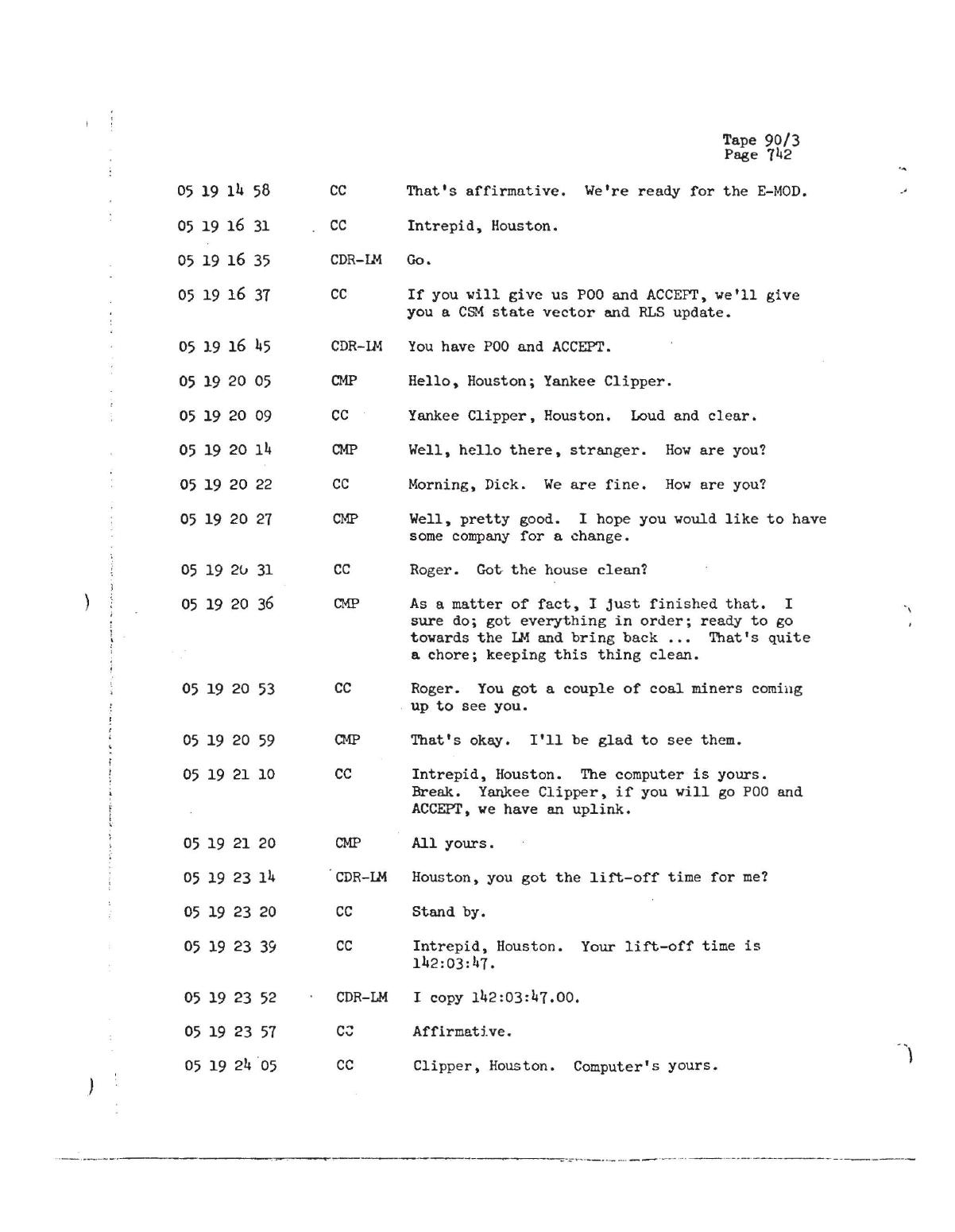
Page 1 gives the immediate transcript setup before the AOT observation. It is typewritten air-to-ground dialogue only; it is not object imagery.
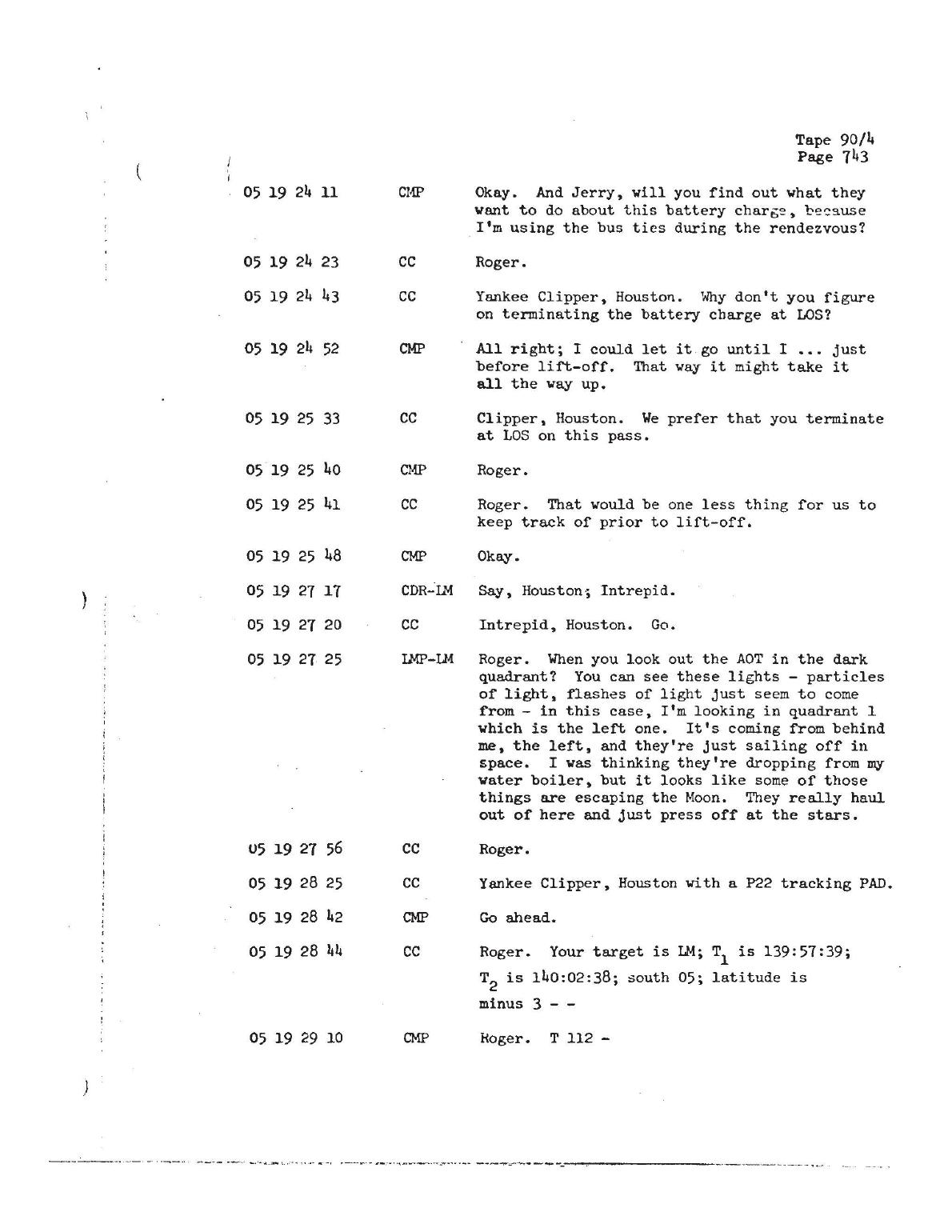
Page 2 preserves Alan Bean's AOT statement about “lights,” “particles of light,” and “flashes of light” seen in the dark quadrant, including the source's own possible water-boiler lead and “escaping the Moon” language.
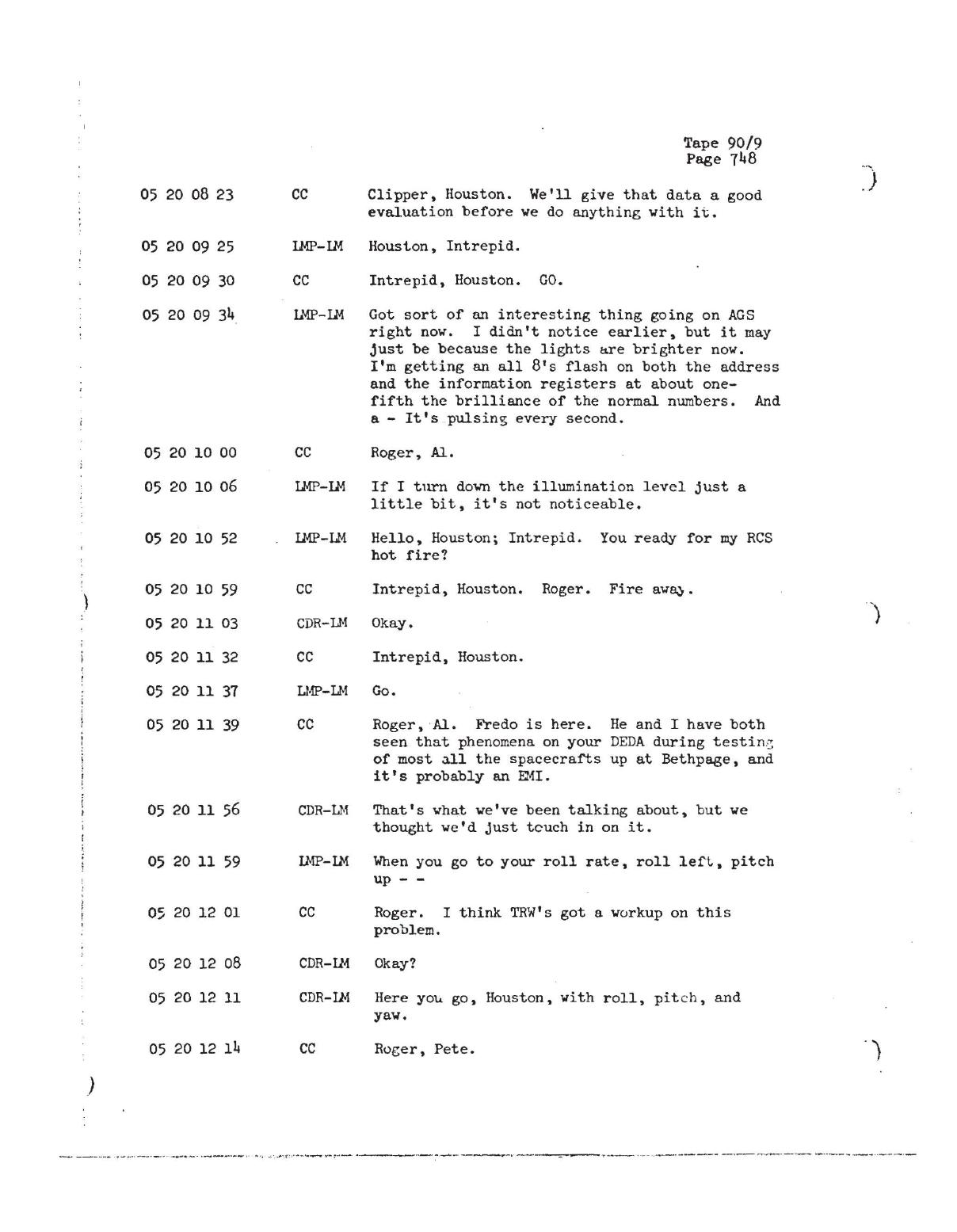
Page 3 is a separate AGS/DEDA display issue: faint “all 8's” flashes on the address and information registers, with Houston describing a similar Bethpage-test phenomenon as probably EMI.
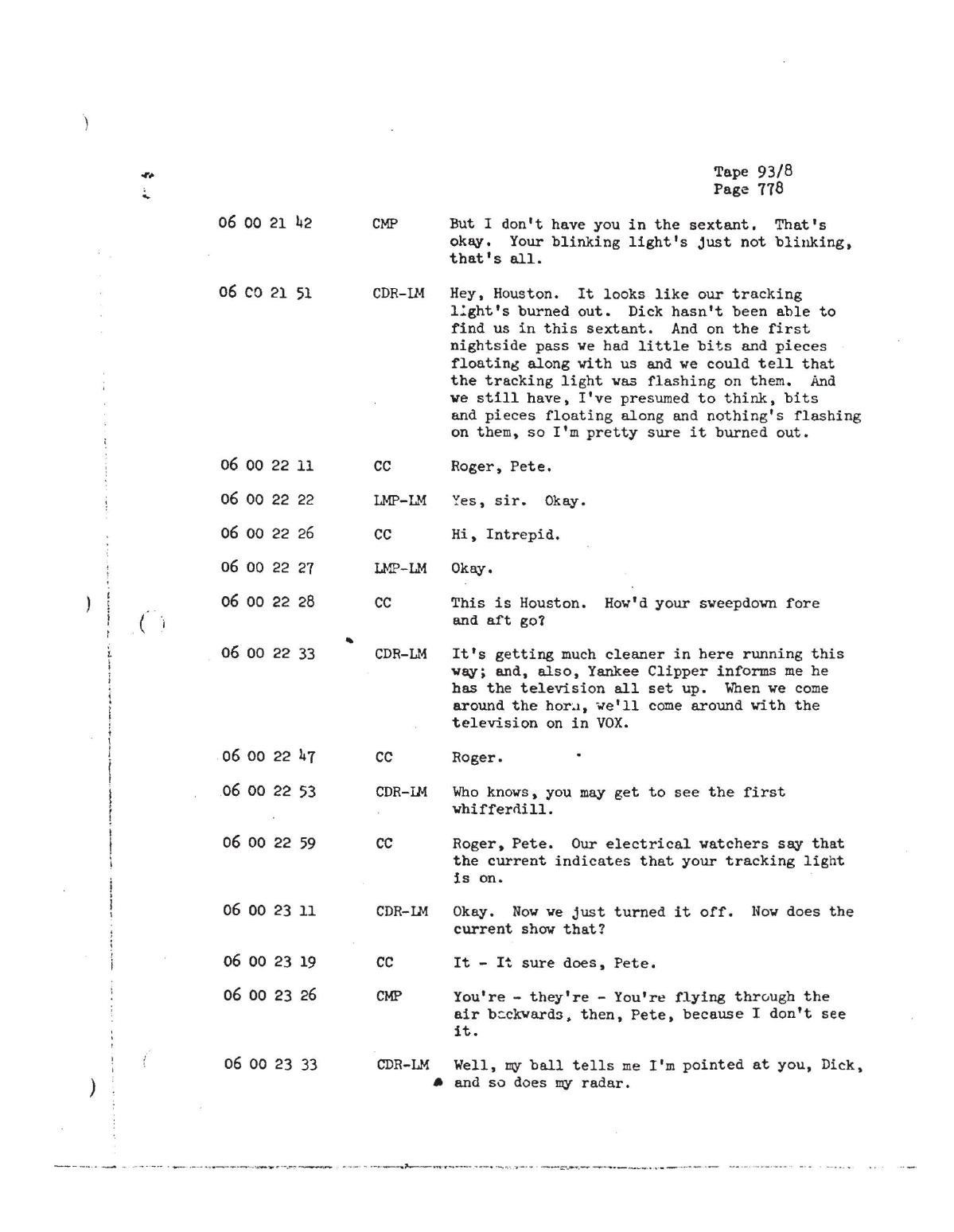
Page 4 is a tracking-light/sextant exchange about small “bits and pieces” visible when illuminated by the LM tracking light. The “radar” wording appears in spacecraft-orientation dialogue, not as a released radar plot or independent object track.
What the file appears to contain
The PDF is a four-page scanned transcript excerpt. Rendered-page review shows only typewritten transcript text, timestamps, speaker labels, and scan artifacts; no page contains a photograph, diagram, map, target display, or object image.
| PDF page | Visible transcript header | Main source content |
|---|---|---|
| 1 | Tape 90/3, page 742 | Routine Apollo 12 communications: Intrepid/Yankee Clipper calls, computer/uplink handling, P00/ACCEPT, CSM state-vector/RLS update, and LM lift-off time 142:03:47.00. This page provides conversation context but no object observation. |
| 2 | Tape 90/4, page 743 | At 05 19 27 25, the LMP-LM says that when looking through the AOT in the dark quadrant, he can see “lights,” “particles of light,” and “flashes of light” in quadrant 1. He says they seem to come from behind him/the left, are “sailing off in space,” may be dropping from the water boiler, and look like some are “escaping the Moon” and pressing off toward the stars. |
| 3 | Tape 90/9, page 748 | A separate cockpit/equipment discussion: at 05 20 09 34, the LMP-LM reports an “all 8's flash” on both the address and information registers, at about one-fifth normal brightness, pulsing every second. Houston later says the same phenomenon was seen on the DEDA during Bethpage spacecraft testing and was “probably an EMI,” with TRW having a workup. This is not the same as the AOT particle/light observation. |
| 4 | Tape 93/8, page 778 | At 06 00 21 42 to 06 00 23 33, CMP cannot see the LM in the sextant because the blinking/tracking light is not blinking. CDR-LM says the tracking light appears burned out; on an earlier nightside pass, small “bits and pieces” floating along were visible because the light flashed on them, but now nothing is flashing on them. Houston says current indicates the tracking light is on; the crew turns it off and Houston confirms the current change. The later radar phrase is in spacecraft-orientation dialogue, not a released radar plot or independent track. |
The clearest source language for the first observation is the page-2 AOT passage: “lights - particles of light, flashes of light,” “sailing off in space,” a possible water-boiler association, and the phrase “escaping the Moon.” The clearest source language for the later sixth-day passage is not an outside-object description in isolation; it is a tracking-light discussion tied to small floating bits/debris visible only when illuminated.
Source custody and provenance
- Official source URL: https://www.war.gov/medialink/ufo/release_1/nasa-uap-d1-apollo-12-transcript-1969.pdf
- Open released-file copy: war-gov-nasa-uap-d1-apollo-12-transcript-1969-5d9d3147
- Agency: NASA
- Release: WAR.GOV / PURSUE Release 01
- Official CSV row:
136 - Container: PDF, 4 pages, 1,030,644 bytes
- SHA-256:
ab911622b7d4203d9d54914f03d1662cf561b7f943afe9d17f9617cfaea06585
The release record describes this as an excerpt from the Apollo 12 Technical Air-to-Ground Voice Transcription, November 1969. The asset inventory fields for incident date/location are not separately populated, so this page treats “Apollo 12 / 1969 / lunar mission context” as source context from the title and release description rather than a separate location finding.
The PDF text layer is noisy in places. The rendered page images are clearer for several important details: visible transcript page headers are 742, 743, 748, and 778; page 3 reads as an AGS/DEDA display issue and “probably an EMI,” not as a second outside visual observation. Any downstream extraction should be checked against the rendered page before using those fields analytically.
Graph context
Open Sky currently models this release item as an official-primary Document plus its release-record document. The semantic graph indexes 39 extracted claims, 13 entity mentions, one sensor-event cue, and no table rows for this asset. Those counts are navigation aids, not findings.
The graph’s single sensor cue is triggered by the page-4 phrase: “my ball tells me I'm pointed at you, Dick, and so does my radar.” In context, that sentence sits inside the tracking-light/sextant orientation exchange. It should not be read as a released radar return on the particles, flashes, or floating bits. The page has no radar plot, no instrument display, no telemetry table, and no object imagery.
Related-document links include the NASA Apollo 17 debriefing item and one unrelated release asset. They are useful for navigation and quality control only unless a human reviewer establishes a source-level relationship. No candidate crosslinks were returned for this item in the current context.
Leads to check
- Compare this excerpt against the complete Apollo 12 Technical Air-to-Ground Voice Transcription around the same mission-elapsed-time windows to recover the surrounding operational context.
- Check Apollo 12 systems documentation for water-boiler venting, LM attitude, RCS operations, lighting, and optical-telescope geometry during the page-2 AOT observation.
- Treat the page-3 “all 8's flash” as a separate avionics/display lead. Look for the Bethpage, DEDA, EMI, or TRW workup referenced by Houston before using that exchange in any anomaly analysis.
- For the page-4 tracking-light passage, compare crew notes, electrical-system logs, and any available rendezvous/TV/audio context. The source itself points toward a tracking-light/current issue and illuminated floating material.
- Clean up OCR/graph extraction where the text layer differs from the rendered pages, especially transcript page numbers, AGS/DEDA wording, “EMI,” and the tracking-light lines.
Lead check notes
- Partial — Full transcript context: the release-file copy and page renders verify the four excerpted transcript pages, but the complete Apollo 12 Technical Air-to-Ground Voice Transcription around these mission-elapsed-time windows is still needed to recover all surrounding operations.
- Partial — Water-boiler and LM systems lead: page 2 itself records Bean considering whether the particles were dropping from the water boiler. This release item does not include the LM attitude, RCS, water-boiler, lighting, or AOT geometry sources needed to test that lead.
- Partial — AGS/DEDA display issue: page 3 supports the “all 8's” flash on the address and information registers, the DEDA/Bethpage comparison, and Houston's “probably an EMI” wording. The Bethpage test records or TRW workup remain external source needs.
- Partial — Tracking-light passage: page 4 supports the sextant/tracking-light exchange, the crew's statement about small “bits and pieces” visible when the light flashed on them, and Houston's current check. Crew notes, electrical logs, TV/audio context, and any rendezvous records would be needed before treating this as more than illuminated nearby material in the transcript.
- Partial — OCR and graph cleanup: rendered pages verify key text-layer corrections: transcript page headers 742/743/748/778, AGS/DEDA wording, “EMI,” and the tracking-light/radar context. Updating downstream OCR or graph extraction remains a separate data-quality task.
Deep investigation — graph + web reconnaissance
Source reread
This check re-opened the official-primary release file, the extracted text layer, and the derived page renders. The PDF verifies as a 4-page, copy-restricted scanned transcript excerpt, 1,030,644 bytes, SHA-256 ab911622b7d4203d9d54914f03d1662cf561b7f943afe9d17f9617cfaea06585. pdfimages shows one scanned page image per page, so the public page renders are the best source for contested OCR.
The page renders correct several machine-text errors. The visible headers are Tape 90/3 page 742, Tape 90/4 page 743, Tape 90/9 page 748, and Tape 93/8 page 778; older OCR/chunk text can misread those as 332/333/342/737. On page 2, the AOT passage reads as Alan Bean seeing “lights - particles of light, flashes of light” in the dark quadrant, coming from behind/left and “sailing off in space”; he immediately raises the possible water-boiler explanation before saying some looked like they were “escaping the Moon.” On page 3, the separate cockpit issue is an AGS/DEDA display report: faint “all 8's” flashes on the address and information registers, with Houston saying the same phenomenon had been seen during Bethpage DEDA testing and was “probably an EMI.” On page 4, the later passage is a tracking-light/sextant exchange about small “bits and pieces” visible only when the LM tracking light flashed on them.
Graph connections
Read-only graph review matched the exact official URL/hash to one current Document asset and one current release-record document for CSV row 136. The semantic layer currently has 39 machine-extracted claims, 13 entity mentions, 1 sensor-event cue, and 7 text chunks for this asset. The single SensorEvent is the page-4 word radar in Conrad's orientation line — “my ball tells me I'm pointed at you, Dick, and so does my radar” — and remains machine_extracted_needs_human_review / not_a_finding; it is not a released radar plot or an independent object track.
No CANDIDATE_CROSSLINK relationship was returned for this file. Direct graph neighbors include the current release record, a secondary UFO-USA markdown conversion, and a related Apollo 17 NASA release record; these are navigation/provenance leads only. A broader title search also surfaces Apollo 12 VM1–VM5 image records, but this transcript excerpt does not cite those images and they should not be treated as corroboration without source-level linkage. A stale NASA source-pack table can surface row 139; the current asset inventory and graph record identify this D1 release item as row 136, so row reconciliation remains a data-quality lead.
External provenance and context
Direct WAR.GOV PDF/landing/CSV probes returned 403 during this check, but an Internet Archive exact-URL capture from 2026-05-08 14:12:00 was fetched and hash-matched the Open Sky release-file copy byte-for-byte. That preserves custody for the canonical URL even when live WAR.GOV access is blocked from this environment.
NASA NTRS citation 19760072997, Apollo 12 Mission Report is useful external official context for the page-4 tracking-light passage. Its systems text says the LM exterior tracking light operated normally during the first darkness pass but not during the second; the switch was cycled, telemetry indicated normal power consumption after the failure, and the failure was isolated to the light's high-voltage section. The same report says rendezvous-radar performance was normal and that a brief later “data good” loss near 150 feet was attributed to rapid attitude changes, not to an outside target.
NASA's current Apollo Journals landing page points researchers to the Apollo Flight Journal portal; the Apollo Flight Journal Day 6 page reproduces the same mission-elapsed-time passages at 139:27:25, 140:09:34, 140:11:39, and 144:21:51. It adds useful adjacent transcript context — for example, the AOT passage is followed by a P22 tracking PAD and the AGS/DEDA passage is placed about 1 hour 55 minutes before LM ignition — but that archive should be used as a context/line-alignment aid, not as a replacement for the WAR.GOV release file or NASA primary reports.
Prosaic checks, limits, and follow-up
The strongest prosaic lanes are already in the source chain: possible LM water-boiler particles for the AOT observation, probable EMI for the AGS/DEDA display flashes, and a documented exterior tracking-light failure illuminating or failing to illuminate nearby floating debris. The page-4 radar word is spacecraft-orientation context, not evidence of radar detection of the particles or debris.
What is still missing is the complete Apollo 12 Technical Air-to-Ground Voice Transcription around these windows, Apollo LM water-boiler/AOT geometry and venting documentation, the Bethpage/TRW DEDA/EMI workup mentioned by Houston, and the mission audio/TV/electrical-log context around the second-darkness-pass tracking-light failure. Astronomy/weather/launch/satellite correlation is not meaningful for this excerpt until a reviewer converts the mission-elapsed-time windows into a precise geometry problem and ties them to a specific external line of sight; the released four pages alone do not provide object range, bearing, independent imagery, or a raw sensor product.
Audit note
No conclusion node, finding, hypothesis, or resolution should be inferred from this page. The graph material is useful for navigation and cleanup; the verified public content remains source facts, astronaut/mission-control dialogue, official mission-report context, prosaic leads, and open follow-up questions.
Limits
This release is a transcript excerpt only. It does not provide the full Apollo 12 audio, complete transcript volume, photographs of the observed particles, an image of the floating bits, raw spacecraft telemetry, or a radar return. It also does not establish whether the AOT particles, the AGS/DEDA flash, and the tracking-light material are related phenomena. The source contains possible mundane leads in its own language—water-boiler material, a probable EMI display issue, and illuminated floating bits near the spacecraft—but this draft does not resolve them.
The public release description uses “unidentified phenomenon” framing. The source pages are narrower: astronaut dialogue, equipment context, and short mission-control responses. Any stronger claim should wait for full-transcript comparison and Apollo systems review.
Sources
- WAR.GOV / PURSUE Release 01 official PDF: NASA-UAP-D1, Apollo 12 Transcript, 1969
- Open Sky released-file copy: /api/explore/war-gov/release-file/war-gov-nasa-uap-d1-apollo-12-transcript-1969-5d9d3147
- Release CSV row:
136 - Verified source hash:
ab911622b7d4203d9d54914f03d1662cf561b7f943afe9d17f9617cfaea06585 - Rendered PDF page review: pages 1-4, visible transcript headers Tape 90/3 page 742; Tape 90/4 page 743; Tape 90/9 page 748; Tape 93/8 page 778.