NASA-UAP-D2, Apollo 17 Transcript, 1972
Evidence media
- Official PDF release-file copy: Open Sky release-file copy.
- The page renders below are derived from the verified official PDF. They show typed transcript pages with highlighted passages; they are not photographs, spacecraft frames, radar plots, or sensor imagery.
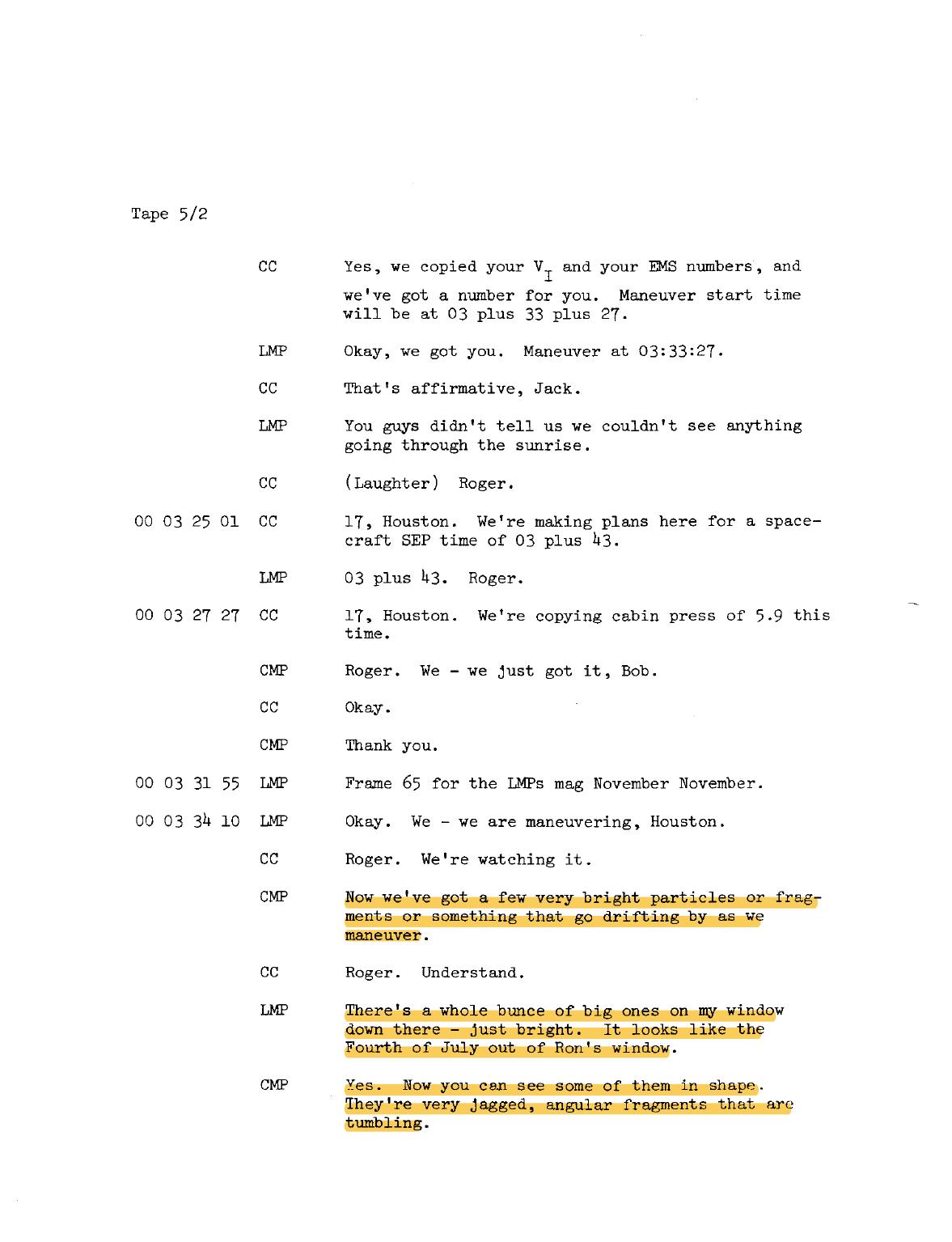 Page 1 render: crew dialogue around the day-00 maneuver highlights bright particles/fragments, a "Fourth of July" appearance, and jagged/angular tumbling pieces near the spacecraft.
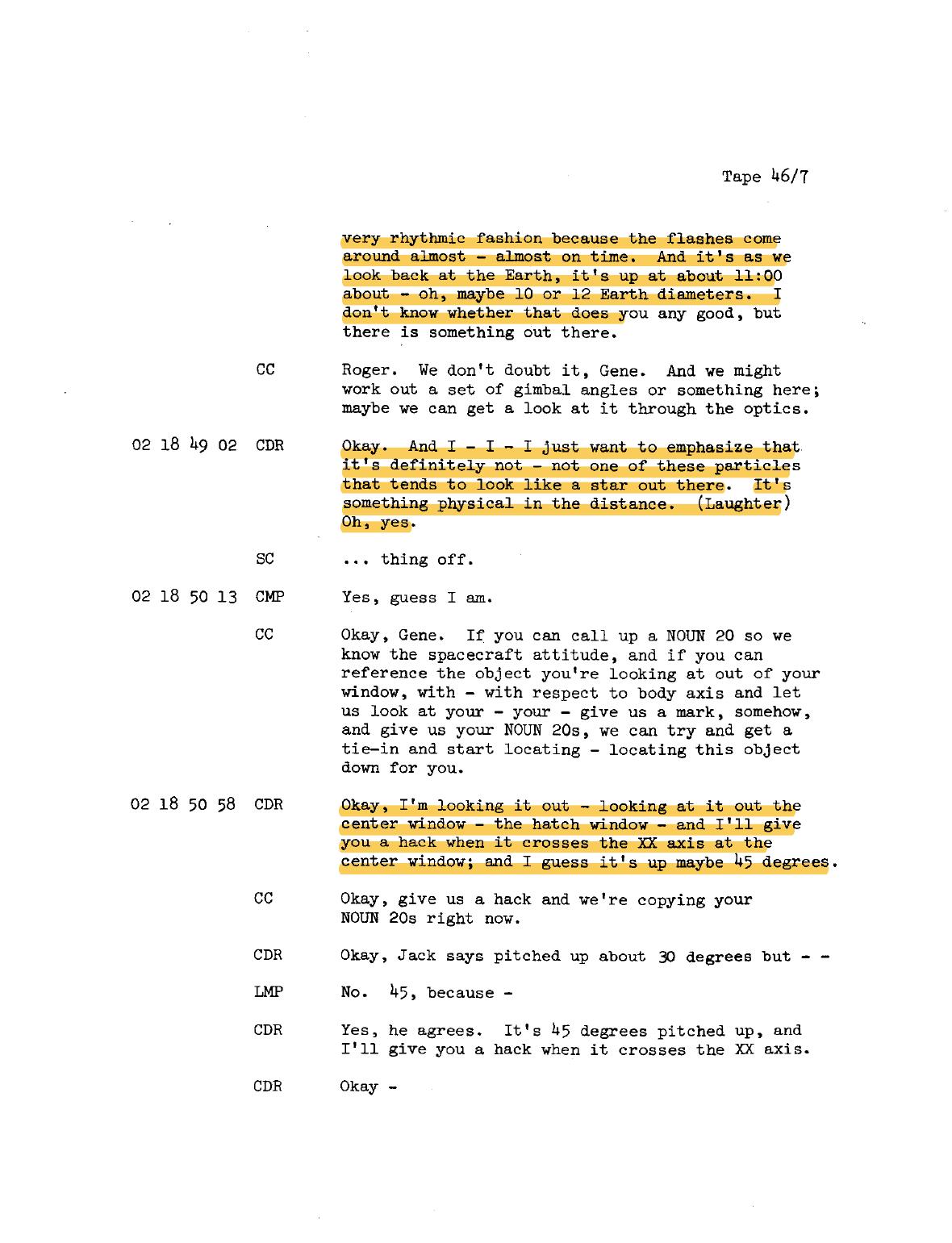 Page 8 render: Cernan emphasizes that the flashing object is not one of the nearby star-like particles, while Mission Control asks for NOUN 20/body-axis information to help locate it.
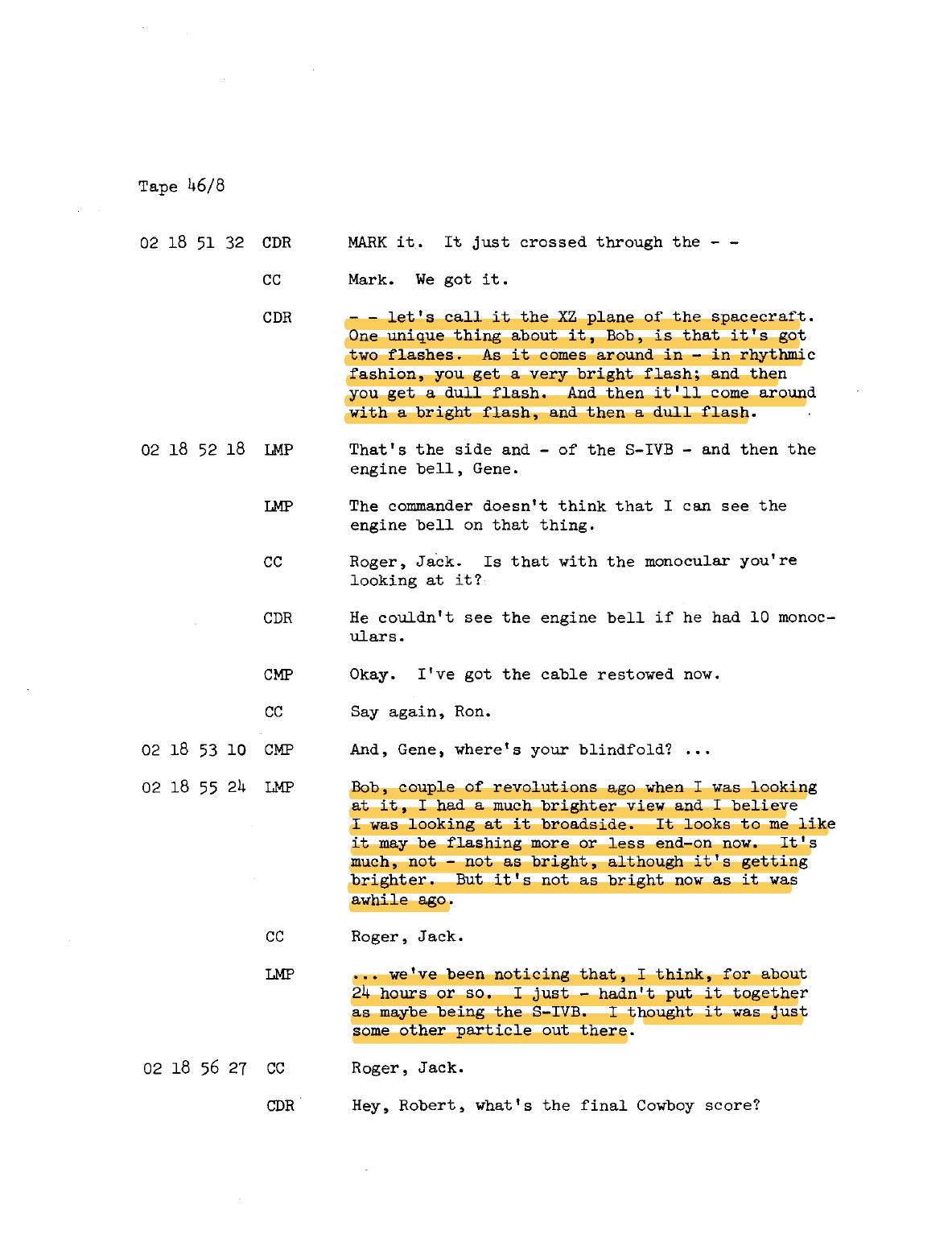 Page 9 render: the transcript records a bright/dull rhythmic flashing pattern and Schmitt's S-IVB interpretation; the page preserves that as source discussion, not a resolution.
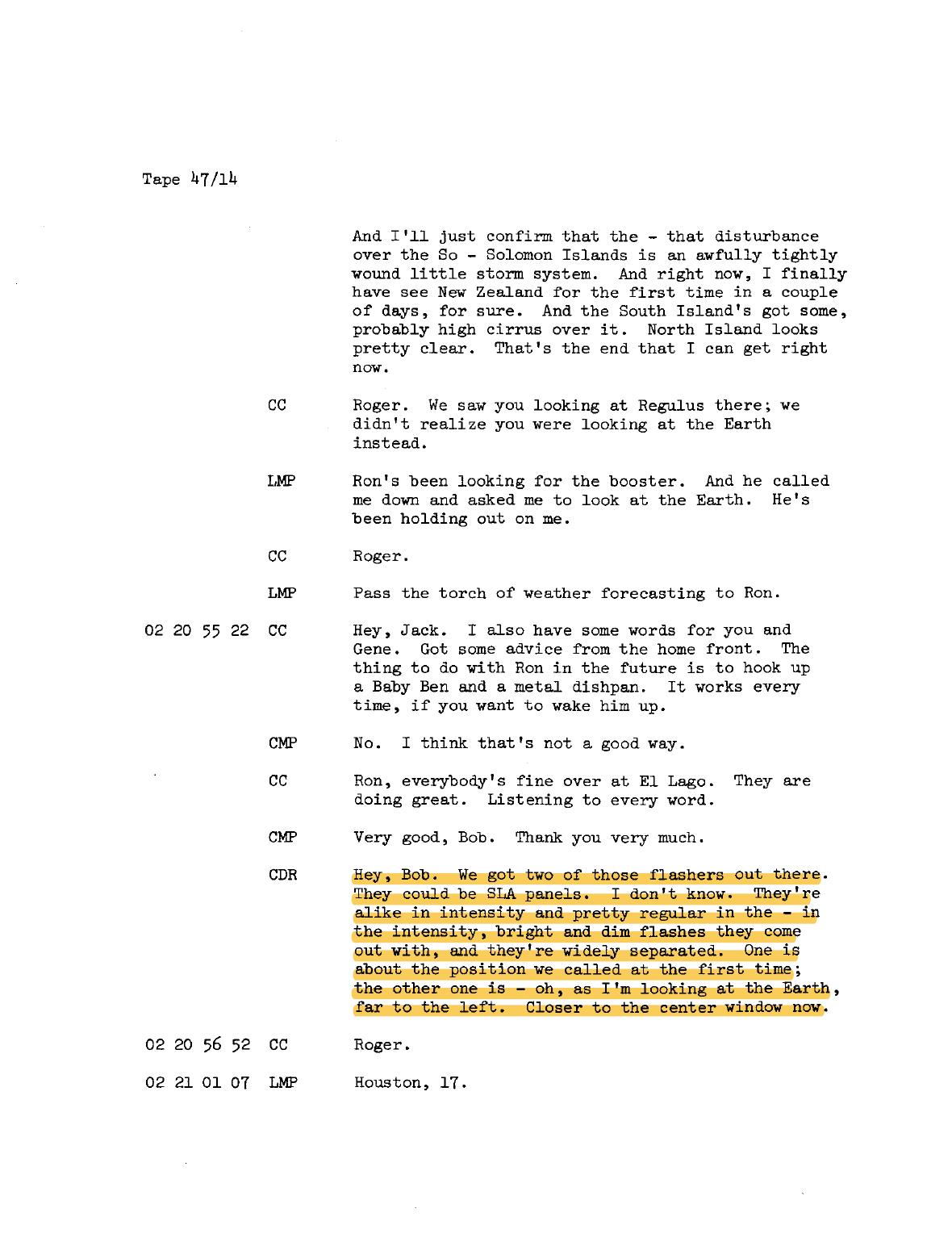 Page 11 render: Cernan reports two separated flashers and says they "could be SLA panels," while keeping uncertainty explicit in the transcript.
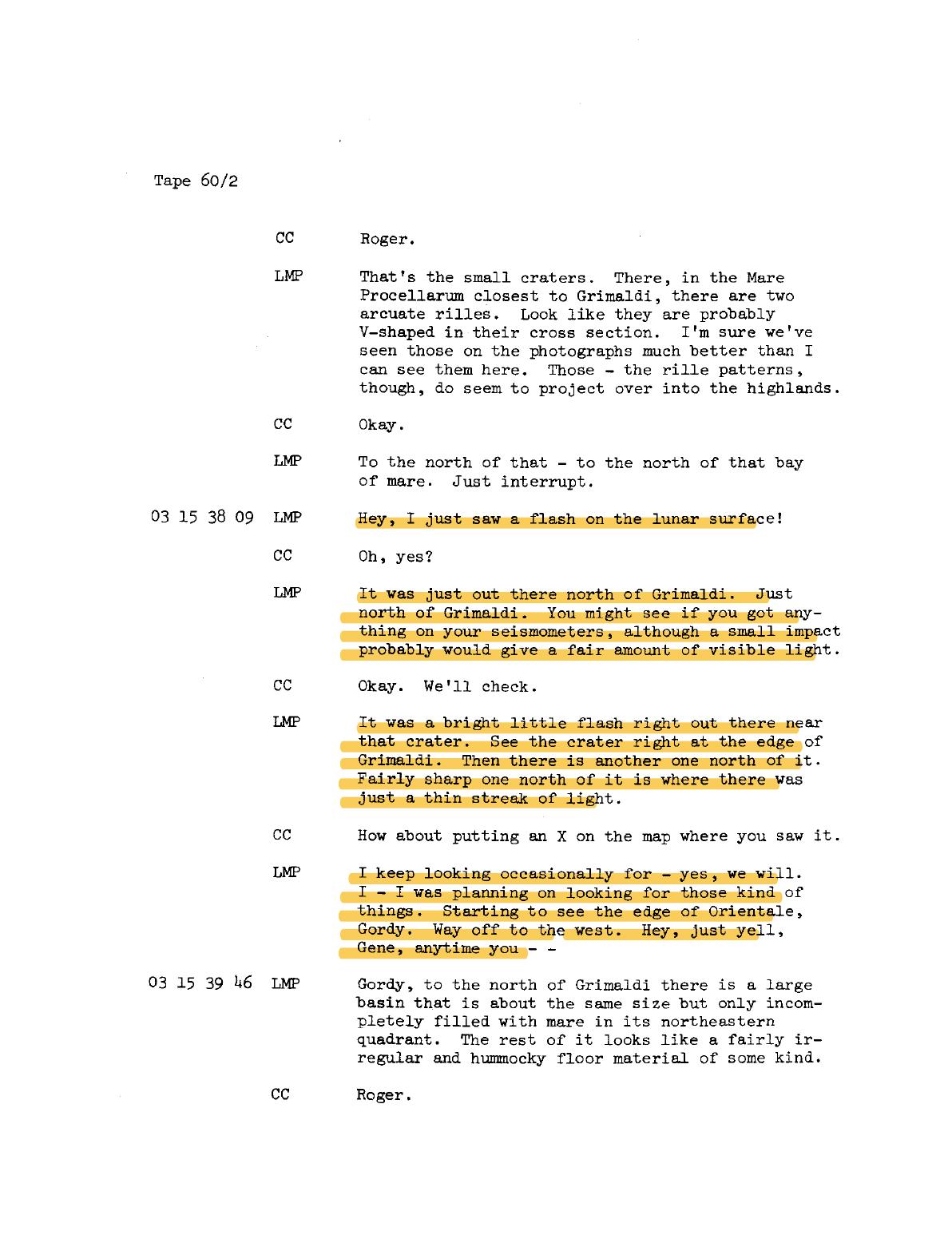 Page 16 render: Schmitt reports a bright flash on the lunar surface north of Grimaldi, suggests checking seismometers, and Mission Control asks him to mark the location on the map.
Investigation reading
This Release 01 file is a 16-page NASA PDF excerpt from the Apollo 17 air-to-ground voice transcript. It is not a photo packet or a sensor-video exhibit. A full pass through all 16 OCR pages, the PDF text layer, and rendered page images shows a typed transcript with yellow-highlighted lines; no embedded photographs, maps, radar plots, lunar images, spacecraft frames, or object imagery are visible in the released PDF.
The highlighted passages collect three separate transcript windows from the mission: a fragment-field report shortly after maneuvering and separation activity on mission day 00; a longer day-02 discussion of flashes, a bright rotating object, and possible S-IVB/SLA hardware identifications; and a short day-03 lunar-surface flash report north of Grimaldi. The source is useful because it preserves the crew's own words, the mission-control follow-up, and the prosaic possibilities considered in real time. It is not, by itself, a resolved case file.
What the file appears to contain
| PDF pages | Transcript window | Source reading |
|---|---|---|
| 1-4 | Day 00, about 00 03 34 10 to 00 03 42 29 | CMP Ronald Evans and LMP Harrison Schmitt describe bright nearby particles/fragments during maneuvering. Schmitt says it looks like the "Fourth of July" out of Evans's window. Evans describes jagged, angular, tumbling fragments, tries pictures, and speculates they may be S-IVB material, ice chunks, or paint. CDR Eugene Cernan adds that some look flat and flakelike, possibly several inches across, twinkling and generally moving away. |
| 5-13 | Day 02, about 02 18 42 34 to 02 21 07 05 | Cernan reports earlier streaks and a bright flash between his eyes while sleep-hazy. He later describes a bright object that appears distant, rotating, and flashing rhythmically. Mission Control asks for spacecraft attitude/body-axis information and NOUN 20 values to help locate it. Schmitt argues the object may be the S-IVB and discusses broadside/end-on brightness. Cernan later reports two separated flashers that "could be SLA panels." The final pages of this window shift heavily into Earth/weather observations around Hawaii, Solomon Islands, Hickam, Hilo, and cloud patterns. |
| 14-16 | Day 03, about 03 15 33 25 to 03 15 39 46 | Schmitt gives lunar-surface geology observations around Oceanus Procellarum and Grimaldi. At 03 15 38 09 he reports, "Hey, I just saw a flash on the lunar surface!" He places it just north of Grimaldi, suggests checking seismometers, and says a small impact could produce visible light. He then describes a bright little flash/thin streak near a crater north of Grimaldi, and Mission Control asks him to mark the location on the map. |
The strongest source language in the second window is not just "flashes" in the abstract. On the rendered transcript, Cernan says the object is not one of the nearby star-like particles, calls it "something physical in the distance," places it while looking back at Earth around the 11 o'clock position, and estimates "maybe 10 or 12 Earth diameters." Mission Control's response is procedural: use gimbal angles/optics if possible, get NOUN 20 spacecraft-attitude values, and have the crew call a mark when the object crosses the spacecraft axis. On the following page, Cernan describes a repeating bright/dull flash pattern. Schmitt then offers the S-IVB interpretation and later says the brightness change may reflect broadside versus end-on orientation.
The source also contains several built-in caution flags. The crew repeatedly discusses ordinary mission hardware: S-IVB, SLA panels, launch-vehicle separation, possible paint or ice fragments, and the difficulty of predicting the S-IVB impact point. The lunar-surface flash is explicitly framed by Schmitt as something that could be checked against seismometers and possibly explained by a small impact. These are source-stated leads, not conclusions.
Source custody and provenance
- Agency: NASA.
- Release: WAR.GOV / PURSUE Release 01.
- Official CSV row:
137. - Source/container type: PDF transcript excerpt.
- Released PDF size:
463,669bytes. - PDF page count:
16. - SHA-256:
9d041c8799a0124dc440c05cacd790a43d9e063e399aaa5cd3ee777b14146d03. - Released file: Open Sky release-file copy.
- Official URL: https://www.war.gov/medialink/ufo/release_1/nasa-uap-d2-apollo-17-transcript-1972.pdf.
The Open Sky release-file copy was verified against the release metadata hash above. Direct access to the official WAR.GOV media URL may be access-controlled from automated tools, so this draft relies on the verified release copy while citing the official URL.
Graph context
The Open Sky graph has the released PDF asset and the corresponding Release 01 record modeled as official-primary Document records. For this asset, the graph currently carries 89 extracted source-text claim records, 17 entity mentions, 22 text chunks, and 16 OCR pages with text. There are no candidate crosslinks attached to this page in the current context output.
The graph extraction is helpful for navigation but needs human review before public interpretation. One extracted IR sensor event is not evidence of infrared instrumentation in this file: the source quote is the line-broken word "ir- regular" in a lunar-surface geology description. That should be treated as an extraction cleanup item. The actual PDF page review found a text transcript only, with no sensor frame, raw instrument return, radar plot, or image exhibit.
Related graph context points toward the Apollo 17 technical crew debriefing as the most relevant follow-up document. Any unrelated-looking related edge should be checked as graph hygiene rather than treated as evidence of a case connection.
Leads to check
- Compare these highlighted transcript excerpts against the complete Apollo 17 Technical Air-to-Ground Voice Transcription to restore the surrounding mission context before quoting the excerpt as a standalone incident.
- Locate the mission frames Evans and Schmitt reference (
Frame 70,frame 50, and other camera comments) and determine whether any corresponding images are available, readable, and actually show the fragment field or ALFMED context. - Check NASA/Apollo trajectory and hardware records for S-IVB and SLA panel positions during the day-02 observation window, including whether the described bright/dull periodicity fits a tumbling spacecraft component.
- For the day-03 lunar flash, compare the reported position north of Grimaldi with Apollo seismic event logs, known lunar impact/flash catalogs, and the map mark requested by Mission Control, if preserved.
- Review the Apollo 17 technical crew debriefing for later crew interpretation of these three windows, especially whether the crew maintained, revised, or rejected the S-IVB/SLA/ice/paint possibilities.
- Clean the graph extraction that reads
ir- regularas anIRsensor event.
Lead check notes
- Partial — Complete transcript/debriefing context. The Release 01 D2 file is an excerpt, not the complete Apollo 17 air-to-ground transcript. The linked Release 01
NASA-UAP-D6, Apollo 17 Technical Crew Debriefing, 1973source adds relevant crew-debriefing context: Schmitt says light flashes occurred nearly continuously when the crew were dark-adapted and mentions one he thought was a lunar-surface flash. The complete air-to-ground transcript and full mission context still need source-level comparison before this excerpt is quoted as a standalone incident. - Partial — Referenced frames. The D2 PDF text layer confirms
Frame 70andframe 50references, and a linked-corpus search found those exact frame references only in this D2 transcript excerpt. Release metadata includes a separateNASA-UAP-VM6, Apollo 17, 1972image record, but its description does not tie it toFrame 70,frame 50, or the ALFMED/fragment-field comments, so the actual referenced images remain a separate source-discovery lead. - Needs external source — S-IVB/SLA geometry. The verified PDF preserves the S-IVB and SLA-panel possibilities in the crew's own discussion: S-IVB appears repeatedly, and page 11 says the two flashers "could be SLA panels." Testing whether the timing/brightness/geometry fits S-IVB or SLA hardware needs NASA trajectory, separation, attitude, and illumination records outside this excerpt.
- Partial — Lunar flash follow-up. Page 16 contains the north-of-Grimaldi flash report, the suggestion to check seismometers, and the request to mark the map. D6 repeats that Schmitt later remembered a lunar-surface flash, but the released D2/D6 excerpts do not include the seismometer result, map mark, lunar-impact catalog comparison, or any original image record.
- Checked — Graph extraction cleanup. The
IRsensor-event extraction is a text-splitting artifact from the page-16 wordir- regularin lunar-geology prose. The rendered PDF pages show transcript text only; no infrared sensor frame, radar plot, or image exhibit is present in this file.
Deep investigation — graph + web reconnaissance
Source reread and visual-media check
A fresh source pass rechecked the Open Sky release-file copy as a 16-page encrypted/copy-restricted PDF transcript excerpt (463,669 bytes; SHA-256 9d041c8799a0124dc440c05cacd790a43d9e063e399aaa5cd3ee777b14146d03). pdfinfo reports 16 pages, and pdfimages shows one grayscale scanned page image per PDF page. The text layer and Frontier OCR preserve the same three excerpt windows already summarized above. Representative rendered-page review of pages 1, 8, and 16 confirmed typed transcript pages with yellow-highlighted lines only: no photograph, sensor frame, lunar map, radar plot, spacecraft image, or diagram is present in the released PDF.
The strongest reread anchors remain source-text anchors rather than image evidence: page 1 says “very bright particles or fragments” and “jagged, angular fragments that are tumbling”; page 8 says the distant flashing object was “something physical in the distance” while Mission Control asked for NOUN 20/body-axis geometry; page 9 preserves Schmitt’s S-IVB interpretation; page 11 preserves Cernan’s “could be SLA panels” caveat; and page 16 preserves Schmitt’s north-of-Grimaldi flash plus the seismometer/map-mark follow-up request.
Read-only graph connections and extraction audit
Read-only Neo4j checks matched the exact D2 asset by official URL and SHA-256, plus the current Release 01 row record. The exact asset carries 24 text chunks, 89 machine-extracted Claim nodes, 17 EntityMention nodes, and one SensorEvent; those semantic nodes remain machine_extracted_needs_human_review / not_a_finding unless source text is checked directly. The claim and entity nodes are useful for navigation around S-IVB, SLA, booster, Apollo 17 crew names, dates, and measurements, but they do not add independent corroboration beyond the transcript.
The single graph SensorEvent is a cleanup item, not instrument evidence: it comes from the line-broken page-16 word “ir- / regular” in “fairly irregular and hummocky floor material,” not from an infrared sensor return. The graph also exposes provenance-hygiene issues to keep separate from case interpretation: a D2 row record can still surface stale FBI Photo B8 file fields, and a D6 row record can carry the D2 final URL/byte fields. For public sourcing, the stable identifiers are the D2 title, exact official media URL, PDF byte/hash record in this page, and the verified release-file route. No CANDIDATE_CROSSLINK edge was found for the exact D2 asset in this check.
External official/archive reconnaissance
Direct WAR.GOV media access behaved like a versioned official-file lane: a direct GET to the D2 official PDF returned a 16-page 643,401-byte PDF with SHA-256 18ee158476f1203b0ce45bc1eb9b209c225e30b4181ec0fb98b338b2cc0b7591, while the normalized extracted text matched the 463,669-byte Open Sky release-file copy. WAR.GOV HEAD, landing-page, and CSV probes returned 403, and the Internet Archive availability probe for the exact WAR.GOV media URL returned rate limiting during this check. That is a custody/versioning note, not a source-text conflict.
NASA’s official mission-transcripts index, Mission Transcripts: Mercury, Gemini, and Apollo, currently lists the full “Apollo 17 Technical Air-to-Ground Voice Transcription, December 1972, 2,461 pages.” The NASA Technical Reports Server record 20070011739, “The Mission Transcript Collection: U.S. Human Spaceflight Missions from Mercury Redstone 3 to Apollo 17,” describes the broader NASA transcript collection as nearly every word captured by onboard and air-to-ground recordings, across 80 transcripts and nearly 45,000 pages. Those official NASA sources make the complete Apollo 17 transcript the best next provenance anchor for restoring context around the excerpted tapes; they do not, by themselves, resolve the observations.
Prosaic checks and open questions
The source itself provides the first prosaic lanes before any escalation: S-IVB material, ice chunks, or paint for the day-00 fragment field; S-IVB rotation and later SLA panels for the day-02 flashers; and a possible small lunar impact plus seismometer/map-mark check for the day-03 Grimaldi flash. A limited graph check for modeled 1972 launch or December 1972 astronomy records returned no useful Apollo 17 correlate, but that is a graph-coverage limitation, not an exclusion. The meaningful checks are still source-specific: S-IVB/SLA trajectory and illumination records, the referenced camera frames (Frame 70 and frame 50), Apollo 17 photo indexes, the complete transcript pages around Tapes 5/2-5/5, 46/4-47/16, and 59/19-60/2, plus lunar seismic/impact-log comparison for the north-of-Grimaldi flash.
Audit note
This deep check adds source-reread, graph-hygiene, and official-web context only. It creates no finding, hypothesis, or resolution decision. The safe public posture remains: this Release 01 file is a highlighted Apollo 17 transcript excerpt that preserves crew testimony, Mission Control geometry requests, and source-stated mundane explanations; it is not original imagery or an instrument-data packet.
Limits
This page is an investigation draft, not a finding. The released file is a transcript excerpt with highlighted text, not original imagery or an instrument-data packet. It preserves strong first-person descriptions from Apollo 17 crew and mission-control attempts to collect geometry, but it also preserves immediate mundane explanations and uncertainty. The PDF does not include the referenced photos, map mark, seismometer check results, full mission transcript, or later debriefing analysis.
Because this is an excerpted release item, the safest public reading is: Apollo 17 crew discussed bright particles/fragments, distant flashing objects possibly associated with mission hardware, and a lunar-surface flash near Grimaldi; the source itself contains several prosaic leads; no resolution is asserted here.
Sources
- WAR.GOV / PURSUE Release 01 official media URL: NASA-UAP-D2, Apollo 17 Transcript, 1972.
- Open Sky release-file route for the verified copy: war-gov-nasa-uap-d2-apollo-17-transcript-1972-78dc972c.
- Release 01 CSV row
137; SHA-2569d041c8799a0124dc440c05cacd790a43d9e063e399aaa5cd3ee777b14146d03. - Open Sky semantic graph context for
NASA-UAP-D2, Apollo 17 Transcript, 1972(graph_investigation_draft,needs_human_review,not_a_finding).