NASA-UAP-D4, Apollo 11 Technical Crew Debriefing, 1969
Evidence media
- Official PDF: Open Sky release-file copy of the WAR.GOV/NASA Release 01 asset. The PDF is a scanned transcript excerpt, not an imagery packet.
- Derived page renders from the official PDF are included below to show the key source passages. These are page renders from the transcript PDF, not standalone photographs, video frames, maps, radar plots, or sensor images.
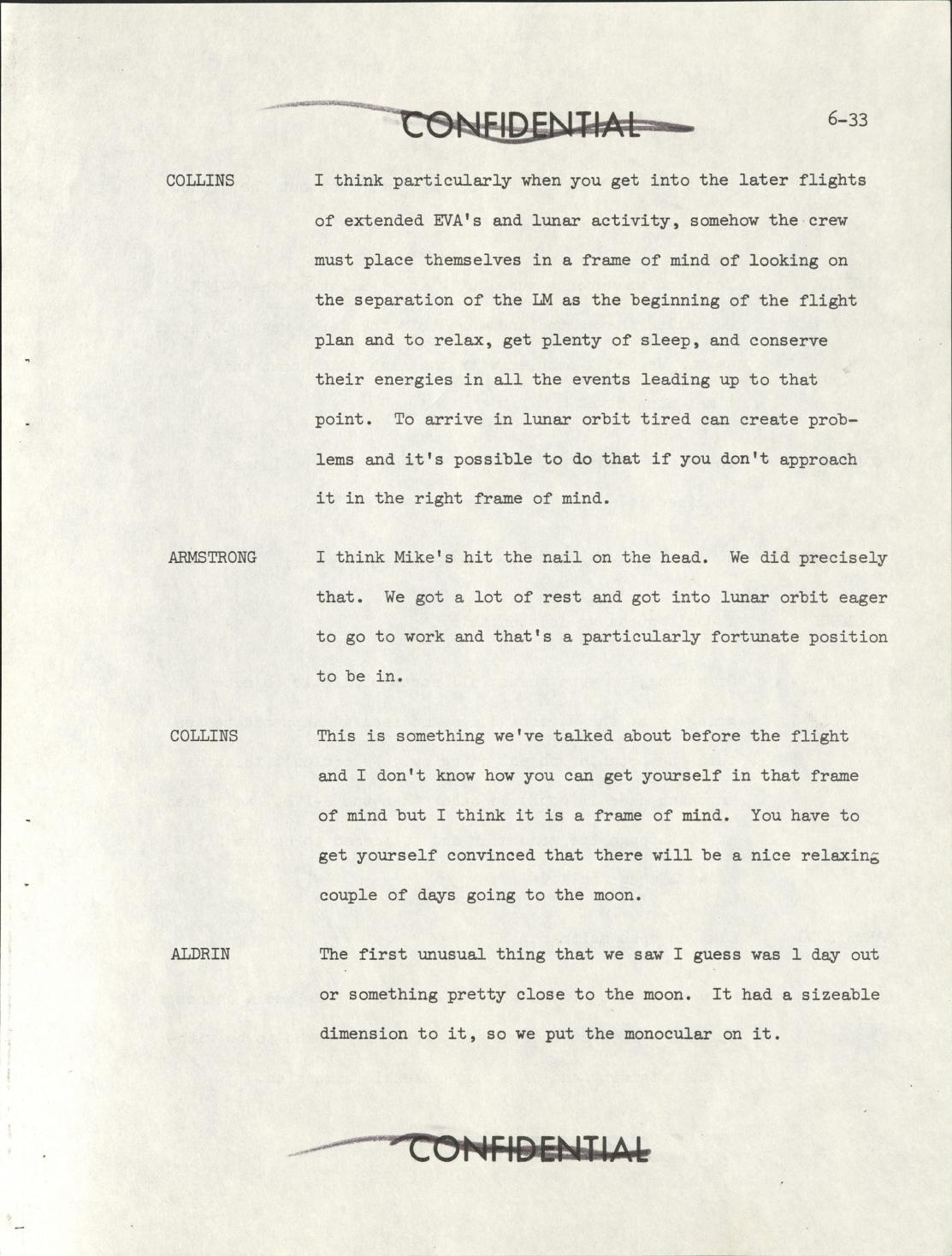
Page 2 begins the outbound-object passage: Aldrin says the crew saw the "first unusual thing" about a day out or near the Moon and used a monocular because it appeared to have sizeable dimension.
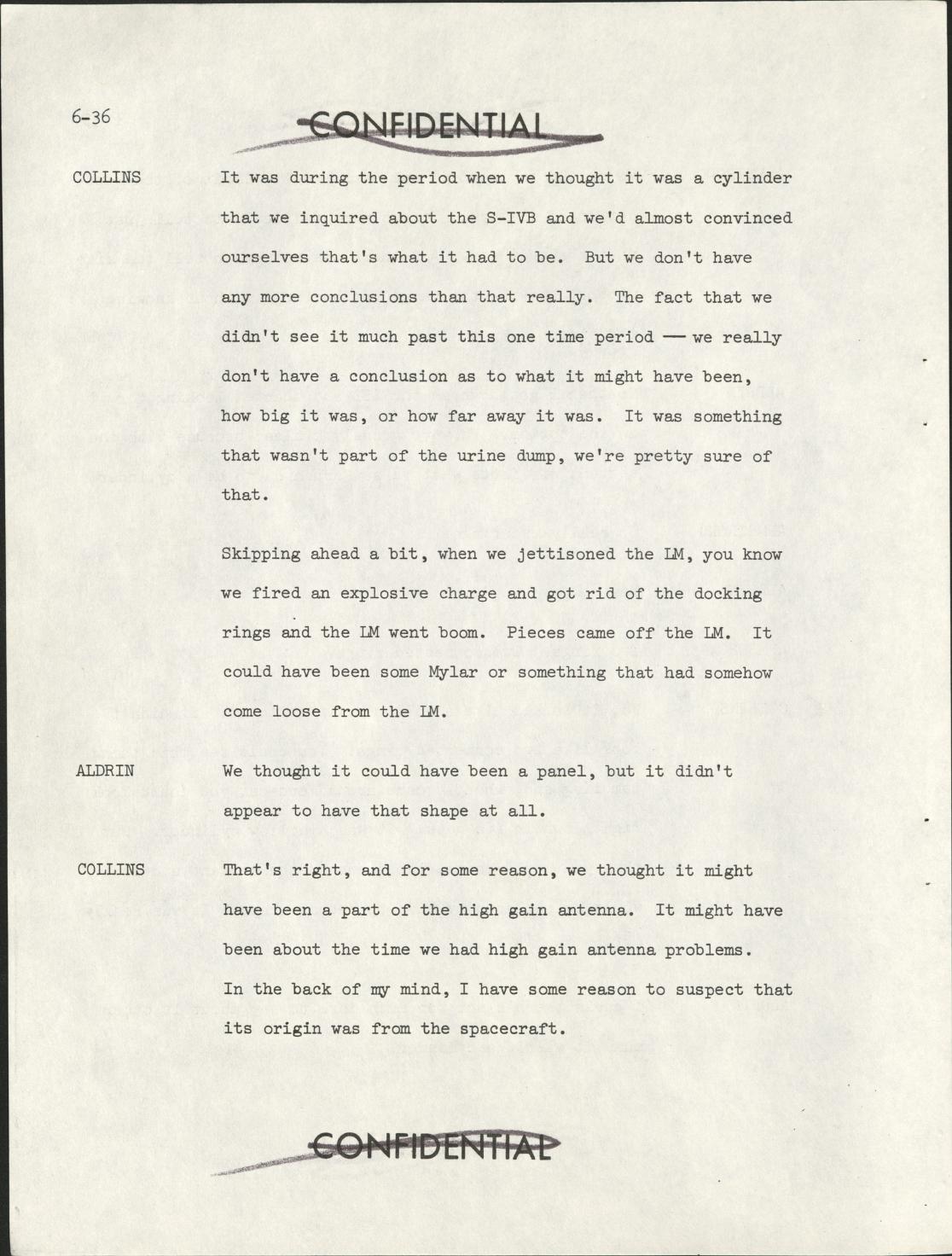
Page 5 is the most important cautionary page for the outbound object: Collins says the crew had no firm conclusion about size, range, or identity, and raises spacecraft-origin possibilities such as Mylar, a panel, or high-gain antenna material.
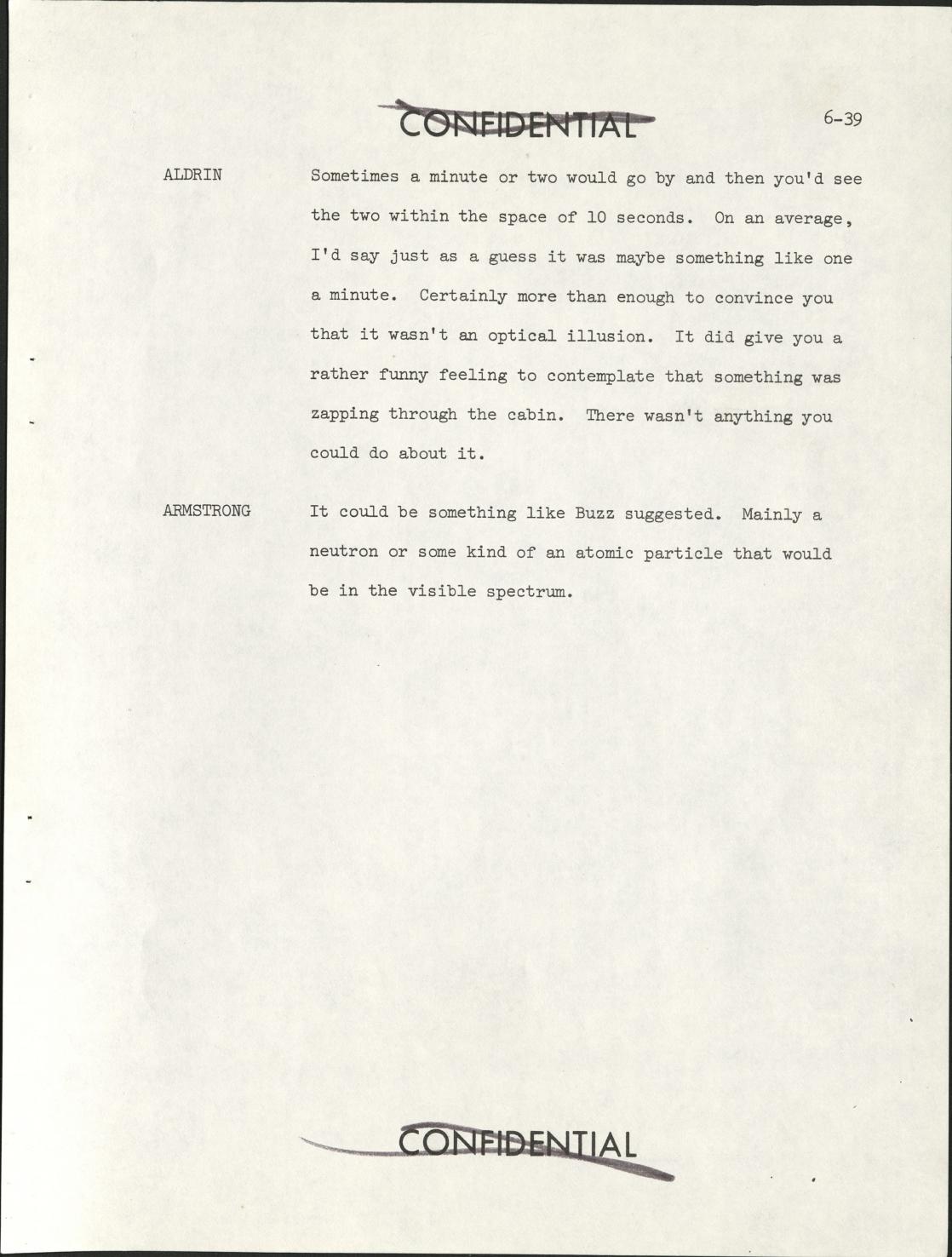
Page 8 closes the in-cabin flash passage, with Aldrin describing repeated flashes and Armstrong suggesting a neutron or other atomic-particle type explanation.
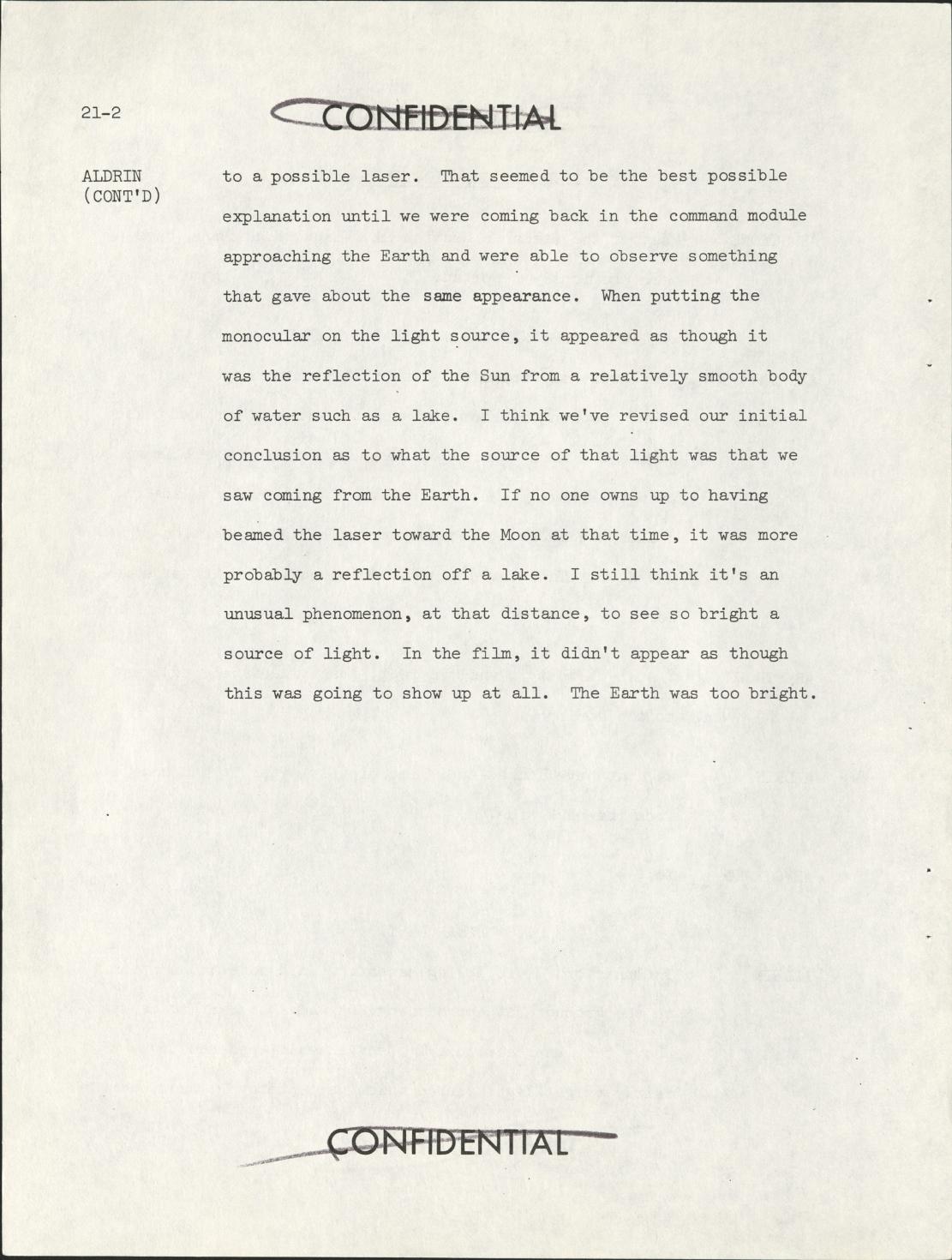
Page 11 preserves the lunar-orbit bright-light follow-up: the crew first considered a possible laser, but Aldrin says the later monocular comparison made sunlight reflecting from a smooth body of water, such as a lake, the more probable source unless a ground laser is confirmed.
Investigation reading
This Release 01 file is an eleven-page scanned PDF excerpt from NASA's Apollo 11 Technical Crew Debriefing, dated July 31, 1969. It is transcript evidence, not an imagery packet. The released PDF contains cover pages for Volume I and Volume II plus excerpted transcript pages. Rendered-page checks show typed debriefing text only: no embedded photographs, maps, diagrams, radar plots, film frames, or instrument displays.
The public interest here is narrow but important: the excerpt preserves three Apollo 11 crew discussions that have often been pulled into UFO/UAP lore. Read in sequence, the document is less a single mystery claim than a set of crew debriefing notes with explicit uncertainty and several source-stated prosaic leads. The draft status for this page is graph_investigation_draft; it remains needs_human_review and not_a_finding.
| Released pages | Reading notes |
|---|---|
| Page 1 | Volume I cover and NASA custody/classification markings. |
| Pages 2-5 | Translunar observation: Aldrin says the crew saw an unusual object about a day out or near the Moon and used a monocular. The crew considered the S-IVB stage, learned it was reported 6,000 miles away, described shape ambiguity, and discussed spacecraft-origin possibilities such as debris, Mylar, a panel, or high-gain antenna context. |
| Pages 6-8 | Inside-cabin flashes: Aldrin describes small flashes while trying to sleep with lights out, later double flashes and line-like effects. Armstrong notes possible sunlight leakage from window covers and then suggests a neutron or atomic-particle type explanation. |
| Page 9 | Volume II cover and NASA custody/classification markings. |
| Pages 10-11 | Section 21, Visual Sightings: Aldrin describes a Mars/Moon-horizon optical illusion and a lunar-orbit bright light initially ascribed to a possible laser, later revised toward sunlight reflected from a smooth body of water such as a lake. |
What the file appears to contain
The first high-signal passage is the outbound/translunar object discussion. Aldrin says the crew saw the "first unusual thing" roughly one day out or close to the Moon and that it had enough apparent dimension to justify using the monocular. Collins asks whether they simply looked out the window and saw it. Aldrin says they were not sure but thought it might be the S-IVB, then called the ground and were told the S-IVB was 6,000 miles away. The crew also mentions a high-gain antenna problem around that period.
The shape language is intentionally unstable. Aldrin says the brighter object seemed to have "a bit of an L shape" and Armstrong compares it to an open suitcase. Armstrong then cautions that it was at the limit of eye resolution, with no way to know size without range or range without size. Aldrin says the sextant, when out of focus, made the object look like a cylinder. Armstrong suggests two connected rings; Collins says it looked like a hollow cylinder and later like an open-book shape when focus changed. By page 5, Collins says they had no conclusion about what it was, how big it was, or how far away it was, while raising spacecraft-origin possibilities such as Mylar, a panel, or high-gain antenna material. The crew is fairly clear that the observation should not be treated as a resolved object identification.
The second passage concerns flashes seen inside the cabin. Aldrin describes small flashes while trying to sleep with the lights out, usually spaced minutes apart, sometimes as double flashes separated by roughly a foot, and sometimes as a line with no apparent direction of motion. He speculates cautiously about some form of penetration or emission but says there was not much support for that idea. He also compares the effect with static electricity and tries to correlate it with the Sun direction. Armstrong says he had previously attributed some light to leakage around the window covers, but on the last night he watched carefully and made many observations. The crew then discusses a particle-like explanation: Armstrong suggests a neutron or some kind of atomic particle visible in the spectrum. This section reads as in-cabin visual/physiological or particle-effect discussion, not as an external craft report.
The third passage is in Section 21, "Visual Sightings." Aldrin first describes a brief Mars/Moon-horizon optical illusion and Armstrong agrees it was likely adjacent to the horizon. Then Aldrin describes a lunar-orbit light source observed when Earth came above the lunar horizon near CDH. The crew initially considered a possible laser. On return, after seeing a similar effect through the monocular, Aldrin says the best explanation became a reflection of the Sun from a smooth body of water such as a lake. He still calls the brightness unusual at that distance, but the source text itself supplies the reflection/lake lead and notes that the film probably would not show it because Earth was too bright.
Source custody and provenance
- Publisher/source: WAR.GOV PURSUE Release 01, NASA asset, official CSV row
138. - Official/source URL: https://www.war.gov/medialink/ufo/release_1/nasa-uap-d4-apollo-11-technical-crew-debriefing-1969.pdf
- Open released file: war-gov-nasa-uap-d4-apollo-11-technical-crew-debriefing-1969-d14e0371
- Verified release-file size:
29,286,242bytes. - Verified SHA-256:
aacc41814dd16583bbeabe068026bf286cd9b0e464ff097c5c7b97b00d308443. - PDF page count:
11pages. The PDF is image-scan based and copy-restricted; the selectable text pass produced no usable body text, while Open Sky OCR coverage has text for all eleven pages. - Visual/media pass: the PDF contains one high-resolution scanned page image per PDF page. Rendered pages checked from both transcript clusters show text pages only, not photographic or sensor exhibits.
The released file is an excerpt, not the complete Apollo 11 debriefing volumes. The page images include the original NASA debriefing cover/custody markings for Volume I and Volume II, and the extracted pages correspond to transcript sections around Volume I pages 6-33 through 6-39 and Volume II pages 21-1 through 21-2.
Graph context
The graph currently models this item as an official Document asset plus the corresponding Release 01 row record. The exact asset record preserves the official PDF URL, the official-primary provenance tier, and the verified file hash above. The semantic layer attached to this page reports 85 extracted source-text claims, 24 entity mentions, 0 extracted sensor events, and 0 table rows.
Those graph claims are useful as navigation aids, but the released source remains a transcript excerpt. The claim categories concentrate around observation statements, witness testimony, object descriptors, motion/measurement language, time/agency metadata, and prosaic leads. Several generated object-descriptor claims pick up cover-page or surrounding transcript text, so this item should be read from the page-level source rather than from claim counts alone. No candidate crosslinks are promoted here, and related-document links should be treated as review leads unless a human verifies a source-level connection.
Leads to check
- Compare this Release 01 excerpt against the full NASA Apollo 11 Technical Crew Debriefing volumes to confirm page boundaries, omitted surrounding discussion, and whether the excerpt changes the context of the three highlighted observations.
- Reconcile the outbound-object timing with Apollo 11 mission timelines, S-IVB position data, SLA panel/debris behavior, urine/waste dumps, LM/CSM hardware events, and the high-gain antenna issue mentioned by the crew.
- For the cabin-flash section, compare Apollo medical/radiation documentation and other astronaut reports of cosmic-ray or particle-induced visual flashes before treating the passage as an external-object report.
- For the lunar-orbit bright-light passage, check mission transcripts, film/photography logs, Earthrise geometry, possible ground laser activity, and specular reflection from smooth water bodies before escalating the sighting.
- Review graph extraction quality for this file: some object-descriptor and motion claims come from broad transcript context or cover-page text rather than a discrete observation. Related-document edges need source-level verification before they are used analytically.
Lead check notes
- Partial — full-volume context: the current linked Release 01 corpus contains this eleven-page excerpt, not the complete Apollo 11 debriefing volumes. The page images support the excerpt boundaries already described here: Volume I cover plus pages 6-33 through 6-39, then Volume II cover plus pages 21-1 through 21-2. The surrounding full-volume discussion remains an external NASA-source check.
- Partial — outbound object / spacecraft-origin leads: the rendered pages and OCR confirm the crew considered the S-IVB, were told it was 6,000 miles away, and also discussed dumps, Mylar, a panel, the high-gain antenna, and possible spacecraft-origin material. A search of the current linked corpus found Apollo 17/D2 as another S-IVB-related transcript context, but no D4-specific S-IVB ephemeris, SLA-panel/debris chronology, waste-dump log, or hardware-event packet is attached here.
- Partial — cabin flashes: pages 6-8 confirm Aldrin's in-cabin flash description, his static-electricity comparison, Armstrong's window-cover leakage note, and Armstrong's neutron/atomic-particle suggestion. The NASA cluster already preserves adjacent Apollo/Skylab light-flash context, but this page still lacks an attached Apollo medical/radiation primary source, so the radiation and astronaut-physiology comparison remains open.
- Needs external source — lunar-orbit bright light: pages 10-11 confirm both the possible-laser wording and Aldrin's later lake-reflection explanation. Exact laser/lake-reflection language in the current linked Release 01 OCR appears to be confined to this D4 excerpt; mission transcript alignment, film/photography logs, Earthrise geometry, and any ground-laser source remain missing.
- Partial — graph/provenance cleanup: the asset inventory and exact graph records point to CSV row
138, SHA-256aacc41814dd16583bbeabe068026bf286cd9b0e464ff097c5c7b97b00d308443,85source-text claims,24entity mentions,0extracted sensor events, and no candidate crosslinks. Those graph claims are useful for navigation only; broad descriptor/motion claims should not be promoted without page-level source comparison.
Deep investigation — graph + web reconnaissance
Source reread
The source file was rechecked as an official-primary Release 01 PDF: 29,286,242 bytes, SHA-256 aacc41814dd16583bbeabe068026bf286cd9b0e464ff097c5c7b97b00d308443, 11 pages, AES-256/copy-restricted, and no embedded file attachments. The PDF image inventory shows one high-resolution scanned page image per page. A selectable-text pass produced only page breaks, so the reliable reading path is the Open Sky OCR plus rendered page review.
The rendered-page check supports the same source reading as the earlier human draft. Page 2 opens Aldrin's outbound-object passage: the crew saw the "first unusual thing" and used a monocular because it seemed to have sizeable dimension. Page 5 is the key cautionary page: Collins says the crew had no firm conclusion about identity, size, or range and raises spacecraft-origin possibilities such as Mylar, a panel, or high-gain antenna material. Page 8 keeps the cabin-flash passage inside the spacecraft, with Armstrong suggesting a neutron or other atomic-particle explanation. Page 11 keeps the lunar-orbit bright-light passage as a possible-laser idea later revised toward sunlight reflected from a smooth body of water such as a lake. The checked renders are transcript pages, not photographs, video frames, radar plots, telescope images, or sensor records of an object.
Graph connections
Read-only graph review found the exact official asset by URL/hash and keeps it separate from the Release 01 row record. The exact asset currently has 11 direct text chunks, 85 machine-extracted claims, 24 entity mentions, 0 sensor events, and 0 candidate crosslinks. The claim distribution is mostly object-descriptor, observation, witness-testimony, motion/measurement, time, agency, and prosaic-lead navigation tags; those claims remain machine_extracted_needs_human_review / not_a_finding unless the page text itself supports them.
The graph also shows a provenance-cleanup issue rather than a source-content conflict: the exact D4 asset is current and hash-verified, but some row-record fields around the NASA cluster still carry stale file URLs or byte totals from neighboring Release 01 records. In particular, a D4 row record can surface stale FBI Photo B9 file fields, and a D7/Skylab row record can surface the D4 PDF URL/byte total. Those are manifest-hygiene leads only; they are not corroborating sightings or separate Apollo 11 evidence.
External provenance and context
Direct WAR.GOV checks for the official PDF and CSV returned 403 Forbidden during this review, which is consistent with other Release 01 access behavior and is not a blocker because the Open Sky release-file copy verifies by size and hash. Internet Archive CDX has an exact-official-URL snapshot for the D4 PDF at timestamp 20260508141016, status 200, MIME type application/pdf, length 29294044; that is a custody lead, not a replacement source unless the archived file is fetched and hash-compared.
NASA NTRS search did not surface an exact public citation for the full Apollo 11 Technical Crew Debriefing title in this check. It did return official adjacent context records that matter for follow-up: Apollo 11 mission report (https://ntrs.nasa.gov/citations/19710015566 and https://ntrs.nasa.gov/citations/19700008096) and Apollo mission 11, trajectory reconstruction and postflight analysis, volume 1 (https://ntrs.nasa.gov/citations/19700014995). The mission report confirms the July 16, 1969 launch, translunar injection, S-IVB context, passive thermal control, and a transearth-coast cabin-light-scintillation note that discusses high-energy cosmic particles as one possible explanation. It also documents the Apollo 11 laser-ranging retroreflector experiment and later reflected laser signals from Earth observatories; that is lunar-surface experiment context, not proof that the page-11 light source was a ground laser.
Prosaic checks before escalation
- Outbound/translunar object: the source itself supplies the first checks — S-IVB position, then spacecraft-origin material such as Mylar, a panel, high-gain antenna material, dumps, or other hardware/debris. The graph launch-correlation layer did not return a modeled Apollo 11/1969 launch record, so graph absence here is a coverage limit, not an exclusion.
- Cabin flashes: D4 frames the flashes as in-cabin visual effects. NASA mission-report context separately discusses cabin light scintillations visible to dark-adapted crew and a high-energy-particle/cosmic-ray explanation. That makes this a radiation/physiology/spacecraft-lighting comparison lane before any external-object framing.
- Lunar-orbit bright light: D4 already weakens the possible-laser interpretation by preserving Aldrin's later smooth-water/sun-reflection explanation and the note that the film likely would not show the source because Earth was too bright. Follow-up needs mission-transcript timing, Earthrise geometry, film logs, and any observatory/laser records before treating it as more than an unresolved visual report.
Follow-up leads and limits
The main missing sources are the complete Apollo 11 debriefing volumes, full air-to-ground transcript alignment around the three passages, S-IVB ephemeris and separation/debris records, high-gain antenna anomaly detail, dump/hardware-event timelines, Apollo medical/radiation documentation, lunar-orbit Earth geometry, and photography/film logs. Until those are attached, this page should remain a source-grounded transcript review: it preserves crew testimony and source-stated prosaic leads, but it does not create a finding, hypothesis, or resolution decision.
Limits
This file does not include an object photograph, video, radar return, telemetry plot, or independent sensor record. It also does not include the crew's original monocular view, the claimed light source on film, or the full debriefing volumes. The scan/OCR is readable enough for page-level review, but some stamps and cover markings are illegible and the released PDF does not provide selectable body text.
Most importantly, the crew's own transcript contains uncertainty and prosaic leads: S-IVB was considered and then questioned; spacecraft debris or hardware-origin possibilities were raised; the cabin flashes were discussed as possible light leakage or particle effects; and the lunar-orbit bright light was later revised toward a sunlight reflection from a lake or similar smooth water body. This page preserves the source reading and review leads only. It does not assert a finding, hypothesis, or resolution.
Sources
- WAR.GOV PURSUE Release 01 official PDF: NASA-UAP-D4, Apollo 11 Technical Crew Debriefing, 1969
- Open Sky release-file copy for verified access: war-gov-nasa-uap-d4-apollo-11-technical-crew-debriefing-1969-d14e0371
- WAR.GOV PURSUE Release 01 CSV row
138/ NASA. - Open Sky source verification for this draft: PDF size
29,286,242bytes; SHA-256aacc41814dd16583bbeabe068026bf286cd9b0e464ff097c5c7b97b00d308443;11PDF pages; Open Sky OCR text present for all11pages. - NASA NTRS adjacent context: Apollo 11 mission report, Apollo 11 mission report, and Apollo mission 11, trajectory reconstruction and postflight analysis, volume 1.
- Internet Archive CDX custody lead for the exact official D4 PDF URL: snapshot timestamp
20260508141016, status200, MIME typeapplication/pdf, length29294044.