NASA-UAP-D5, Apollo 17 Crew Debriefing for Science, 1973
Evidence media
Derived page renders from the official PDF:
Page 1 is the NASA cover/indexing page for APOLLO 17 CREW DEBRIEFING FOR SCIENCE, dated January 8, 1973, from the Manned Spacecraft Center. It is not object imagery.
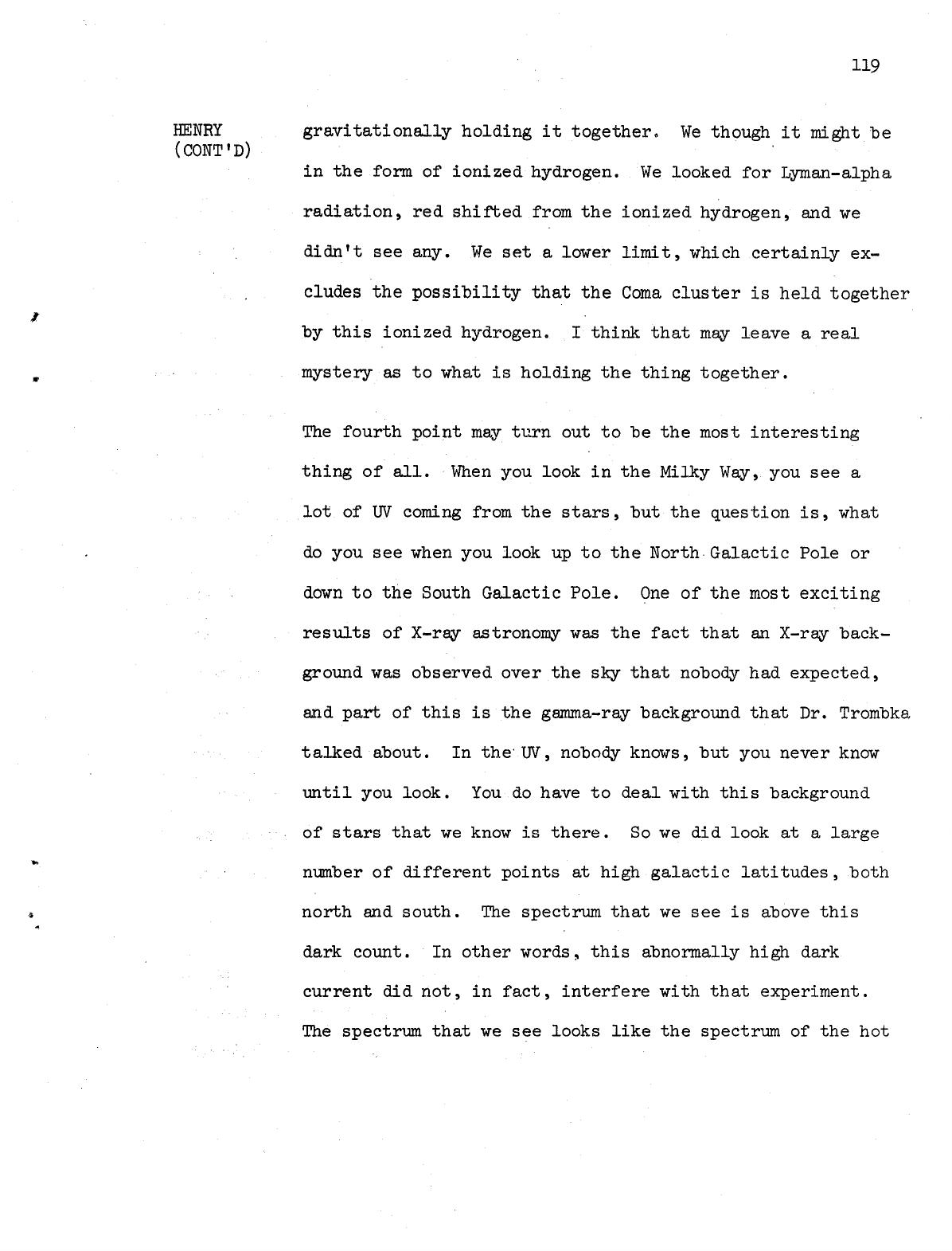
Page 2 is transcript page 119. Henry discusses Lyman-alpha radiation, the Coma cluster, and ultraviolet background observations toward the North and South Galactic Poles; no photos, maps, diagrams, or sensor frames are visible.
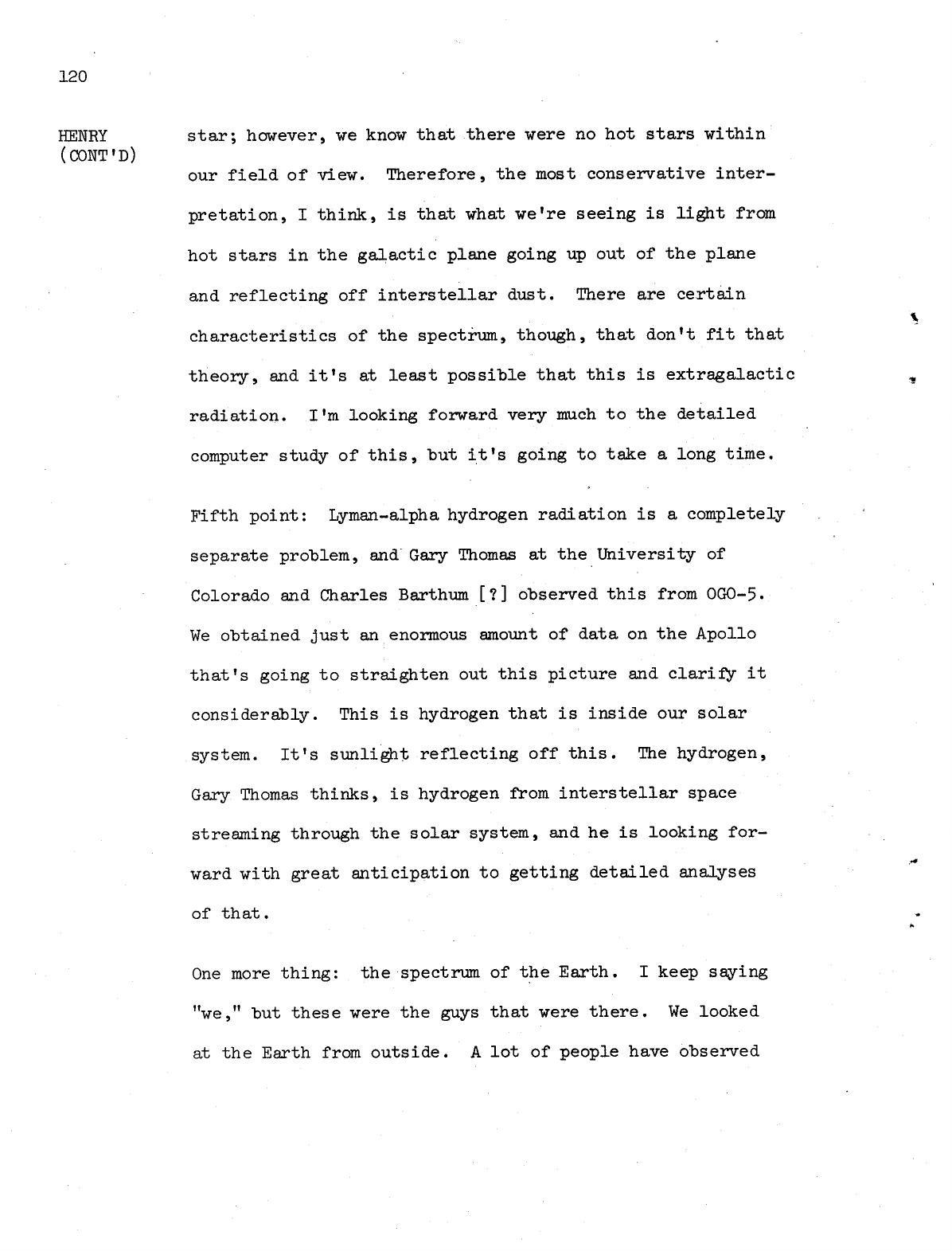
Page 3 is transcript page 120. Henry gives the conservative interstellar-dust interpretation, notes possible extragalactic radiation pending study, and begins a separate Lyman-alpha / Earth-spectrum discussion that cuts off in the released excerpt.
Investigation reading
This is a short NASA transcript excerpt, not an object-imagery packet. I reviewed the full released PDF: three pages, 212,585 bytes, SHA-256 5d7db3870de8c01a1c39b7e8a4185dd026fe132f01d1cd5ded60f10866722f7e. The PDF is an encrypted scan with copy disabled, but OCR covers all three released pages and a rendered-page pass confirms the visible layout.
The file consists of a cover/title page plus two transcript pages from the Apollo 17 science crew debriefing. Page 1 identifies the document as APOLLO 17 CREW DEBRIEFING FOR SCIENCE, dated January 8, 1973, prepared by the Science Requirements Branch / Planetary and Earth Sciences Division at the Manned Spacecraft Center in Houston. Pages 2 and 3 are numbered 119 and 120 and continue remarks by HENRY about ultraviolet and other astronomical background measurements.
Across the full excerpt, I did not find UAP, UFO, unidentified, object-photo language, maps, diagrams, radar plots, sensor frames, or visual evidence of an aerial object. The high-signal content is a science discussion of unexpected astronomical background observations: an X-ray background, gamma-ray background, ultraviolet measurements at high galactic latitudes, a hot-star-like spectrum despite no hot stars in the instrument field of view, a conservative interpretation involving light reflected from interstellar dust, and the possibility that some component could be extragalactic radiation.
What the file appears to contain
| Released page | Reading |
|---|---|
| 1 | NASA cover and indexing page for Apollo 17 Crew Debriefing for Science, January 8, 1973. No photos or data figures are visible. |
| 2 | Transcript page 119. Henry closes a point about Lyman-alpha radiation and ionized hydrogen in the Coma cluster, then introduces a fourth point about looking away from the Milky Way toward the North and South Galactic Poles. The speaker compares the unexpected X-ray background with ultraviolet-background uncertainty and says the observed UV spectrum is above the dark-count level. |
| 3 | Transcript page 120. Henry says the observed spectrum looks like a hot-star spectrum even though there were no hot stars in the field of view. He gives the conservative interpretation as hot-star light from the galactic plane reflecting from interstellar dust, while noting that some spectrum characteristics do not fit that theory and that extragalactic radiation is at least possible. He then turns to Lyman-alpha hydrogen radiation observed from OGO-5 and begins a separate point on Earth spectrum observations. |
The excerpt’s most important source language is not a sighting claim. It is an astronomy-result discussion: there were no hot stars within our field of view; the conservative explanation offered in the transcript is reflected light from hot stars off interstellar dust; and the unresolved part is framed as a candidate scientific interpretation requiring detailed computer study.
Source custody and provenance
The official Release 01 record identifies this as NASA-UAP-D5, Apollo 17 Crew Debriefing for Science, 1973, agency NASA, CSV row 139, PDF source type, incident date field 1973, and no stated incident location. The official URL is:
The Open Sky release-file copy is available at:
/api/explore/war-gov/release-file/war-gov-nasa-uap-d5-apollo-17-crew-debriefing-for-science-1973-63c47bad
The verified hash for the released PDF is 5d7db3870de8c01a1c39b7e8a4185dd026fe132f01d1cd5ded60f10866722f7e. The visible PDF metadata title/subject match the released title. The release description says this is an excerpt from the January 8, 1973 Apollo 17 Crew Debriefing for Science in which Dick Henry, co-investigator on the ultraviolet experiment, discusses unexpected results on pages 119-120.
Graph context
The graph has both the PDF asset record and the Release 01 CSV record for this file. The semantic layer currently shows 23 extracted source-text claims, 11 entity mentions, 0 sensor events, and 0 table rows. There are no candidate crosslinks attached to this item.
The extracted claims are useful as navigation cues, but they over-broaden some astronomy language. For example, text about light from hot stars ... reflecting off interstellar dust can surface as an object-descriptor-style claim even though the PDF is not an object sighting report and contains no object image. The absence of sensor events matches the source review: this release item is a transcript excerpt, not radar/IR/FMV/video evidence.
Related graph navigation points toward other NASA Apollo release material, including Apollo 12 transcript/video records. Those links should be treated as collection context only until the relevant files are read page by page. The exact release record and source inventory identify this D5 item with CSV row 139; any alternate row reference surfaced by derived manifest text should be checked against the current Release 01 CSV before being used.
Leads to check
- Locate the full NASA Apollo 17 science debriefing volume, not only the released three-page excerpt, so the surrounding pages before 119 and after 120 can be read in sequence.
- Verify the uncertain OCR name
Charles Barthum [?]against a cleaner NASA copy or published Apollo ultraviolet-experiment records. - Compare Henry’s remarks with published Apollo 17 ultraviolet / far-UV astronomy experiment results, especially the interstellar-dust and possible-extragalactic-radiation interpretation.
- Check whether the excerpt’s final Earth-spectrum sentence continues into a relevant discussion on the next unreleased page.
- Keep the Release 01 row number aligned to CSV row
139unless the official CSV proves otherwise.
Lead check notes
Partial— Full-volume context: the Open Sky release-file copy is a three-page excerpt, not the complete science debriefing volume. The current linked Release 01 OCR corpus surfaces the sameApollo 17 Crew Debriefing for Science/ Henry astronomy text only in this D5 item, so pages before 119 and after 120 still require the full NASA volume.Partial— Name/spelling check: the page-3 render and OCR support the lineGary Thomas at the University of Colorado and Charles Barthum [?] observed this from OGO-5, but the current linked OCR corpus finds thatCharles Barthum/OGO-5wording only in this excerpt. A cleaner NASA copy or Apollo ultraviolet-experiment publication is needed before normalizing the surname.Partial— Published-results comparison: the excerpt itself supports Henry’s interstellar-dust and possible-extragalactic-radiation wording. A linked-corpus search found no separate NASA result paper in Release 01; comparison against Apollo 17 far-UV astronomy publications remains an external-source lead.Blocked— Earth-spectrum continuation: the released page 3 visibly stops afterA lot of people have observed; no following page is present in the released PDF, so the next sentence cannot be checked without the full debriefing volume.Partial— Row cleanup: the current Release 01 asset inventory and graph record identify row139; older derived NASA collection metadata can surface row142. Keep row139unless the official WAR.GOV CSV or manifest history proves otherwise.
Deep investigation — graph + web reconnaissance
Source reread
The Release 01 asset remains a three-page scanned NASA PDF, not an object-imagery packet. The verified PDF is 212,585 bytes with SHA-256 5d7db3870de8c01a1c39b7e8a4185dd026fe132f01d1cd5ded60f10866722f7e; pdfinfo reports three pages, AES-256 encryption with copy disabled, and the title/subject NASA-UAP-D5, Apollo 17 Crew Debriefing for Science, 1973. pdfimages shows one 300-ppi scanned page image per page.
Rendered-page review confirms page 1 is the NASA cover/indexing page for APOLLO 17 CREW DEBRIEFING FOR SCIENCE, dated January 8, 1973, from the Manned Spacecraft Center. Pages 2-3 are typed transcript pages 119-120 by HENRY (CONT'D). No photographs, maps, diagrams, plots, radar products, spacecraft imagery, or sensor frames are visible in the release. The high-signal source text is Henry's astronomy discussion: a Coma-cluster Lyman-alpha non-detection, ultraviolet observations toward the North and South Galactic Poles, a spectrum above dark count, no hot stars within our field of view, a conservative interstellar-dust reflection interpretation, possible extragalactic radiation pending computer study, and a separate OGO-5 / solar-system hydrogen discussion.
Graph connections
Read-only graph checks match the page-level reading. The graph has the exact PDF asset plus the current Release 01 CSV row 139; the exact asset carries the PDF URL, 212,585 byte length, and matching SHA-256. The semantic layer for this asset currently contains 23 machine-extracted claims, 11 entity mentions, 0 sensor events, 5 direct text chunks, and 0 candidate crosslinks. Exact text-chunk hits are present for Lyman-alpha, OGO-5, Gary Thomas, Charles Barthum [?], Coma cluster, extragalactic radiation, interstellar dust, and hot stars.
The graph's broad object_descriptor and witness_testimony claim kinds come from phrases such as light from hot stars ... reflecting off interstellar dust and the transcript's observed wording. Those are useful navigation cues only; they are not object-sighting evidence and are not findings. One related row-record node still carries stale Apollo 12 file fields while the exact D5 PDF asset is correct, and a row-142 Apollo image neighbor appears as provenance/navigation drift rather than a content-level connection. The secondary UFO-USA Markdown conversion is also a derived lead, not primary custody.
External provenance and context
Direct WAR.GOV/PURSUE PDF, landing-page, and CSV probes returned 403 from this environment, so the public citation should keep using the exact official URL plus the verified Open Sky release-file copy and hash. Internet Archive CDX probing for the exact PDF URL returned a temporary 503, so no archived-copy replacement is asserted here.
NASA NTRS does not surface an exact Apollo 17 Crew Debriefing for Science / MSC-07632 citation in the checks run for this page. It does provide official context for the surrounding science lane: NTRS 19740010315, Apollo 17 Preliminary Science Report / NASA-SP-330, summarizes the mission science report; NTRS 19730010713, The Apollo 17 far ultraviolet spectrometer experiment, describes the 1180-1680 Å instrument and its lunar, Earth, solar-system, galactic, and astronomical observation program; NTRS 19750002056, Apollo 17 ultraviolet spectrometer experiment (S-169), covers scientific objectives, operations, and results including lunar atmosphere/albedo, zodiacal light, astronomical observations, spacecraft environment, and atomic hydrogen. NTRS 20070011739, The Mission Transcript Collection, establishes NASA's broader transcript-collection context but is not the exact D5 debriefing PDF.
Prosaic checks and limits
The normal weather, launch, satellite, aircraft, or astronomy-correlation lanes are not meaningful for this file as a UAP event because the release does not describe a dated sighting, location, platform track, or anomalous object. The source-internal explanation lane is scientific rather than UAP-prosaic: compare Henry's tentative interstellar-dust / possible-extragalactic-radiation discussion against the full Apollo 17 ultraviolet spectrometer experiment papers and data. A graph year-only probe for 1973 launch/astronomy context did not return modeled correlation nodes, but that absence should not be treated as evidence for or against the transcript's science discussion.
Follow-up leads
- Locate a full copy of
APOLLO 17 CREW DEBRIEFING FOR SCIENCE/MSC-07632so transcript pages before 119 and after 120 can be read in sequence. - Resolve the uncertain page-3 name
Charles Barthum [?]against cleaner NASA copies or Apollo 17 ultraviolet-experiment publications before normalizing the surname. - Compare the released excerpt with the NTRS Apollo 17 UV spectrometer records, especially the interstellar-dust, extragalactic-radiation, OGO-5, and hydrogen-in-the-solar-system threads.
- Keep row
139as the current Release 01 identity while treating alternate row142and stale adjacent graph file fields as provenance-cleanup leads only.
Audit note
This deep-investigation pass adds graph/web provenance context without changing the source posture: the page remains an official-primary transcript excerpt, not a UAP sighting report, and no Finding, Hypothesis, or ResolutionDecision is asserted.
Limits
This is only a three-page excerpt. Page 3 ends mid-thought at A lot of people have observed, so the released file does not preserve the whole Earth-spectrum discussion. The file does not include the full experiment report, tables, charts, instrument logs, original ultraviolet spectra, photographs, maps, or sensor frames.
The cover page OCR is noisy because it is a scanned title page, though the rendered page is legible enough to confirm the NASA title, date, and issuing center. Pages 2-3 are readable transcript text, but individual names and hyphenated line breaks should be verified before quotation in a formal article.
No finding, hypothesis, or resolution is asserted here. This page is an investigation draft preserving what the released source appears to contain and what should be checked next.
Sources
- Official WAR.GOV PDF: https://www.war.gov/medialink/ufo/release_1/nasa-uap-d5-apollo-17-crew-debriefing-for-science-1973.pdf
- Open Sky release-file copy:
/api/explore/war-gov/release-file/war-gov-nasa-uap-d5-apollo-17-crew-debriefing-for-science-1973-63c47bad - Release 01 CSV row:
139 - SHA-256:
5d7db3870de8c01a1c39b7e8a4185dd026fe132f01d1cd5ded60f10866722f7e - Source title:
NASA-UAP-D5, Apollo 17 Crew Debriefing for Science, 1973