NASA-UAP-D6, Apollo 17 Technical Crew Debriefing, 1973
Evidence media
- Official PDF release-file copy: Open Sky release-file copy.
- The page renders below are derived from the verified official PDF. They show the document cover and the single transcript page in this excerpt; they are not photographs, maps, radar plots, telemetry displays, spacecraft imagery, or other sensor frames.
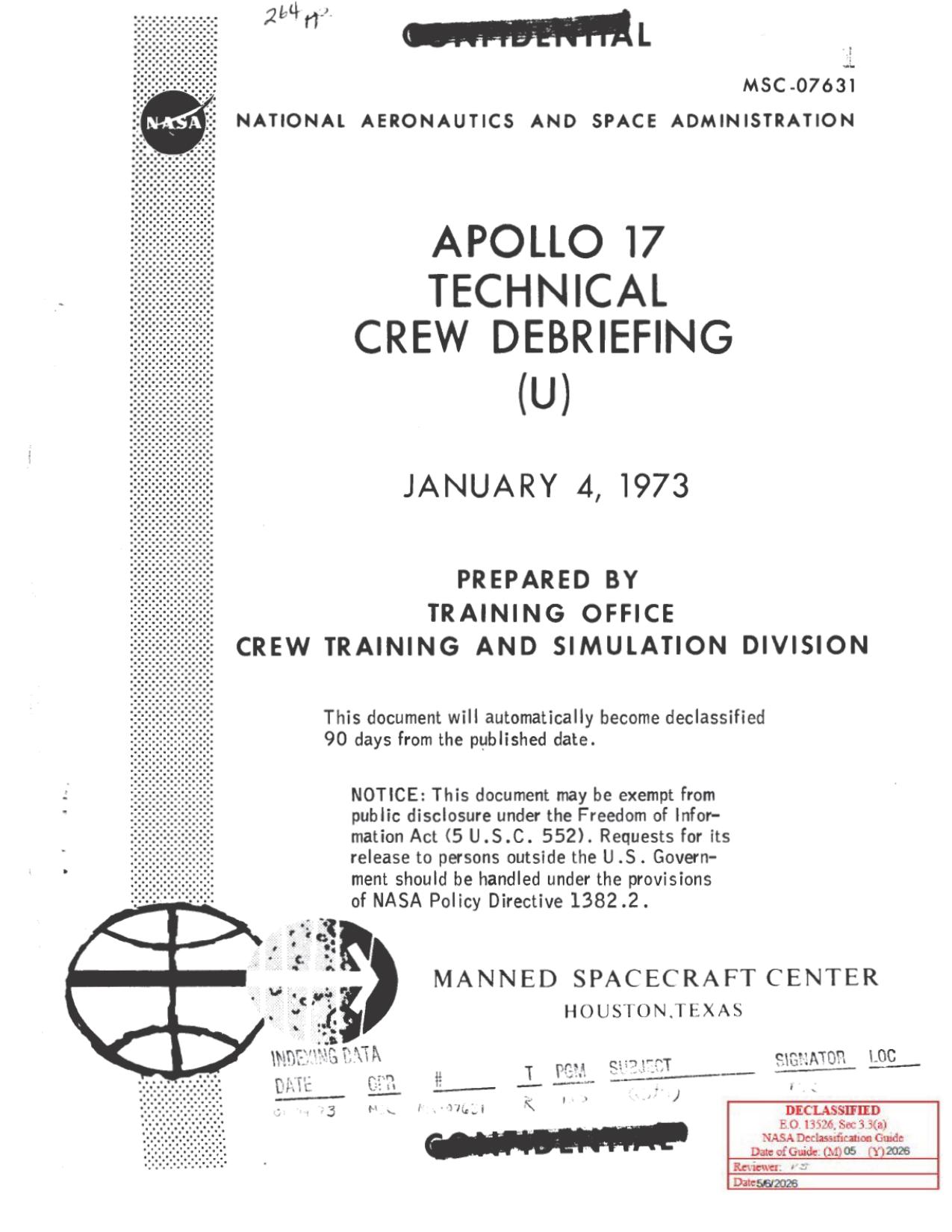 Page 1 render: NASA cover/admin page for
 APOLLO 17 TECHNICAL CREW DEBRIEFING (U), document MSC-07631, dated January 4, 1973, with declassification and routing markings.
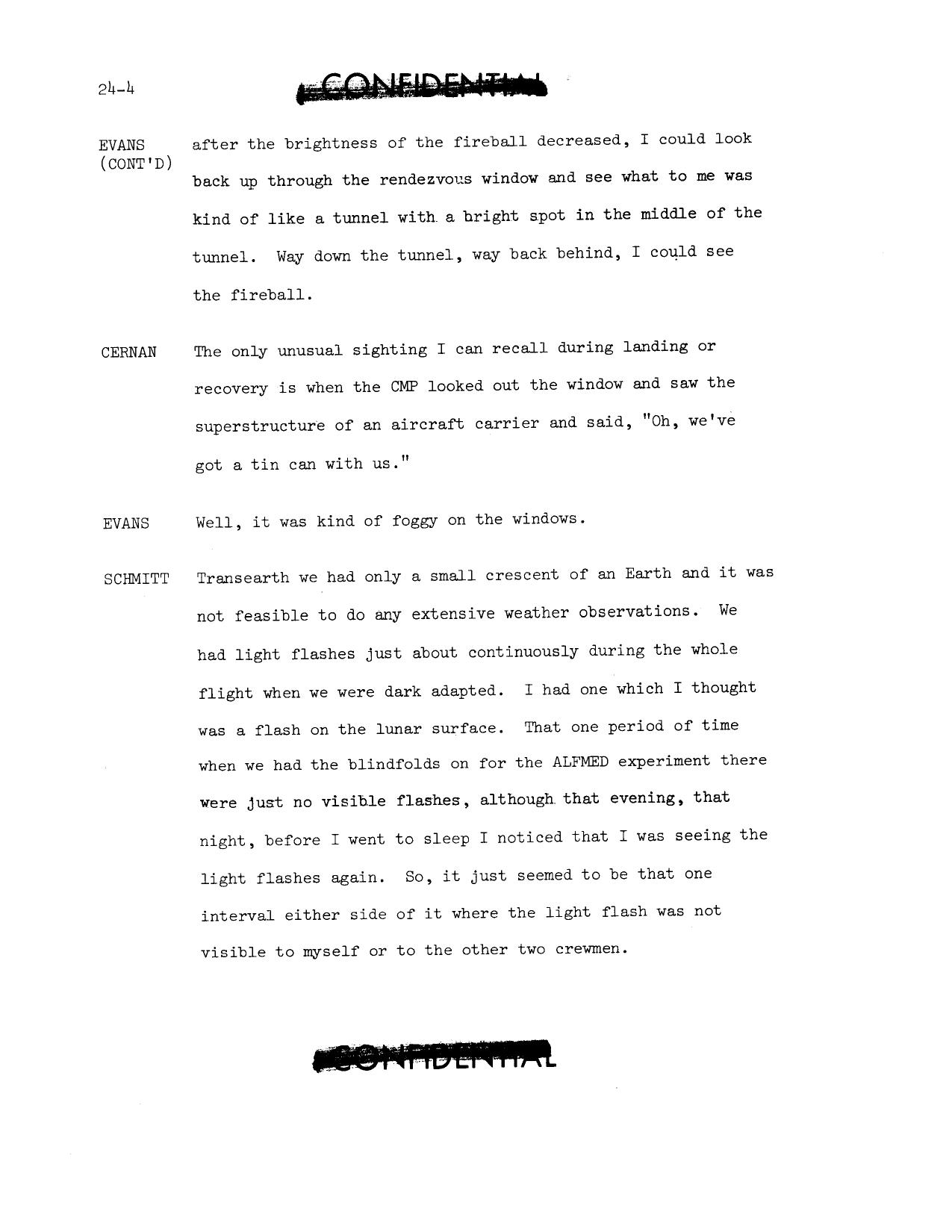 Page 2 render: transcript page
 24-4, with Evans's fireball/window description, Cernan's aircraft-carrier/foggy-window recovery comment, and Schmitt's dark-adapted light-flash and ALFMED remarks.
Investigation reading
This Release 01 item is a two-page NASA PDF excerpt from the Apollo 17 Technical Crew Debriefing, dated January 4, 1973. It should be read as transcript/documentary evidence, not as an image exhibit. The rendered pages show a scanned cover page and one scanned transcript page; they do not contain photographs, maps, diagrams, radar plots, telemetry displays, spacecraft imagery, or other sensor frames.
| Page | Source reading |
|---|---|
| 1 | Cover/title page for APOLLO 17 TECHNICAL CREW DEBRIEFING (U), document MSC-07631, prepared by the Training Office / Crew Training and Simulation Division at the Manned Spacecraft Center, Houston, Texas. The page carries crossed-out CONFIDENTIAL markings, public-release/declassification markings, and administrative indexing marks. |
| 2 | Transcript page 24-4, with short speaker-labeled passages from Evans, Cernan, and Schmitt. Evans describes seeing a fireball through the rendezvous window as a tunnel-like view with a bright spot. Cernan says the only unusual landing/recovery sighting he recalled was the command module pilot seeing the superstructure of an aircraft carrier and joking about a “tin can.” Evans adds that the windows were foggy. Schmitt then discusses Apollo 17 light flashes during dark-adapted periods and the ALFMED blindfold interval. |
The high-signal Schmitt passage reads, in part: “We had light flashes just about continuously during the whole flight when we were dark adapted. I had one which I thought was a flash on the lunar surface.” He adds that during the blindfolded ALFMED interval there were “just no visible flashes,” but that before sleep that night he was seeing the light flashes again.
What the file appears to contain
The file appears to preserve a narrow excerpt from a larger Apollo 17 debriefing. Its relevant content is mostly about visual perceptions and mission-context observations, not a standalone UAP case file.
The page-2 transcript includes three distinct threads that should not be collapsed into one event:
- Evans fireball/window description: after the brightness of a fireball decreased, Evans says he could look back through the rendezvous window and see something like a tunnel with a bright spot in the middle, with the fireball visible farther back.
- Cernan recovery/aircraft-carrier comment: Cernan frames the aircraft-carrier view as the only unusual landing/recovery sighting he could recall; Evans immediately notes foggy windows.
- Schmitt light-flash discussion: Schmitt reports frequent light flashes while dark adapted, one flash he thought was on the lunar surface, and a temporary absence of visible flashes during the ALFMED blindfold period.
For Open Sky purposes, this is best handled as a short transcript-source page. The wording supports follow-up on Apollo light-flash/ALFMED context and on the surrounding debrief pages, but it does not itself provide object imagery, an instrument return, a resolved location, or a public finding.
Source custody and provenance
- Official/source URL: NASA-UAP-D6 PDF
- Open Sky release-file copy: war-gov-nasa-uap-d6-apollo-17-technical-crew-debriefing-1973-0b298cfc
- PURSUE Release 01 CSV row:
140 - Agency:
NASA - File type: scanned/copy-restricted PDF,
2pages,513,402bytes - SHA-256:
2c874c40c55505f2348177ddde77c9fd015bf971e6e059c43508a92bc9ee6b30
Technical read-through notes: the PDF text layer is copy-restricted and did not yield selectable text in the direct text extraction pass. The release OCR covers both pages, and rendered-page inspection confirms the same page structure: cover page plus transcript page. Direct official media requests may return 403, so the page relies on the verified Open Sky release-file copy while citing the official URL above.
Graph context
The graph has both a Release 01 record node and a PDF asset node for this item. The current semantic layer preserves 28 extracted claims, 16 entity mentions, 1 sensor-event record, and no semantic table rows. Those records are useful as navigation aids, but they should not be treated as findings.
Important graph-reading cautions:
- The single sensor-event record appears to be triggered by the word
aircraftinside the phraseaircraft carrier. In the source, that line is a recovery-scene visual comment through foggy windows, not a radar, aircraft-sensor, or UAP instrument record. - The
light flashesclaims are transcript statements about Schmitt’s reported visual experience during dark-adapted Apollo 17 flight conditions and the ALFMED interval. They need Apollo medical/radiation and ALFMED context before any interpretation. - Related graph navigation points include
NASA-UAP-D2, Apollo 17 Transcript, 1972andNASA-UAP-VM2, Apollo 12, 1969. Those related records should be checked directly before being used to connect events. - No candidate crosslinks are currently listed for this item.
Leads to check
- Locate the surrounding pages of the full Apollo 17 Technical Crew Debriefing around transcript page
24-4so the Evans fireball/window passage and Schmitt light-flash discussion are not interpreted from a two-page excerpt alone. - Compare Schmitt’s light-flash remarks with Apollo ALFMED documentation, Apollo medical/radiation literature, and crew debrief context for dark-adapted visual flashes.
- Compare this excerpt against the related Apollo 17 transcript item in Release 01 to separate translunar/debris/object discussions from this later technical-debriefing passage.
- Treat the aircraft-carrier line as a recovery visibility/context lead unless a separate source shows it was modeled differently.
- Verify row-level provenance if future Release 01 indexes surface alternate row numbers or related Apollo records beside row
140.
Lead check notes
- Partial — Surrounding debriefing context. The Open Sky release-file copy contains only the cover page and transcript page
24-4; it does not include adjacent pages before or after the Evans/Cernan/Schmitt exchange. The full Apollo 17 Technical Crew Debriefing volume remains the missing source for surrounding context. - Partial — ALFMED and light-flash context. The verified page-2 transcript preserves Schmitt's statement that light flashes occurred when the crew were dark adapted, with no visible flashes during the blindfolded ALFMED interval. The related Release 01
NASA-UAP-D2, Apollo 17 Transcript, 1972page supplies separate air-to-ground context for ALFMED, S-IVB/SLA-panel discussion, and a north-of-Grimaldi lunar flash, but Apollo medical/radiation and ALFMED primary documentation are still needed before interpreting the light-flash remarks. - Partial — Related Apollo 17 records. Current Release 01 metadata lists separate Apollo 17 materials for D2, D5, D6, and VM6. D2 is useful transcript context; D5 is a science-debriefing excerpt; VM6 is a separate image record. None of those records, as currently modeled here, supplies the missing adjacent D6 debrief pages or resolves the D6 light-flash passage.
- Checked — Aircraft-carrier line. Page
24-4frames the aircraft-carrier reference as Cernan's landing/recovery visibility comment, immediately followed by Evans noting foggy windows. The graph's single platform/sensor-style extraction from the wordaircraftshould be treated as cleanup context, not as evidence of an aircraft sensor or UAP instrument event. - Checked — Row provenance. The current Release 01 metadata and verified PDF source identify this item as row
140with SHA-2562c874c40c55505f2348177ddde77c9fd015bf971e6e059c43508a92bc9ee6b30. Related Apollo 17 records have their own rows and should remain catalog context unless an official index update links them more specifically.
Deep investigation — graph + web reconnaissance
Source reread
- The Open Sky release-file copy re-verifies as a
513,402-byte, two-page PDF with SHA-2562c874c40c55505f2348177ddde77c9fd015bf971e6e059c43508a92bc9ee6b30. PDF metadata reportsNASA-UAP-D6, Apollo 17 Technical Crew Debriefing, 1973, AES-256 encryption with copying disabled, and one page image per PDF page; a direct text-layer extraction produced only page breaks, so OCR plus rendered-page review are the readable source path. - Render review confirms page 1 is a cover/admin page for
APOLLO 17 TECHNICAL CREW DEBRIEFING (U),MSC-07631, January 4, 1973, prepared by the Training Office / Crew Training and Simulation Division at the Manned Spacecraft Center. Page 2 is transcript page24-4. Neither page contains photographs, maps, diagrams, radar plots, telemetry displays, spacecraft imagery, or other sensor frames. - Page
24-4separates three source threads: Evans's entry-fireball/rendezvous-window description, Cernan's recovery-scene aircraft-carrier “tin can” remark with Evans's foggy-window caveat, and Schmitt's dark-adapted light-flash / ALFMED blindfold interval remarks. Those should stay separated; the file is not a single resolved UAP event.
Graph connections
- Read-only Neo4j checks found the exact Release 01 PDF asset and the current row
140record. The asset carries28machine-extracted claims,16entity mentions,4direct text chunks,1machineSensorEvent, and noCANDIDATE_CROSSLINKrecords. - The single
SensorEventis an unreviewed deterministic extraction from the phraseaircraft carrier; the source sentence is a recovery visibility comment through foggy windows, not an aircraft-sensor, radar, IR, telemetry, or UAP instrument return. - Same-title/URL/hash matching also exposed row-record field drift: the row
140record has the D6 title and current row anchor, while some stale file fields still point at the Apollo 17 D2 transcript asset. That is a provenance-cleanup lead, not evidence of a second D6 source or a cross-case corroboration. - Related graph navigation points such as
NASA-UAP-D2, Apollo 17 Transcript, 1972andNASA-UAP-VM2, Apollo 12, 1969remain catalog/context leads only unless their source pages are read directly against this D6 excerpt.
External provenance and context
- Live WAR.GOV/PURSUE probes for the official PDF, landing page, and current/legacy CSV paths returned
403 Access Deniedduring this check. That is an access/custody condition, not a source-content contradiction, because the verified release-file copy matches the inventory size and SHA-256 above. - NASA NTRS citation
19760005597, “Apollo light flash investigations” in Biomedical Results of Apollo /NASA-SP-368(1975), is the strongest official context lead for Schmitt's ALFMED/light-flash passage. Its abstract frames Apollo 15, 16, and 17 light-flash sessions as investigations of high-energy heavy cosmic rays penetrating the command module and crew members' eyes, and says the Apollo Light Flash Moving Emulsion Detector experiment correlated particle records with crew light-flash reports. - NASA NTRS citation
19730013036, “Visual light flash phenomenon, part C” from the Apollo 16 Preliminary Science Report (1972), gives official ALFMED instrument context: the device is described as a helmet-like system carrying cosmic-radiation-sensitive emulsions around the subject's head to record incident cosmic-ray particles. - A non-official full-volume PDF mirror of Apollo 17 Technical Crew Debriefing was found during web reconnaissance. It aligns transcript page
24-4with adjacent pages24-2and24-3, where the crew discuss star visibility, possible S-IVB/SLA panels, RCS/dump residue particles, and the bright entry fireball before the D6 excerpt begins. Because that mirror is not official custody, it is useful as a page-targeting lead for the full debriefing volume, not as replacement provenance.
Prosaic checks and follow-up leads
- Source-internal prosaic lanes are strong here: entry-fireball optics through the rendezvous window, a foggy recovery window while viewing the aircraft carrier, and Apollo light-flash physiology/radiation context around dark adaptation and ALFMED. The two-page excerpt does not provide enough time, geometry, instrument, or location detail for meaningful weather, astronomy, satellite, or launch-correlation claims.
- A read-only graph context probe did not return a modeled 1972/1973 launch or astronomy correlate for this document; that should be treated as graph coverage status only, not an external exclusion.
- Follow-up should prioritize an official full-volume Apollo 17 Technical Crew Debriefing copy around pages
24-2through24-4, Apollo 17 ALFMED session records, medical/radiation analysis tied to Schmitt/Evans/Cernan reports, and cleanup of the stale D2 file fields on the row140graph record.
Audit note
This deep check does not create a finding, hypothesis, or resolution decision. The public page remains needs_human_review / not_a_finding; machine-extracted graph claims are retained as navigation aids until source-verified.
Limits
This is only a two-page excerpt, not the full debriefing volume. It contains transcript text and administrative cover-page material, not original photographs, maps, radar plots, telemetry, or raw sensor data. The PDF is copy-restricted, so OCR and rendered-page review carry the readable text for this draft. The page remains needs_human_review and not_a_finding.
Sources
- WAR.GOV / PURSUE Release 01 official PDF: https://www.war.gov/medialink/ufo/release_1/nasa-uap-d6-apollo-17-technical-crew-debriefing-1973.pdf
- Open Sky release-file copy: /api/explore/war-gov/release-file/war-gov-nasa-uap-d6-apollo-17-technical-crew-debriefing-1973-0b298cfc
- PURSUE Release 01 CSV row
140:NASA-UAP-D6, Apollo 17 Technical Crew Debriefing, 1973 - Source pages reviewed for this draft: PDF page 1 cover/title page and page 2 transcript page
24-4.