NASA-UAP-D7, Skylab Techincal Crew Debriefing 1973
Evidence media
- Official PDF release-file copy — an 11-page scanned NASA transcript excerpt. The PDF contains typed debriefing pages only; it does not include photos, maps, plotted tracks, radar displays, telemetry plots, or spacecraft imagery.
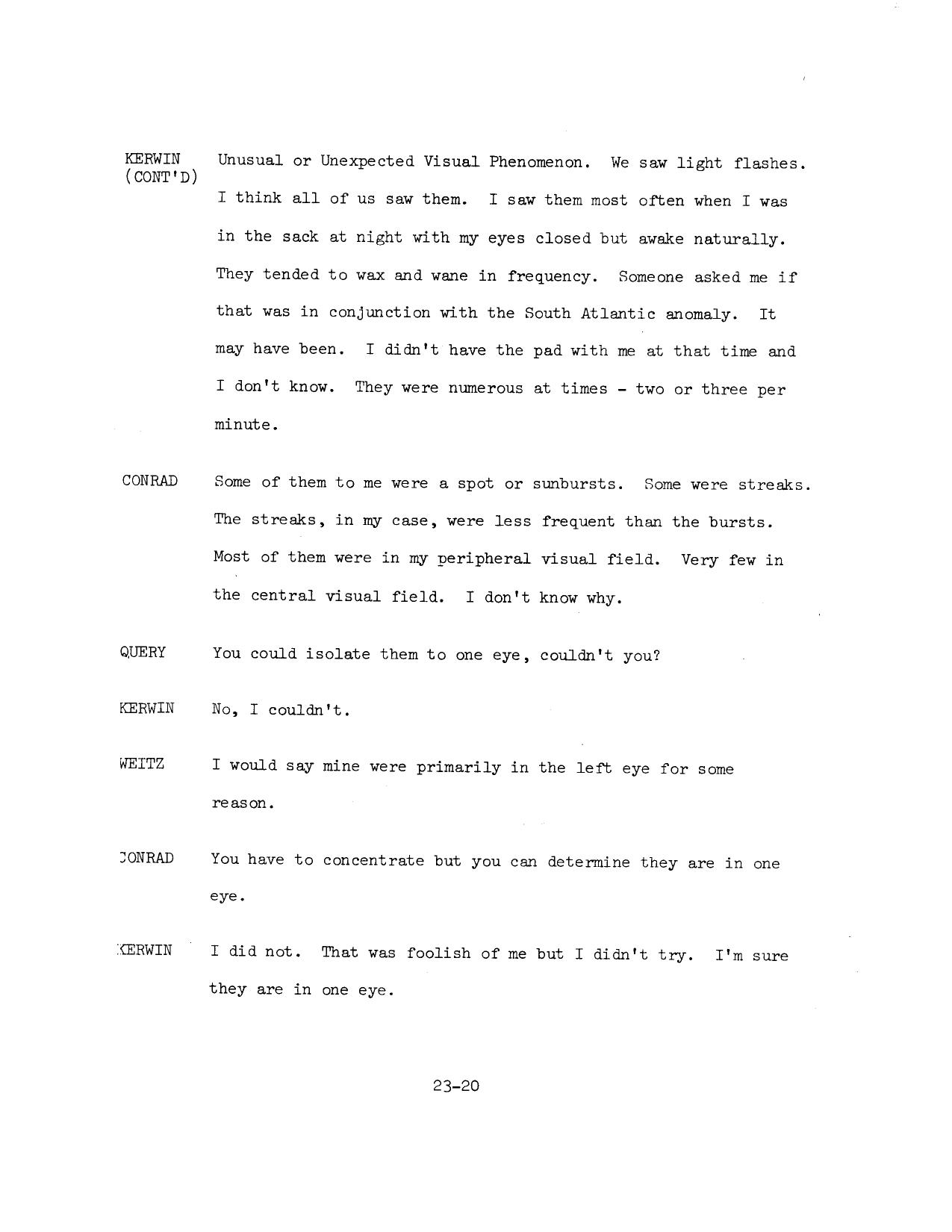 Derived page render, PDF page 2. Kerwin, Conrad, and Weitz discuss eyes-closed light flashes, peripheral streaks, and whether timing might relate to the South Atlantic anomaly.
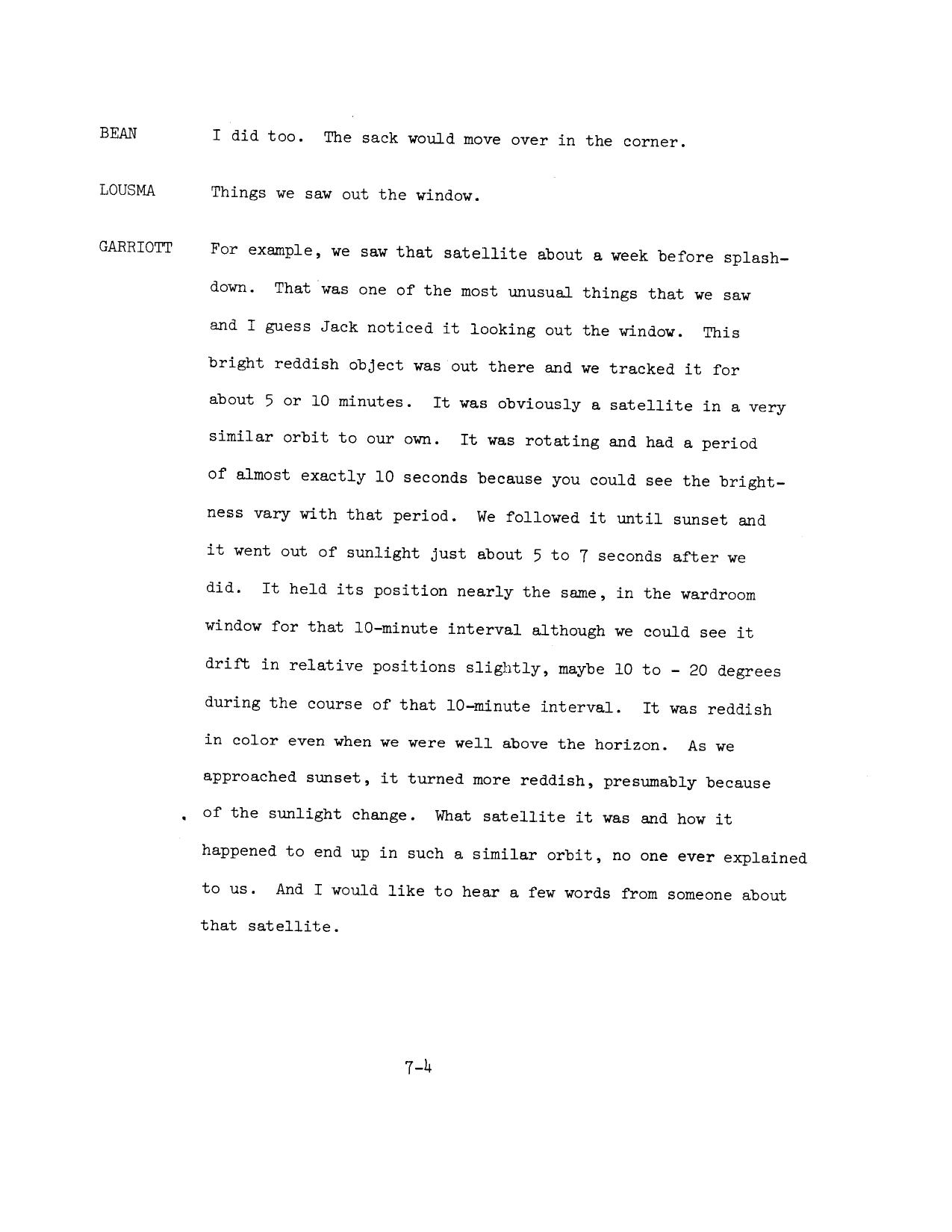 Derived page render, PDF page 5. Garriott describes a bright reddish object tracked for five to ten minutes, varying in brightness with an almost 10-second period, and going out of sunlight shortly after Skylab.
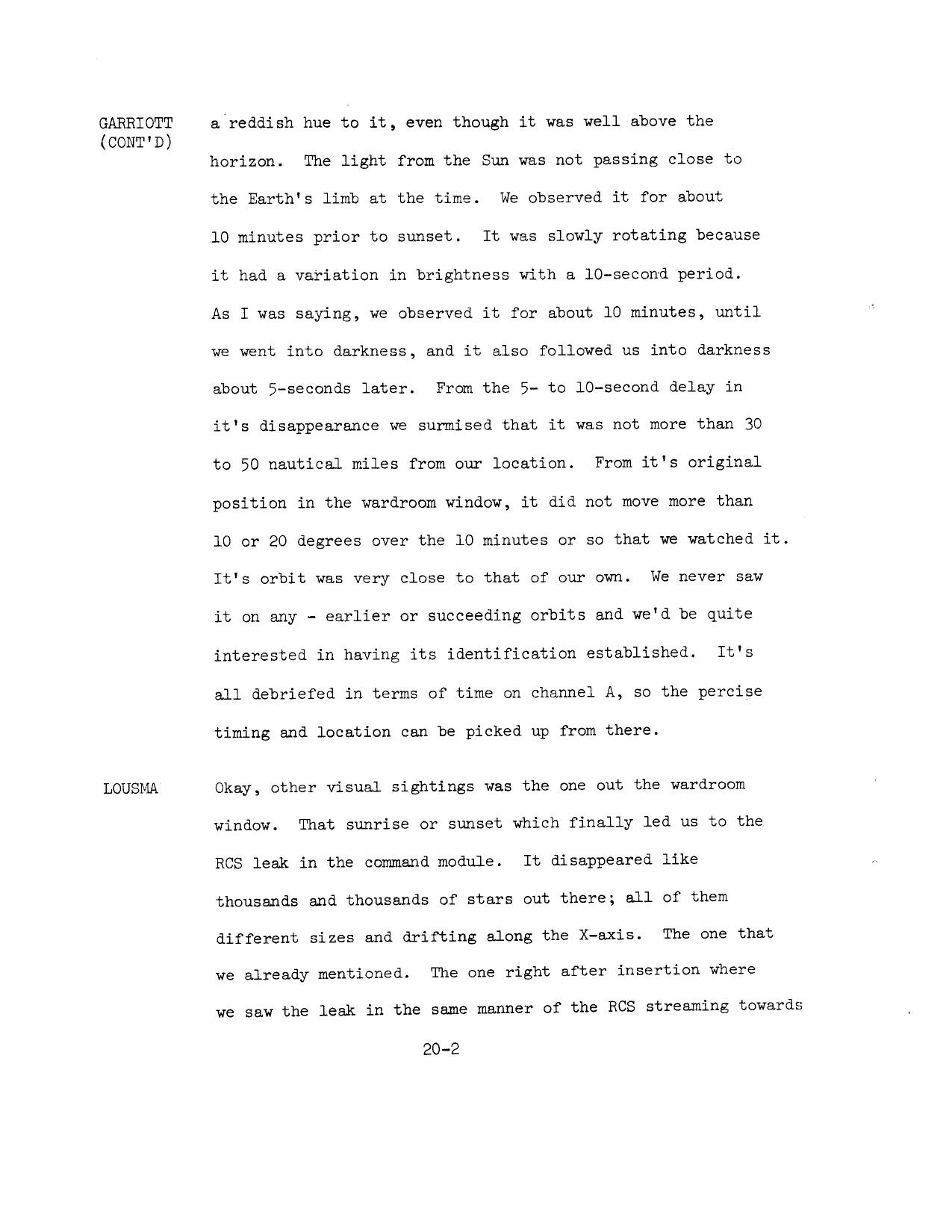 Derived page render, PDF page 8. The transcript continues the reddish-object account with the 30-to-50-nautical-mile estimate, channel A timing/location lead, and then shifts into source-stated RCS-leak context.
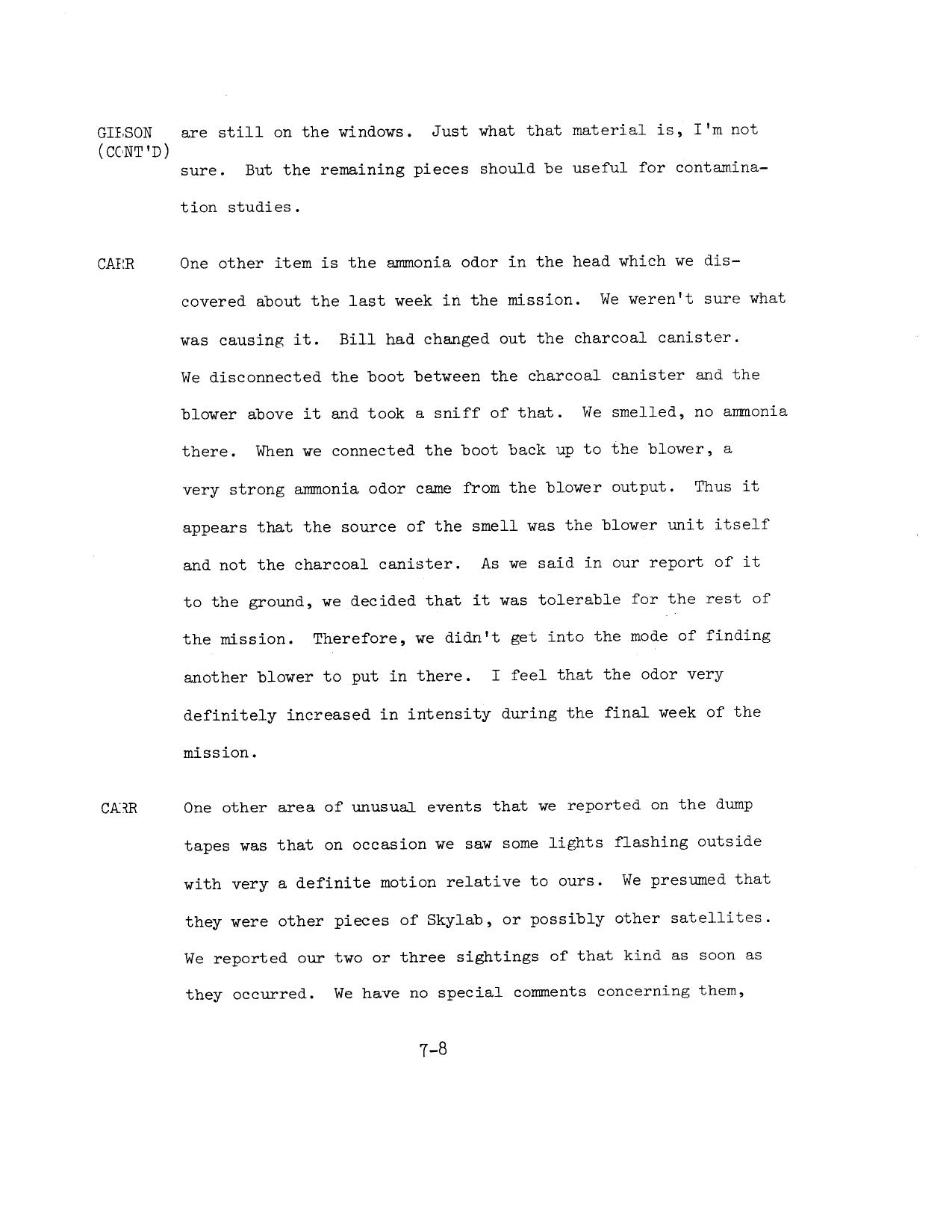 Derived page render, PDF page 10. Carr reports occasional flashing lights outside Skylab on dump tapes, with definite relative motion, and states the crew presumed pieces of Skylab or possible satellites.
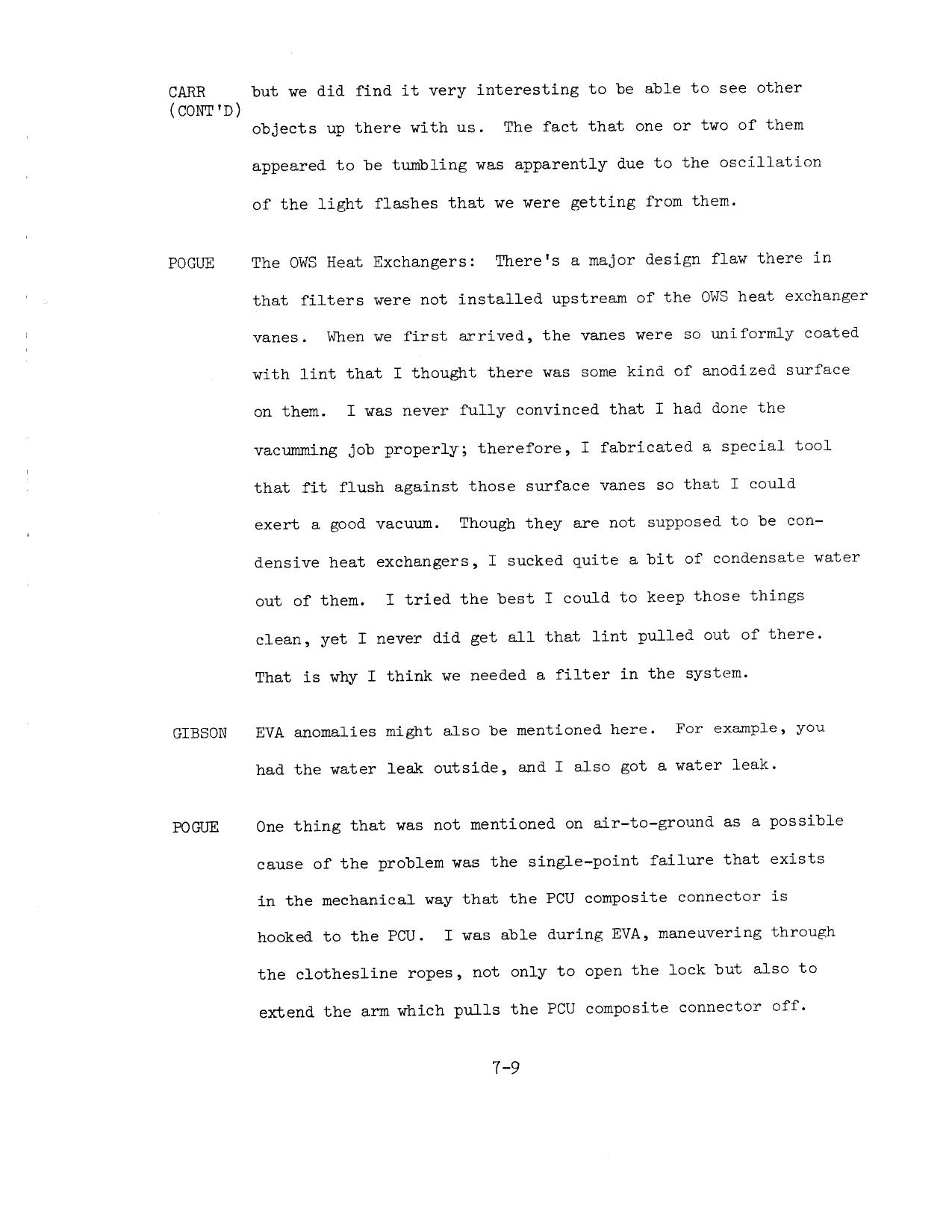 Derived page render, PDF page 11. Carr's continuation says one or two objects appeared to be tumbling because of oscillating light flashes before the transcript moves back into ordinary technical-debrief material.
Investigation reading
This Release 01 item is an eleven-page PDF excerpt from NASA Skylab technical crew debriefings. I reviewed it as transcript evidence, not as object imagery. The rendered pages are cover pages and typed debrief transcript pages; they do not contain photographs, maps, radar displays, telemetry plots, spacecraft imagery, or sensor frames. The scanned PDF is copy-restricted, so the selectable text layer is effectively empty, but the Release 01 OCR covers all eleven pages and the page renders are legible enough to check the high-signal lines.
The file is built from three short Skylab excerpts. Pages 1-3 are from the Skylab 1/2 Technical Crew Debriefing dated June 30, 1973. Pages 4-8 are from the Skylab 1/3 Technical Crew Debriefing dated October 4, 1973. Pages 9-11 are from the Skylab 1/4 Technical Crew Debriefing dated February 22, 1974.
In the Skylab 1/2 excerpt, Kerwin, Conrad, and Weitz discuss light flashes seen most often at night with eyes closed. Kerwin says the flashes could wax and wane, were sometimes two or three per minute, and may have been connected with the South Atlantic anomaly, though he did not have a pad with him to confirm timing. Conrad describes spots, sunbursts, and less frequent streaks, mostly in peripheral vision. The next page separates those flashes from a possible fire-sensor wink and from what Weitz thought could be cosmic particles, including an entrance streak and exit streak across the eye. This portion reads as a crew/medical visual-phenomenon discussion, not as an external-object sighting.
The Skylab 1/3 excerpt is the strongest external-sighting section. Garriott describes a bright reddish object seen about a week before splashdown, noticed by Jack Lousma out the wardroom window and tracked for about five or ten minutes. The transcript says it appeared to be a satellite in a very similar orbit, varied in brightness with an almost ten-second period, stayed in roughly the same wardroom-window position with only about 10 to 20 degrees of relative drift, and went out of sunlight about five to seven seconds after Skylab did. The same account later estimates, from a five- to ten-second disappearance delay, that the object was not more than about 30 to 50 nautical miles away. Garriott says the timing and location were debriefed on channel A and that the crew wanted the object's identification established. Bean and Lousma add important limits: they never saw it again, it never took the shape of an object, and attempts with monitors could not make it anything other than a bright light.
That same Skylab 1/3 section also records ordinary visual context. Countdown and powered-flight observations include the swing arm, booster protector cover, flashes, debris, and separation events described as normal. A later wardroom-window event is tied to an RCS leak in the command module, with many star-like drifting points along the X-axis. Those are source-stated context leads that should stay separate from the reddish-object account.
The Skylab 1/4 excerpt adds a shorter later report. Carr says the crew reported on the dump tapes occasional flashing lights outside with definite motion relative to Skylab. He says they presumed these were other pieces of Skylab or possibly other satellites, reported two or three such sightings when they happened, and had no special comments beyond finding it interesting to see other objects with them. Page 11 adds that one or two appeared to be tumbling, apparently because of oscillating light flashes. Surrounding text on pages 10-11 concerns ammonia odor, OWS heat exchangers, and EVA anomalies, so the sighting passage is embedded inside a broader technical debrief rather than a standalone UAP case report.
What the file appears to contain
The PDF appears to be a Release 01 excerpt packet selected from historical NASA crew debriefing volumes. It preserves crew testimony about three categories of visual material:
- eyes-closed light flashes and streaks discussed by Skylab 1/2 crew members, with South Atlantic anomaly and cosmic-particle context;
- a Skylab 1/3 bright reddish object or satellite-like light tracked from the wardroom window near sunset, with transcript-stated motion, timing, brightness-period, and range-estimate details;
- Skylab 1/4 flashing lights outside the station, source-presumed by Carr to be Skylab pieces or possible satellites.
The file does not itself provide photographs, plotted positions, orbital element data, mission-control audio, full channel A transcripts, dump-tape transcripts, or an official identification of the reddish object. Its evidentiary value is the source text: what the astronauts said in the selected debrief excerpts, what mundane or operational context they mentioned, and which follow-up records would be needed before any stronger assessment.
Source custody and provenance
- Official/source URL: https://www.war.gov/medialink/ufo/release_1/nasa-uap-d7-skylab-technical-crew-debriefing-1973.pdf
- Open Sky release-file copy: war-gov-nasa-uap-d7-skylab-techincal-crew-debriefing-1973-8bb54e0a
- SHA-256:
49e232c72a77f16f7e06593789a36882d614888d882a74d71eabcc7d2ce94fb6 - File size reviewed:
659,470bytes; PDF page count:11. - Release CSV row:
141; agency: NASA; source kind: PDF. - OCR status:
frontier_ocr_complete, with11 / 11pages carrying OCR text and7OCR chunks. - PDF structure check: one scanned page image per PDF page, 300 ppi, copy disabled; the direct text layer returned only page breaks during review.
- Direct official media access returned
403during this review, so the page relies on the verified Open Sky release-file copy while preserving the official URL as the canonical source pointer.
Graph context
The graph has two exact Release 01 records for this item: the WAR.GOV release-record document for CSV row 141, and the linked PDF asset document for the canonical PDF URL. The asset record carries official-primary provenance and the same SHA-256 listed above.
The semantic graph currently preserves 142 extracted source-text claims, 39 entity mentions, 0 sensor events, and 0 table rows for this file. Claim categories are dominated by observation and witness-testimony records, with additional object-descriptor, motion, time, agency, and prosaic-lead entries. Those records are useful for navigation and source-tracing, but they are not findings.
There are no candidate crosslinks on this asset. Related graph neighbors include other NASA Release 01 records such as the Apollo 11 technical crew debriefing and an Apollo 12 record; those should be treated as comparison leads only until read directly. No graph sensor event is attached to this item, which matches the source reading: the PDF is transcript evidence, not instrument data.
Leads to check
- Retrieve the full Skylab 1/2, 1/3, and 1/4 technical crew debriefing volumes around these excerpted pages to see what surrounding questions, mission phases, and crew comments were omitted from the Release 01 packet.
- For the Skylab 1/3 reddish object, look for the channel A timing/location record named in the transcript, then compare it against mission timeline, attitude, lighting geometry, nearby objects, cataloged satellites, jettisoned hardware, and any Skylab-associated debris.
- For the Skylab 1/4 flashing-light reports, look for the dump-tape reports Carr references and compare them against known Skylab debris, other satellites, and station-relative illumination conditions.
- Keep the Skylab 1/2 eyes-closed light-flash material in a separate medical/radiation lane: South Atlantic anomaly exposure, cosmic-particle literature, ALFMED/Apollo-era light-flash studies, and fire-sensor/fire-flash confusion are relevant context checks.
- Verify OCR-sensitive lines against high-resolution renders before quoting them heavily. Examples include
indentification,percise,norminal, the awkward phrasewith very a definite motion relative to ours, and the10 to - 20 degreesrendering that visually reads as a 10-to-20-degree range. - If a future source provides exact times, test whether the reddish object's sunset-disappearance timing and 30-to-50-nautical-mile estimate are internally consistent with Skylab's orbital geometry.
Lead check notes
- Partial — full Skylab debriefing volumes. The Open Sky release-file copy and current linked Release 01 text corpus preserve only the eleven selected D7 pages. They do not include the full Skylab 1/2, 1/3, or 1/4 debriefing volumes around these excerpts, so the surrounding Q&A and mission-phase context still need NASA archive sources.
- Partial — channel A timing/location. Page 8 says the reddish-object timing and location were debriefed on channel A, and a linked-corpus search found the exact
channel Alead only in this D7 excerpt. No channel A transcript, mission timeline, spacecraft attitude, object catalog, or debris-correlation record is attached to this Release 01 item. - Blocked — Skylab 1/4 dump-tape trail. Pages 10-11 state that Carr's crew reported the flashing-light sightings on dump tapes and presumed Skylab pieces or possible satellites, but the released PDF does not include the dump tapes, an air-to-ground transcript, or a separate media/telemetry file for those reports.
- Partial — medical/radiation lane. Pages 2-3 support the eyes-closed flash/streak discussion and the South Atlantic anomaly/cosmic-particle framing. Related Apollo 17 D6 material in the linked Release 01 corpus carries ALFMED/light-flash context, but D7 itself does not include an ALFMED record or radiation/medical analysis source.
- Checked — OCR-sensitive wording. The page renders support the source spellings/wording
indentification,percise,norminal, andwith very a definite motion relative to ours. Page 5 carries the OCR-sensitive10 to - 20 degreeswording, while page 8 reads10 or 20 degrees; neutral public wording should keep this as an approximate 10-to-20-degree drift range. - Needs external source — orbital geometry test. The 5-to-10-second disappearance delay and 30-to-50-nautical-mile estimate are source-stated on page 8, but testing the internal geometry requires exact channel A time/location, Skylab ephemeris and attitude, illumination geometry, nearby satellite/debris catalogs, and any jettisoned-hardware records.
Limits
This page is a graph investigation draft and needs human review. It does not identify the objects, resolve the source-stated satellite/debris possibilities, or convert crew statements into a finding. The Release 01 file is an excerpted packet, not the full NASA debriefing set. It contains typed transcript pages and cover pages only; there are no photographs, raw sensor records, orbital plots, or mission-control audio in this PDF. Because the official media URL was blocked during this review, custody verification rests on the matching Open Sky release-file copy, the recorded official URL, the release inventory, and the SHA-256 hash.
Deep investigation — graph + web reconnaissance
Source reread
A fresh source check confirms this item is an 11-page scanned PDF excerpt packet, not a sensor-media file. The reviewed release-file copy is 659,470 bytes with SHA-256 49e232c72a77f16f7e06593789a36882d614888d882a74d71eabcc7d2ce94fb6; its PDF metadata identifies NASA-UAP-D7, Skylab Technical Crew Debriefing, 1973, and the file has one 300-ppi scanned page image per PDF page. The direct text layer is copy-disabled; the useful text is the Release 01 OCR plus the page renders.
Representative page review supports the key distinctions already made above: page 2 is an eyes-closed light-flash/medical discussion; pages 5 and 8 are the Skylab 1/3 reddish-object account; pages 10 and 11 are Carr's Skylab 1/4 dump-tape flashing-light statement. Page 5 visibly prints the awkward phrase 10 to - 20 degrees, while page 8 gives the clearer 10 or 20 degrees wardroom-window drift wording. Page 8 also anchors the 5- to 10-second disappearance delay, the 30 to 50 nautical miles crew estimate, and the line that precise timing/location should be picked up from channel A. Page 10 supports dump tapes and Carr's source-stated presumption that the lights were other pieces of Skylab, or possibly other satellites. None of the rendered pages contains a photograph, plotted track, radar return, telemetry display, or spacecraft image.
Graph connections
The Neo4j graph has an exact official asset record for the canonical PDF URL and hash, plus the Release 01 CSV-row record for row 141. The exact asset carries 142 machine-extracted Claim nodes, 39 EntityMention nodes, 0 SensorEvent nodes, and OCR/text chunks tied to the official-primary source. The claim mix is mostly observation, witness-testimony, object-descriptor, motion, time, and a small number of prosaic-lead records. These are navigation aids only: they remain machine_extracted_needs_human_review / not_a_finding, and source text takes priority where the graph misses phrases such as channel A or the full pieces of Skylab / satellites wording.
The graph also exposes useful provenance hygiene notes. The row-141 record preserves the correct D7 title and PDF pointer, but some row-record fields still carry stale Apollo 11 D4 final_url / content-length values, and a stale RELATED_TO edge points to an Apollo VM3 row. Those are manifest-cleanup leads, not corroboration. A secondary UFO-USA GitHub markdown conversion is present as a derived copy of the official asset; it is a convenience/reference lead only and does not replace the WAR.GOV/PURSUE source.
Official and archival context
NASA/NTRS reconnaissance found an official mission-report layer that materially helps the Skylab 1/3 account. NTRS 19740011377, Skylab mission report, second visit, section 10.5 Visual Observations and Unusual Events, separately summarizes the reddish-object observation: a bright reddish object like a satellite was seen from the wardroom window about 10 days before entry; it was brighter than Jupiter; it was observed about 10 minutes before sunset; its angular change was reported as 0.17 to 0.35 radian; its reflected light went out 5- to 10-second after Skylab entered darkness; the report gives a 55 to 90 kilometers range estimate; and a roughly 10-second peak-to-peak brightness variation led the crew to believe it was rotating. That report also places the account among adjacent visual/operational items, including S052 television-screen objects with washer-like dark centers and later small-particle blizzard events tied to reaction-control-system failures. Those adjacent items are context, not evidence that the reddish object is resolved.
Exact NTRS checks for the debrief report numbers visible on the Release 01 pages (JSC-08053, JSC-08478, JSC-08809) did not locate the full technical crew debriefing volumes during this pass. NASA mission pages still provide official mission context: Skylab 3 launched July 28, 1973, and flew the Bean/Garriott/Lousma crew for about 59.5 days; Skylab 4 identifies the Carr/Gibson/Pogue crew and the longer third occupied mission. For the eyes-closed light-flash lane, NTRS records such as Light flashes observed by astronauts on Skylab 4 and Visual light flash observations on Skylab 4 explicitly connect Skylab light-flash observations with cosmic-ray flux and the South Atlantic Anomaly, which supports keeping that material separate from external-object sightings.
Prosaic checks and follow-up leads
The best first-pass prosaic lanes are source-internal: satellite or nearby orbital object for the Garriott/Lousma reddish light; Skylab pieces or other satellites for Carr's dump-tape flashing lights; reaction-control venting/particles for the separate blizzard context; and radiation/cosmic-ray/South Atlantic Anomaly mechanisms for eyes-closed flashes. None of those checks can be completed from D7 alone because the excerpt omits the channel A timing/location record, dump-tape reports, station attitude, ephemeris, viewing geometry, and contemporary satellite/debris catalog matches.
Priority follow-up is therefore: recover the full Skylab 1/2, 1/3, and 1/4 technical debriefing volumes or verified NASA scans around the cited page ranges; locate the channel A record for the Skylab 1/3 observation; compare the mission-report 55 to 90 kilometers estimate with the transcript's 30 to 50 nautical miles; search NORAD/space-object/debris records only after exact time and Skylab state vector are pinned; and look for Carr's referenced dump-tape reports before treating the Skylab 1/4 lights as a separate case. Until then, this remains source-backed transcript testimony with strong prosaic/operational leads, not a finding.
Audit note
This section adds graph and official-web context without writing to Neo4j. It preserves the Release 01 page as evidence review: source facts, crew testimony, machine graph extractions, external NASA context, prosaic checks, and unresolved follow-up are kept separate.
Sources
- WAR.GOV / PURSUE Release 01 official PDF URL: NASA-UAP-D7, Skylab Techincal Crew Debriefing 1973
- Open Sky release-file copy: /api/explore/war-gov/release-file/war-gov-nasa-uap-d7-skylab-techincal-crew-debriefing-1973-8bb54e0a
- Release CSV row
141; NASA; PDF; SHA-25649e232c72a77f16f7e06593789a36882d614888d882a74d71eabcc7d2ce94fb6. - Open Sky graph source dataset
war_pursue_uap_release_2026_05_08and semantic datasetwar_pursue_release01_semantic_2026_05_12.