NASA-UAP-VM2, Apollo 12, 1969
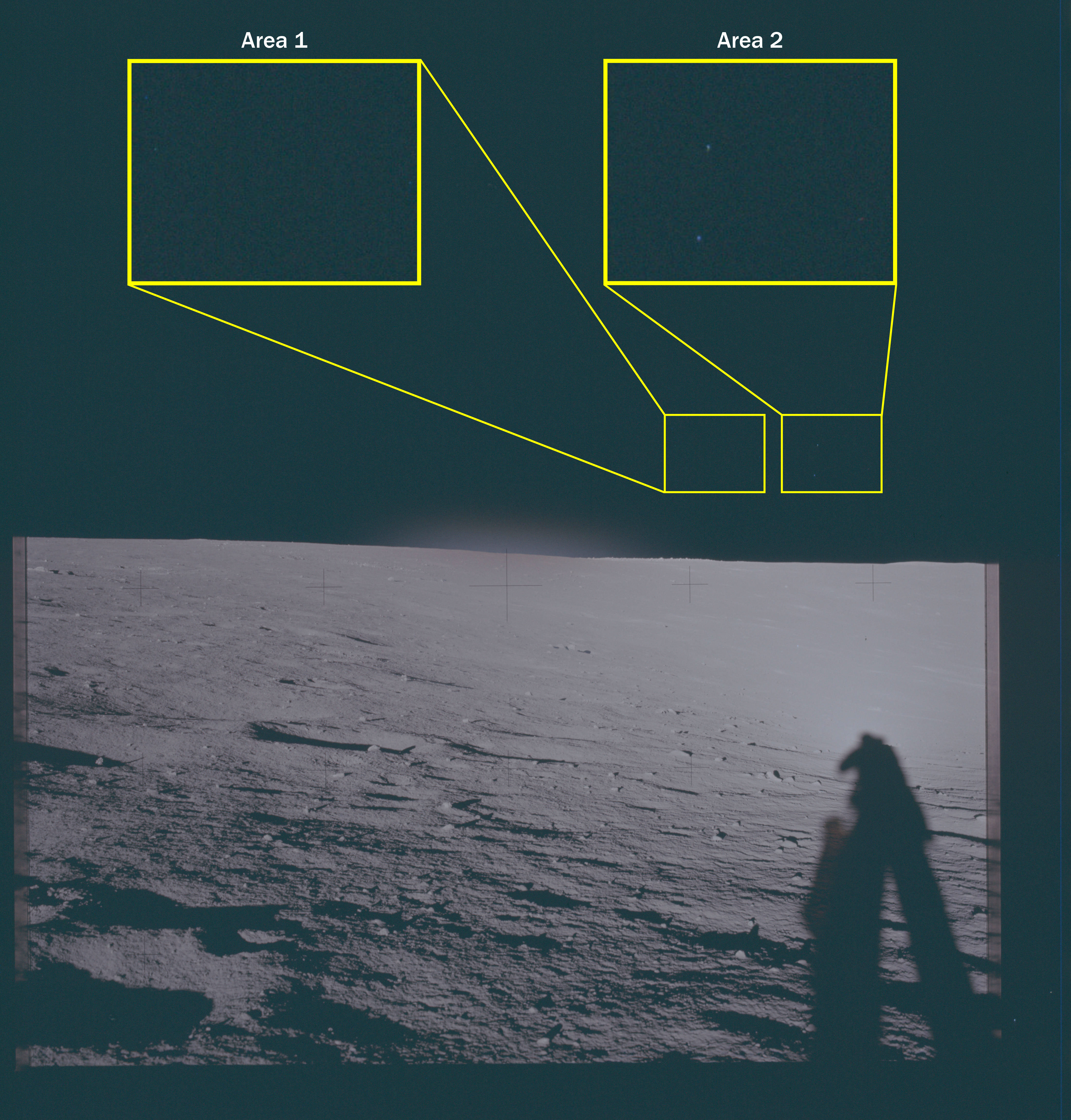
NASA-UAP-VM2 is an official Release 01 image item attributed to NASA. The release describes it as an archival Apollo 12 lunar-surface photograph from 1969. The released JPEG is an annotated version: two dark-sky regions above the lunar horizon are labeled Area 1 and Area 2 with yellow callout graphics.
This draft records source-visible context, provenance, graph navigation cues, and review leads. It does not identify the highlighted marks and does not treat the release annotations as an analytical conclusion.
Evidence media
Official Release 01 annotated JPEG. The image shows a lunar-surface scene with release-added Area 1 and Area 2 yellow boxes and callouts in the dark sky above the horizon. The marked regions contain faint point-like specks against a grainy dark background; this single image does not resolve structure, motion, scale, distance, or object class.
Investigation reading
The verified JPEG is a high-resolution Apollo-style lunar surface scene. The lower portion shows gray regolith, a low uneven horizon, rocks, shallow depressions, long shadows, scan/frame-edge artifacts, and Apollo-style reseau or crosshair marks. The upper portion is a dark blue-black sky/background with visible film or scan grain, compression noise, color mottling, and small specks.
The key reading issue is separation. The lunar terrain, horizon, dark sky, shadows, reseau marks, frame borders, specks, and grain are image-record content. The thick yellow boxes, connector lines, lower callout boxes, and white labels reading Area 1 and Area 2 are release-added annotations. Those annotations direct attention to selected sky regions, but they are not original Apollo scene content and do not establish what the selected marks are.
Visual inspection of the annotated regions shows only tiny unresolved marks against a noisy dark background. Area 1 is mostly dark sky with subtle grain and a few faint bluish or whitish point-like specks. Area 2 contains several small isolated bright or colored specks, including pale/whitish, bluish, and faint reddish/pinkish points. The lower linked callout boxes also enclose dark sky with occasional tiny specks. None of these marks resolves into structure, scale, distance, trajectory, or object class from this single still image.
What the file appears to contain
- A JPEG image,
4400 × 4600pixels,2,630,734bytes. - A lunar surface scene associated in the release with Apollo 12 and the Moon in 1969.
- A dark sky/background above the horizon, with visible grain, color noise, and small point-like specks.
- Release-added yellow annotation boxes, connector lines, and labels for
Area 1andArea 2. - Apollo-style reseau/crosshair marks and film/scan/frame-edge artifacts.
- OCR text limited to the page marker plus the visible annotation labels:
=== Page 1 ===
Area 1                    Area 2
The official release description says the image has been modified from its original state to assist viewers in identifying areas of interest, and that the highlights are contextual only; the description also states that the alterations do not constitute an analytical judgment, investigative conclusion, or factual determination regarding the subject matter.
Source custody and provenance
| Field | Value |
|---|---|
| Official title | NASA-UAP-VM2, Apollo 12, 1969 |
| Agency | NASA |
| Release | WAR.GOV / PURSUE Release 01 |
| Source kind | image |
| Official/source URL | https://www.war.gov/medialink/ufo/release_1/nasa-uap-vm2-apollo-12-1969.jpg |
| Open Sky release-file route | /api/explore/war-gov/release-file/war-gov-nasa-uap-vm2-apollo-12-1969-bd941195 |
| File format / dimensions | JPEG, 4400 × 4600 |
| File size | 2,630,734 bytes |
| SHA-256 | acaa311b10923b3a575041b3d62ea6e698d7694fdd6b91ceb4689984f7354c48 |
| OCR status | frontier_ocr_complete, 1 page / 1 chunk |
| Incident date/location fields | 1969 / Moon |
| Image asset row tracked by context | 146 |
| Exact release-record row preserved in graph | 143 |
The Open Sky release-file copy checked for this draft matches the recorded byte size and SHA-256 above. That hash anchors the exact annotated JPEG discussed here.
Graph context
The graph has exact official-primary records for this item:
ImageEvidence:official:image:war-pursue-uap-release:nasa-uap-vm2-apollo-12-1969-jpg:bd9411951868Document:official:doc:war-pursue-uap-release:record:8baa965d44a473f7
The semantic graph preserves 5 extracted claims, 3 entity/date mentions, 0 sensor-event records, and 3 text chunks across the official manifest description, OCR, and Release 01 CSV record text. The extracted claim categories are navigation aids only: they mainly capture the agency, the source description of highlighted areas of interest, and release/incident years.
Related-record context currently points to NASA-UAP-VM5, Apollo 12, 1969 and NASA-UAP-D6, Apollo 17 Technical Crew Debriefing, 1973. Those links are useful leads for source comparison and catalog cleanup, but they do not show that the records resolve one another or describe the same object or event.
Leads to check
- Locate the underlying unannotated Apollo/NASA mission frame or catalog record for VM2 and compare it against the annotated release image.
- Verify the row mapping before cross-citation: the image context tracks row
146, while the exact release-record node preserves row143. - Compare VM2 with
NASA-UAP-VM5, Apollo 12, 1969for same-mission annotation style, source-frame continuity, and repeated sky-region artifacts. - Check adjacent Apollo 12 frames, if available, for persistence or disappearance of the same point-like marks.
- Evaluate ordinary image-chain explanations before escalation: film grain, dust, scratches, emulsion marks, scan noise, color-channel artifacts, compression, and later annotation/enlargement effects.
- Treat
Area 1,Area 2, yellow boxes, leader lines, and lower callout boxes as release annotations, not original lunar-scene features.
Lead check notes
- Checked — release-file image: The Open Sky release-file copy matches the Release 01 metadata for JPEG size
2,630,734bytes, dimensions4400 × 4600, and SHA-256acaa311b10923b3a575041b3d62ea6e698d7694fdd6b91ceb4689984f7354c48. - Checked — annotation separation: Visual review supports treating the yellow boxes, leader lines, lower callout boxes, and
Area 1/Area 2labels as release-added annotation graphics, not original Apollo scene content. - Partial — VM2/VM5 same-release comparison: The current linked corpus includes
NASA-UAP-VM5, Apollo 12, 1969as another Apollo 12 annotated image with a similar release-annotation posture. That is source/catalog context only; it does not show that VM5 resolves VM2 or that the same point-like marks persist. - Partial — row mapping: The image asset context tracks row
146, while the exact release-record node preserves row143. Keep both row references visible until official manifest history or corrected release metadata reconciles them. - Blocked — unannotated source frame and adjacent frames: The Release 01 image/OCR provides no NASA frame ID, magazine/camera metadata, coordinates, timestamp, or adjacent-frame sequence. Comparing the annotated sky regions against the unannotated Apollo frame and adjacent frames requires external NASA/Apollo catalog imagery or a less-processed source copy.
- Needs external source — ordinary image-chain checks: Film grain, dust, scratches, emulsion defects, scan noise, color-channel artifacts, compression, and annotation/enlargement effects cannot be assessed beyond the single annotated JPEG without the unannotated source frame, scan lineage, and adjacent-frame context.
Deep investigation — graph + web reconnaissance
Source reread and file provenance
The verified Release 01 image remains the same annotated JPEG described above: 2,630,734 bytes, 4400 × 4600 pixels, SHA-256 acaa311b10923b3a575041b3d62ea6e698d7694fdd6b91ceb4689984f7354c48, and OCR limited to the Area 1 / Area 2 labels. Visual reread separates the original Apollo lunar scene from the release-added yellow boxes, leader lines, enlarged callouts, and labels. The highlighted sky areas contain tiny unresolved bright or colored specks in a noisy scanned-film background; they do not resolve structure, motion, scale, distance, or object class.
The JPEG metadata adds a useful source-frame lead: embedded XMP references AS12-46-6846.jpg and an Adobe Illustrator creator tool, consistent with an annotated derivative made from an Apollo frame rather than an unmodified mission photograph. The metadata does not provide a mission timestamp, camera station, look direction, or analytical identification of the specks.
Direct WAR.GOV fetches for the image, thumbnail, CSV, and Release 01 landing page returned HTTP 403 during this check, so custody is anchored by the verified release-file copy plus archived official CSV evidence. A Wayback snapshot of the official WAR.GOV CSV from 2026-05-09T00:38:33Z preserves the VM2 row as current row 146: title NASA-UAP-VM2, Apollo 12, 1969, type IMG, agency NASA, incident date/location 1969 / Moon, and the same official image and thumbnail URLs. That supports the asset-inventory row 146 while leaving the older graph release-record row 143 as a reconciliation issue.
External provenance and source-frame context
The strongest external source-frame lead is the Lunar and Planetary Institute Apollo Image Atlas page for https://www.lpi.usra.edu/resources/apollo/frame/?AS12-46-6846. It identifies AS12-46-6846 as a 70mm Hasselblad Apollo 12 image, Magazine 46, Magazine Letter Y, 60 mm lens, color HCEX film, with the description 8 FRAME PAN NW OF ALSEP; PAN. The LPI print-resolution image at https://www.lpi.usra.edu/resources/apollo/images/print/AS12/46/6846.jpg is an unannotated 3900 × 3900 JPEG of the same lunar-surface scene: low horizon, gray regolith, reseau/fiducial crosses, frame/scan border effects, a dark sky/background, and small unresolved sky specks, but no yellow Area 1 / Area 2 callout graphics.

Adjacent LPI records AS12-46-6845, AS12-46-6847, and AS12-46-6848 are also cataloged as the same 8 FRAME PAN NW OF ALSEP sequence. They are the next official-archive comparison set for persistence checks: if a highlighted point survives across adjacent frames in a geometrically consistent way, that would be different evidence than a single-frame speck; if it appears only in one scan or shifts with film/scan artifacts, that supports an image-chain explanation.
Graph connections and modeling cautions
Read-only graph review found the exact ImageEvidence record official:image:war-pursue-uap-release:nasa-uap-vm2-apollo-12-1969-jpg:bd9411951868 and the exact release-record Document official:doc:war-pursue-uap-release:record:8baa965d44a473f7. The image record has official-primary provenance, the same JPEG URL, full-download SHA-256, 2,630,734-byte size, frontier OCR status, and related CSV row 146. Across the image and release-record text, the graph preserves three text chunks: the official manifest/CSV row text, the image manifest-description chunk, and the frontier-OCR chunk.
The graph also preserves five deterministic extracted Claim nodes, all marked machine_extracted_needs_human_review and not_a_finding. They capture only agency/time/description snippets such as NASA, 1969, 2026, and the release text saying the highlighted areas are contextual. There are no DESCRIBES_SENSOR_EVENT relationships for this image and no entity-mention relationships surfaced in the exact-record query.
Related graph navigation currently points to NASA-UAP-VM5, Apollo 12, 1969 and, through the release-record side, to NASA-UAP-D6, Apollo 17 Technical Crew Debriefing, 1973. Those are provenance/corpus-navigation leads only. The VM2 release-record node still carries row 143 and some Apollo 17 D6 PDF/hash residue from an earlier manifest reconciliation, while the image asset, archived official CSV, and current page context point to row 146; this should be treated as a graph cleanup lead, not evidence that the Apollo 17 debriefing resolves the VM2 image.
Prosaic checks and unresolved questions
The first-order prosaic lane is image-chain analysis: film grain, dust, scratches, emulsion marks, scanning artifacts, color-channel noise, JPEG compression, reseau/fiducial marks, frame-edge effects, and the release-added enlargement/annotation process. The unannotated LPI frame preserves the same lunar scene and shows ordinary Apollo photo/scan cues; the Release 01 annotations make selected few-pixel sky features easier to see but do not add physical measurements.
Astronomy, weather, launch, satellite, and trajectory correlation are not meaningful from this page alone because the released VM2 file provides no exact mission elapsed time, camera station, pointing geometry, exposure data, or verified source-frame sequence analysis. If the Apollo 12 catalog frame can be tied to exact EVA timing and camera orientation, a star/planet/film-defect comparison against the adjacent Magazine 46 frames becomes the proper next check.
Follow-up leads and audit note
- Compare the unannotated LPI
AS12-46-6846print against adjacent framesAS12-46-6845,AS12-46-6847, andAS12-46-6848for persistence, disappearance, or scan-only artifacts in the same sky regions. - Reconcile Release 01 row numbering: archived official CSV row
146and image asset row146versus the graph release-record row143/ D6 field residue. - Seek a NASA/JSC or Apollo Lunar Surface Journal source scan with frame metadata, EVA timing, camera station, and exposure details before making any star-field or spacecraft/debris comparison.
- Keep VM2's highlighted marks classified as unresolved image features, not findings or hypotheses, unless a source-frame and adjacent-frame analysis materially changes the evidence.
Limits
- This page does not identify the highlighted marks as spacecraft, stars, reflections, particles, defects, artifacts, or any other object class.
- The visible marks in the annotated areas are tiny, point-like, unresolved, and embedded in a noisy scanned-film background.
- The file is a single still image; it does not provide motion, persistence, trajectory, range, altitude, size, or speed.
- OCR adds no frame ID, camera metadata, coordinates, timestamp, or mission-catalog link beyond the
Area 1/Area 2labels. - No graph sensor event is modeled for this item.
- The official release language itself says the annotations are contextual and not an investigative conclusion or factual determination.
Sources
- Official/source image URL: https://www.war.gov/medialink/ufo/release_1/nasa-uap-vm2-apollo-12-1969.jpg
- WAR.GOV / PURSUE Release 01 CSV/image asset record:
NASA-UAP-VM2, Apollo 12, 1969 - Open Sky release-file route:
/api/explore/war-gov/release-file/war-gov-nasa-uap-vm2-apollo-12-1969-bd941195 - Open Sky source dataset:
war_pursue_uap_release_2026_05_08 - Open Sky semantic dataset:
war_pursue_release01_semantic_2026_05_12 - Graph exact records:
ImageEvidenceandDocumentrecords listed above
All claims on this page are source-text claims, direct visual readings, or review leads. This page is not an adjudication or resolution decision.