NASA-UAP-VM4, Apollo 12, 1969
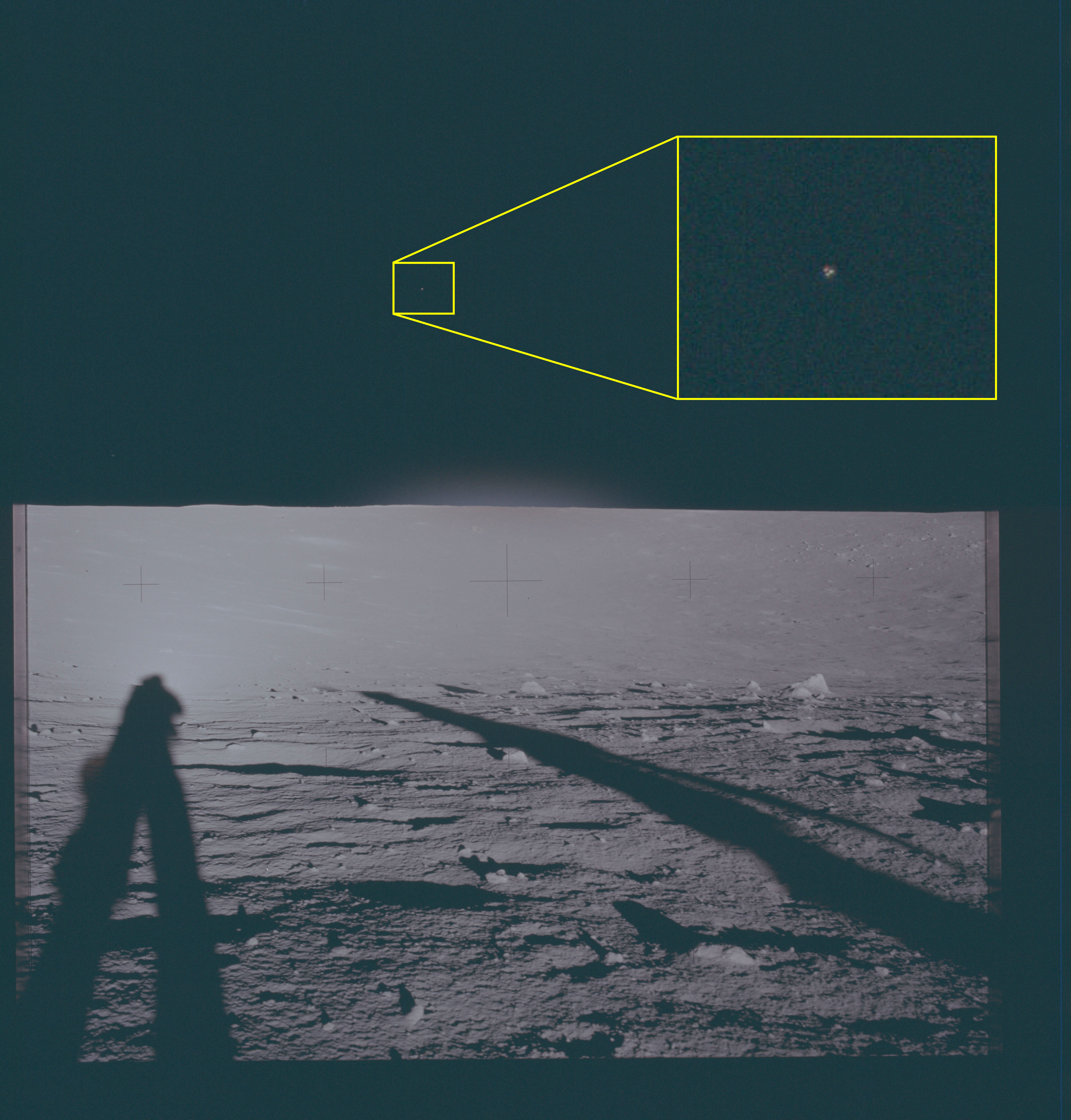
NASA-UAP-VM4 is an official Release 01 image item attributed to NASA. The release describes it as an archival Apollo 12 lunar-surface photograph from 1969. The released JPEG has yellow callout graphics pointing to a small area of interest in the dark sky above the lunar horizon. This draft records the source custody, visible image content, OCR limits, and graph context. It does not identify the highlighted point or treat the release annotation as a conclusion.
Evidence media
The Open Sky release-file copy is the official annotated JPEG (4400 × 4600, SHA-256 92ae47295e427519e9189d241db01823223b6c232125ea8015a603100f80b6c2). It shows a gray Apollo 12 lunar-surface scene with a dark sky/background, yellow source box, yellow leader lines, and a yellow-bordered enlarged inset; the marked point remains a tiny unresolved bright pixel cluster, not a resolved shape or structure.
Investigation reading
The underlying scene is a wide lunar-surface view: gray regolith, a low uneven horizon, rocks or darker patches, shallow relief, and long shadows across the foreground. A large human-shaped shadow appears in the lower-left foreground, and a long narrow shadow runs diagonally across the surface. The upper part of the frame is a very dark sky/background with a slight scan-color cast, faint specks, vertical banding or edge artifacts, and Apollo-style fiducial/reseau marks.
The yellow graphics are release-added annotations, not original lunar-scene content. A small yellow rectangle encloses a tiny mark in the dark sky, slightly left of the frame's vertical axis and above the horizon. Two yellow leader lines connect that box to a larger yellow-bordered inset placed on the upper-right side of the released image. The inset is an enlarged crop of the boxed area.
Inside the original-scale box, the marked feature is only a very small light-colored speck or compact pixel cluster. In the magnified inset it remains unresolved: a tiny whitish to pale-yellow point-like cluster with slight warm reddish/orange pixels and surrounding image noise. It has no dependable outline, body, trail, plume, shadow, orientation, or structure. The single annotated JPEG does not provide enough information to infer distance, size, motion, duration, persistence, or physical nature.
What the file appears to contain
- A
4400 × 4600JPEG image,2,444,608bytes, tracked as a NASA Release 01 image item. - An Apollo 12 lunar-surface scene associated in the release metadata with the Moon and 1969.
- A dark sky/background above the lunar horizon with scan/film noise, specks, and fiducial marks.
- A release-added yellow source box, leader lines, and magnified inset.
- A tiny bright unresolved point or pixel cluster inside the annotated sky region.
- OCR output that contains only the page marker and no readable caption, frame number, coordinates, camera metadata, or mission catalog identifier.
The controlling official description says the image was modified from its original state to help viewers identify areas of interest and that the highlights are contextual only, not an analytical judgment, investigative conclusion, or factual determination.
Source custody and provenance
| Field | Value |
|---|---|
| Official title | NASA-UAP-VM4, Apollo 12, 1969 |
| Agency | NASA |
| Release | WAR.GOV / PURSUE Release 01 |
| Source kind | image / JPEG |
| Official/source URL | https://www.war.gov/medialink/ufo/release_1/nasa-uap-vm4-apollo-12-1969.jpg |
| Open Sky release-file route | /api/explore/war-gov/release-file/war-gov-nasa-uap-vm4-apollo-12-1969-34f3278a |
| Image dimensions | 4400 × 4600 |
| File size | 2,444,608 bytes |
| SHA-256 | 92ae47295e427519e9189d241db01823223b6c232125ea8015a603100f80b6c2 |
| Image asset row | 148 |
| Exact release-record row in graph | 145 |
| OCR status | frontier_ocr_complete; 1 page / 1 chunk; text only === Page 1 === |
| Incident date/location fields | 1969 / Moon |
The verified Open Sky release-file copy matches the recorded byte size and SHA-256. The row difference between the image asset row and the exact release-record row is a provenance-cleanup lead, not evidence of a second image.
Graph context
The graph has exact official-primary records for an ImageEvidence node and a release-record Document node for this title. The semantic layer currently preserves 5 extracted claims, 3 entity/date mentions, 0 sensor-event records, and 0 table rows. The source-text claims are mainly the agency/title context, the 1969/Moon metadata, and the official description of a highlighted area above the horizon with contextual-only annotations.
No sensor event is modeled for this image. The graph also carries related-record context for NASA-UAP-VM1, Apollo 12, 1969 and a separate State Department Papua New Guinea cable record. Those relationships are catalog/navigation leads only. They do not show that VM4, VM1, or the cable describe the same object, event, or explanation.
Leads to check
- Overlay-register the annotated Release 01 JPEG against the likely unannotated Apollo source frame
AS12-46-6848to separate original image content from release processing and callouts. - Compare the annotated release image against high-resolution adjacent frames
AS12-46-6845throughAS12-46-6852to test whether the highlighted sky speck persists, moves, or disappears as an image-chain artifact. - Compare VM4 with VM1 and the other Apollo VM images for repeated frame areas, repeated annotation style, or repeated processing signatures, without treating that comparison as a shared-event finding.
- Check ordinary image-chain explanations before escalation: film grain, dust, scratches, emulsion defects, scan artifacts, color-channel fringing, compression, enlargement/interpolation, and edge or banding artifacts.
- Repair the row/title/hash mismatch around the VM and State Department records before using row numbers in cross-page citations.
Lead check notes
- Checked — Source-frame lead: embedded JPEG metadata names
AS12-46-6848_Zoom/AS12-46-6848.jpg; NASA NTRS and the LPI Apollo Image Atlas independently placeAS12-46-6848in Apollo 12 MagazineY/ Magazine46. Exact pixel registration between the LPI frame and the annotated release JPEG remains a follow-up task. - Partial — Annotation separation: the yellow source box, leader lines, and enlarged inset are visibly release-added context graphics, and the JPEG metadata records Adobe Illustrator processing, but the current evidence copy is not enough to reconstruct every pre-release crop, scale, color, or interpolation step.
- Partial — Adjacent-frame comparison: a browse-level check of
AS12-46-6845throughAS12-46-6852did not show a resolved object or motion track, but high-resolution adjacent-frame comparison is still needed for a stronger persistence test. - Needs external source — Ordinary image-chain checks such as film grain, dust, scratches, emulsion defects, scan artifacts, color-channel fringing, compression, enlargement, and banding still require original-scan provenance, exposure/camera metadata, and exact overlay registration.
- Checked — Provenance mapping: the release inventory supports image asset row
148, while the graph release-record rows around VM1–VM6 and the State Department cable carry row/title/hash shifts; keep the row-number difference as a provenance-cleanup note rather than a separate-image or cross-case claim.
Deep investigation — graph + web reconnaissance
Source reread and image-chain notes
- Direct WAR.GOV CSV and JPEG fetches during this check returned
403, so the official-primary custody check used the verified Open Sky release-file copy, the archived official CSV, and the graph source records. The verified JPEG copy remains2,444,608bytes with SHA-25692ae47295e427519e9189d241db01823223b6c232125ea8015a603100f80b6c2. - An Internet Archive snapshot of the official Release 01 CSV from
2026-05-08preserves row148forNASA-UAP-VM4, Apollo 12, 1969, typeIMG, agencyNASA, incident date1969, incident locationMoon, and the same official image URL: https://www.war.gov/medialink/ufo/release_1/nasa-uap-vm4-apollo-12-1969.jpg. - The JPEG metadata is a useful source-chain clue: it names the working title
AS12-46-6848_Zoom, records Adobe Illustrator processing on2026-05-06, and references source assetAS12-46-6848.jpg. A Windows source-file reference is present in the embedded metadata but is not reproduced here; treat it as image-chain metadata, not a substantive conclusion. - The frontier OCR layer still contributes no caption or frame data beyond
=== Page 1 ===, so the frame association comes from the JPEG metadata plus external Apollo image catalogs rather than OCR text.
NASA and archival frame context
- NASA NTRS
Apollo 12 70-mm Photographic Catalog(NTRS 19720009770,NSSDC-70-10,NASA-TM-X-68811) lists frameAS12-46-6848on the proof-print page with neighboring framesAS12-46-6847throughAS12-46-6852. That catalog page supplies the frame label but no detailed caption for the individual image. - NASA NTRS
Apollo 12 photography 70 mm, 16 mm, and 35 mm frame index(NTRS 19720009769,NSSDC-70-11,NASA-TM-X-68810) placesAS12-46-6848inside MagazineY, framesAS12-46-6715through6868: color photographs taken before, during, and after the first EVA, with a reseau grid on the 60-mm lens. The index describes frames6845through6852as an eight-frame panorama of1000 Crater, northwest of Head Crater, showing the entire rim with numerous rocks. - The Lunar and Planetary Institute Apollo Image Atlas page for
AS12-46-6848lists70mm Hasselblad, Mission12, Magazine46, Magazine LetterY, 60-mm lens, film typeHCEX, film colorcolor, and description8 FRAME PAN NW OF ALSEP; PAN: https://www.lpi.usra.edu/resources/apollo/frame/?AS12-46-6848. The LPI high-resolution frame appears consistent with an unannotated source counterpart for the released annotated image, but exact overlay registration should be done before treating it as a pixel-perfect match.
Graph connections and provenance cautions
- The graph has an exact
ImageEvidencenode for the official image URL and SHA-256, with related CSV row148,2text chunks, and5machine-extracted claims. Those claims are still markedunreviewed_machine_extract/machine_extracted_needs_human_review/not_a_finding; they preserve agency, date, and publisher-description wording, not a resolved sighting conclusion. - The image has no modeled
SensorEventand no table-row evidence. The only source text chunk with substance is the official manifest description; the OCR chunk contains only the page marker. - The release-record graph neighborhood is row-shifted around the Apollo VM images: the
ImageEvidencerow148matches this VM4 JPEG hash, while a direct release-recordDocumentat row148is titled as the State Department Papua New Guinea cable, and theDocumenttitledNASA-UAP-VM4carries a VM1-sized body hash. Treat those as provenance-cleanup leads and navigation artifacts, not evidence that VM4 is connected to the Papua New Guinea cable or VM1 as an event.
Prosaic checks and unresolved questions
- Visual reread of the annotated image and the LPI frame supports only a tiny unresolved bright speck or compact pixel cluster in the sky area. It does not resolve into a body, trail, plume, shadow, structure, or measurable motion.
- A browse-frame check of the surrounding
AS12-46-6845throughAS12-46-6852panorama did not show a clear resolved object or motion track across adjacent frames. It mainly supplies ordinary Apollo panorama context: lunar terrain, long shadows, horizon, reseau marks, scan/film specks, and compression/downsample limits. - The first prosaic lanes remain image-chain checks: dust, film grain, emulsion defect, scratch, scanner artifact, color-channel fringing, JPEG compression, enlargement/interpolation, and annotation/inset resampling. A physical point-source interpretation would need the original unannotated scan, exposure/camera metadata, exact frame registration, and high-resolution adjacent-frame comparison.
- Weather checks are not meaningful for a lunar-surface frame, and astronomy/launch/satellite correlation is blocked by missing exposure time, pointing geometry, lens/camera settings beyond the 60-mm catalog context, and a single annotated still.
Follow-up leads and audit note
- Overlay-register the official annotated JPEG against the LPI
AS12-46-6848high-resolution frame and record any crop, scale, color, or interpolation differences. - Compare high-resolution adjacent frames
AS12-46-6845throughAS12-46-6852for persistence or absence of the same sky feature before escalating beyond image-chain hypotheses. - Resolve the graph row/title/hash shifts around VM1–VM6 and the State Department cable rows so public row references do not imply false document relationships.
This deep check adds provenance, graph, and prosaic-context leads only. It does not create a Finding, Hypothesis, or ResolutionDecision, and the page remains not_a_finding.
Limits
- The highlighted mark is tiny and unresolved even in the enlarged inset.
- The yellow box, leader lines, and inset are release annotations, not lunar-scene content.
- A single still image gives no motion track, persistence, range, scale, speed, trajectory, or depth information.
- Apparent color in the inset may be affected by scan, compression, enlargement, or channel artifacts.
- OCR contributes no independent caption or mission-frame metadata.
- This draft does not identify the mark as a spacecraft, star, reflection, particle, defect, artifact, or any other object class.
Sources
- Official/source image URL: https://www.war.gov/medialink/ufo/release_1/nasa-uap-vm4-apollo-12-1969.jpg
- WAR.GOV / PURSUE Release 01 CSV image asset:
NASA-UAP-VM4, Apollo 12, 1969, image row148; Internet Archive CSV snapshot checked from2026-05-08. - NASA NTRS:
Apollo 12 70-mm Photographic Catalog,NTRS 19720009770,NSSDC-70-10,NASA-TM-X-68811: https://ntrs.nasa.gov/api/citations/19720009770 - NASA NTRS:
Apollo 12 photography 70 mm, 16 mm, and 35 mm frame index,NTRS 19720009769,NSSDC-70-11,NASA-TM-X-68810: https://ntrs.nasa.gov/api/citations/19720009769 - Lunar and Planetary Institute Apollo Image Atlas frame page for
AS12-46-6848: https://www.lpi.usra.edu/resources/apollo/frame/?AS12-46-6848 - Open Sky release-file route:
/api/explore/war-gov/release-file/war-gov-nasa-uap-vm4-apollo-12-1969-34f3278a. - Open Sky graph exact records:
ImageEvidencefor the JPEG and release-record provenance nodes for the WAR.GOV rows, with row/title/hash mismatch noted above. - Open Sky source dataset:
war_pursue_uap_release_2026_05_08; semantic dataset:war_pursue_release01_semantic_2026_05_12.
All interpretations above are source-text readings, visual observations, or investigation leads. This page remains a graph-investigation draft and is not a finding.