NASA-UAP-VM5, Apollo 12, 1969
NASA-UAP-VM5 is an official Release 01 image item attributed to NASA. The released file is an annotated JPEG associated with Apollo 12 and the Moon in 1969. This page records a source-reading of the released image, its official description, OCR text, and Open Sky graph context. It is an investigation draft only: the highlighted features are not identified here, and the release annotations are not treated as conclusions.
Evidence media
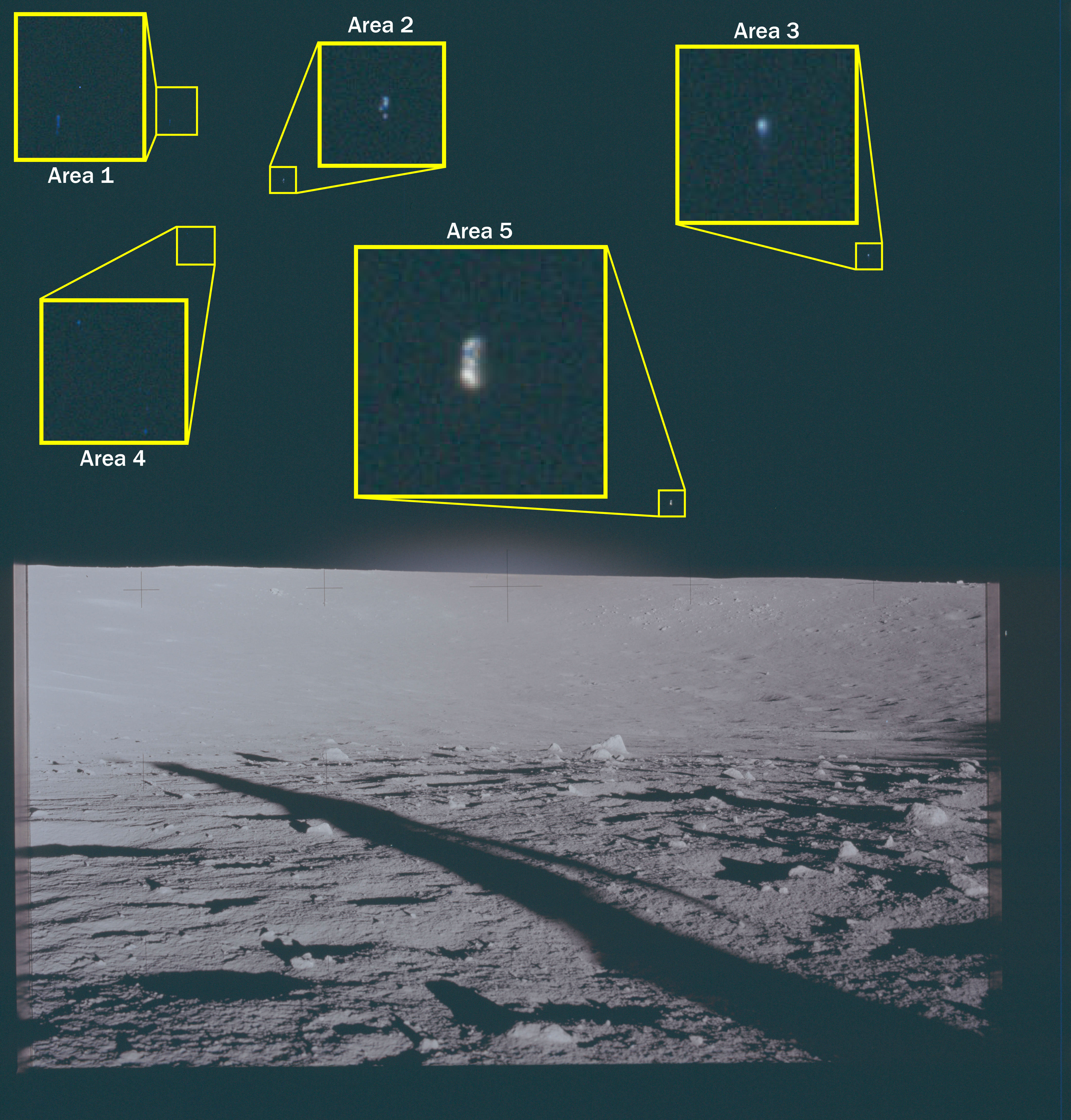
Official Release 01 annotated JPEG (4400 × 4600, SHA-256 472793feaf12754d25ed699a667fdd5cee91d61dda66b8027ff7fbdc48d00ccd). The image shows a gray Apollo 12 lunar-surface scene under a dark sky, with release-added yellow boxes, leader lines, and magnified insets labeled Area 1 through Area 5. The marked sky regions contain small pale blue, white, or bright unresolved marks; this single annotated still does not resolve structure, motion, scale, distance, or object class.
Investigation reading
The verified JPEG is a high-resolution still image, 4400 × 4600 pixels, showing a gray lunar-surface scene below a dark sky/background. The lower portion contains uneven regolith, shallow relief, scattered rocks or darker patches, and strong shadows. The upper portion is mostly dark, with visible grain/noise, vertical banding, frame-edge or scan-edge effects, and Apollo-style fiducial/crosshair marks.
The release version adds conspicuous yellow annotation graphics and white labels for Area 1 through Area 5. Those labels, boxes, leader lines, and enlarged inset panels are added presentation elements. They are separate from the original photographed scene.
Inside the five annotated sky regions are tiny unresolved bright or bluish-white marks. At the displayed resolution, Area 1 appears as a faint short bluish vertical mark or compact cluster in the upper-left sky. Area 2 appears as a compact, slightly vertical bluish-white mark in the upper center-left sky, possibly two closely adjacent bright pixels in the enlargement. Area 3 appears as a small rounded pale spot in the upper-right sky. Area 4 is fainter, a small bluish point or short dash in the left-middle sky. Area 5 is the brightest and most vertically extended of the five, appearing as an irregular white-to-blue-white elongated patch above the horizon.
Those are visual location notes, not identifications. Each feature occupies very few source pixels and becomes blocky in the enlarged inset. The dark background shows noise and compression structure, so the apparent shapes may be affected by film grain, dust, scan artifacts, JPEG compression, color fringing, or enlargement artifacts.
The full OCR text for the item is limited to the release-added labels: Area 1, Area 2, Area 3, Area 4, and Area 5. It does not provide a NASA frame number, camera metadata, timestamp, coordinates, mission-catalog identifier, or explanation for the highlighted marks.
What the file appears to contain
- A
2,590,279byte JPEG image,4400 × 4600pixels. - A lunar-surface photograph associated in Release 01 with Apollo 12, 1969, and the Moon.
- A dark sky/background above the lunar horizon.
- Five release-added annotation groups: yellow source boxes, leader lines, enlarged yellow-bordered insets, and white labels.
- Tiny unresolved light specks, short streaks, or compact pixel clusters inside the annotated sky regions.
- Visible image-quality constraints: dark-field noise, grain, frame/scan artifacts, fiducial marks, color fringing, and JPEG macroblocking in the enlarged inset regions.
The controlling official description says the image was modified from its original state to help viewers identify areas of interest, and that the highlights are contextual only. It also states that the alterations do not constitute an analytical judgment, investigative conclusion, or factual determination regarding the nature or significance of the subject matter.
Source custody and provenance
| Field | Value |
|---|---|
| Official title | NASA-UAP-VM5, Apollo 12, 1969 |
| Agency | NASA |
| Release | WAR.GOV / PURSUE Release 01 |
| Kind | Image |
| Incident date/location fields | 1969 / Moon |
| Official/source URL | https://www.war.gov/medialink/ufo/release_1/nasa-uap-vm5-apollo-12-1969.jpg |
| Open Sky release-file route | /api/explore/war-gov/release-file/war-gov-nasa-uap-vm5-apollo-12-1969-784dc42f |
| Dimensions / format | JPEG, 4400 × 4600 |
| File size | 2,590,279 bytes |
| SHA-256 | 472793feaf12754d25ed699a667fdd5cee91d61dda66b8027ff7fbdc48d00ccd |
| OCR status | frontier_ocr_complete, 1 page / 1 chunk |
| Image asset row tracked in Release 01 metadata | 149 |
| Exact release-record row preserved in graph context | 146 |
The Release 01 metadata and Open Sky release-file copy agree on the file size and SHA-256 above. That hash anchors this page to the exact annotated JPEG reviewed here.
Graph context
Open Sky has exact official-primary graph records for this item as both an image evidence record and a Release 01 document/manifest record. The graph context preserves the official title, agency, official URL, incident date/location fields, image hash, and source provenance.
The semantic layer currently carries 5 extracted source-text claims, 3 entity/date mentions, 0 sensor-event records, and no table rows for this item. The claim categories are limited to source-text facts such as the NASA agency attribution, the 1969 Apollo/Moon context, and the official description that five highlighted areas of interest appear above the horizon. The graph does not provide independent range, speed, trajectory, duration, sensor track, or original NASA frame metadata for VM5.
Related graph context includes another Apollo 12 image item, NASA-UAP-VM2, Apollo 12, 1969, and a separate State Department Kazakhstan cable record. Those are cross-record leads only. They do not establish a shared object, shared event, or resolution.
Leads to check
- Locate the unannotated NASA/Apollo source frame or mission catalog entry and compare it directly with the Release 01 annotated JPEG.
- Reconcile the row-number tension: Release 01 image metadata row
149versus release-record graph row146. - Compare VM5 with the other Apollo 12 VM images, especially VM2, to see whether the same horizon, sky-region, annotation style, or source frame repeats.
- Check adjacent Apollo 12 frames for persistence: do the highlighted marks remain fixed, move, or disappear as one-frame artifacts?
- Review ordinary image-artifact explanations before escalation, including film grain, dust, scratches, emulsion flaws, scan seams, reseau/fiducial marks, color fringing, compression, and enlargement effects.
Lead check notes
- Checked — release-file image: The Open Sky release-file copy matches the Release 01 metadata for JPEG size
2,590,279bytes, dimensions4400 × 4600, and SHA-256472793feaf12754d25ed699a667fdd5cee91d61dda66b8027ff7fbdc48d00ccd. - Checked — annotation separation: Visual review supports treating the yellow source boxes, leader lines, enlarged insets, and
Area 1throughArea 5labels as release-added annotation graphics, not original Apollo scene content. - Partial — row mapping: Release 01 image metadata tracks row
149, while the exact release-record graph entry preserves row146. Keep both row references visible until official manifest history or corrected release metadata reconciles them. - Partial — VM comparison: The current linked corpus includes VM1 through VM5 Apollo 12 annotated image pages, and graph context links VM5 to VM2. That is same-release catalog context only; it does not show shared object identity, persistence, or a repeated source frame without direct frame comparison.
- Blocked — unannotated source frame and adjacent frames: The Release 01 image/OCR provides no NASA frame ID, magazine/camera metadata, timestamp, coordinates, unannotated source frame, or adjacent-frame sequence. Comparing the marked sky regions against the original Apollo frame sequence requires external NASA/Apollo catalog imagery or a less-processed source copy.
- Needs external source — ordinary image-chain checks: Film grain, dust, scratches, emulsion defects, scan seams, reseau/fiducial marks, color-channel fringing, compression, and annotation/enlargement effects cannot be assessed beyond the single annotated JPEG without source-frame and scan-lineage context.
Deep investigation — graph + web reconnaissance
Source reread
- The Release 01 asset remains anchored to the verified official-primary JPEG:
2,590,279bytes,4400 × 4600, SHA-256472793feaf12754d25ed699a667fdd5cee91d61dda66b8027ff7fbdc48d00ccd, official URL https://www.war.gov/medialink/ufo/release_1/nasa-uap-vm5-apollo-12-1969.jpg. - OCR contributes only the release-added labels
Area 1throughArea 5; it adds no NASA frame number, camera timestamp, crew transcript, coordinates, or explanation for the marks. - Visual reread confirms the public Release 01 file is an annotated derivative: yellow boxes, leader lines, enlarged insets, and white
Arealabels are presentation graphics. The underlying scene is a lunar-surface frame with dark sky, reseau/fiducial crosses, frame/scan-edge artifacts, grain/noise, and a long diagonal shadow across the surface. - The five highlighted sky features are visible as tiny blue-white marks, specks, or short streaks. They remain unresolved at this generation; the annotations show where to look but do not establish motion, distance, size, or object class.
Read-only graph check
- Neo4j contains an exact
ImageEvidencerecord forofficial:image:war-pursue-uap-release:nasa-uap-vm5-apollo-12-1969-jpg:784dc42f885d, plus a Release 01 manifestDocumentrecord titledNASA-UAP-VM5, Apollo 12, 1969. - The image node has two source text chunks: the frontier OCR chunk (
Area 1–Area 5) and the official manifest-description chunk. It has5machine-extracted claims,3machine-extracted entity/date mentions, and0sensor-event records. The claims are deterministic, unreviewed source-text extracts only; they remainmachine_extracted_needs_human_review/not_a_finding. - The graph preserves a useful provenance tension: the image asset is tied to Release 01 row
149, while the exact release-record document currently carries row146and legacy VM2 URL fields alongside the VM5 title/image URL. A directRELATED_TOedge to a Kazakhstan cable record appears to be row/cross-record cleanup context, not evidence of a shared event or object. - The same graph family includes Apollo 12 VM1 through VM5 image/document records. That supports same-release catalog comparison, not a conclusion that the highlighted marks are the same physical feature across images.
External provenance/context
- Direct official WAR.GOV requests for the image and Release 01 CSV returned
403 Forbiddenduring this check. That is an access/custody note, not a source failure, because the preserved official-primary copy above still matches the expected size and hash. - The Lunar and Planetary Institute Apollo Image Atlas provides a strong unannotated source-frame match:
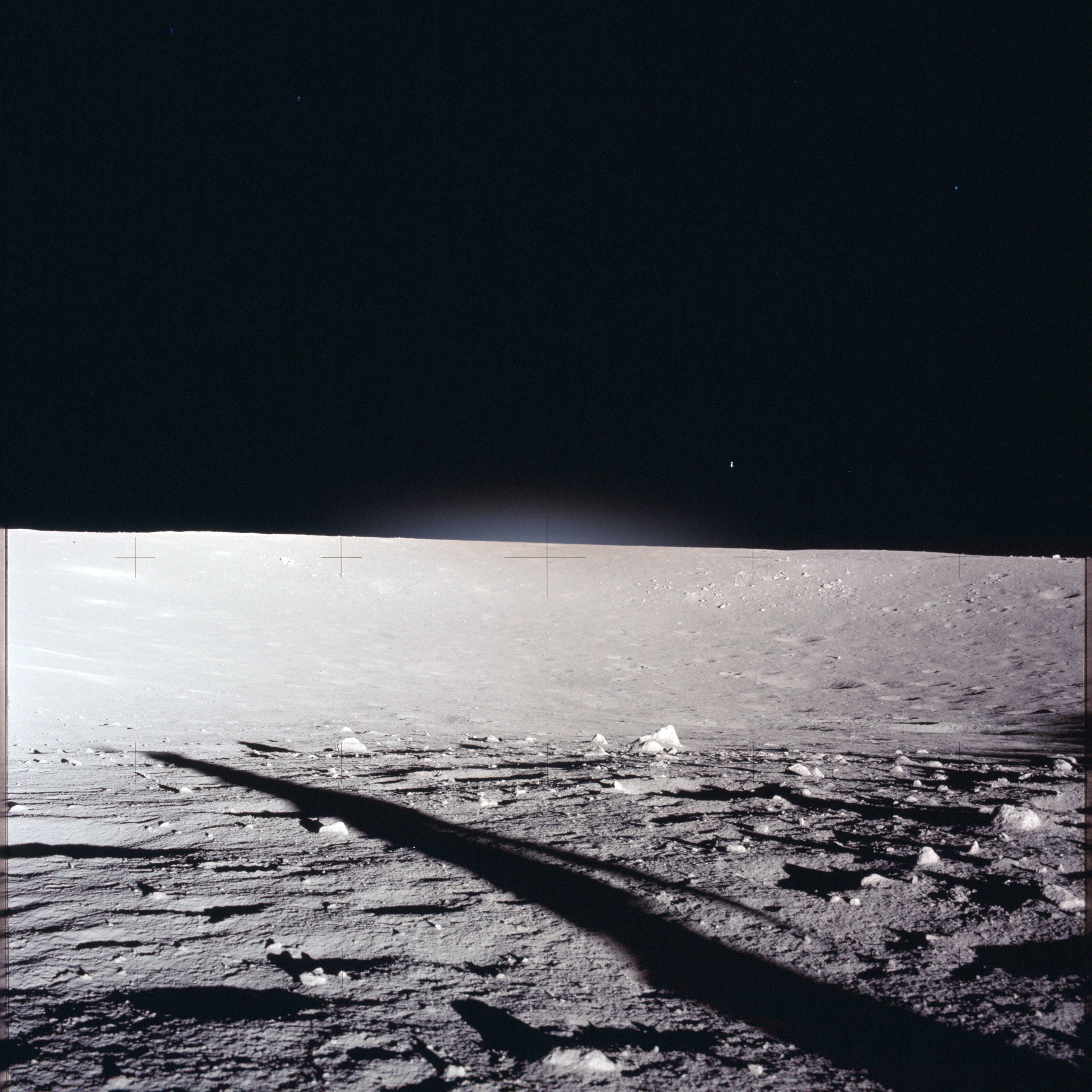
AS12-46-6849, https://www.lpi.usra.edu/resources/apollo/frame/?AS12-46-6849. Its metadata identifies a 70mm Hasselblad Apollo 12 frame, Magazine46/ letterY, 60 mm lens, color HCEX film, with description8 FRAME PAN NW OF ALSEP; PAN. The print-resolution JPEG at https://www.lpi.usra.edu/resources/apollo/images/print/AS12/46/6849.jpg is3900 × 3900,6,016,879bytes, SHA-2566bb28f5f2264fe3fe615f84065840f32213b2d4a60d521279554885c713ce8fd. - Side-by-side visual comparison shows AS12-46-6849 matches the VM5 terrain, horizon, and long diagonal foreground shadow far more specifically than other Apollo 12 candidates. Treat it as the likely unannotated source frame pending a higher-generation NASA/mission-catalog citation chain.
- Adjacent LPI print frames
AS12-46-6848andAS12-46-6850show shifted neighboring views of the same general scene. At contact-sheet scale they do not show the annotated tiny sky marks persisting in the same positions, so they do not currently provide motion or persistence evidence. - Exact-title searches in the NASA Image and Video Library did not surface a
NASA-UAP-VM5record. The productive external path is Apollo frame provenance: LPI/ALSJ frame pages, high-resolution scans, mission photo indexes, and adjacent-frame comparisons.
Prosaic checks before escalation
The strongest ordinary checks remain image-chain checks, not astronomy or satellite correlation. VM5 is a single still with no event time, line of sight, range, or platform geometry. The marks should first be tested against film grain, dust, scratches, emulsion/processing defects, scanner noise, color-channel speckling, contrast stretching, JPEG/resampling artifacts, reseau/fiducial interactions, and annotation/enlargement effects. The unannotated AS12-46-6849 frame visibly contains tiny blue/cyan specks and short dashes in the dark sky, which makes frame-level artifact analysis essential before any escalation.
Follow-up leads / limits
- Pin the full NASA/mission provenance chain for
AS12-46-6849beyond the LPI frame page, including any ALSJ caption, scan-generation note, and original magazine/frame metadata. - Map the five Release 01 annotation boxes back onto AS12-46-6849 pixel coordinates and compare the same regions on higher-generation scans.
- Inspect adjacent frames
AS12-46-6848,AS12-46-6850, and wider Magazine 46 neighbors with aligned crops, not just contact sheets, to test persistence or one-frame blemish behavior. - Reconcile the Release 01 row mapping (
149image asset versus146release-record graph row and VM2 legacy URL fields) as provenance cleanup. - Do not promote a finding from this page. The current evidence supports a likely source-frame identification and ordinary image-chain follow-up, but not an object identification, trajectory, resolution, or hypothesis.
Audit note
This deep investigation used the wiki page, verified source bytes/hash, OCR text, visual review, read-only Neo4j queries, official WAR.GOV access checks, LPI Apollo Image Atlas reconnaissance, and adjacent-frame comparison. No graph writes or Finding/Hypothesis/ResolutionDecision conclusions were made.
Limits
- This page does not identify any highlighted feature as a spacecraft, astronomical object, reflection, particle, defect, artifact, or other object class.
- The released file is a single annotated still. It does not establish motion, distance, size, speed, duration, or physical nature.
- The five highlighted marks are tiny and unresolved, even in the release-provided enlarged insets.
- The yellow boxes and labels guide attention but are not original scene content.
- The official description itself states that the annotations are contextual and are not an analytical judgment, investigative conclusion, or factual determination.
- Without the unannotated NASA frame and mission metadata, the amount of crop, enhancement, compression, or annotation influence cannot be fully assessed.
Sources
- Official/source image URL: https://www.war.gov/medialink/ufo/release_1/nasa-uap-vm5-apollo-12-1969.jpg
- WAR.GOV / PURSUE Release 01 CSV/image asset record:
NASA-UAP-VM5, Apollo 12, 1969 - Open Sky release-file route:
/api/explore/war-gov/release-file/war-gov-nasa-uap-vm5-apollo-12-1969-784dc42f - Open Sky source dataset:
war_pursue_uap_release_2026_05_08 - Open Sky semantic dataset:
war_pursue_release01_semantic_2026_05_12 - OCR text preserved for the released JPEG:
Area 1throughArea 5
All claims on this page are source-text claims, visual-context notes, or leads for human review. Review status remains graph_investigation_draft; investigation status remains needs_human_review; finding status remains not_a_finding.