NASA-UAP-VM6, Apollo 17, 1972
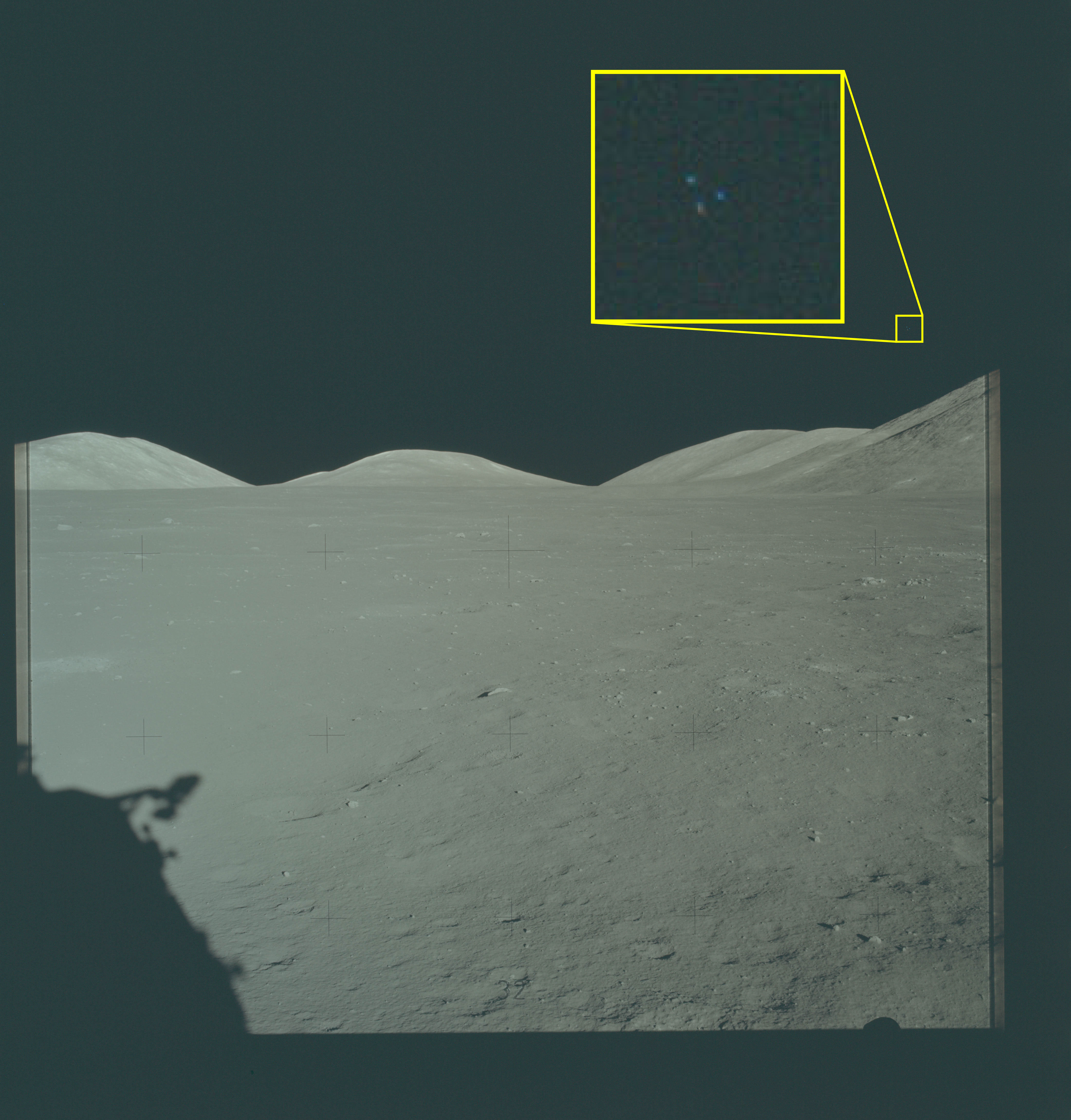
This Release 01 item is an official NASA image record associated with Apollo 17. The released description says the photograph was taken in December 1972 and highlights three small “dots” in a triangular formation in the lower-right quadrant of the lunar sky. The same description says there is no consensus about the feature, that preliminary U.S. government analysis treats a physical object in the scene as possible, and that the original Apollo 17 film has been obtained for further NASA/DOW analysis.
This draft treats the file as an evidence lead, not a resolved case. The useful work is to keep the released visual claim, the image provenance, and the comparison questions separate: visible dots in the annotated JPEG are not the same thing as a confirmed object classification.
Evidence media
Official Release 01 JPEG, 1,778,754 bytes, 4400 × 4600 pixels, SHA-256 ce62e46b3535a4683ef6fd192d858be52dbbd9ca011ae1a9cb43dba947815f54. The yellow rectangle, connector lines, and magnified inset are annotation graphics on the released image; the underlying scene is Apollo 17 lunar terrain under a dark sky. The inset shows a few tiny bright marks against a blocky magnified background, but the still image alone does not identify them.
Investigation reading
The verified release-file copy is a 1,778,754-byte RGB JPEG at 4400 × 4600 pixels. Direct visual inspection shows a lunar-surface scene under a dark sky: gray terrain, a low horizon, surface texture, camera/fiducial-style marks, frame or spacecraft-edge artifacts, and a visible marking resembling 32 near the lower part of the scene. Those are part of the underlying image context and should be separated from the release overlay.
The yellow graphics are release-added annotation aids. They include a small yellow source rectangle in the right-side sky, a larger yellow-bordered magnified inset, and yellow connector lines between them. In the magnified inset, three tiny bright marks are clearly distinguishable against a dark, blocky background. One appears pale/whitish, one bluish, and one warmer pale gray/tan. Other nearby mottling is not clean enough to count as additional dots because the inset is strongly affected by enlargement, JPEG compression, color noise, and pixel block structure.
The OCR body for this image is effectively empty apart from the page marker, so the controlling source text is the official Release 01 description and the visible JPEG itself.
What the file appears to contain
- A historical Apollo 17 lunar-scene JPEG released as a NASA image asset.
- A dark lunar sky, gray lunar terrain, frame/scan/camera marks, and normal image noise/artifact context.
- Release-added yellow annotation graphics pointing to a small lower-right sky region.
- A magnified inset where three small bright marks are distinguishable, but no measurable size, distance, speed, trajectory, or persistence can be established from this still alone.
- No embedded transcript, video, telemetry display, radar plot, or independent sensor frame in this file.
The official description is careful but high-signal: it says the dots are “clearly visible upon magnification,” says there is “no consensus,” and says further NASA/DOW analysis of the original Apollo 17 film is pending.
Source custody and provenance
| Field | Value |
|---|---|
| Official title | NASA-UAP-VM6, Apollo 17, 1972 |
| Agency | NASA |
| Release | WAR.GOV / PURSUE Release 01 |
| Source kind | Image / JPEG |
| Size and dimensions | 1,778,754 bytes; 4400 × 4600 pixels |
| Official/source URL | https://www.war.gov/medialink/ufo/release_1/nasa-uap-vm6-apollo-17-1972.jpg |
| Open Sky release-file route | /api/explore/war-gov/release-file/war-gov-nasa-uap-vm6-apollo-17-1972-3deb237b |
| SHA-256 | ce62e46b3535a4683ef6fd192d858be52dbbd9ca011ae1a9cb43dba947815f54 |
| OCR status | frontier_ocr_complete; image-only OCR body contains only the page marker |
The verified release-file copy matches the recorded SHA-256 above. The Release 01 source index marks the image as row 150; a direct current CSV title read places the title on enumerated data row 151, and the release-record graph node still carries a record-147-current-row anchor. Treat that as a row-indexing/provenance cleanup lead, not as evidence that this is a different image.
Graph context
The graph has exact official-primary records for the image asset and for the corresponding Release 01 document/CSV record. The semantic layer currently surfaces six extracted claims, four entity/date mentions, zero sensor events, and zero table rows. The extracted claims are primarily release-description statements: NASA/Apollo provenance, the 1972 date, and the “no consensus” observation-language around the dots.
Related graph-neighborhood items include another NASA Apollo image record (NASA-UAP-VM3, Apollo 12, 1969) and a State Department cable record. Those are catalog/provenance navigation leads only. There are no candidate crosslinks attached to this context, and nothing in the graph record turns this single annotated JPEG into a resolved event.
Leads to check
- Locate the unannotated Apollo 17 source frame or highest-quality NASA scan and compare the same sky coordinates to the release JPEG.
- Compare adjacent Apollo 17 frames for persistence, movement, or fixed-frame artifact behavior.
- Determine whether the yellow zoom annotation was added during Release 01 preparation or inherited from a prior analysis copy.
- Test ordinary image explanations first: film dust, scratches, emulsion defects, scan artifacts, reseau/fiducial marks, color fringing, resizing, sharpening, and JPEG compression.
- Track the promised NASA/DOW original-film analysis when released and reconcile the row-number/anchor mismatch in the Release 01 source index, current CSV, and graph record.
Lead check notes
- Blocked — unannotated source frame: The current public release-file item is the annotated JPEG only, and the OCR body contains no source text beyond the page marker. A highest-quality unannotated NASA scan or original-film comparison is still needed before the sky marks can be treated as measured features.
- Needs external source — adjacent Apollo 17 frames: The current Release 01 record does not include adjacent frames, camera sequence metadata, or NASA/DOW film-analysis results. Persistence, motion, and fixed-frame artifact checks remain unresolved.
- Partial — annotation provenance: The release description confirms this is a magnified presentation of a previously discussed photograph, but the current linked source does not show whether the yellow zoom graphics were added for Release 01 or inherited from an earlier analysis copy.
- Partial — ordinary-image checks: The released JPEG supports a visible three-dot lead in the magnified inset, but still-image-only review cannot separate film dust, scratches, emulsion defects, scan artifacts, reseau/fiducial marks, color fringing, resizing, sharpening, or JPEG compression without the unannotated source film or a higher-quality scan.
- Partial — row/provenance cleanup: Release context preserves a row-anchor mismatch: Release 01 source-index row
150, direct CSV enumerated row151, and graph record anchor147. The title, official URL, byte size, and SHA-256 all match this VM6 image, so the mismatch remains a catalog cleanup lead rather than a content change.
Deep investigation — graph + web reconnaissance
Source reread and visual control points
The controlling source text is still the Release 01 manifest description plus the released JPEG. The image OCR layer contributes only a page marker, so it does not add independent body text. The manifest describes a December 1972 Apollo 17 photograph with three “dots” in a triangular formation in the lower-right lunar sky, says there is “no consensus” about the feature, says preliminary U.S. government analysis treats a physical object in the scene as possible, and says the original Apollo 17 film was obtained for future NASA/DOW analysis.
A fresh visual check of the annotated JPEG supports the same cautious reading: the yellow source rectangle, connector lines, and large yellow-bordered zoom box are release-added annotation graphics, not photographed scene content. In the magnified dark inset, three clear tiny bright marks are distinguishable. Other faint speckles and mottled patches are not clean enough to count because the enlargement is very dark, blocky, and JPEG-compressed. The still image alone still provides no reliable scale, distance, size, motion, altitude, or object class.
Read-only graph connections
The read-only graph has exact official-primary records for the VM6 ImageEvidence asset and the corresponding Release 01 manifest Document. The image node has the verified official URL, JPEG content type, 1,778,754-byte length, SHA-256 ce62e46b3535a4683ef6fd192d858be52dbbd9ca011ae1a9cb43dba947815f54, one manifest-description text chunk, one empty OCR/page-marker chunk, six HAS_EXTRACTED_CLAIM machine claims, and zero connected SensorEvent nodes. The extracted claims are deterministic manifest-text claims only: NASA/agency mentions, the 1972 date, and the quoted “no consensus” observation language. They remain machine_extracted_needs_human_review and not_a_finding.
The graph also preserves a row-shift cleanup issue that should not be treated as an event relationship. The VM6 image record is tied to source-pack row 150, while the current archived CSV places the VM6 title on enumerated data row 151, and the release-record document anchor still carries row 147. Direct RELATED_TO neighbors also reflect this manifest-revision churn: one VM6 document edge points toward the VM3/Apollo 12 image record, and the VM6 image edge points toward the State Department Tbilisi cable record. Those are catalog/provenance cleanup leads only, not evidence that the Apollo 17 image, Apollo 12 image, or State Department cable describe the same occurrence.
External provenance and context
Direct live requests to the WAR.GOV media URL, CSV URL, landing page, and Release 01 press release returned 403 during this check, so the verified cached official-primary copy and archived public captures remain the useful provenance controls. Internet Archive CDX records list multiple 200 image/jpeg captures of the exact VM6 official JPEG URL on 2026-05-08 and 2026-05-09. A 2026-05-08 archived WAR.GOV CSV snapshot lists NASA-UAP-VM6, Apollo 17, 1972 with agency NASA, type IMG, incident location Moon, incident date 1972, the same official JPEG URL, and the same description text.
Official NASA context confirms Apollo 17 as NASA’s final Apollo lunar landing mission at Taurus-Littrow, and NASA’s Apollo Lunar Surface Journal / Apollo Flight Journal remain the best official research lanes for mission transcripts, surface context, frame sequences, and crew-photo indexing. Exact NASA Image and Video Library searches for the Release 01 title and for the distinctive “three dots” / triangular-formation wording did not return a matching public NASA library item during this pass. That means the public Release 01 page still lacks a pinned original NASA frame ID, roll/frame metadata, or unannotated highest-quality source scan.
Prosaic checks and open questions
The first checks are ordinary image and provenance checks, not escalation: compare the unannotated Apollo 17 source frame, adjacent frames, and original-film analysis; look for persistence or movement; and test dust, scratches, emulsion defects, scan artifacts, reseau/fiducial marks, color fringing, resizing, sharpening, and JPEG compression. Weather checks are not applicable to a lunar-surface still. Launch, satellite, and astronomy correlation checks are blocked until the original frame ID, exact exposure time, camera station/pointing, field of view, and adjacent-frame sequence are known.
Open follow-ups: identify the Apollo 17 source frame and film magazine; compare the same sky region in unannotated/high-resolution NASA scans; wait for the promised NASA/DOW original-film analysis; and repair the graph row/relationship mismatches so catalog navigation does not imply false cross-case corroboration.
Audit note
This section is a wiki/graph/web reconnaissance update only. No Neo4j writes were made, no finding or hypothesis is asserted, and the page remains a provenance-verified evidence lead pending human review.
Limits
- The page does not identify the dots as craft, debris, stars, reflections, or film artifacts.
- The three-dot count is a visual read of the annotated release JPEG and its magnified inset, not a measurement from original film.
- The file is a single still image; it does not provide motion, range, trajectory, altitude, or sensor corroboration.
- OCR contributes no substantive body text for this image-only item.
- The official source says further analysis is pending, so Open Sky should not outrun the source record.
Sources
- Official/source image URL: https://www.war.gov/medialink/ufo/release_1/nasa-uap-vm6-apollo-17-1972.jpg
- WAR.GOV / PURSUE Release 01 CSV record for
NASA-UAP-VM6, Apollo 17, 1972 - Open Sky release-file route:
/api/explore/war-gov/release-file/war-gov-nasa-uap-vm6-apollo-17-1972-3deb237b - SHA-256 verification:
ce62e46b3535a4683ef6fd192d858be52dbbd9ca011ae1a9cb43dba947815f54 - Open Sky graph context: exact ImageEvidence and Release 01 document records for the same official title/source URL
This is a graph-informed investigation draft pending human review. It preserves the source claim and review leads without asserting a finding.