DOW-UAP-PR33, Unresolved UAP Report, Syria, October 2024
Evidence media
- Open Sky release-file copy of the official PR33 MP4 — verified as a 426,911-byte MP4 with SHA-256
5bdc888fd25014c5519d625764233f66ee0214bfa48c1670aff5d7c00029a5d9. - Official DVIDS page for video 1006079.
Derived frame-context sheets below are sampled from the official MP4. They are not standalone object images and should be read as orientation aids for the released video, black masking/redactions, colored overlays, and interface marks.
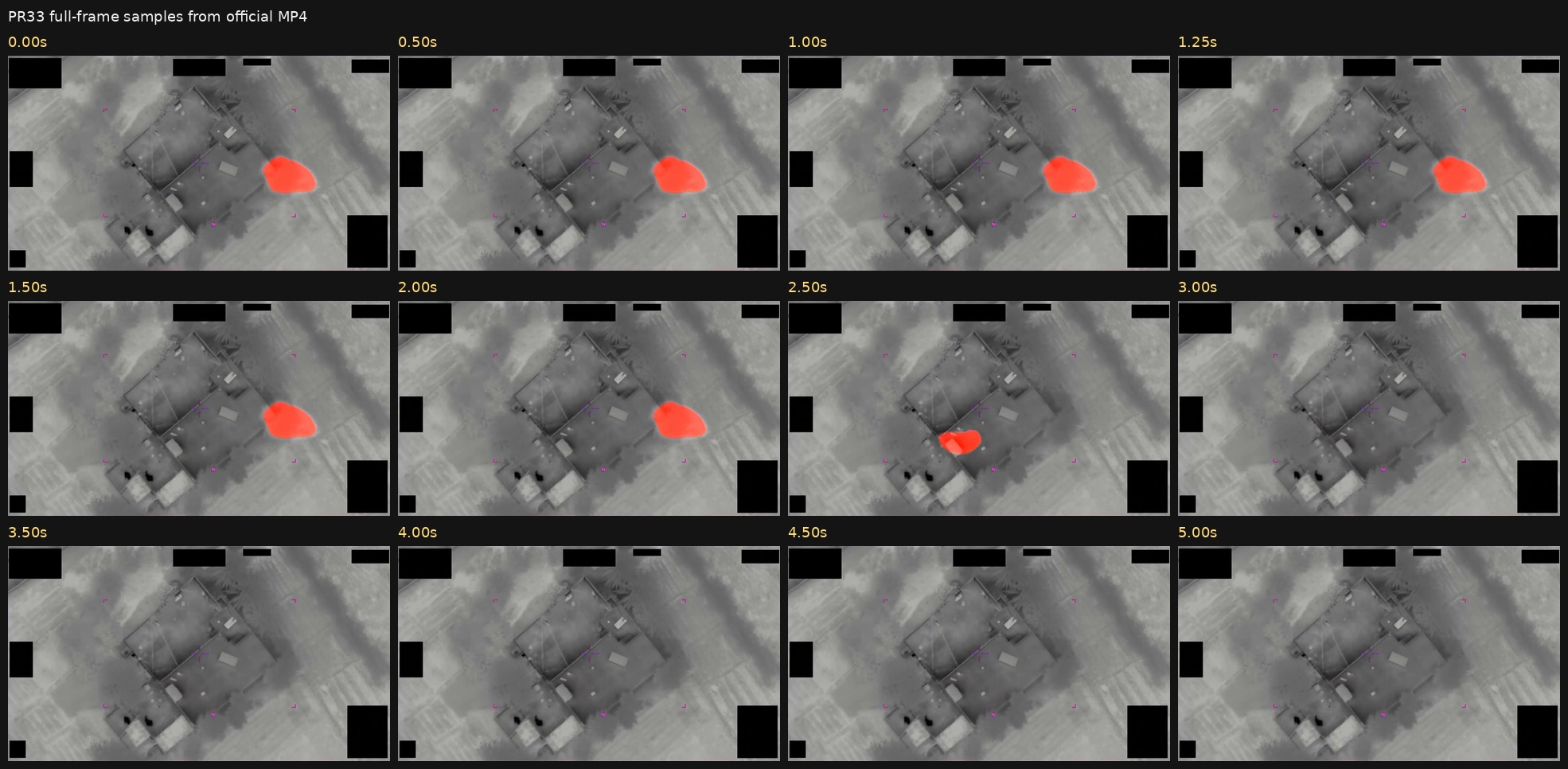 Full-frame samples show the grayscale scene, black edge masks, magenta interface marks, and the orange/red semi-transparent regions visible during the first half of the clip.
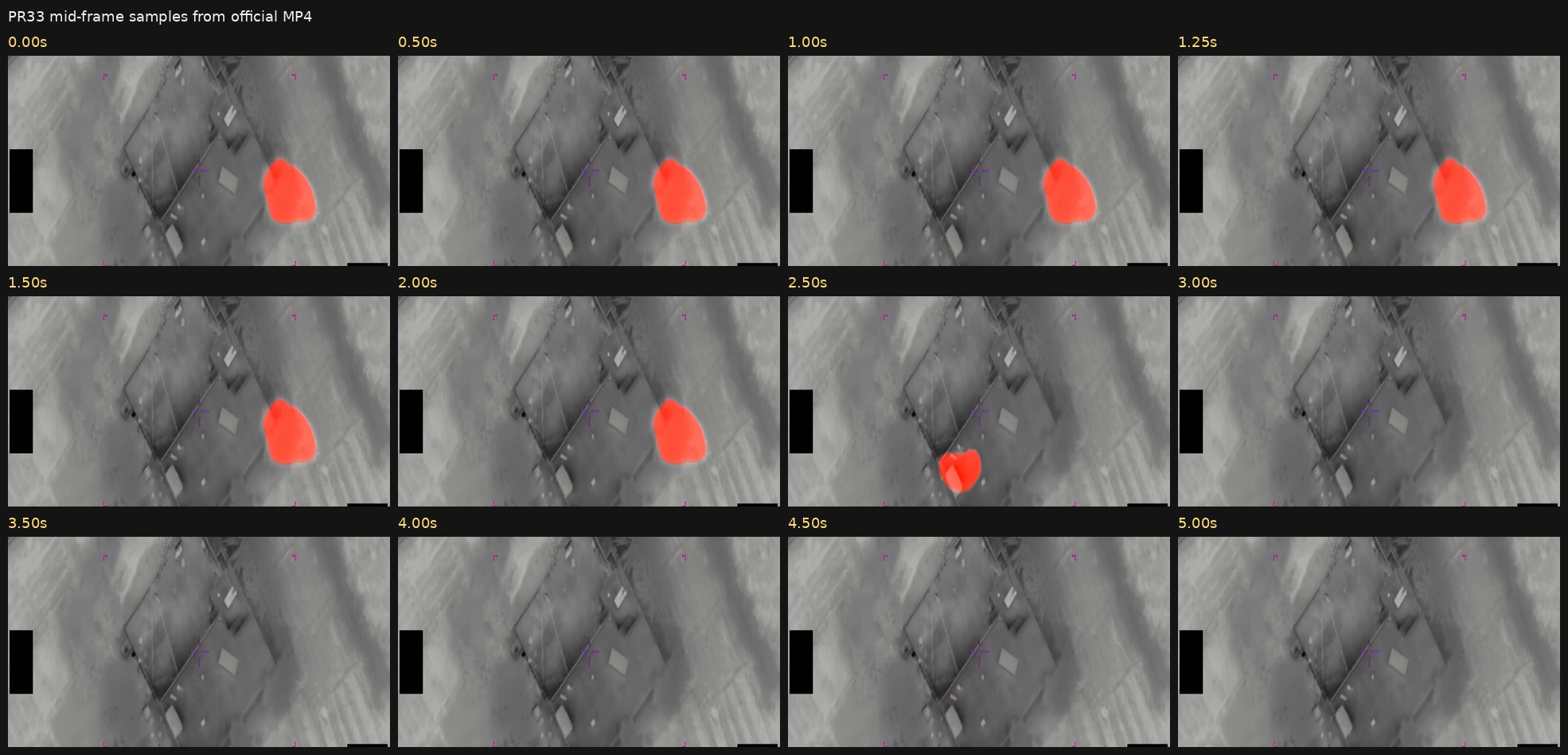 Mid-frame samples focus on the orange/red overlay region near the structure and ground scene.
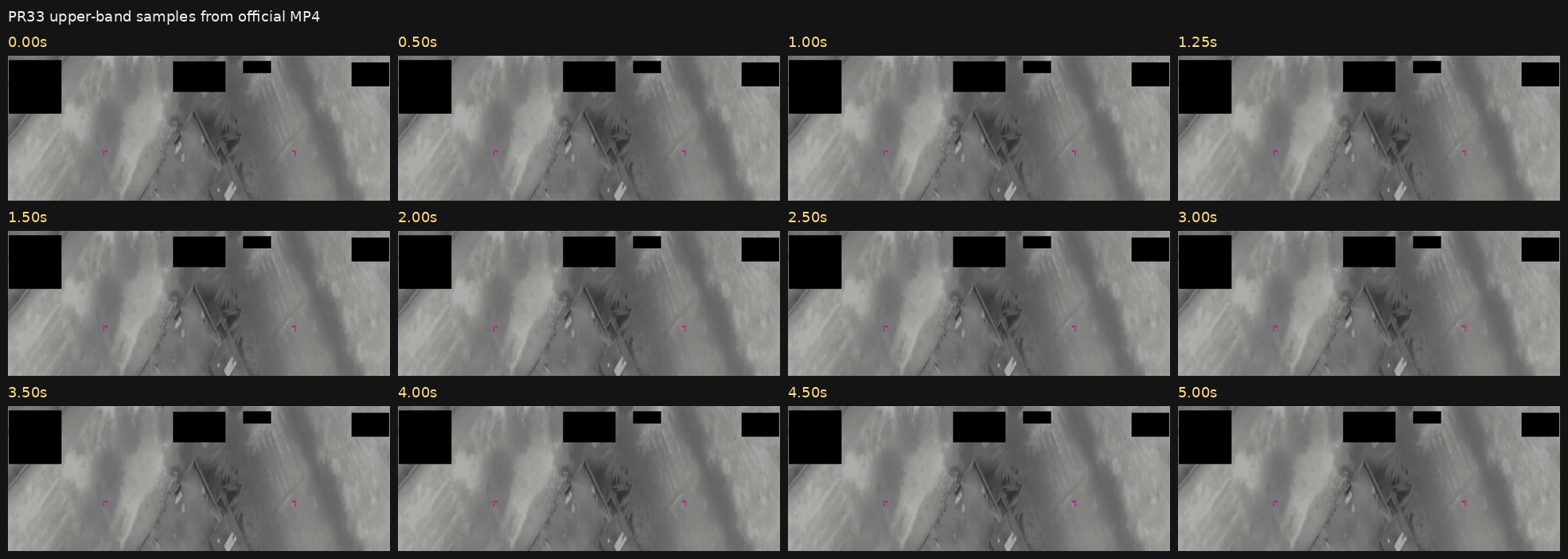 Upper-band samples preserve the top-edge masking and interface context; they do not, by themselves, resolve a separate bright object at the top of the feed.
Investigation reading
This item is a short DVIDS video record paired in Release 01 with DOW-UAP-D32, Mission Report, Syria, October 2024. The reviewed file is a 5.03-second, 1920×1080, 30 fps H.264 MP4 with 151 video frames and an AAC audio stream. Audio-level review found the track effectively silent for investigative purposes, and the source inventory does not provide a transcript or OCR body for the video. The usable source material here is the DVIDS/Release description plus the actual released MP4 frames.
The visible video is a grayscale overhead/FMV-style scene centered on a building or compound-like structure. Across the clip, the same scene remains mostly stable, with black rectangular masks/redactions around portions of the frame and magenta/purple interface marks over the imagery. Those masks and marks should not be treated as physical scene content.
The official video description says that from 00:01 to 00:03, two semi-transparent, irregularly shaped orange areas overlay the background imagery. Frame review is broadly consistent with that description but needs careful language: the orange/red areas appear visually as semi-transparent colored overlay regions, not as resolved objects with hard geometry, texture, shadow, or independent surface detail. In the sampled frames, a large orange/red region is present near the right side of the structure through roughly the first two seconds, and a smaller orange/red region appears lower in the frame around the 2.5-second sample. By about 3.0 seconds and afterward, those colored regions are no longer visible in the sampled frames.
What the file appears to contain
| Time sample | Visible content | Review note |
|---|---|---|
0.00s-2.00s | Grayscale overhead scene with a prominent orange/red semi-transparent region on the right side of the building/ground area. | The colored area behaves visually like an overlay or highlight over background imagery. |
2.50s | A smaller orange/red semi-transparent region appears over a lower/central part of the structure/ground scene. | This appears separate from the earlier right-side colored area in the sampled frames. |
3.00s-5.00s | The grayscale scene remains visible with black masks and magenta interface marks; no orange/red region is visible in the sampled frames. | Later frames help distinguish persistent scene structure from transient colored overlay regions. |
The upper-band crop is useful because D32 describes a light/glare halo effect at the top of the FMV feed. In this PR33 sample set, the upper band is partly obscured by black masks and does not by itself resolve a discrete top-edge object. The strongest visible colored content in PR33 is the semi-transparent orange/red overlay in the mid/full-frame view.
Source custody and provenance
The release identifies this as DOW-UAP-PR33, Unresolved UAP Report, Syria, October 2024, DVIDS video 1006079, from the Department of War / PURSUE Release 01 corpus. The official DVIDS page is:
The Open Sky release-file endpoint is:
The verified MP4 size is 426,911 bytes, and the verified SHA-256 is 5bdc888fd25014c5519d625764233f66ee0214bfa48c1670aff5d7c00029a5d9. Release metadata associates this video with CSV rows 50 and 90, incident location Syria, and an incident date field of 10/20/24, N/A. The release description links the clip to the accompanying DOW-UAP-D32 mission report, which carries the longer form narrative for the 20 October 2024 Syria event.
Graph context
The graph models this item as official primary VideoEvidence plus an associated release-record Document. The semantic layer currently attaches 28 extracted claims, 21 entity mentions, 3 FMV sensor-event records, and 0 table rows. Those counts are navigation aids, not findings.
The useful graph signal is the source-backed connection to DOW-UAP-D32, where the mission report describes a light/glare of unknown origin crossing the FMV feed and a halo effect at the top of the feed. Other related records surfaced by graph navigation should be treated cautiously unless they are the same Release 01 Syria/D32/PR31-PR33 cluster. Location-only Syria links or broad archive matches are not same-event corroboration.
Leads to check
- Align PR33 frame timing against the D32 source timeline:
1559Z,1602Z,1609Z,1620Z, and1644Z. The five-second public clip is not enough by itself to map every D32 timestamp to the released frames. - Compare PR33 with the adjacent PR31 and PR32 DVIDS clips before deciding whether the colored overlay regions are separate clip excerpts, display highlights, or repeated views of the same FMV phenomenon.
- Check optical and sensor-display explanations first: glare, lens/sensor saturation, frame-edge artifacts, overlay/color processing, black mask boundaries, magenta interface symbology, and platform/sensor motion.
- Reconcile release row numbering across the D32 PDF and PR31-PR33 video records before using row numbers as public-facing citations.
- External weather, astronomy, satellite, launch/reentry, aircraft, and drone checks require unredacted geometry or defensible approximations that are not present in the PR33 clip alone.
Lead check notes
- Partial — D32/PR31-PR33 alignment: The paired D32 source page and the three DVIDS video pages confirm that PR33 belongs to the same Syria October 2024 release cluster as PR31 and PR32. PR33 frame samples preserve the official
00:01-00:03orange-area description, but the public clip does not provide an authoritative way to map those seconds to D32's1559Z,1602Z,1609Z,1620Z, and1644Zsource statements. - Partial — adjacent-clip comparison: PR31 preserves a tiny first-second upper-band reddish/orange mark, PR32 preserves a top-edge red/white highlight window, and PR33 preserves semi-transparent orange/red regions in the full/mid-frame view. Those are related source records, but the current public copies do not establish whether they are separate excerpts, display highlights, repeated views, or the same underlying FMV effect.
- Partial — optical/display-artifact checks: The verified MP4 and derived contact sheets separate the black masks, magenta interface marks, grayscale scene, and orange/red overlay-like regions. Higher-fidelity or unredacted FMV, display metadata, and sensor-geometry context are still needed before classifying the regions as scene content, glare, frame-edge/display behavior, compression/color processing, or another prosaic video effect.
- Partial — row/date provenance: PR33 carries DVIDS ID
1006079and release rows50/90; the paired D32 page carries row47with related rows85-87, while PR31 and PR32 carry48/88and49/89. Treat those row values as release-provenance/citation cleanup, not as event-resolution evidence. - Needs external source — environment and traffic checks: Weather, astronomy, satellite, launch/reentry, aircraft, drone, line-of-sight, and ordinary traffic checks need unredacted location/time geometry, platform context, or an official approximation; the five-second PR33 clip alone does not provide enough data.
Deep investigation — graph + web reconnaissance
Source reread
A second pass checked the live DVIDS page, the verified Open Sky release-file MP4, the full-frame and upper-band contact sheets, and the paired D32 mission-report page. PR33 is DVIDS video 1006079, filename DOD_111689005, VIRIN 241002-D-D0360-6161, category B-Roll, length 00:00:05, location SY, date taken 10.01.2024, and date posted 05.07.2026 23:35. The reviewed MP4 verifies as 426,911 bytes with SHA-256 5bdc888fd25014c5519d625764233f66ee0214bfa48c1670aff5d7c00029a5d9; a direct DVIDS/CloudFront range request returned 206 Partial Content, Content-Range: bytes 0-15/426911, and MP4 ftyp magic bytes.
Frame/contact-sheet review keeps the visual reading narrow. The full-frame sheet shows a stable grayscale overhead/FMV-style scene with fixed black rectangular masks, small magenta/purple interface marks, and orange/red semi-transparent overlay-like regions during the first half of the clip. The larger orange/red region appears on the right side of the central scene from 0.00s through about 2.00s; at 2.50s the visible colored region is smaller and nearer the lower-middle/central area; by 3.00s and later sampled frames, no orange/red region is visible. The upper-band sheet is dominated by fixed black masks and interface boundaries and does not by itself resolve a distinct top-edge light/glare object.
The paired D32 mission report remains the source-text anchor. Its reviewed pages preserve 201559:00ZOCT24, LIGHT/GLARE FLASHED OF UNK ORIGIN FLASHED ACCROSS FMV CAMERA FEED, source spelling MISHAPEN AND UNEVEN BALL OF WHITE LIGHT, direct FMV light/glare crossings at 1559Z, 1602Z, and 1644Z, and top-of-feed halo-effect statements at 1609Z and 1620Z. PR33 preserves one short official visual excerpt from that cluster, but the public clip does not provide an authoritative mapping from its 00:01-00:03 description window to any one D32 timeline entry.
Graph connections checked
Read-only Neo4j reconnaissance matched PR33 as an official primary VideoEvidence node plus an associated release-record Document, using the exact DVIDS ID, canonical DVIDS URL, MP4 URL, and SHA-256. The graph has two manifest-description text chunks for the video, 28 machine-extracted Claim records, 21 EntityMention records, and three FMV-oriented SensorEvent records. Those sensor-event rows are source-word/manifest extractions marked machine_extracted_needs_human_review / not_a_finding; they are not radar, telemetry, or independent multi-sensor confirmation.
The narrow source-backed cluster remains D32 plus the three short Syria October 2024 DVIDS clips: PR31 (1006076), PR32 (1006078), and PR33 (1006079). Graph review returned no direct CANDIDATE_CROSSLINK same-event corroboration for PR33. Some direct RELATED_TO navigation around the PR33 video surfaced stale release-row/title drift to D38/PR36 records carrying D32/PR33-era file metadata; that is provenance cleanup, not evidence that the Middle East 2020 records corroborate this Syria clip.
Official web reconnaissance
The DVIDS PR33 page was reachable and matched the title, video ID, VIRIN, filename, date-posted field, category, length, location, and publisher description summarized above. DVIDS also repeats the key caution: its video description is informational and should not be treated as an analytical judgment, investigative conclusion, or factual determination about the event's validity, nature, or significance. Direct WAR.GOV/PURSUE landing and CSV requests returned access-denied responses from this environment, while Internet Archive availability checks for the DVIDS and WAR.GOV URLs returned rate limiting; neither archive path was used as replacement custody in this pass.
The DVIDS 10.01.2024 / VIRIN date cue and the paired D32 internal 20 OCT 2024 fields remain a provenance tension. Until an authoritative manifest history or source note reconciles the two, public citations should preserve both fields rather than silently choosing one as the event date.
Prosaic checks and open limits
The first prosaic lane is optical/display/sensor handling: semi-transparent video overlays, false-color or thermal processing, top-edge frame effects, black mask boundaries, magenta symbology, compression/resampling, lens or sensor glare, and platform/sensor motion. The paired D32 page reports clear weather in the ISR blocks, but that is not enough to clear weather, astronomy, aircraft, drone, satellite, launch/reentry, or line-of-sight possibilities because the public release still lacks unredacted coordinates, platform track, look angle, sensor settings, raw FMV metadata, and external traffic/environment records.
Graph labels for AstronomyEvent, WeatherEvent, and LaunchEvent are present in the database; exact-date graph probes for 2024-10-20 and a narrow launch window around that date returned no modeled rows. That is only a graph-coverage note, not an external exclusion. PR33 remains unresolved source evidence, with prosaic checks required before any escalation.
Audit note
This deep pass made no Neo4j writes and made no finding or hypothesis. It tightened the public source hierarchy for PR33: official DVIDS/MP4 custody and frame review first, paired D32 source text second, graph extraction as machine-review navigation, and external prosaic checks only where the released data can support them. Follow-up should reconcile the DVIDS/D32 date tension and compare PR31-PR33 against the five D32 timeline statements only if higher-fidelity video, unredacted metadata, or an official mapping becomes available.
Limits
This page is an investigation draft, not a finding. The MP4 is only about five seconds long, includes redactions/masks and interface marks, and does not provide unredacted location geometry, platform identity, or raw sensor metadata sufficient to resolve the event. The orange/red regions are visible in the released video, but their meaning is not established by this review. They should be described as semi-transparent overlay-like regions unless a later source proves they are direct scene content or identifies their function.
The DVIDS description itself says the video description is informational and should not be treated as an analytical judgment, investigative conclusion, or factual determination. Open Sky should preserve that caution: PR33 is useful visual context for the D32 report, not a standalone resolution of the Syria October 2024 event.
Sources
- Department of War / DVIDS video: DOW-UAP-PR33, Unresolved UAP Report, Syria, October 2024
- Open Sky release-file copy: war-gov-dow-uap-pr33-unresolved-uap-report-syria-october-2024-1006079
- SHA-256:
5bdc888fd25014c5519d625764233f66ee0214bfa48c1670aff5d7c00029a5d9 - Paired source document: DOW-UAP-D32, Mission Report, Syria, October 2024