NASA-UAP-D3, Gemini 7 Transcript, 1965
Evidence media
- Verified source file: Open Sky release-file copy of the official PDF.
- The page renders below are derived from the verified official PDF. They show transcript/document pages, not photographs, spacecraft imagery, radar displays, or object imagery.
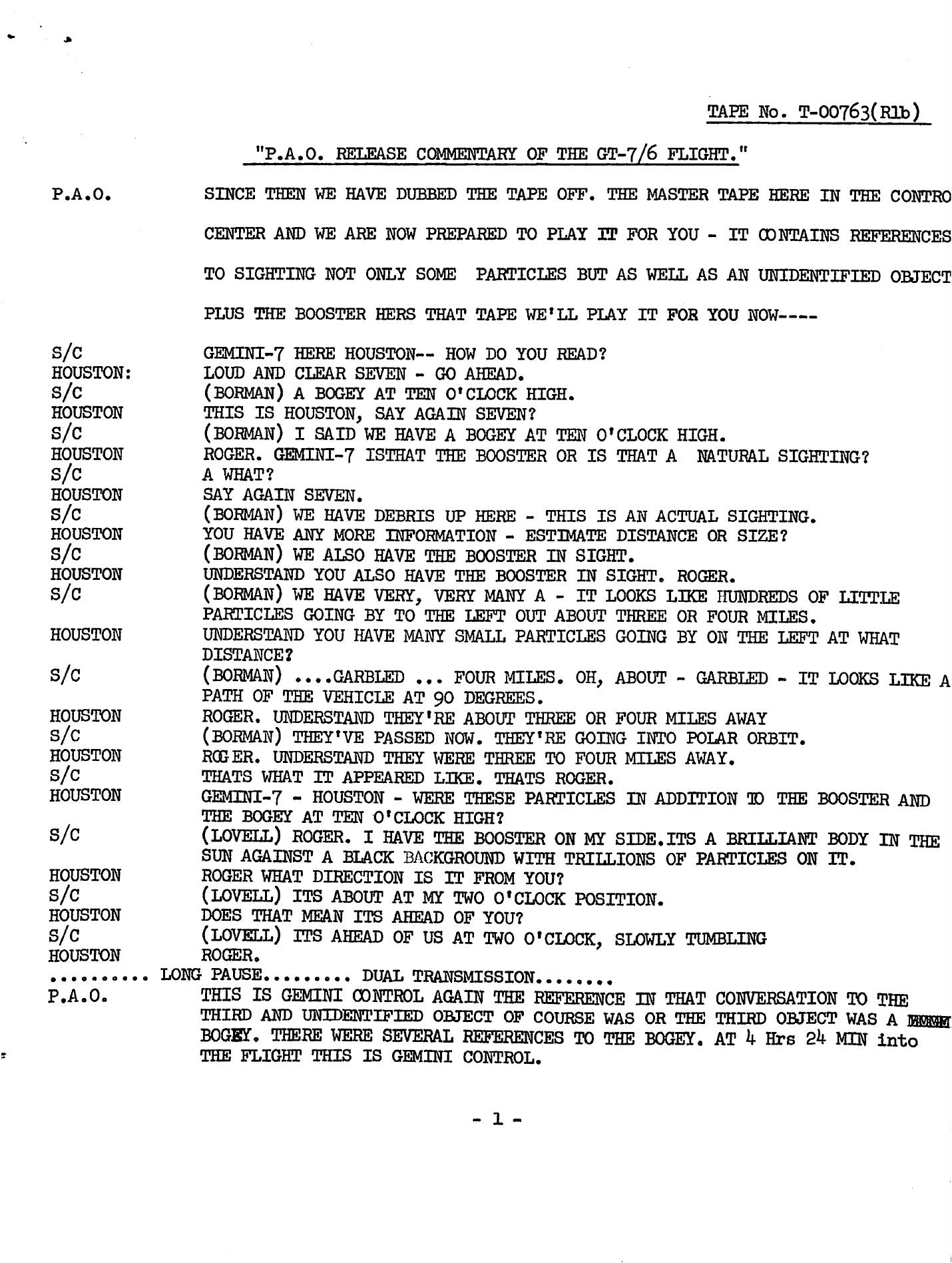
Page 1 is the typed PAO transcript headed TAPE No. T-00763(R1b). The visible exchange includes Borman reporting a bogey at ten o'clock high, Houston asking whether it is the booster or a natural sighting, Borman reporting debris/particles and the booster in sight, and Lovell describing the booster as a brilliant sunlit body with many particles.
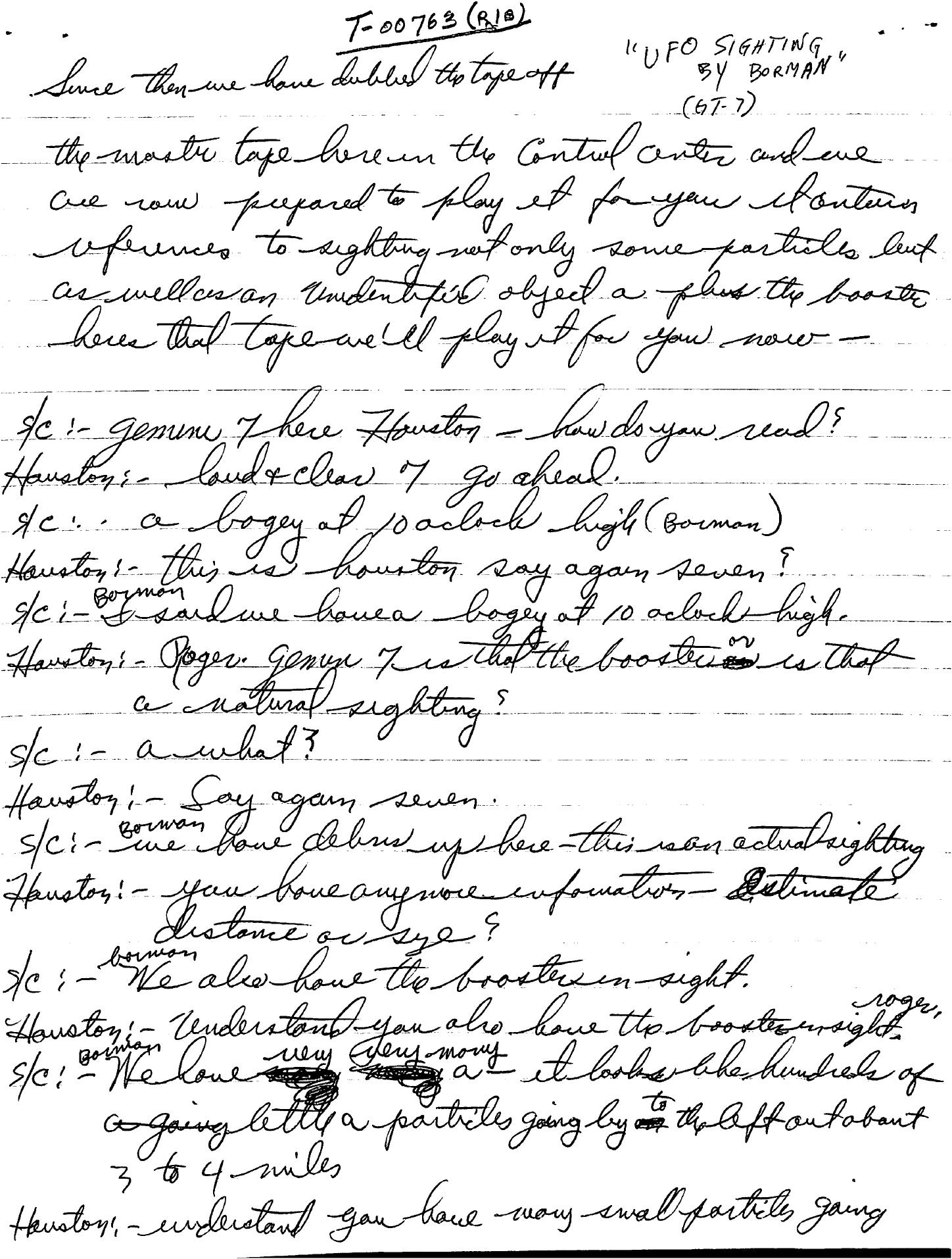
Page 2 is a handwritten transcript-note page headed UFO SIGHTING BY BORMAN (GT-7). It repeats the start of the Gemini 7/Houston exchange, including the bogey report, the booster-or-natural-sighting question, and the first particle-distance language.
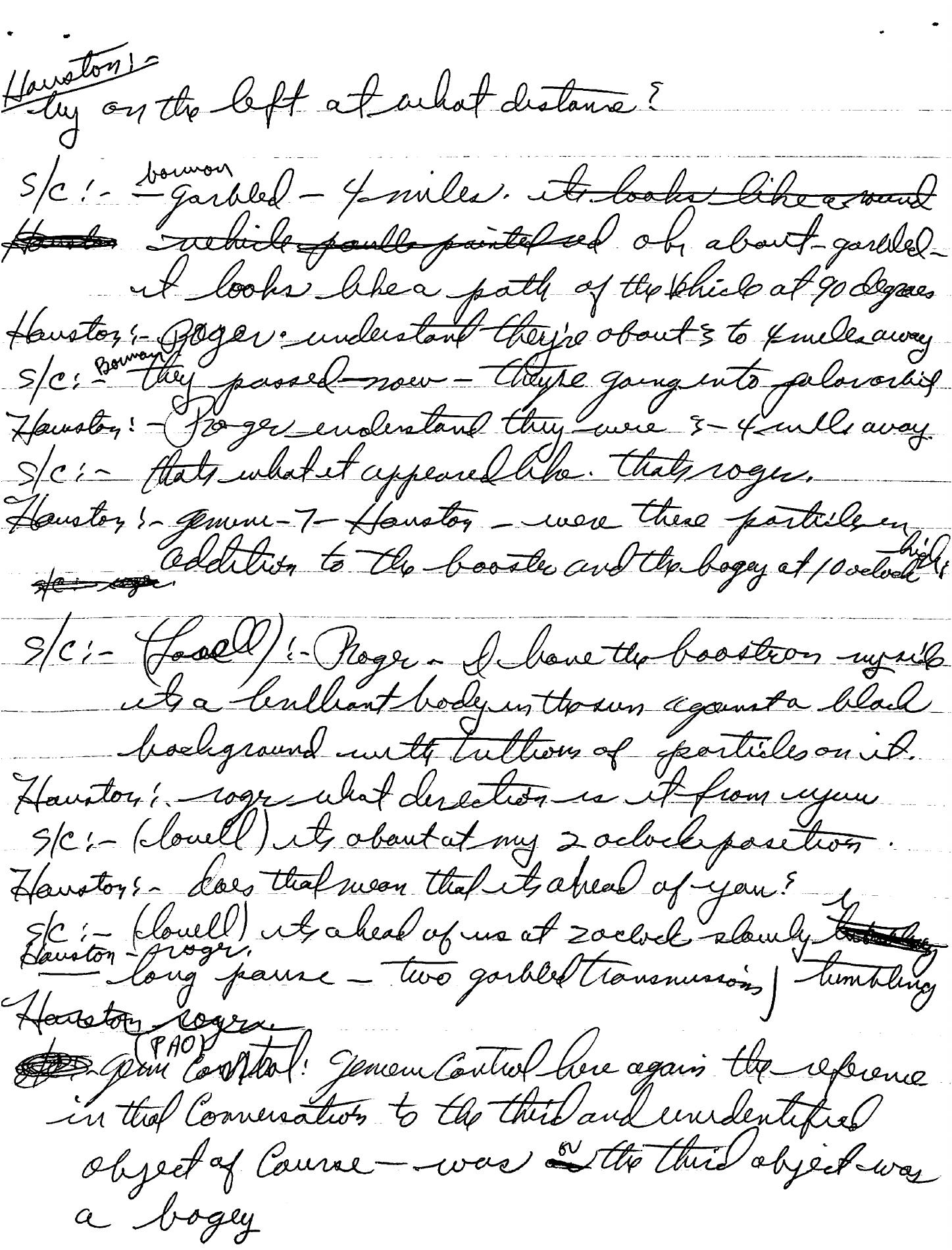
Page 3 continues the handwritten notes, preserving the 3 to 4 miles / polar orbit language, Houston's question about whether the particles were in addition to the booster and bogey, and Lovell's booster description. Several words are garbled or hard to read, so this render is useful for checking OCR-sensitive transcript wording.
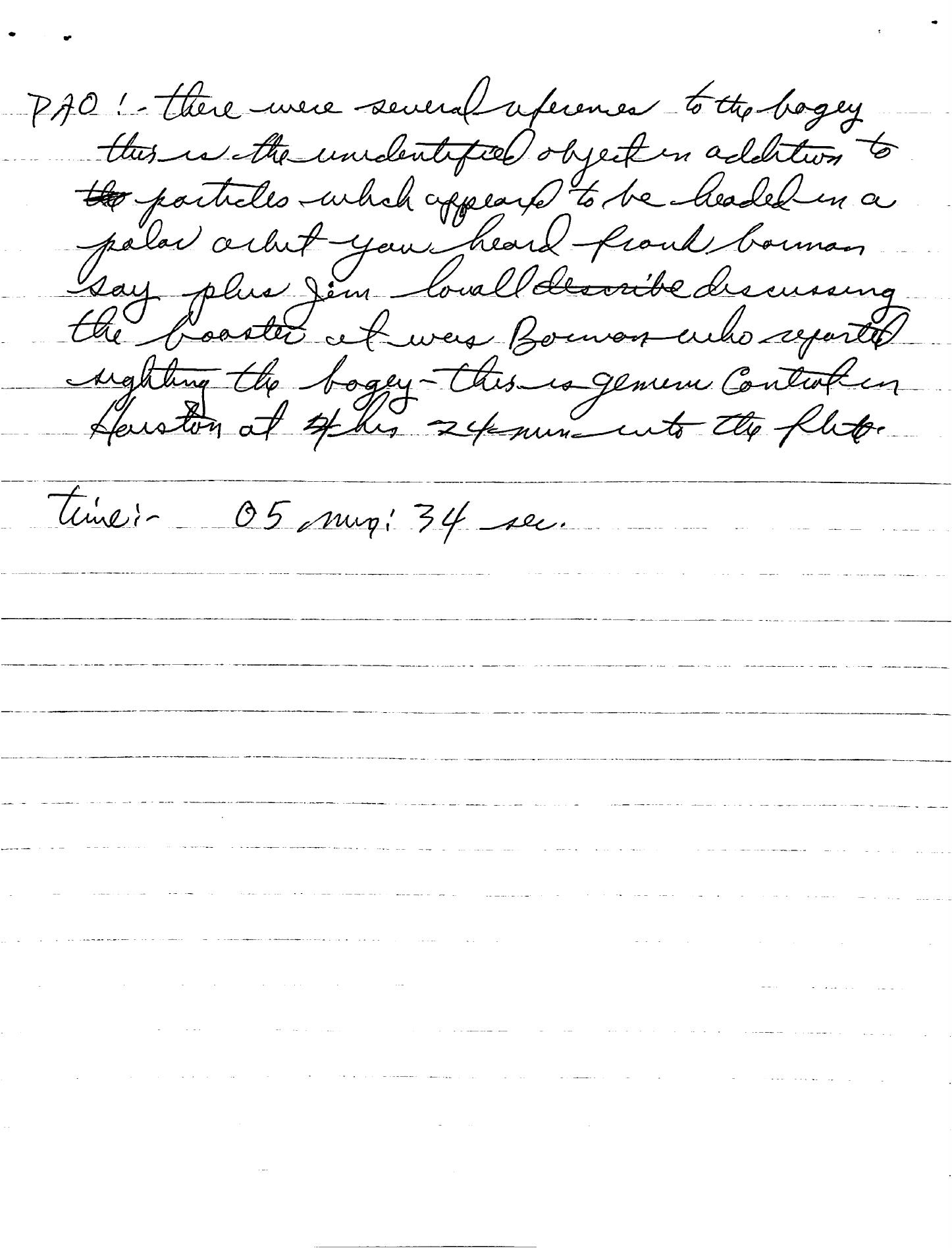
Page 4 is a handwritten PAO closing note, not object imagery. It summarizes the bogey/unidentified-object references, mentions particles and a possible polar-orbit description, attributes the report to Borman and the booster discussion to Lovell, and includes a timing note of about 05 min: 34 sec.
Investigation reading
This Release 01 file is a four-page NASA PDF transcript packet for the Gemini 7/6 flight public-affairs audio. It is not an image, radar, or sensor-frame exhibit. The verified PDF is built from scanned page images: page 1 is a typewritten transcript headed TAPE No. T-00763(R1b) and pages 2-4 are handwritten or annotated transcript notes headed around T-00763 (R10) and "UFO SIGHTING BY BORMAN" (GT-7). A full page pass found no photographs, spacecraft frames, maps, telemetry plots, radar displays, or object imagery in the released PDF.
The source preserves one short exchange. Public Affairs introduces a tape that contains references to some particles, an unidentified object, and the booster. Borman then reports a bogey at ten o'clock high; Houston asks whether it is the booster or a natural sighting; Borman replies that there is debris and calls it an actual sighting. The conversation then separates several things that need to stay separate in public reading: the bogey, a field of many small particles, and the booster.
The most important source-control point is that the transcript itself contains both the unusual language and the immediate prosaic context. Houston asks about the booster. Borman says the booster is also in sight. Houston later asks whether the particles are in addition to the booster and the bogey. Lovell's clearest statement concerns the booster: he reports having the booster on his side, a brilliant body in the sun against a black background, with many particles on it or around it. This page therefore preserves the transcript as testimony and mission-control context, not as a resolved identification.
What the file appears to contain
| PDF pages | Page form | Source reading |
|---|---|---|
| 1 | Typed PAO transcript | Public Affairs introduces the tape as containing references to particles, an unidentified object, and the booster. Borman reports a bogey at ten o'clock high. Houston asks whether it is the booster or a natural sighting. Borman reports debris, says the booster is also in sight, describes hundreds of small particles going by to the left about three or four miles away, says they passed and are going into polar orbit, and Lovell describes the booster at his two o'clock position, slowly tumbling. |
| 2 | Handwritten/annotated transcript notes | The same exchange begins again under the handwritten annotation UFO SIGHTING BY BORMAN (GT-7). It repeats the bogey report, Houston's booster-or-natural-sighting question, Borman's debris statement, the booster in sight, and many small particles going by to the left at about 3 to 4 miles. |
| 3 | Handwritten continuation | The particle-distance exchange continues. The notes preserve 3 to 4 miles, going into polar orbit, Houston asking whether the particles were in addition to the booster and the bogey, and Lovell saying the booster is a brilliant body against a black background with many particles. Lovell places it about two o'clock/ahead and slowly tumbling, with garbled transmissions noted. |
| 4 | Handwritten PAO closing note | Public Affairs summarizes that there were several references to the bogey, calling it the unidentified object in addition to the particles, and says the particles appeared to be headed in a polar orbit. It attributes the bogey report to Borman, references Lovell discussing the booster, and places the exchange at about 4 hours 24 minutes into the flight, with a handwritten time notation of 05 min: 34 sec. |
The file's strongest language is the direct report of a bogey at ten o'clock high and the PAO label unidentified object. The same source also records the nearby booster, many small particles/debris, garbled portions, distance estimates that are explicitly phrased as appearances, and Houston's attempt to distinguish the booster, particles, and bogey.
Source custody and provenance
- Agency: NASA.
- Release: WAR.GOV / PURSUE Release 01.
- Official CSV row:
20. - Incident date/location in release record:
12/5/65, Low Earth Orbit. - Source/container type: PDF transcript packet.
- Released PDF size:
328,211bytes. - PDF page count:
4. - SHA-256:
73cb8f0dc879a38811d9d745c11771263e112ec12a0e6bbabc27b9f781ddb74b. - Released file: Open Sky release-file copy.
- Official URL: https://www.war.gov/medialink/ufo/release_1/255_t_763_r1b_transcripts.pdf.
The Open Sky release-file copy was verified against the release metadata hash above. pdfinfo reports four pages and scan-image encryption with copying disabled; pdfimages shows one 400-ppi monochrome scanned page image on each PDF page. Direct selectable text extraction yielded no meaningful text, so the source reading used the complete four-page OCR plus rendered page images for visual confirmation.
Graph context
The Open Sky graph has both the released PDF asset and its corresponding Release 01 record modeled as official-primary Document records. The asset is linked to CSV row 20, the official media URL, the verified SHA-256 hash, and four OCR pages with text. The current semantic layer carries 46 extracted source-text claim records, 17 entity mentions, and 2 extracted sensor-event records for this item; there are no candidate crosslinks attached in the current context output.
The two extracted sensor-event records should be treated cautiously. Their source quote is the release description's explanation that bogey was contemporary nomenclature for an unknown aircraft, not a separate instrument return in the PDF. The rendered source pages show transcript text only. This page status is graph_investigation_draft; investigation status is needs_human_review; finding status is not_a_finding.
Leads to check
- Compare this PDF against the companion Release 01
NASA-UAP-D3A, Gemini 7 Audio Excerpt, 1965item so the transcript can be checked against the actual air-to-ground/Public Affairs audio. - Restore the surrounding Gemini 7 mission timeline around roughly 4 hours 24 minutes into the flight, including spacecraft attitude, booster separation/visibility, illumination, and any mission-control logs not included in this excerpt.
- Check NASA mission records for the Gemini Agena/booster geometry and expected debris/particle behavior, especially whether a sunlit tumbling booster and ice/debris cloud could match the transcript's position and motion language.
- Separate the three source categories during review: Borman's bogey report, the many small particles/debris, and Lovell's booster description. Do not collapse them into one object without source support.
- Resolve text-quality issues by comparing OCR against the rendered pages and audio where possible, especially
thillions/billions,path/road of the vehicle, and the PAO redacted or overwritten phrase on page 1.
Lead check notes
- Partial — The D3 PDF confirms the transcript side of the Gemini 7 exchange, but it does not include the companion
NASA-UAP-D3Aaudio excerpt. The transcript/audio comparison remains open until the D3A release file is listened against these four pages. - Partial — The PDF itself places the exchange at about
4 hrs 24 mininto the flight and preserves booster, particle, and bogey context. Spacecraft attitude, booster separation/visibility geometry, illumination, and mission-control logs outside this excerpt require external Gemini 7 mission records. - Partial — The source-backed prosaic/context leads are the booster and many small particles/debris: Houston asks whether the sighting is the booster or a natural sighting, Borman says the booster is also in sight, and Lovell describes the booster with many particles. This file does not contain trajectory, debris-cloud, or lighting analysis, so those checks remain external-source needs.
- Checked — This draft keeps the source categories separate: Borman's
bogeyreport, the many particles/debris, and Lovell's booster description. The page should continue to avoid collapsing them into one object without additional source support. - Partial — Rendered pages now support the OCR/text-quality check. The packet is scan-derived and contains garbled or hard-to-read wording, including the
thillions/billionsvariant,path/road of the vehicle, and the PAO redacted/overwritten phrase; the companion audio or a cleaner NASA transcript is still needed before normalizing those readings.
Limits
This page is an investigation draft, not a finding. The released PDF is a transcript packet and handwritten transcript notes; it does not include original photographs, film, radar, telemetry, or raw sensor data. The source contains garbled transmissions, OCR/handwriting uncertainties, and a PAO summary layer in addition to the crew/Houston dialogue.
The safest public reading is: during Gemini 7, Borman reported a bogey at ten o'clock high and debris/particles; Houston immediately asked whether the sighting was the booster or a natural sighting; Borman also had the booster in sight; Lovell described the booster as a brilliant body against a black background with many particles; and Public Affairs later summarized the bogey as the unidentified object in addition to the particles. No resolution is asserted here.
Deep investigation — graph + web reconnaissance
Source reread
A fresh source pass confirms this is a four-page scanned transcript packet, not a visual-evidence packet. The verified PDF is 328,211 bytes with SHA-256 73cb8f0dc879a38811d9d745c11771263e112ec12a0e6bbabc27b9f781ddb74b; pdfinfo reports four AES-256 encrypted/copy-disabled pages, and pdfimages shows one 400-ppi monochrome scanned page image per page.
The rendered pages and OCR support the main transcript sequence but leave several wording-quality cautions:
- Page 1 clearly has Borman reporting
A BOGEY AT TEN O'CLOCK HIGHand repeating that Gemini 7 hada bogey at ten o'clock high. Houston's immediate question is visible asGEMINI-7 ISTHAT THE BOOSTER OR IS THAT A NATURAL SIGHTING?, withISTHATrun together in the typed source. - Borman then says
WE HAVE DEBRIS UP HERE - THIS IS AN ACTUAL SIGHTING, says the booster is also in sight, and describes hundreds of little particles going by to the left at about three or four miles. He later says the particles had passed and weregoing into polar orbit, while also qualifying the distance as what itappearedlike. - Houston explicitly asks whether the particles were
in addition to the booster and the bogey at ten o'clock high. That line is important: the source itself separates the bogey, the booster, and the particles rather than proving they are one object. - Lovell's typed page-1 line reads like
TRILLIONS OF PARTICLES ON ITaround a brilliant sunlit booster against a black background. The handwritten continuation on page 3 looks closer toa billion of particles on it. Treat the quantity word as a transcript/handwriting/OCR-quality issue until the companion audio or cleaner NASA transcript is aligned. - Page 4's PAO note identifies the bogey as the
unidentified objectin addition to the particles, says Borman reported sighting the bogey, places the exchange at about4 hrs. 24 min. into the flight, and separately gives a05 min. 34 sec.tape timing note.
Graph connections
The read-only graph has two official-primary Document records for this item: the Release 01 CSV record for row 20 and the linked PDF asset at the same official media URL/hash. The asset record carries 4 OCR pages with text and 4 OCR chunks; direct graph relationships include 46 machine-extracted Claim records, 17 EntityMention records, 2 SensorEvent records, and 7 text chunks across the asset/record pair.
Those graph claims are useful as an audit index, not as findings. All sampled claims are marked machine_extracted_needs_human_review and not_a_finding. The two SensorEvent records are both unknown modality entries derived from the manifest phrase that bogey was contemporary nomenclature for an unknown aircraft; they are not radar, telemetry, camera, or instrument returns in the PDF. Entity mentions mostly capture NASA, date/year fields, booster, debris, and a generic aircraft phrase. No CANDIDATE_CROSSLINK relationships were returned for this asset.
The graph also exposes a nearby official Release 01 companion: NASA-UAP-D3A, Gemini 7 Audio Excerpt, 1965, CSV row 21, DVIDS video ID 1006119. That is a transcript-audio comparison lead, not a resolution of the bogey report.
External provenance and context
Direct WAR.GOV fetches for the PDF and current CSV returned 403 Access Denied during this check, so custody rests on the already verified Release 01 file copy plus archive corroboration. An Internet Archive exact-URL snapshot from 20260508132318 downloaded as a 328,211 byte PDF and matched the same SHA-256 hash, giving an independent archive check for the released file bytes.
DVIDS currently serves the companion page NASA Audio 12/5/1965 Low Earth Orbit and the public closed-caption track at video/closedcaption/id/1006119. The DVIDS page metadata captured here lists Date Taken 12.04.1965, Date Posted 05.07.2026 23:23, Video ID 1006119, VIRIN 651206-D-D0360-1065, length 00:06:11, and location (UNDISCLOSED LOCATION). The caption file has 70 cues and broadly confirms the same PAO/crew/Houston exchange, including bogey, booster, particles, and the PAO closing summary, but it also has transcription artifacts such as Lowell for Lovell and Germany Control for Gemini Control. Use it as a comparison source, not a clean replacement transcript.
NASA NTRS also has official Gemini VII/VI-A mission-context material, including Rendezvous of Gemini VII and Gemini VI-A by Manned Spacecraft Center authors. That source is useful context for the mission/rendezvous environment, but it does not by itself identify the D3 bogey or replace the four-page transcript packet.
Prosaic checks and open questions
The first prosaic lane is source-internal: Houston asks about the booster or a natural sighting; Borman separately reports debris/particles and says the booster is also in sight; Lovell describes a brilliant sunlit booster with particles around it. That does not close the case, but it is the strongest immediate context in the released transcript.
Terrestrial weather checks are not meaningful for this low-Earth-orbit transcript without spacecraft geometry. The relevant follow-up checks are orbital and source-control checks: Gemini 7 attitude, booster separation and visibility, sunlight/terminator geometry, particle/debris behavior, the full air-to-ground transcript, and the original PAO/master tape around roughly 4 hours 24 minutes into the flight. Graph probes did not return modeled exact-date launch/astronomy context for 1965-12-05; that is graph-coverage absence, not an exclusion of prosaic possibilities.
Audit posture remains unchanged: this is transcript testimony plus mission-control/PAO context, with no released imagery, radar track, telemetry plot, or resolved identification. The page stays needs_human_review and not_a_finding.
Sources
- WAR.GOV / PURSUE Release 01 official media URL: NASA-UAP-D3, Gemini 7 Transcript, 1965.
- Open Sky release-file route for the verified copy: war-gov-nasa-uap-d3-gemini-7-transcript-1965-48e4bc1b.
- Release 01 CSV row
20; SHA-25673cb8f0dc879a38811d9d745c11771263e112ec12a0e6bbabc27b9f781ddb74b. - Open Sky semantic graph context for
NASA-UAP-D3, Gemini 7 Transcript, 1965(graph_investigation_draft,needs_human_review,not_a_finding).